Router and Gateway MCQs: 12 Solved Questions with Explanations
Test the differences between routers, bridges, switches and gateways through 12 published questions, each with exact options, the correct answer and a concise explanation.
KnowledgeGate Team
Exam prep & CS education
Updated 7 Sep 20266 min read
Router, bridge, switch and gateway are often treated as interchangeable network boxes, but exam questions separate them by OSI layer, address type, network boundary and job. The wrong answer is usually a familiar device doing the wrong kind of forwarding. Cables, modems, servers and transfer-rate calculations form wider mixed-hardware practice; router and gateway questions instead hinge on network boundaries, Layer 3 forwarding, protocol translation and IOS commands. Use GATE CS Exam Preparation as the wider study route.
Related reading: TCP/IP layers and switching MCQs.
1. Router and gateway basics to know before the MCQs
Start with each device's normal layer, address and job.
Device | OSI layer | What it handles or uses |
|---|---|---|
Repeater and hub | Layer 1 | Signals or bits |
Bridge and conventional Ethernet switch | Layer 2 | Frames, forwarded by MAC address |
Router | Layer 3 | Packets, forwarded by IP address |
Gateway | No single universal layer | A network boundary or translation function |
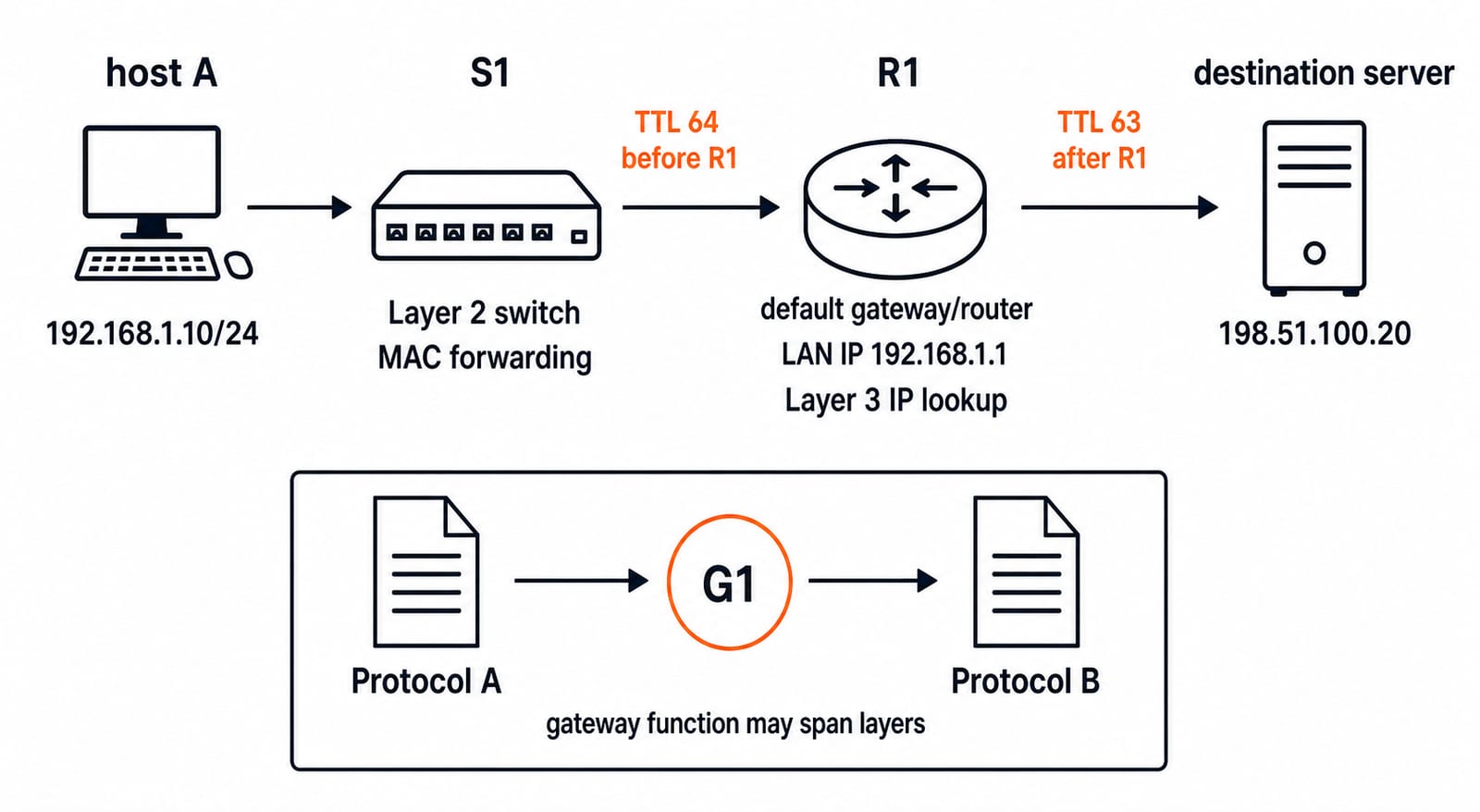
A home router can serve as the LAN's default gateway. A protocol gateway may translate unlike message formats, so gateway has no fixed OSI layer.
Now take host A at 192.168.1.10/24, with router R1 at 192.168.1.1 as its default gateway, sending to server 198.51.100.20. The switch forwards the local frame by MAC address. R1 removes the incoming Layer 2 header, decrements the IP TTL from 64 to 63, looks up 198.51.100.20, and forwards the packet through its WAN interface. The broader Computer Networks MCQs collection gives you more device and protocol practice.
2. Router, bridge and switch MCQs
Question 1: Transparent bridge versus router
GATE 2004.
"Which of the following is NOT true with respect to a transparent bridge and a router?"
A. Both bridge and router selectively forward data packets
B. A bridge uses IP addresses while a router uses MAC addresses
C. A bridge builds up its routing table by inspecting incoming packets
D. A router can connect between a LAN and a WAN
Correct answer: B. A bridge uses IP addresses while a router uses MAC addresses.
This statement reverses the address types. A transparent bridge learns and forwards with Layer 2 MAC addresses; a router uses Layer 3 IP addresses and can connect a LAN to a WAN.
Solve Question 1 on KnowledgeGate
Question 2: Connecting topologies with the same protocol
NVS 2017.
"An electronic device used to connect different types of topologies having the same protocol."
A. Repeater
B. Router
C. Bridge
D. Switch
Correct answer: C. Bridge.
A bridge joins LAN segments at Layer 2 even when their physical layouts differ, provided the higher-level protocol is the same. Protocol translation would instead require a gateway.
Solve Question 2 on KnowledgeGate
Question 3: Layer 3 forwarding
TPSC 2026.
"In networking, which device operates at Layer 3 of the OSI model and makes forwarding decisions based on IP addresses ?"
A. Router
B. Bridge
C. Hub
D. Switch
Correct answer: A. Router.
A router reads the destination IP and chooses a next hop at Layer 3. Bridges and ordinary switches use MAC addresses at Layer 2; a hub repeats at Layer 1.
Solve Question 3 on KnowledgeGate
Question 4: Connecting separate networks
TPSC 2025.
"Which device is used to connect two or more networks and forward packets between them ?"
A. Router
B. Switch
C. Hub
D. Modem
Correct answer: A. Router.
The phrase "between networks" points to a router. A switch connects devices inside a LAN, a hub repeats signals, and a modem converts access-link signals rather than choosing packet paths.
Solve Question 4 on KnowledgeGate
3. Gateway and protocol-boundary MCQs
Question 5: Entry and exit point of a network
Bihar STET 2025.
"Which network device serves as the entry and exit point of a network, as all data coming in or going out of a network must first pass through it?"
A. Modem
B. Gateway
C. Switch
D. Repeater
Correct answer: B. Gateway.
A gateway is the boundary through which traffic enters or leaves a network. In an IP LAN, the router's default-gateway interface performs this role, but gateway describes a function, not one hardware design.
Solve Question 5 on KnowledgeGate
Question 6: Home Internet gateway wording
RSSB 2023.
"Identify the gateway for simple Internet connectivity at homes."
A. Internet Service Provider (ISP)
B. Server
C. LAN
D. WAN
Correct answer: A. Internet Service Provider (ISP).
Here, the ISP is the external gateway providing the home's path to the Internet. The home router is usually each device's local default gateway, while the ISP provides onward connectivity.
Solve Question 6 on KnowledgeGate
Question 7: Different protocols
UP Police 2013.
"Which of the following device is used to connect two systems, especially if the systems use different protocols?"
A. hub
B. bridge
C. gateway
D. repeater
Correct answer: C. gateway.
Different protocols require translation, not merely forwarding. A gateway can translate between unlike systems; hubs and repeaters regenerate traffic, while a bridge forwards Layer 2 frames without protocol conversion.
Solve Question 7 on KnowledgeGate
4. OSI layer and WAN hardware MCQs
Question 8: Devices at the physical layer
RSSB 2022.
"Network devices ………………… and ………………… are used at physical layer."
A. Gateway, Bridge
B. Router, Repeater
C. Hub, Switch
D. Repeater, Hub
Correct answer: D. Repeater, Hub.
Repeaters regenerate signals, and hubs are multiport repeaters, so both are Layer 1 devices. Bridges and conventional switches use Layer 2, while routers use Layer 3.
Solve Question 8 on KnowledgeGate
Question 9: Essential WAN hardware
UP Police 2013.
"Which of the following is essential for WAN hardware?"
A. Bridge
B. Switch
C. Router
D. Firewall
Correct answer: C. Router.
A WAN interconnects distinct networks, so it needs a router to select and forward packets between them. A switch serves a local LAN and a firewall enforces policy, but neither replaces routing here. Route choice also depends on recognising IP networks and prefixes.
Solve Question 9 on KnowledgeGate
5. Cisco router command MCQs
Question 10: Copying an IOS image
Accenture 2025.
"Which command is used to upgrade an IOS on a Cisco router?"
A. copy tftp run
B. copy tftp start
C. config net
D. copy tftp flash
Correct answer: D. copy tftp flash.
The IOS image moves from a TFTP server into flash memory, so copy tftp flash matches source and destination. Running and startup configuration targets are not the image destination asked for.
Solve Question 10 on KnowledgeGate
Question 11: Clearing the startup configuration
Accenture 2025.
"If you wanted to delete the configuration stored in NVRAM, what would you type?"
A. erase startup
B. erase nvram
C. delete nvram
D. erase running
Correct answer: A. erase startup.
NVRAM stores the startup configuration, so that is the configuration to erase. The shortened option erase startup identifies the target; the running configuration is not stored in NVRAM.
Solve Question 11 on KnowledgeGate
Question 12: Console-line configuration mode
Accenture 2024.
"What does the command
RouterA(config)#line cons 0allow you to perform next?"
A. Set the Telnet password.
B. Shut down the router.
C. Set your console password.
D. Disable console connections.
Correct answer: C. Set your console password.
line cons 0 selects the console line and enters its configuration context. The next commands can set its password and login behaviour; Telnet uses virtual terminal lines.
Solve Question 12 on KnowledgeGate
6. How router and gateway questions are tested
Revise with this matrix:
Test angle | Recall rule |
|---|---|
Device role | Router means between networks; gateway means a boundary or translation point. |
Layer and address | Router means Layer 3 and IP; bridge or switch means Layer 2 and MAC. |
Scope | Switch means inside a LAN; router means across networks or a WAN. |
IOS operation | Read |
Watch for reversed MAC and IP roles, a local default gateway confused with the ISP, a router chosen for protocol translation, and every box treated as Layer 3. Transport-layer service and port questions are a separate practice need.
7. Router and gateway MCQs: the short version
Keep five lines ready: hub or repeater means Layer 1; bridge or switch means Layer 2 and MAC; router means Layer 3 and IP; gateway means a network boundary or translation; router commands must be read by source, destination and configuration context. Use this recall order before you inspect any answer choices. Now retry all 12 questions without looking at the bold answers. For structured Computer Networks coverage and connected subject practice, GATE Guidance by Sanchit Sir is the next step.
Keep learning
Computer Networks Basics & Criteria MCQs: 12 Solved Questions with Explanations
Solve 12 Computer Networks questions, then use clear explanations and worked criteria checks to separate similar terms confidently.
3 Oct 20268 min readComputer Networks MCQs
TCP Timers, RTT Estimation & SWS: 10 Solved MCQs and NATs
Solve 10 TCP exam questions covering timer roles, Silly Window Syndrome, recursive RTT estimates, Jacobson/Karels RTO and Karn's rule.
Updated 28 Sep 20267 min readComputer Networks MCQs
RSA Algorithm MCQs: 12 Solved Questions with Step-by-Step Explanations
Practise RSA key generation, modular inverses, encryption, signatures and defining equations, with concise working for conceptual and numerical answers.
25 Sep 20268 min readComputer Networks MCQs
Firewall, VPN, IDS and IPS MCQs: 11 Network Security Questions Solved
Solve 11 previous-year questions on firewalls, VPNs, IDS and IPS. Learn rule filtering, connection state, DMZ design, IPsec modes, tunnels and signatures.
Updated 24 Sep 20267 min readComputer Networks MCQs