Network Topology MCQs: 12 Solved PYQs with Answers and Explanations
Solve 12 network topology PYQs and learn how physical cues, failure behaviour, cabling needs and pair counting reveal the correct answer.
KnowledgeGate Team
Exam prep & CS education
Updated 5 Sep 20267 min read77 views
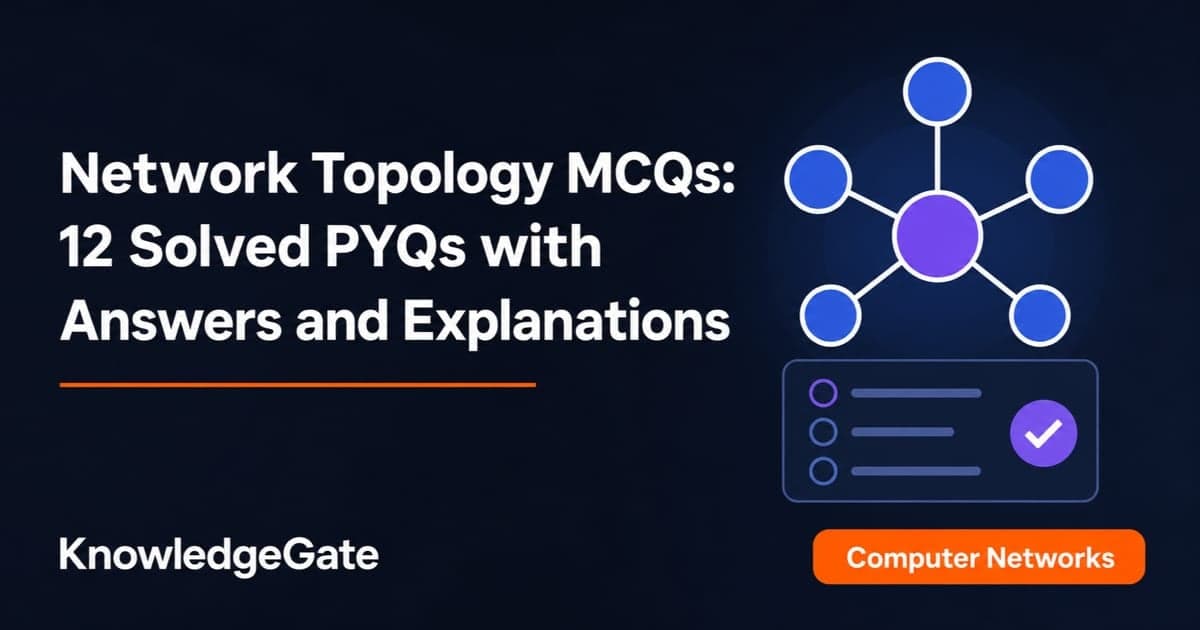
Star, bus, ring, and mesh definitions look easy until a question stops naming the shape. It may ask about a failed central device, extra cable, terminators, a closed path, or the number of links between every pair. Then a memorised definition is not enough.
Network-topology PYQs turn the four basic shapes into failure, cabling, and pair-counting problems. Anchor each choice to four cues: central device, shared backbone with terminators, closed loop, and direct links between every pair. The Computer Networks MCQs hub adds practice across the wider subject.
1. Network topology basics to recall before solving
A physical topology describes the actual arrangement of nodes and communication links. Logical topology describes how data moves, which may differ from the visible arrangement. In a star, every device has a point-to-point link to one central device. A bus places all devices on one shared backbone, with a terminator at each end. A ring closes the path through the nodes. A full mesh directly connects every unordered pair of nodes.
Cue | Topology | Immediate consequence |
|---|---|---|
central hub or switch | star | central device is a single point of failure |
single backbone plus terminators | bus | shared-medium contention |
closed loop | ring | one break can interrupt a non-redundant ring |
every pair directly linked | full mesh | n(n-1)/2 duplex links |
The CS Fundamentals for Exams & Placements category is the broader revision route for Computer Networks and other core CS subjects. For these questions, identify the physical cue first, then infer the behaviour.
2. Star topology MCQs: central devices, cabling, and failure points
Question 1, TPSC 2025 (Assistant Programmer)
Which type of network topology has all devices connected to a central device ?

A. Ring topology
B.  Bus topology
C. Star topology
D. Mesh topology
Answer: C. Star topology. Every endpoint has its own link to a central hub or switch. A ring joins each node to neighbours, a bus uses a shared backbone, and a full mesh joins every pair directly.
Question 7, Navodaya Vidyalaya Samiti 2017
Which of the following is NOT an advantage of star topology compared to other standard topologies?

A. Easy to connect new nodes or devices
B. Require less cable length
C. All nodes are directly connected to the server.
D. Isolation of faulty node is easy.
Answer: B. Require less cable length. A star needs a separate cable run from every node to the centre, so low cable use is not its general advantage. Easier expansion and isolation of a faulty spoke are genuine strengths.
Question 9, DSSSB 2021 (TGT - Shift 5)
Which of the following statement(s) is/are not true about star topology?
 I. Failure of the central computer shuts down the entire network
 II. Connection of additional computers increases the communication time

A. Only I
B. Only II
C. Both I and II
D. Neither I nor II
Answer: B. Only II. Statement I is true because the central device is the shared dependency. Statement II is not inherently true: adding a node to a switched star adds a dedicated spoke, not another hop on one shared path.
3. Bus topology MCQs: terminators and shared-backbone limits
Question 2, MPPSC 2025
In a bus topology, what are the special connector located at the end of the bus called?

A. Routers
B. Terminators
C. Hubs
D. Switches
Answer: B. Terminators. A terminator at each end of the backbone absorbs the signal and prevents reflections. Routers, hubs, and switches forward or concentrate traffic. They do not perform end-of-cable termination.
Question 5, UP Police 2013 (Paper 2 - Subject Oriented (Shift I))
What is the drawback of using a BUS topology?

A. Only a pair of nodes can be connected
B.  Performance degrades as additional computers are added or on heavy traffic
C. There are no drawbacks
D. Very slow data rates
Answer: B. Performance degrades as additional computers are added or on heavy traffic. All attached devices compete for the same backbone, so more active devices mean greater contention and collision pressure in the textbook shared-medium model. The problem depends on load. It is neither a two-node limit nor proof that every bus is always slow.
4. Ring topology MCQs: closed loops, break points, and FDDI
Question 3, UP Police 2016 (Paper 2 - Subject Oriented (Shift II))
In which of the following network topologies can the failure of  one individual node  break the entire communication path of the network?

A. Tree
B. Bus
C. Ring
D. Mesh
Answer: C. Ring. In the textbook single-ring model, every node forms part of the closed communication path. One failed node can therefore open that path. This conclusion does not apply unchanged to redundant or bypass-equipped rings.
Question 4, DSSSB 2021 (TGT - Shift 1)
In a ________ network topology, stations are connected in a closed loop; there is no host computer controlling the others, and all stations are equal.

A. Ring
B. Tree
C. Bus
D. Star
Answer: A. Ring. The decisive cue is “closed loop”, with every station participating as a peer in the path. A star depends on a central connecting device. Bus and tree arrangements do not form one peer-to-peer closed loop.
Question 11, Indian Space Research Organization 2017 (May)
Physical topology of FDDI is?

A. Bus
B. Ring
C. Star
D. None of the above
Answer: B. Ring. FDDI uses dual counter-rotating rings, so ring is the matching option. Its secondary ring provides redundancy. That is why the single-break warning for a basic, non-redundant ring is not the whole story for FDDI.
5. Mesh topology MCQs: ports, duplex links, and pair counting
A full mesh has n(n-1)/2 physical duplex links because one link represents one unordered pair. Each node needs n-1 ports. Across all devices, that gives n(n-1) cable endpoints, but two endpoints belong to each physical cable.
Question 6, HTET 2022
_________ topology requires highest number of ports and largest amount of cabling in computer networks.

A. Star
B. Ring
C. Mesh
D. Bus
Answer: C. Mesh. For 5 devices, each device needs 5 - 1 = 4 ports. The network needs 5 x 4 / 2 = 10 cables. Star, ring, and bus require fewer direct point-to-point links for the same five devices.
Question 8, UGC NET 2014 (December)
For n devices in a network, ________ number of duplex-mode links are required for a mesh topology.

A. n(n + 1)
B. n (n – 1)
C. n(n + 1)/2
D. n(n – 1)/2
Answer: D. n(n - 1)/2. Each of the n devices can connect to n - 1 others, giving n(n - 1) ordered endpoints. Every duplex link appears once from each end, so divide by 2. For n = 8, the result is 8 x 7 / 2 = 56 / 2 = 28 links.
Question 10, UGC NET 2019 (June)
A fully connected network topology is a topology in which there is a direct link between all pairs of nodes. Given a fully connected network with  \(𝑛\)  nodes, the number of direct links as a function of  \(𝑛\)  can be expressed as

A. \(\frac{n(n+1)}{2}\)
B. \(\frac{(n+1)}{2}\)
C. \(\frac{n}{2}\)
D. \(\frac{n(n-1)}{2}\)
Answer: D. n(n - 1)/2. You can also count by choosing an unordered pair of nodes, C(n,2). For n = 6, C(6,2) = 6 x 5 / 2 = 30 / 2 = 15. Using n(n - 1) alone would count each link twice.
6. Mixed-topology numerical: four bus segments joined in a mesh
Question 12, RPSC 2024 (Programmer - P1)
Let us assume that there are four (4) network segments in Bus topologies: A1–A2, B1–B2–B3, C1–C2 and D1–D2–D3. If A1, B1, C1 and D1 are interconnected in mesh, then how many mesh connections are required?

A. 45
B. 6
C. 10
D. 12
E. Question not attempted
Answer: B. 6. Only the four named gateway nodes form the mesh, so the calculation is 4 x (4 - 1) / 2 = 4 x 3 / 2 = 12 / 2 = 6. The pairs are A1-B1, A1-C1, A1-D1, B1-C1, B1-D1, and C1-D1. The remaining devices stay inside their bus segments, so their counts do not change the requested number of mesh connections.
7. Network topology exam patterns and common traps
Network-topology exams use four recurring patterns: recognise a topology from a physical cue, infer what fails with a component, compare cabling or reliability, and calculate full-mesh links.
Three traps deserve special attention. Do not confuse a star's central device with a bus backbone. Do not treat every ring as non-redundant after learning the basic single-ring failure rule, because FDDI uses a dual ring. Finally, do not stop at n(n-1) for full-mesh duplex links. That counts cable endpoints, so divide by 2 for physical links.
For another calculation-heavy Computer Networks set, solve Subnetting MCQs: 12 Solved IP Addressing Questions.
8. The short version and the next practice step
Keep this memory chain ready: central device -> star, terminators -> bus, closed loop -> ring, every pair -> full mesh, and full-mesh links -> n(n-1)/2.
For placement-oriented core-subject revision, continue with CS Fundamentals for Placements by Sanchit Sir. For a broader GATE CS study route, use GATE Guidance by Sanchit Sir. Choose the route that matches your exam, then return to the practice bank and solve topology questions without looking at the cue table.
Keep learning
Computer Networks Basics & Criteria MCQs: 12 Solved Questions with Explanations
Solve 12 Computer Networks questions, then use clear explanations and worked criteria checks to separate similar terms confidently.
3 Oct 20268 min readComputer Networks MCQs
TCP Timers, RTT Estimation & SWS: 10 Solved MCQs and NATs
Solve 10 TCP exam questions covering timer roles, Silly Window Syndrome, recursive RTT estimates, Jacobson/Karels RTO and Karn's rule.
Updated 28 Sep 20267 min readComputer Networks MCQs
RSA Algorithm MCQs: 12 Solved Questions with Step-by-Step Explanations
Practise RSA key generation, modular inverses, encryption, signatures and defining equations, with concise working for conceptual and numerical answers.
25 Sep 20268 min readComputer Networks MCQs
Firewall, VPN, IDS and IPS MCQs: 11 Network Security Questions Solved
Solve 11 previous-year questions on firewalls, VPNs, IDS and IPS. Learn rule filtering, connection state, DMZ design, IPsec modes, tunnels and signatures.
Updated 24 Sep 20267 min readComputer Networks MCQs