

Information Security and Cyber Laws for GATE: Scope, Question Patterns and Preparation Order
Study this cluster without guessing its official weightage. Build the concepts, trace a tampered request, diagnose weak lanes and follow a realistic revision order.
KnowledgeGate Team
Exam prep & CS education
Updated 28 Oct 20265 min read
Information Security and Cyber Laws appears in notes and practice material, but that label does not prove a fixed, standalone GATE weightage. Verify the official scope first. Then use six study lanes, a worked HMAC trace, MCQ/MSQ/NAT response practice, an error-rate diagnostic and a 14-day revision order.
Fix the GATE scope before starting the 14-day security sprint
For the official syllabus boundary and completed-paper weightage method, start with Information Security & Cyber Laws for GATE: Syllabus Scope, Weightage Reality and Prep Order. It owns that scope decision. The next step is a six-lane HMAC sprint focused on classification, integrity, authentication, authorisation, response formats, diagnostics and revision.
Security scenarios reuse Computer Networks protocols and traffic controls, while cryptography can require modular arithmetic or logic. Those prerequisites do not turn security into a named paper unit. Place a verified in-scope cluster beside your core plan through the GATE CS Exam Preparation Courses.
For your exact attempt, the current official syllabus remains the authority. Concept coverage and practice frequency are neither official inclusion nor weightage evidence.
Build the topic map in six lanes
Lane | Questions to answer | Key distinctions |
|---|---|---|
Security goals and risk | Asset, threat, control? | Confidentiality vs integrity vs availability; threat vs vulnerability vs control |
Authentication and authorisation | Identity or permission? | Authentication vs authorisation |
Cryptography and integrity | Hide, check, sign? | Encryption vs hashing vs HMAC vs digital signature |
Network and endpoint defence | Allow, detect, block? | Firewall vs IDS vs IPS |
Incidents and evidence hygiene | Event and records? | Response vs evidence preservation |
Cyber-law vocabulary | Technical or legal? | Policy breach vs legal question needing a current authoritative source |
Cyber-law vocabulary includes unauthorised access, electronic records, identity misuse, privacy, evidence preservation and incident reporting. Never infer sections, penalties, deadlines or conclusions from undated notes.
Worked incident: trace integrity, authentication and authorisation separately
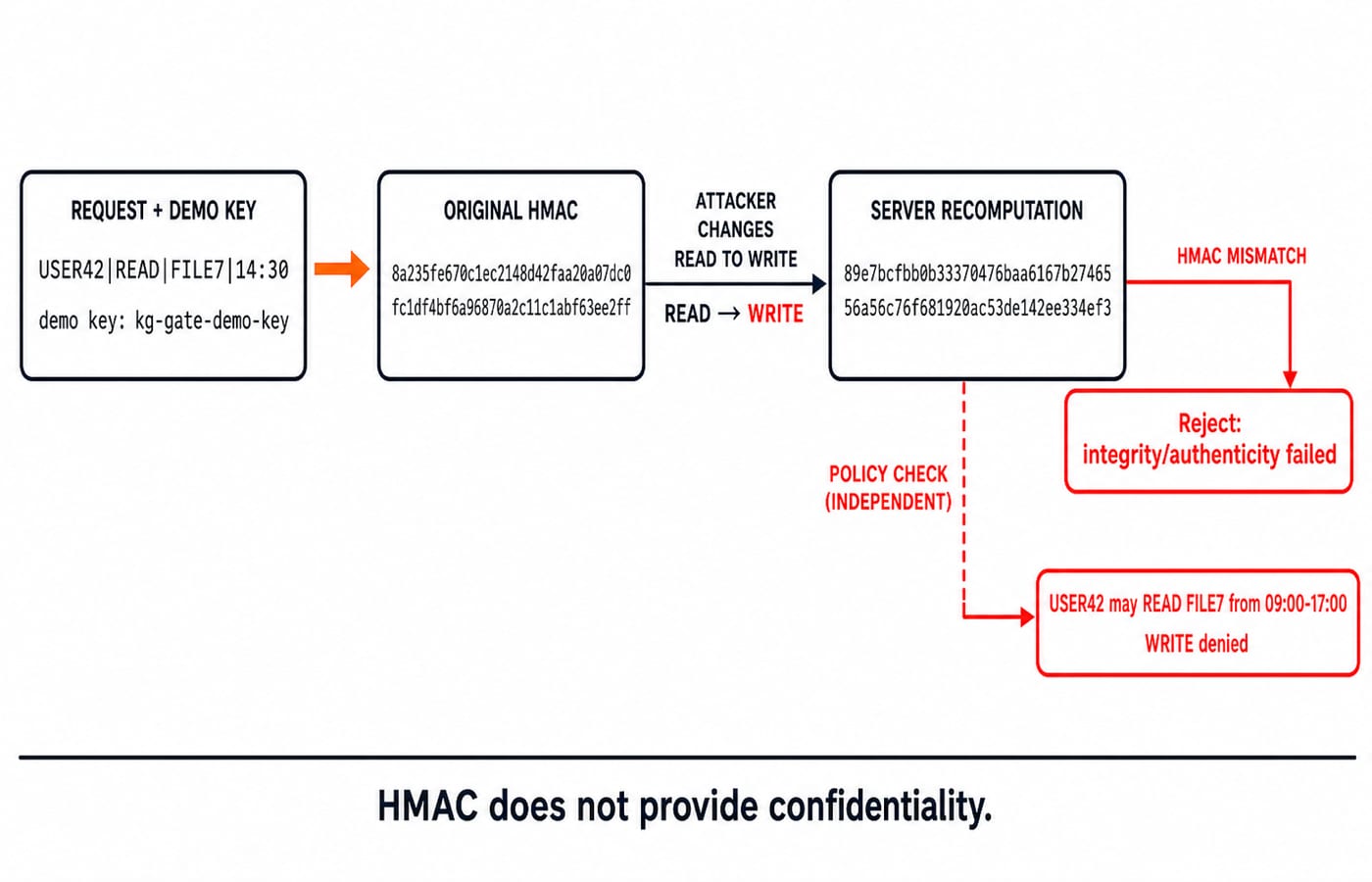
At 14:30, USER42 has already authenticated, and the server has bound demo HMAC key kg-gate-demo-key to that session. The user sends USER42|READ|FILE7|14:30. Policy permits READ on FILE7 from 09:00 to 17:00, never WRITE. Printed demo keys are for teaching, never deployment.
Original HMAC-SHA-256:
8a235fe670c1ec2148d42faa20a07dc0fc1df4bf6a96870a2c11c1abf63ee2ff.An attacker changes only
READtoWRITE:USER42|WRITE|FILE7|14:30.Server recomputation:
89e7bcfbb0b33370476baa6167b2746556a56c76f681920ac53de142ee334ef3.The mismatch fails integrity and message authenticity. Reject.
Continue checking:
WRITEalso fails authorisation because policy grants onlyREAD.
The authenticated session establishes identity, the HMAC checks message integrity and authenticity, and policy decides authorisation. HMAC does not encrypt the payload, so it supplies no confidentiality. The request also proves nothing about system availability.
Convert the concepts into MCQ, MSQ and NAT-style practice
Single answer: Mallory changes READ to WRITE in transit. Which property is directly violated? Integrity. No secret reading or service failure is stated, excluding confidentiality and availability.
Multiple select: (A) the HMAC mismatch detects modification; (B) HMAC encrypts FILE7; (C) policy denies WRITE; (D) availability is proved. A and C only. MCQ, MSQ or NAT? GATE Question Types Explained shows why response method changes with format.
Toy NAT learning model, not a secure cipher: for x = 11, shift k = 7 modulo 26: y = (11 + 7) mod 26 = 18. Reverse: (18 - 7) mod 26 = 11.
Use an error-rate diagnostic to choose the next study lane
A 20-question diagnostic ranks revision needs. It does not estimate official weightage, marks or rank.
Baseline: 3 security goals/risk, 3 identity/access, 4 cryptography, 4 network defence, 3 incidents and 3 cyber-law vocabulary, 20 total. Correct: 2/3 + 1/3 + 1/4 + 3/4 + 2/3 + 1/3 = 10/20.
Rank by error rate: cryptography is 3/4 = 75%; identity/access and cyber-law vocabulary are each 2/3, about 67%; security goals and incidents are each 1/3, about 33%; network defence is 1/4 = 25%. Start with cryptography, then the two tied lanes; the diagnostic predicts neither marks nor rank.
Follow a 14-day preparation order with 21 honest hours
Daily: 45 minutes on concepts, 30 minutes solving questions and 15 minutes correcting the error log, 90 minutes total. 14 x 90 = 1,260 minutes; 1,260 / 60 = 21 hours. Revision, not mastery.
Day 1: baseline; Days 2 to 3: goals, threats, vulnerabilities and access control.
Days 4 to 6: cryptography, hashing, HMAC and signatures; Days 7 to 8: network and endpoint controls.
Day 9: incident reasoning; Day 10: cyber-law vocabulary and source checks.
Day 11: mixed distinctions; Day 12: MCQ/MSQ/NAT response practice.
Day 13: fresh 20-question diagnostic; Day 14: error-log retest and next-plan decision.
Miss one day? Move its concept block to Day 11; keep Day 13. Miss two? Retain baseline, cryptography, identity/access, network defence and final diagnostic. Remove mixed practice, never double work or sacrifice sleep.
Remove the five traps that create false confidence
Why it happens | What goes wrong | What to do instead |
|---|---|---|
Encryption resembles hashing | HMAC supposedly hides payload | Name secrecy, integrity or authentication |
A user logged in |
| Authorise separately; only |
Firewall, IDS and IPS inspect traffic | Allow, detect and prevent seem alike | Name the exact response |
An undated note quotes law | A stale section or deadline survives | Verify the source or stay conceptual |
A small set gives | It supposedly predicts weightage or rank | Use errors only for revision order |
Source discipline: Record the authoritative URL, title and date. Without them, omit the legal or official number, section or deadline.
Information Security and Cyber Laws: the short version and next step
Goals and risk: asset, threat, vulnerability, control.
Identity and access: authenticate, then authorise.
Cryptography and integrity: encryption, hashing, HMAC, signatures.
Network defence: firewall, IDS, IPS.
Incidents: trace events, preserve evidence.
Cyber law: stay conceptual without a current authoritative source.
Redo the incident from memory, explain both HMAC values, then repeat the diagnostic after 14 study days.
For weak lanes, GATE Guidance by Sanchit Sir lists goal-based theory and practice sequencing, hotspot guidance, and performance analysis. It gives no score guarantee.
After correcting gaps, the GATE Test Series adds timed practice. Its listing describes 46 tests and Computer Networks coverage, not official security or cyber-law weightage.
Keep learning

Emerging Technologies in Web Technology: Cloud, IoT, Edge and Blockchain with Worked Examples
Follow 200 factory sensors from MQTT messages to edge decisions, cloud functions, a live dashboard and a toy blockchain. The worked numbers make each role concrete.
Updated 27 Oct 20265 min readGATE Strategy & Roadmap
Electronic Data Interchange (EDI) and E-Commerce: Layers, X12 Segments and Legal Validity Explained
Learn EDI from the business document to the X12 envelope, then follow it through a VAN, a 997 acknowledgment, signature verification and Indian cyber law.
Updated 26 Oct 20265 min readGATE Strategy & Roadmap
Cyber Threats and Malware Attacks: Types, Attack Vectors, and Worked Security Problems
Learn to distinguish malware classes, map attacks to the CIA triad, and solve password, cipher, and key-count numericals. The guide also covers common attack vectors and a safe way to study Indian cyber law.
Updated 24 Oct 20266 min readGATE Strategy & Roadmap
Cyber Safety and Security: Information Security and Cyber Law with Worked Examples
Learn information security as an applied subject. Classify security failures, work Caesar and RSA examples, separate common attacks, and revise India's cyber-law framework.
Updated 22 Oct 20266 min readGATE Strategy & Roadmap