Relational Calculus in DBMS: Tuple and Domain Calculus Explained with Worked Examples
Learn TRC and DRC through one small database, then trace existential and universal queries without getting caught by quantifier or safety mistakes.
KnowledgeGate Team
Exam prep & CS education
Updated 13 Aug 20267 min read
You finish relational algebra, meet relational calculus, and suddenly queries look like logic formulas instead of steps. GATE questions ask what a formula computes or whether it is safe, while interviewers use the topic to test whether you understand declarative querying. Three students, four enrolment rows and three courses are enough to make both forms concrete, and to expose the quantifier slip that silently turns an answer of {Asha} into the empty set.
What relational calculus is and where it sits in DBMS
Relational algebra is procedural: it gives a sequence of operations such as selection, projection, and join. Relational calculus is declarative: it states the condition that an answer must satisfy, without prescribing an execution order. SQL is closer in spirit to calculus, and a database optimiser converts that request into an algebra-like plan. See SQL Queries and Joins in DBMS for the SQL counterpart of these queries.
Tuple relational calculus (TRC) binds variables to whole tuples. Domain relational calculus (DRC) binds variables to individual attribute values. Both use first-order logic over relations, and both help define relational completeness. That makes calculus useful not only for exams, but also for theory-focused DBMS interviews.
Tuple relational calculus: syntax and a worked query
The general TRC form is { t | P(t) }, read as "the set of tuples t for which predicate P holds". Its atoms include t ∈ Relation, comparisons such as t.A = c, and comparisons between tuples such as t.A = s.B. We combine them with ∧, ∨, ¬, ∃, and ∀. The output variable on the left of the bar is free; a variable introduced by a quantifier is bound.
The worked queries all run against these three relations:
Relation | Exact rows |
|---|---|
Student(rollNo, name, dept) | (101, Asha, CSE), (102, Bharat, ECE), (103, Chitra, CSE) |
Enrolled(rollNo, courseId) | (101, C101), (101, C102), (102, C101), (103, C103) |
Course(courseId, cname, credits) | (C101, DBMS, 4), (C102, OS, 4), (C103, Maths, 3) |
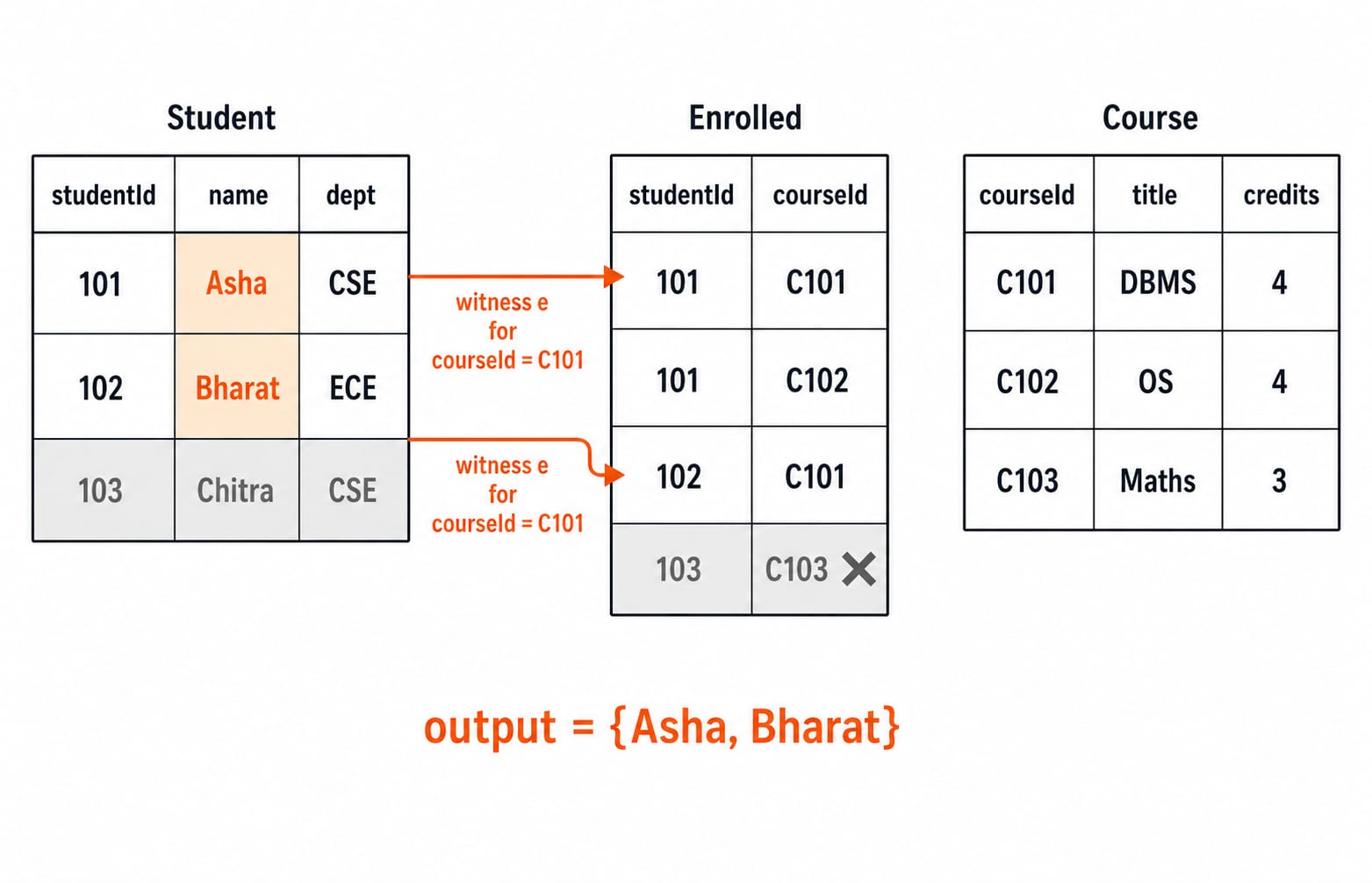
Query 1 asks for names of students enrolled in C101:
{ t.name | t ∈ Student ∧ ∃e (e ∈ Enrolled ∧ e.rollNo = t.rollNo ∧ e.courseId = 'C101') }
Trace each Student tuple. For (101, Asha, CSE), (101, C101) is a witness for e, so Asha qualifies. For (102, Bharat, ECE), (102, C101) is a witness, so Bharat qualifies. Chitra fails because her only enrolment is (103, C103). The result is { Asha, Bharat }.
Domain relational calculus: the same query value by value
DRC has the form { <x1, x2, ...> | P(x1, x2, ...) }. Each variable ranges over an attribute value, so a membership atom looks like <r, n, d> ∈ Student.
Query 2 rewrites the C101 request in DRC:
{ <n> | ∃r ∃d (<r, n, d> ∈ Student ∧ ∃c (<r, c> ∈ Enrolled ∧ c = 'C101')) }
One successful binding is r = 101, n = Asha, d = CSE, and c = C101. Bharat has the corresponding binding with r = 102. Chitra has no binding with c = C101, so the answer remains { Asha, Bharat }.
Feature | TRC | DRC |
|---|---|---|
Variable ranges over | A whole tuple | One attribute value |
Membership style |
|
|
Classic related language | Tuple-oriented notation | QBE-style notation |
Expressive power | Equal to safe DRC | Equal to safe TRC |
In an exam, first identify what each variable ranges over. Options often mix the notations so that you misread a position as a tuple attribute.
Quantifiers: enrolled in all 4-credit courses
∃ asks for at least one witness. ∀ demands that every relevant object passes. The standard pattern for an "all" query is ∀x (condition(x) → requirement(x)). The implication limits the requirement to objects satisfying the condition.
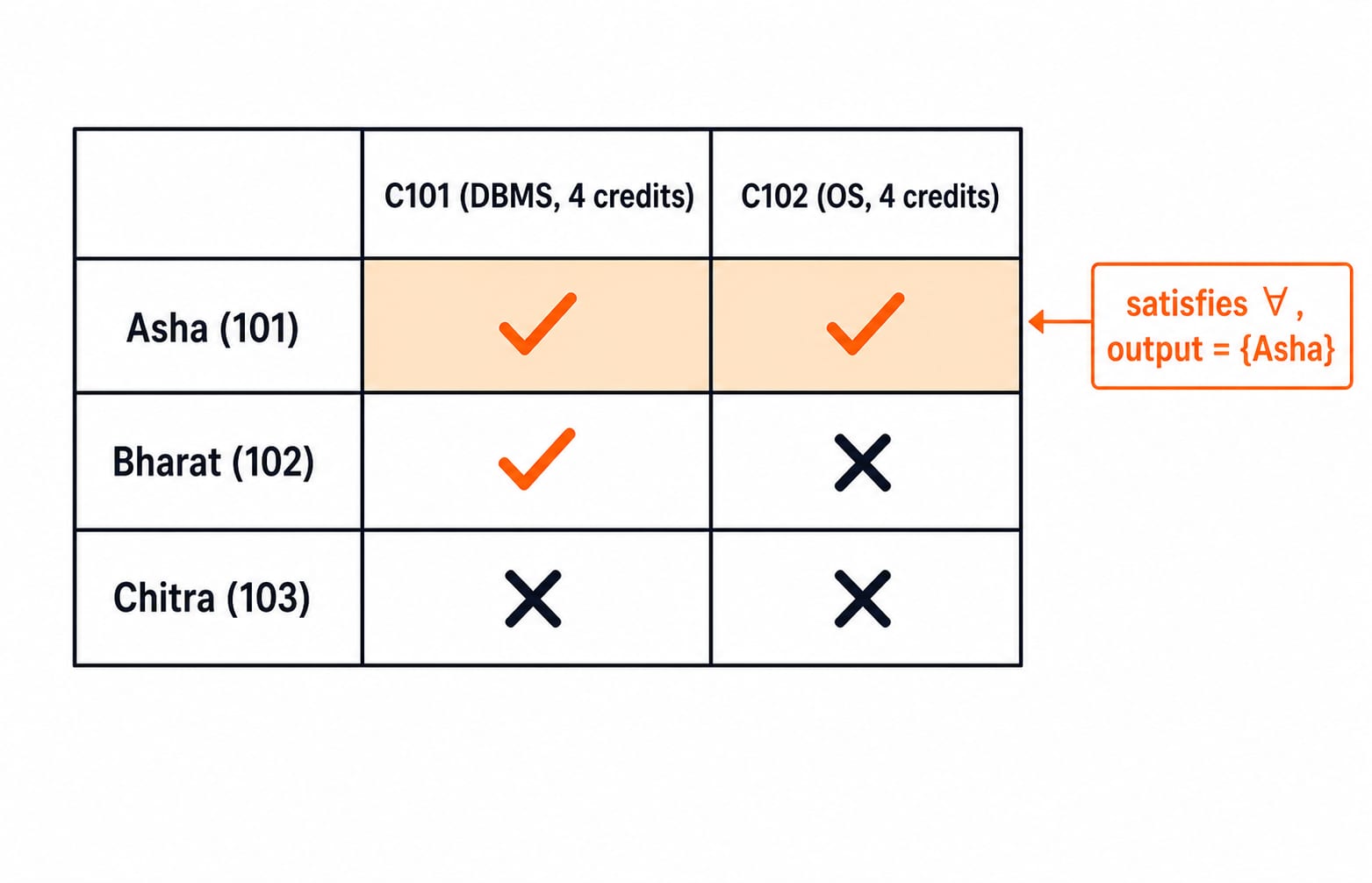
Query 3 asks for names of students enrolled in every 4-credit course:
{ t.name | t ∈ Student ∧ ∀c (c ∈ Course ∧ c.credits = 4 → ∃e (e ∈ Enrolled ∧ e.rollNo = t.rollNo ∧ e.courseId = c.courseId)) }
The 4-credit courses are C101 and C102. Asha has both, so she passes. Bharat has C101 but not C102, so he fails. Chitra has neither, so she fails. The result is { Asha }. This is relational algebra's division idea expressed declaratively.
Now replace → with ∧: ∀c (c ∈ Course ∧ c.credits = 4 ∧ ∃e (...)). When c is C103, c.credits = 4 is false. The entire conjunction is therefore false for every student, so the expression returns the empty set, not { Asha }.
Safety and expressive power
Consider { t | ¬(t ∈ Student) }. It asks for every tuple in the universe that is not a Student tuple, so its answer is unbounded. A safe expression restricts every result value to the active domain of the expression: constants and values present in the relations it mentions.
Safe TRC, safe DRC, and basic relational algebra express exactly the same set of queries, so a language matching that power is called relationally complete. That equality is what questions comparing RA, TRC and DRC turn on: anything you can write with the five primitive algebra operators (selection, projection, Cartesian product, union and set difference) has a safe calculus formula, and every safe formula has an algebra expression. Relational Algebra for GATE works the same equivalence from the operator side.
Basic calculus has no aggregation, no grouping and no transitive closure. "List every prerequisite of C101, direct or indirect" cannot be written as a single first-order formula at all, because the chain of prerequisites has no fixed length and no fixed formula can quantify over a chain of unknown length. SQL answers questions like that only because later standards added aggregate functions and recursive common table expressions, which sit outside the calculus rather than inside it.
How GATE and interviews test relational calculus
GATE commonly tests four skills: translating a formula into English, classifying an expression as safe or unsafe, matching algebra with calculus or SQL, and recognising equivalent formulas in multiple-select options. Recent GATE papers have used MCQ, MSQ, and NAT formats. For the current syllabus and paper details, always check the official GATE website of the organising institute rather than relying on a remembered pattern.
An interview may begin with "declarative versus procedural" or ask why SQL is not exactly relational algebra. Query 1 gives a compact answer: TRC states the qualifying condition, SQL expresses the same request declaratively, and the optimiser chooses an operational plan. A common follow-up is why SQL can print a name twice when the calculus answer holds it once. Ask for students enrolled in any 4-credit course: the TRC set { t.name | t ∈ Student ∧ ∃e ∃c (...) } is { Asha, Bharat }, while a plain join of Enrolled and Course prints Asha twice, once through C101 and once through C102, because SQL works on multisets unless you write DISTINCT.
After formula-reading drills, practise them under time with the GATE Test Series and check why every wrong option fails.
Traps that cost marks
Using
∧instead of→inside∀. Students copy the existential pattern, but a non-qualifying object then makes the universal formula false. Remember:∃usually pairs with∧; restricted∀uses→.Misplacing negation. "Students not enrolled in C101" needs
¬∃earound the matching-enrolment condition. Writing∃e (e ∈ Enrolled ∧ e.rollNo = t.rollNo ∧ e.courseId ≠ 'C101')asks instead for one enrolment in some other course. Asha satisfies that through C102, so she is returned as "not enrolled in C101" even though (101, C101) is sitting in Enrolled.Confusing free and bound variables. If the question asks for one output column, the expression should expose one free output value. Do not return a quantified variable or accidentally leave another variable free.
Treating DRC positions like named attributes. In
<r, n, d> ∈ Student, position carries the meaning. Swappingrandnchanges the query rather than renaming variables.
The short version and your next step
Relational calculus says what the answer must satisfy, not how to compute it. TRC binds tuples; DRC binds values. Use witnesses with ∃, implication with restricted ∀, and active-domain restrictions for safety. Safe calculus and relational algebra have equal expressive power.
For the Databases syllabus in sequence, from algebra and calculus through SQL, normalization, and transactions, continue with GATE Guidance by Sanchit Sir. Use the GATE CS Subject Weightage guide to see how Databases weighs against the other subjects before you decide how many hours this topic deserves.
Keep learning
Data Mining and Data Warehouse Explained: Concepts, OLAP and Worked Examples
Follow six orders from operational sources into a warehouse, calculate OLAP totals, and test an association rule on five shopping baskets.
Updated 4 Oct 20266 min readDBMS
Set Operations and Cartesian Product in Relational Algebra: Worked Examples and Exam Traps
Learn when relational set operations are legal, calculate exact union and difference results, enumerate a Cartesian product, and trace how a join filters it.
Updated 29 Sep 20266 min readDBMS
DBMS Interview Questions: Keys, Normalisation and Transactions Through One Worked Schema
Build defensible DBMS interview answers by tracing keys, normal forms, ACID and isolation through one university-enrolment database.
Updated 25 Sep 20265 min readDBMS
Super Key, Candidate Key and Primary Key: A Worked DBMS Example
Use one ENROLMENT relation to derive two candidate keys, enumerate every super key, select a primary key and translate the result into SQL.
Updated 24 Sep 20266 min readDBMS