

RBI Retail Direct Scheme Explained: RDG Accounts, G-Secs and Exam Traps
Separate the RDG account from the securities it holds, follow primary and secondary transactions, and work through a coupon example. Then test the difference between repayment, resale value and investment return.
KnowledgeGate Team
Exam prep & CS education
Updated 3 Nov 20265 min read
Buying a government security directly does not turn it into a savings account, and a dependable issuer does not guarantee an unchanged resale value. For candidates working on Banking & Insurance exam preparation, confusing these ideas can spoil an otherwise straightforward answer. The key distinctions are the account, the instrument and the transaction route, followed by a fixed-coupon calculation.
What RBI Retail Direct actually does
RBI's Retail Direct Scheme FAQ, dated 12 November 2021, describes a facility through which individual investors can open a Retail Direct Gilt (RDG) account with RBI and access government securities directly.
Keep three roles separate. The online platform provides access to transactions. The RDG account holds securities. The linked bank account handles cash movements, including coupon payments and redemption proceeds.
For government borrowing, the government is the issuer and the investor is the holder of its security. RBI supplies the scheme infrastructure; an RDG holding is not an RBI fixed deposit. Opening the account does not itself determine an interest payment. That depends on the security bought.
Direct access allows individuals to hold securities themselves instead of obtaining exposure through a pooled investment product. It is an access route, not a requirement that every investor use this scheme.
Separate the securities before memorising the scheme
The word “government” identifies the borrower, but it does not tell you the payment structure. Compare the instruments on separate dimensions:
Instrument | Issuer | Payment or maturity distinction |
|---|---|---|
Treasury bills, or T-bills | Central Government | Discount instruments, with no periodic coupon; redeemed at face value |
Dated government securities | Central Government | Have a stated maturity and may pay coupons |
State Development Loans, or SDLs | State governments | State borrowing instruments whose terms determine payments and maturity |
A discount instrument earns through the difference between acquisition at a discount and redemption at face value. A coupon-paying security instead has specified interest payments. Do not transfer one structure to the other just because both involve government borrowing.
The dated FAQ also lists Sovereign Gold Bonds (SGBs); inclusion in that historical list does not mean a fresh subscription window is open.
For broader preparation context, use RBI Grade B Syllabus 2026: Phase 1 and Phase 2 Decoded to organise your syllabus reading.
Follow the account and the two transaction routes
The high-level sequence is eligibility and KYC checks, RDG account opening, bank-account linkage and security holdings. The listed prerequisites include an Indian rupee savings account, PAN, KYC documentation, an email address and mobile details. Eligible investors can hold an account singly or jointly.
Now separate the markets. In the primary market, investors participate in an issue offered by the issuer. In the secondary market, investors buy or sell securities already issued.
Primary-auction participation for dated G-Secs, T-bills and SDLs is non-competitive. Suppose an investor requests 20,000 rupees face value. This illustrative request neither sets the auction's interest rate nor chooses a bid price; it is not a minimum or an assured allotment.
Allotment uses the weighted average price of successful competitive bids in that auction, so the price becomes known after the auction. These primary-auction mechanics do not describe every secondary-market transaction. Once a security is held, its terms determine the scheduled income.
Worked example: calculate the coupon, then the final cash flow
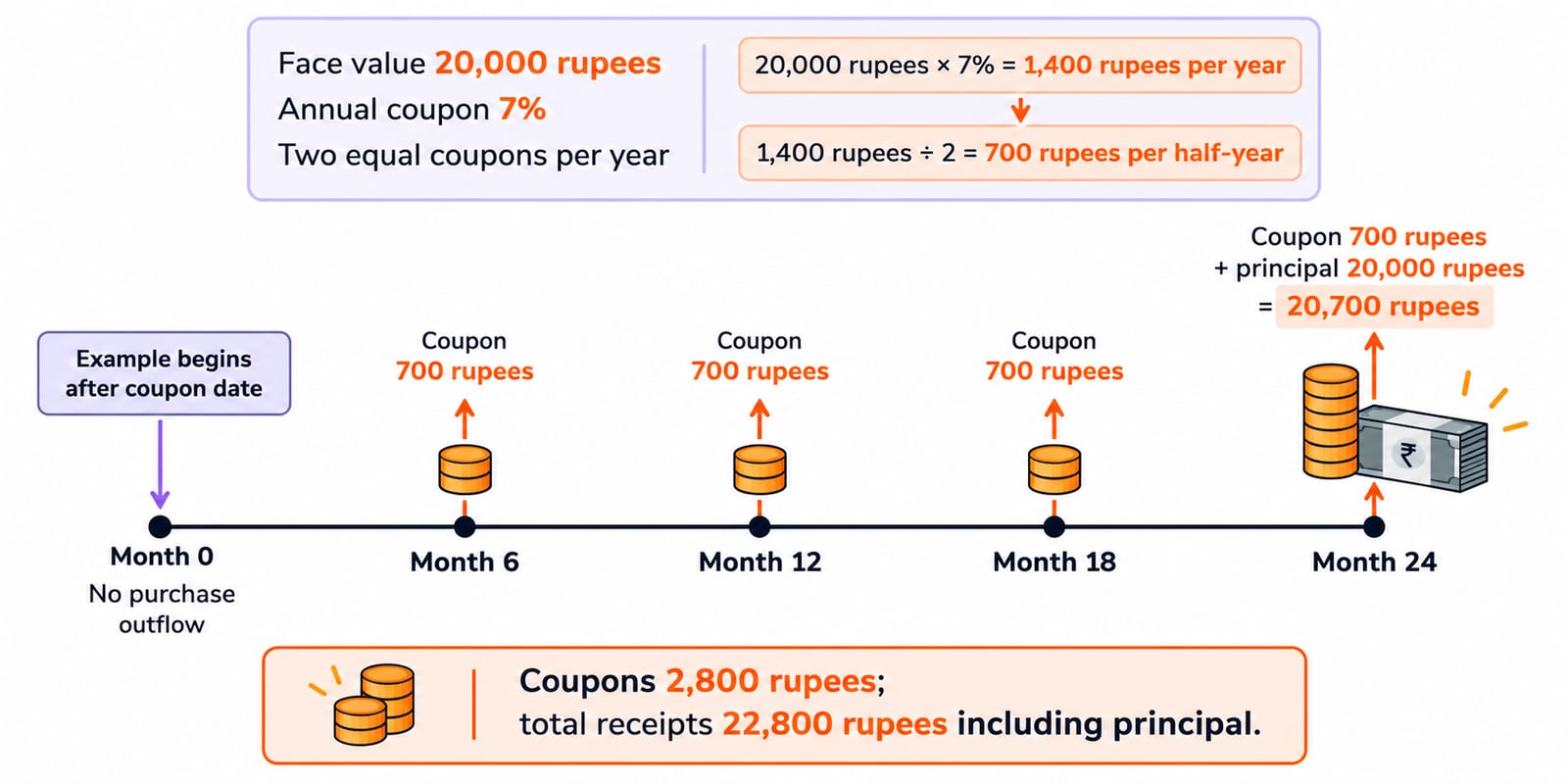
Use these hypothetical figures, not a live offer or advice: a fixed-coupon dated security with 20,000 rupees face value, a 7% annual coupon and exactly two equal coupon payments per year.
Assume two years remain, the example begins immediately after a coupon date, and the investor holds through maturity. Ignore tax, reinvestment and transaction costs. We are calculating receipts, with no purchase-price or yield-to-maturity calculation.
Annual coupon: 20,000 rupees × 7/100 = 1,400 rupees.
Each six-month coupon: 1,400 rupees ÷ 2 = 700 rupees.
Months 6, 12 and 18: receive 700 rupees on each date.
Month 24: final coupon 700 rupees + redeemed face value 20,000 rupees = 20,700 rupees.
All four coupons: 4 × 700 rupees = 2,800 rupees.
Total receipts: 2,800 rupees + 20,000 rupees = 22,800 rupees, including returned principal.
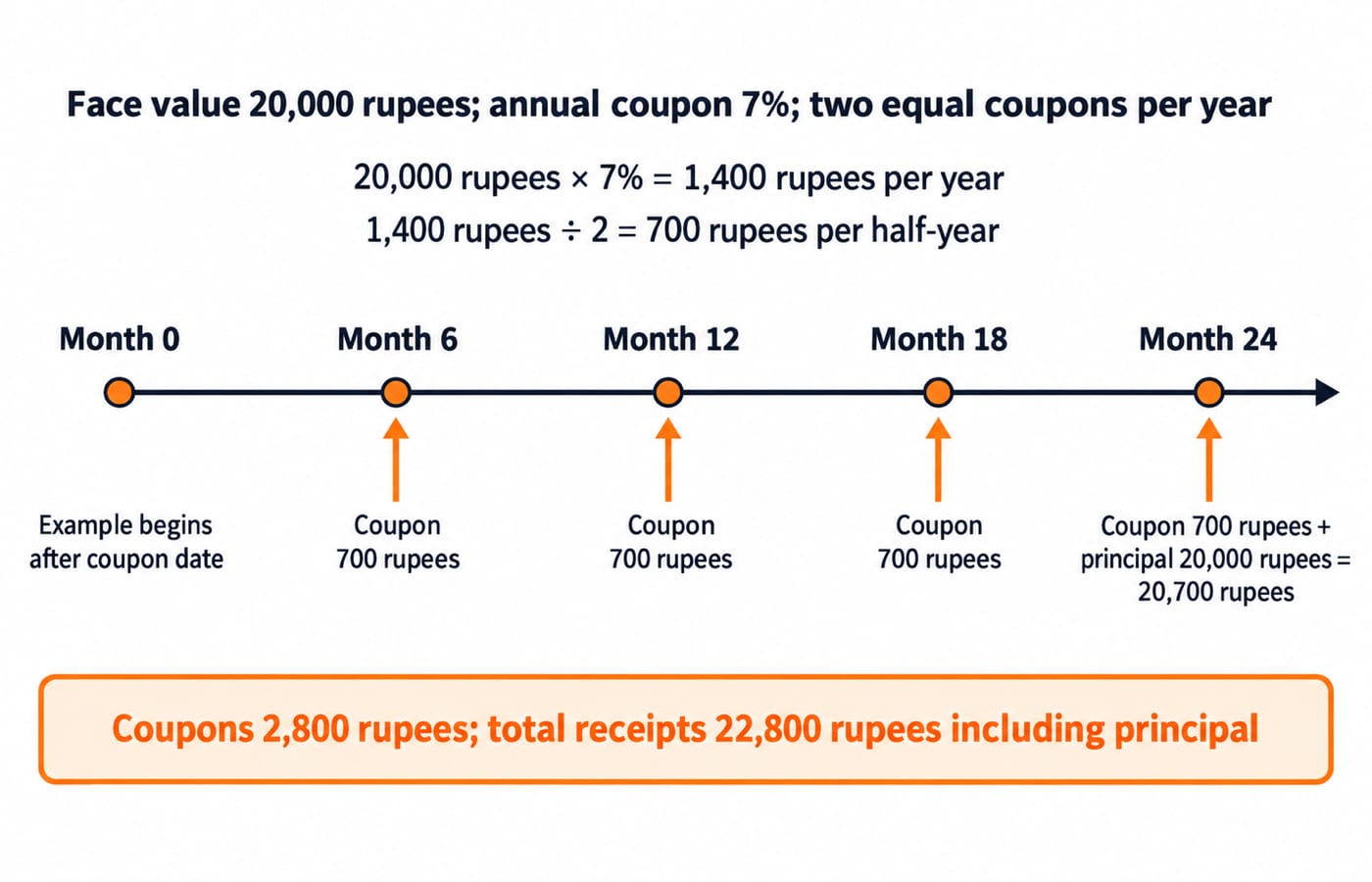
The 22,800 rupees is gross cash received, not profit or a computed investment return. Most of it is the returned 20,000 rupees principal.
A changed resale valuation does not change this security's specified coupon. Selling early ends the assumed holding path: the seller cannot also count the diagram's later coupons and maturity payment as receipts.
Three traps: credit risk, coupon and liquidity
“Government-backed means I cannot lose on sale.” This confuses repayment reliability with market valuation. Absence of domestic-currency credit risk does not remove early-sale market risk. Other things equal, rising market interest rates reduce an existing fixed-coupon security's resale value; falling rates increase it. The 700 rupees coupons stay fixed while newly issued comparable securities reflect changed rates. Holding this example to maturity returns 20,000 rupees face value.
“A 7% coupon guarantees my investment earns 7%.” The missing detail is the denominator. Coupon interest uses face value, here 20,000 rupees. Assessing investment return also requires acquisition cost, sale or redemption proceeds, and cash-flow timing. Coupon rate alone cannot supply the answer.
“A secondary market guarantees an immediate exit on my preferred terms.” Access and execution are different. A trading route allows an attempted sale; it does not promise a counterparty at the desired valuation. An investor's ability to seek an exit is not a promise about the result.
How an exam-style question can test the distinction
The checks below test the scheme’s account, auction and cash-flow distinctions.
Q1. An RDG account holds government securities, while the linked bank account receives cash payments. True or false?
True. Securities and cash sit in different accounts with different roles.
Q2. In the example, what is the six-month coupon?
(a) 700 rupees
(b) 1,400 rupees
(c) 2,800 rupees
(d) 20,700 rupees
Answer: (a). Option (b) is the annual coupon, (c) totals four coupons, and (d) is the month-24 receipt including principal.
Q3. Which statement is incorrect?
(a) An RDG account can be opened singly or jointly.
(b) Primary-auction bids through Retail Direct are non-competitive.
(c) Retail Direct allows buying and selling in the secondary market.
(d) Selling before maturity always returns the investor's original outlay.
Answer: (d). Early-sale market risk remains. Statements (a) to (c) match the operational distinctions in RBI's dated Retail Direct Scheme FAQ.
Separate stable concepts from changing announcements in revision notes. Banking Awareness IBPS PO Mains: Static Core + Weekly Plan provides a follow-on study method.
The short version and your next revision step
Remember the chain: the RDG account holds the instrument, the platform provides market access, the instrument sets cash flows, and an early sale introduces market risk.
Close the example and reproduce 1,400 rupees annually, 700 rupees per half-year and 20,700 rupees at maturity. Then explain why total receipts include principal and why coupon rate alone does not measure investment return. That explanation matters as much as the arithmetic.
For broader preparation, the IBPS PO Mains Preparation Course includes General / Economy / Banking Awareness. Use it as an optional resource while practising these account, instrument and risk distinctions.
Keep learning

JWT Authentication in Node.js and Express: Access Tokens, Refresh Tokens, and the Security Pitfalls That Leak Accounts
Trace a complete Express login, protected request, expiry, and refresh cycle. Then fix the token mistakes that make an apparently working system unsafe.
Updated 30 Oct 20266 min read98 viewsWeb Development

Direct Mapping in Cache Memory: Address Bits, Cache-Line Mapping and a Hit-Ratio Worked Example
Learn how a direct-mapped cache chooses one line, splits a byte address into tag, index and offset, and creates conflict misses in a worked trace.
Updated 29 Oct 20266 min read65 viewsComputer Organization & Architecture

Cache Mapping Techniques and Memory Units: Direct, Associative and Set-Associative Worked Example
Use one address to learn memory-unit conversion, cache organisation and the exact tag, index and offset fields for all three mapping techniques.
Updated 18 Sep 20266 min read149 viewsComputer Organization & Architecture

Mathematical Induction and Proof Techniques for GATE CS: Direct, Contrapositive and Contradiction Worked
Learn when to use direct proof, contrapositive, contradiction and induction, with complete algebra and the proof errors GATE commonly turns into options.
Updated 30 Oct 20266 min read114 viewsGATE Strategy & Roadmap