Questions and Practice Problems on Propositions: Worked Truth Tables and Logic Traps
Translate proposition statements reliably, build truth tables, test equivalence and validity, find satisfying assignments, and repair common logic errors.
KnowledgeGate Team
Exam prep & CS education
Updated 16 Sep 20266 min read
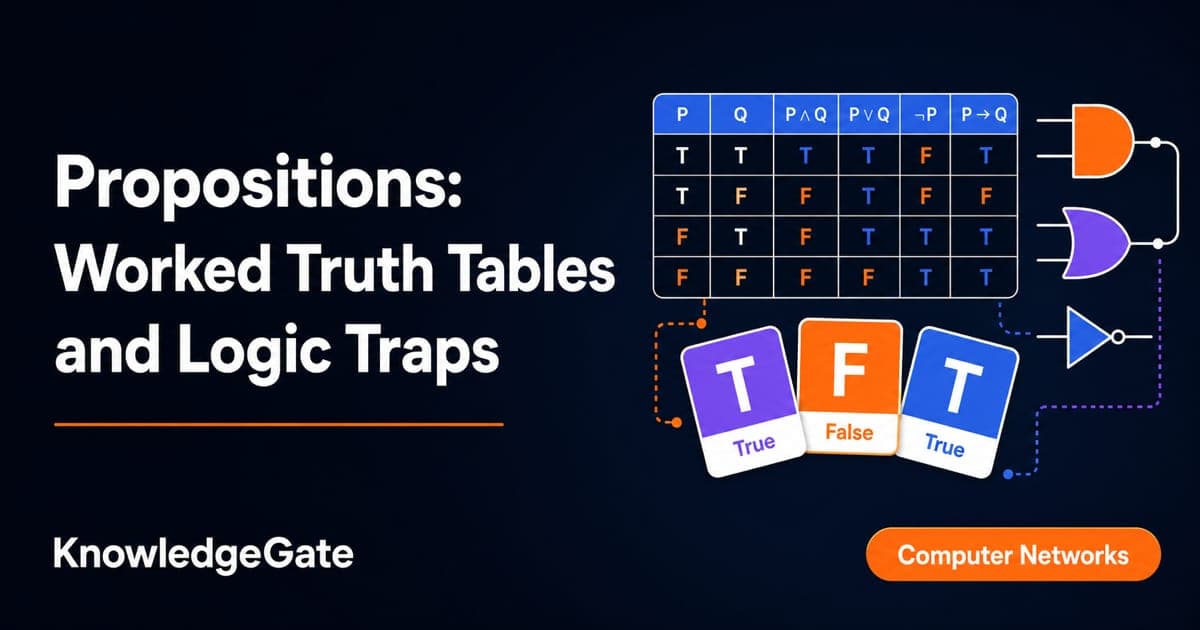
Proposition questions look short, but one reversed arrow, missing bracket or unchecked truth assignment can change the answer completely. Use the same solve order every time: decide whether the sentence is a proposition, define the atoms, translate the wording, evaluate or tabulate, and finish with a classification or counterexample. The same solve order handles a central eight-row formula and practice problems on equivalence, validity and satisfiability.
Related reading: proposition MCQs and logical operator MCQs.
Propositions and practice problems: identify the object before calculating
A proposition is a declarative sentence with one definite truth value under a fixed interpretation. 11 is prime is T, while 15 is even is F. Both are propositions because being false does not stop a sentence from having a truth value.
In contrast, x + 4 = 10 is an open sentence until x is fixed or quantified. Close the window is a command, and Is 11 prime? is a question. None is a proposition in its given form.
The p, q and r, then join them to make compound formulas. With n distinct atoms, a truth table needs 2^n assignments. Three atoms need 8 rows; four need 16. See the Propositional and Predicate Logic: Truth Tables and Quantifiers develops the connective and quantifier foundations; mixed proposition practice requires the solve order used below.
Translate if, only if and exactly when before touching a truth table
Use p for "the lab is open", q for "the tutor is present", and r for "the practice session runs".
"The practice session runs only if the lab is open and the tutor is present" is
r -> (p ∧ q)."If the lab is open and the tutor is present, the practice session runs" is
(p ∧ q) -> r."The practice session runs exactly when both prerequisites hold" is
r <-> (p ∧ q)."At least one prerequisite is missing" is
not(p ∧ q), equivalentlynot p ∨ not q.
At p=T, q=F, r=T: r -> (p ∧ q) = T -> F = F; (p ∧ q) -> r = F -> T = T; r <-> (p ∧ q) = T <-> F = F; and not(p ∧ q) = not F = T. The first two results differ, so reversing "only if" changes the formula. Use Implication and Biconditional Operators in Logic to isolate arrow direction before combining it with classification and validity.
Fully worked truth table: prove a case-based argument is a tautology
Classify
F = [(p ∨ q) ∧ (p -> r) ∧ (q -> r)] -> r.
Set A = (p ∨ q) ∧ (p -> r) ∧ (q -> r), then calculate:
|
|
|
|
|
|
|
|
|---|---|---|---|---|---|---|---|
T | T | T | T | T | T | T | T |
T | T | F | T | F | F | F | T |
T | F | T | T | T | T | T | T |
T | F | F | T | F | T | F | T |
F | T | T | T | T | T | T | T |
F | T | F | T | T | F | F | T |
F | F | T | F | T | T | F | T |
F | F | F | F | T | T | F | T |
At (p,q,r)=(T,F,T), all three parts of A are true, so A=T and T -> T=T. At (p,q,r)=(T,T,F), both promises to r fail, making A=F; the outer implication is F -> F=T because its antecedent is false.
All eight final entries are T, so F is a tautology. If at least one case occurs and each possible case implies r, then r follows.
![Eight-row truth table proving [(p OR q) AND (p -> r) AND (q -> r)] -> r is a tautology, with every final-column entry true.](https://cdn.knowledgegate.ai/blog-assets/blog_asset_1784662686498_ivchk8.jpg)
Equivalence, validity and satisfiability need different kinds of evidence
The claim tells you how much evidence you must produce. For equivalence, compare every assignment. For rows (T,T), (T,F), (F,T), (F,F), both p -> q and not p ∨ q produce T,F,T,T. Therefore p -> q ≡ not p ∨ q. One matching row is not enough because equivalence requires matching outputs on every row.
Now test the argument p ∨ q, p, therefore not q. Set p=T, q=T. The first premise is T ∨ T=T, the second premise is p=T, and the conclusion is not q=F. The premises are true while the conclusion is false, so the argument is invalid. This error treats inclusive OR as if exactly one input could be true.
Finally, satisfy G=(p ∨ q) ∧ (not p ∨ r) ∧ not q. The last part fixes q=F. Then p ∨ q forces p=T, and not p ∨ r forces r=T. Thus (p,q,r)=(T,F,T) makes G=T. One true assignment proves satisfiability; one counterexample disproves validity or equivalence.
Four proposition practice problems to solve before reading the answer
Evaluate
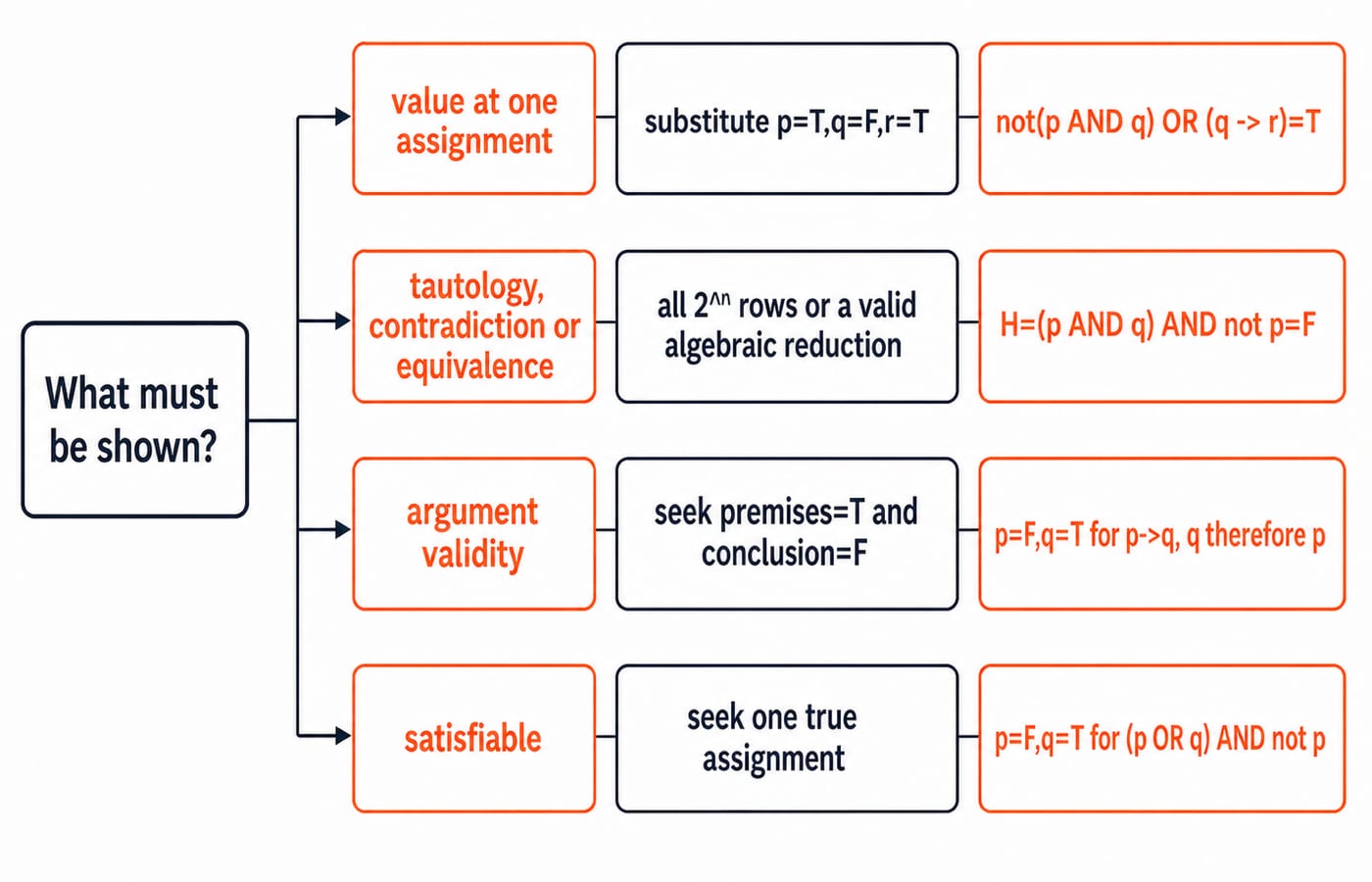
not(p ∧ q) ∨ (q -> r)atp=T,q=F,r=T.
Since p ∧ q=F, the working is not F ∨ (F -> T)=T ∨ T=T.
Classify
H=(p ∧ q) ∧ not p.
Regroup it as (p ∧ not p) ∧ q=F ∧ q=F. It is a contradiction.
Find a satisfying assignment for
(p ∨ q) ∧ not p.
Choose p=F,q=T. Then the formula is T ∧ T=T, so the assignment satisfies it.
How many rows are needed for
(p ∧ q) -> (r ∨ s)?
There are four distinct atoms. Therefore the table needs 2^4=16 rows.
Match the method to the demand. Use direct substitution for one supplied valuation. Use a full table or valid algebra for classification and equivalence. For validity, hunt for premises T and conclusion F. For satisfiability, find one assignment that makes the complete formula T.
Proposition traps: repair the exact wrong move
Converse trap: Over the domain
{1,2,3}, letp(x)meanx is in {1,2}andq(x)meanx is in {1,2,3}.p -> qis true for every domain element, but the converseq -> pfails atx=3. The contrapositivenot q -> not premains equivalent to the original.De Morgan trap:
not(p ∨ q)isnot p ∧ not q, notnot p ∨ not q. Atp=T,q=F, the correct left side isnot T=F; the wrong expression isF ∨ T=T.Classification trap: One true row does not prove a tautology, and one false row does not prove a contradiction. A mixed final column means contingency. Ordinary
∨is inclusive, soT ∨ T=T.Bracket trap: Do not evaluate
not p ∧ qasnot(p ∧ q). Atp=T,q=F, the first isF ∧ F=F, while the second isnot F=T.
How proposition questions are tested and how to practise them
Stable question forms include identifying propositions, translating wording, filling truth-table columns, classifying or comparing formulas, and validating an argument with a proof or counterexample.
For a three-variable problem, try a 12-minute loop: spend 2 minutes defining atoms and brackets, 5 minutes building the 8-row table, 3 minutes checking decisive rows, and 2 minutes recording the exact error. Accuracy comes before compressing the method. Repeat the loop before trying to work faster.
Use GATE CS Exam Preparation for the wider route and Propositional and Predicate Logic MCQs: 12 Solved for a focused drill set. Our practice bank has over 25 questions on this subtopic, though that does not mean every one is an official PYQ.
Questions on propositions: the short version and next step
Use five steps: test whether the sentence is a proposition, define the atoms, translate faithfully, choose the right evidence, and state the final classification. Check all rows to prove a tautology; one false row refutes it. Premises T with conclusion F refute validity, while one true assignment proves satisfiability. Rebuild the eight-row table without looking, then use GATE Guidance by Sanchit Sir for the broader Discrete Mathematics sequence and guided problem practice.
Keep learning

Classification of Finite and Infinite Groups: Orders, Cyclicity and Worked Examples
Learn how group axioms, group order, element order and generators classify finite and infinite groups through complete, checkable examples.
Updated 4 Oct 20266 min readEngineering Mathematics
Bipartite, Cycle, Regular and Complement Graphs: Tests, Formulas and a C6 Worked Example
Learn a dependable order for classifying simple graphs, then apply it to C6 and list, count and test every edge in its complement.
Updated 29 Sep 20266 min readEngineering Mathematics

Basic Terminologies in Linear Programming: Feasible Solutions, BFS and an Optimal Solution Worked Step by Step
Separate feasible, basic feasible and optimal solutions through geometry, slack variables, vertex enumeration and concise counterexamples.
Updated 25 Sep 20265 min readEngineering Mathematics

Assignment Problem and Hungarian Method: Formulation with a Complete Worked Example
Learn why greedy assignment fails, how matrix reductions preserve the optimum, and how the uncovered-value adjustment leads to a minimum cost of 140.
Updated 24 Sep 20266 min readEngineering Mathematics