Bijective Function MCQs: 10 Solved Questions on Definition, Counting and Properties
Solve 10 bijective-function MCQs with collision checks, range analysis, composition logic and permutation counting, each followed by a worked explanation.
KnowledgeGate Team
Exam prep & CS education
Updated 24 Oct 20267 min read
A bijection is one-one and onto, but exam questions hide those tests inside domains, ranges, compositions, piecewise rules and counting language. Definition checks, polynomial classification, composition rules and permutation counting all demand the same evidence: one collision disproves injectivity, while one missing codomain value disproves surjectivity. Questions 1 to 7 continue in the bijective-function practice hub; Questions 8 to 10 each link to a full worked solution. Use Discrete Mathematics MCQs for broader mixed-topic practice.
Calibrate bijection with two tests and one finite count
Test injectivity first. Either assume f(x1) = f(x2) and prove x1 = x2, or find two inputs that collide. Then test surjectivity. Take an arbitrary target y in the stated codomain and solve f(x) = y using an input from the stated domain. A function is bijective only when both tests pass.
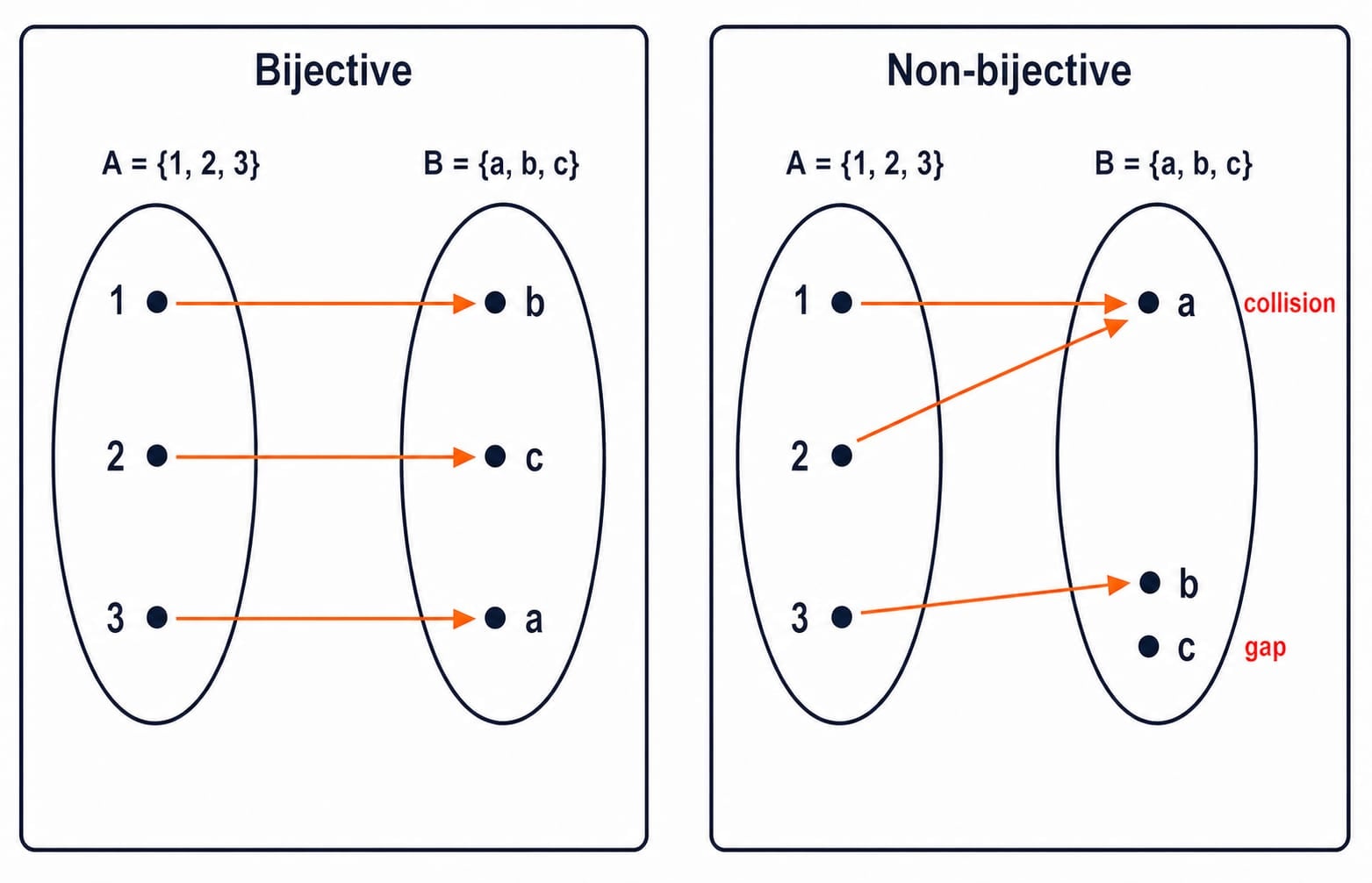
Let A = {1,2,3} and B = {a,b,c}. Define h(1)=b, h(2)=c and h(3)=a. No image repeats, and every member of B is used, so h is bijective. Its inverse is h⁻¹(a)=3, h⁻¹(b)=1 and h⁻¹(c)=2.
For all bijections from A to B, the first input has 3 image choices, the second has 2 and the third has 1. Therefore the count is 3 × 2 × 1 = 3! = 6. Unequal finite set sizes give zero bijections.
Now define k(1)=a, k(2)=a and k(3)=b. Inputs 1 and 2 collide at a, while c has no pre-image. Thus k is neither injective nor surjective.
Questions 1-2: recognise the definition and prove a real polynomial is bijective
Question 1
A function is bijective when it is:
A. Neither injective nor surjective
B. Injective but not surjective
C. Surjective but not injective
D. Both injective and surjective
Correct answer: D. Both injective and surjective.
Injective means no codomain value has more than one pre-image. Surjective means none has zero. Together, each has exactly one pre-image, so an inverse exists on the whole codomain. Options A, B and C fail at least one test.
Question 2
For real x, let f(x)=x³+5x+1. Which statement is correct?
A. f is one-to-one but not onto R
B. f is onto but not one-to-one R
C. f is one-to-one and onto R
D. f is neither one-to-one nor onto R
Correct answer: C. f is one-to-one and onto R.
Read fx as f(x). Since f'(x)=3x²+5>0 for every real x, the function is strictly increasing and injective. Its limits at negative and positive infinity are negative and positive infinity respectively. Continuity therefore makes the range all of R, so it is onto. The checks f(-1)=-5, f(0)=1, f(1)=7 illustrate the increase but do not prove it.
Questions 3-4: use collisions and ranges instead of guessing from formulas
Question 3
A function f: R→R defined as y = x² + 2x, choose the correct statement
A. ‘f’ is Bijection
B. ‘f’ is surjection
C. ‘f’ is one-one function
D. None of the above
Correct answer: D. None of the above.
Complete the square: f(x)=(x+1)²-1. The collision f(0)=f(-2)=0 disproves injectivity. The minimum is -1, so the range is [-1,∞), not R; for example, -2 has no pre-image. Thus A, B and C are false.
Question 4
Consider the mappings f₁ and f₂ defined as follows:
f₁: ℝ → ℝ, where f₁(x) = x² + x for x ∈ ℝ.
f₂: ℤ → ℤ, where f₂(y) = 2y for y ∈ ℤ.
Here, ℝ is the set of real numbers and ℤ is the set of integers. Which statement is true?
A. f₁ is neither injective nor surjective; f₂ is injective but not surjective.
B. f₁ is injective but not surjective; f₂ is injective but not surjective.
C. Both f₁ and f₂ are injective as well as surjective.
D. f₁ is not injective but is surjective; f₂ is injective but not surjective.
Correct answer: A. f₁ is neither injective nor surjective; f₂ is injective but not surjective.
For f₁, f₁(0)=f₁(-1)=0, so injectivity fails. Also, x²+x=(x+1/2)²-1/4, so values below -1/4 are absent. For f₂, 2y₁=2y₂ forces y₁=y₂, but no integer input maps to an odd target such as 1.
Questions 5-6: classify functions on natural numbers by finding one collision and one gap
Question 5
Let f map the natural numbers to the integers, with
f(x) = x² - 3x + 3. Which property does f have?
A. Injective function
B. Surjective function
C. Bijective function
D. None of the above
Correct answer: D. None of the above.
Since f(1)=f(2)=1, injectivity fails. Also, f(x)=(x-3/2)²+3/4, so natural-number inputs cannot produce negative integer targets such as -1. This holds whether N includes 0.
Question 6
Consider the mapping f:N→N, where N is the set of natural numbers, defined by
f(n)=n² for odd n
f(n)=2n+1 for even n
For n∈N, which of the following is true about f?
A. Bijective
B. Surjective but not Injective
C. Injective but not surjective
D. Neither surjective nor injective
Correct answer: D. Neither surjective nor injective.
Odd inputs produce 1,9,25,49,...; even inputs produce 5,9,13,17,.... The cross-branch collision f(3)=3²=9=f(4)=2(4)+1 defeats injectivity. Targets 2,3,4,6,7,8 occur in neither list, so surjectivity also fails.
Questions 7-8: read composition claims in the correct direction
Composition of Functions MCQs: 10 Solved Questions treats evaluation order, domains and general transfer rules. Here, composition supplies evidence for the narrower injective-or-surjective decision. Onto (Surjective) Function MCQs: 11 Solved Questions owns inclusion-exclusion counts and surjection-only cases; these two problems pair onto evidence with one-one evidence to decide what a component must satisfy.
Question 7
Let f:A→B and g:B→C denote two functions. If the function g∘f:A→C is a surjection and g is an injection then function f is,
A. Injection
B. Surjection
C. Bijection
D. None of these
Correct answer: B. Surjection.
Take any b in B. Since g∘f is onto, some a satisfies g(f(a))=g(b). Injectivity of g gives f(a)=b, so f is onto. It need not be injective: for A={1,2}, B={b}, C={c}, let f(1)=f(2)=b and g(b)=c. Both hypotheses hold despite the collision.
Question 8
g is a function from A to B, f is a function from B to C, and f∘g maps A to C. If f and f∘g are onto (surjective), which statement about g must be true?
A. g must be an onto (surjective) function.
B. g must be a one-to-one (injective) function.
C. g must be bijective, that is, both one-to-one and onto.
D. g is not required to be one-to-one or onto.
Correct answer: D. g is not required to be one-to-one or onto.
Let A={a,b,c}, B={0,1,2,3} and C={red,blue}. Set g(a)=0 and g(b)=g(c)=1. Define f(0)=red, f(1)=blue, f(2)=red and f(3)=blue. Both f and f∘g are onto. Yet g is not injective because g(b)=g(c), and not onto because it misses 2 and 3.
Asked in GATE 2025 (Computer Science, Set 1). See the full worked solution.
Questions 9-10: combine interval behaviour with a bijection count
Question 9
The function f: [0,3]→[1,29] defined by f(x) = 2x³ - 15x² + 36x + 1 is
A. injective and surjective
B. surjective but not injective
C. injective but not surjective
D. neither injective nor surjective
Correct answer: B. surjective but not injective.
Differentiate: f'(x)=6x²-30x+36=6(x-2)(x-3). The function rises from f(0)=1 to f(2)=29, then falls to f(3)=28. Continuity makes it cover [1,29], so it is onto. The collision f(3/2)=f(3)=28 defeats injectivity. The critical point at x=2, not endpoints alone, reveals the turn.
Asked in ISRO 2017 (Computer Science, December paper). See the full worked solution.
Question 10
Given a set of elements N = {1, 2, ..., n} and two arbitrary non-empty subsets A ⊆ N and B ⊆ N, how many of the n! permutations π from N to N satisfy min(π(A)) = min(π(B)), where min(S) is the smallest integer in the set of integers S, and π(S) is the set of integers obtained by applying permutation π to each element of S?
A. (n - |A ∪ B|) |A| |B|
B. (|A|² + |B|²)n²
C. n! × |A ∩ B| / |A ∪ B|

D. |A ∩ B|² / ⁿC|A ∪ B|
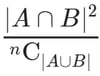
Correct answer: C, the option n! × |A ∩ B| / |A ∪ B|.
Let U=A∪B. Each element of U is equally likely to receive its smallest image. The two minima match exactly when that element belongs to A∩B, a fraction |A∩B|/|A∪B| of all n! permutations.
For n=5, |A∩B|=2 and |A∪B|=4:
5! × 2/4 = 120 × 1/2 = 60.
Thus 60 permutations qualify. This is a symmetry count over bijections, not n! alone.
Asked in GATE 2006 (Computer Science). See the full worked solution.
Diagnose errors by failure type, then choose the next practice step
Skill tested | Questions | Retest rule |
|---|---|---|
Definition and direct bijection proof | 1-2 | Check both injectivity and surjectivity |
Collision plus range analysis | 3-6 | Write one collision and one missing target |
Composition direction | 7-8 | Label every domain and codomain before composing |
Interval coverage and permutation counting | 9-10 | Find critical points or the uniformly chosen element |
For Questions 3 to 6, write a collision and a missing target. For Questions 7 and 8, label each arrow. For Question 9, calculate critical points and endpoints. For Question 10, identify the uniformly chosen element before multiplying by n!.
The short version
Prove injectivity with algebra or disprove it with one collision. Prove surjectivity against the stated codomain, not just the values you test. Call a function bijective only after both checks pass. For a wider syllabus path, use GATE Guidance by Sanchit Sir. Then revisit the questions without the explanations. Write evidence for both tests before choosing an answer, and keep the stated domain and codomain visible throughout.
Keep learning
Conditional Probability Questions with Solutions: 12-Question Practice Set
Practise 12 conditional probability questions on independence, restricted samples, Bayes' rule, draws and complements, with checked calculations.
20 Oct 20267 min readDiscrete Mathematics MCQs
Order of Elements in Groups MCQs: 10 Solved Objective Questions
Build a reliable method for finding element orders, then apply it to 10 bank questions, including NAT, MSQ and two composition-table problems.
Updated 16 Oct 20267 min readDiscrete Mathematics MCQs
Partial Order Relation MCQs: 12 Solved Poset and Total Order Questions
Solve 12 published partial order questions with fresh explanations covering posets, total orders, lattices, recursive comparisons, linear extensions and counterexamples.
12 Oct 20267 min readDiscrete Mathematics MCQs

Set Operations MCQs: 11 Solved Questions with Step-by-Step Explanations
Solve 11 set operations MCQs, then compare your decisive step with a fresh explanation covering counts, identities, complements and constructions.
Updated 8 Oct 20267 min readDiscrete Mathematics MCQs