Order of Elements in Groups MCQs: 10 Solved Objective Questions
Build a reliable method for finding element orders, then apply it to 10 bank questions, including NAT, MSQ and two composition-table problems.
KnowledgeGate Team
Exam prep & CS education
Updated 16 Oct 20267 min read
Finding an element's order is simple only when the notation is clear. A distractor may swap the group order with one element's order, accept any exponent satisfying a^m=e instead of the least one, or miss the identity row in a Cayley table. Cyclic generators, subgroup orders, Euler's totient function, group-property checks and composition tables demand different tests. Before opening each explanation, identify the identity and write successive powers yourself. The Discrete Mathematics MCQs hub provides wider practice.
Determine the order of an element before solving the MCQs
The order of an element a, written ord(a), is the least positive integer r for which a^r=e. The word "least" matters. From a^12=e alone, the order could be 1, 2, 3, 4, 6 or 12.
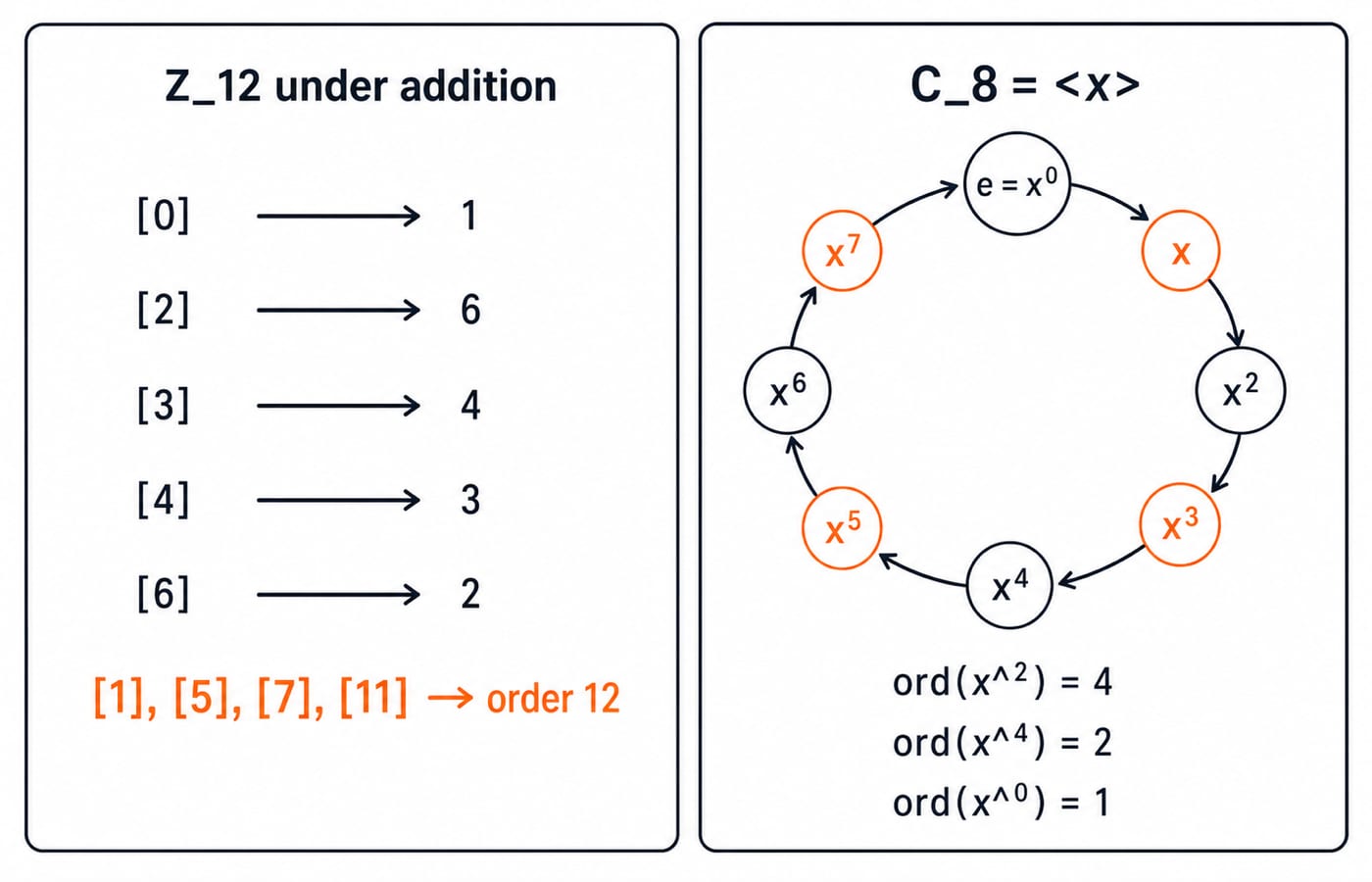
In the additive group Z_12, ord([k])=12/gcd(12,k). Therefore ord([0])=1, ord([2])=6, ord([3])=4, ord([4])=3 and ord([6])=2. The generators are [1], [5], [7] and [11], since these representatives are coprime to 12, so phi(12)=4.
The matching rule in C_8=<x> is ord(x^k)=8/gcd(8,k). Thus x, x^3, x^5 and x^7 have order 8; x^2 and x^6 have order 4; x^4 has order 2; and x^0=e has order 1.
Use GATE Guidance by Sanchit Sir for the full Discrete Mathematics sequence.
Cyclic groups, subgroups and generators: Questions 1 to 3
Question 1 (MCQ)
Every subgroup of cyclic group is itself a
A. Abelian Group
B. Finite Group
C. Cyclic Group
D. None of these
Answer: C. Cyclic Group. If G=<g> and H is nontrivial, choose the least positive m with g^m in H. For any g^k in H, division gives k=qm+r, where 0<=r<m; then g^r in H, so minimality forces r=0. Hence every element of H is a power of g^m, making H=<g^m> cyclic and consequently abelian.
Question 2 (MCQ)
Consider the given statements
A: All cyclic groups are abelian groups.
B: The order of the cyclic group is the same as the order of its generator.
A. A and B are false
B. A is true but B is false
C. B is true but A is false
D. A and B both are true
Answer: D. A and B both are true. If each element is a power of g, then g^i g^j=g^(i+j)=g^(j+i)=g^j g^i, so the group is abelian. In a finite cyclic group, a generator produces every element before its powers repeat. Its order therefore equals the number of elements in the group.
Question 3 (NAT)
If G₁ is a cyclic group of order 8 , then how many generators are possible
This is a numerical-answer question, so no options are given.
Answer: 4. A cyclic group of order 8 has phi(8)=8(1-1/2)=4 generators. If G₁=<x>, they are x, x^3, x^5 and x^7, corresponding to the exponents 1,3,5,7 that are coprime to 8.
Use Lagrange and Sylow carefully: Questions 4 and 5
Question 4 (MCQ)
Which of the following options are true if G is a finite group of 54 elements?
A. Group G is a cyclic group.
B. The total number of subgroups of G will be equal to 16.
C. The size of the largest possible proper subgroup of G is 27.
D. The size of the smallest subgroup of G is 5.
Answer: C. Since 54=2*3^3, subgroup orders divide 54, and the largest proper divisor is 27. A Sylow 3-subgroup of order 27 exists; its count divides 2 and is 1 mod 3, so that count is 1. The group need not be cyclic, its total subgroup count is not fixed by its order, and its smallest subgroup is the trivial subgroup of order 1.
Question 5 (MCQ)
Which of the following options are true if G is a finite group of 35 elements?
A. The size of the smallest proper subgroup of G is 1.
B. The total number of subgroups of G will be equal to 16.
C. The size of the largest possible proper subgroup of G is 7.
D. The size of the smallest subgroup of G is 5.
Answer: A and C are true under the standard definition of proper subgroup; the source key lists C only. Since 35=5*7, possible subgroup orders are 1,5,7,35, and Sylow's theorems guarantee subgroups of orders 5 and 7. Thus 7 is the largest proper subgroup order, while the trivial subgroup of order 1 makes A true as written. The earlier Subgroup MCQs: 12 Solved Questions set develops the divisor-and-existence method; here the point is to catch the wording distinction between proper and nontrivial proper.
Check whether the operation really forms a group: Questions 6 and 7
Question 6 (MCQ)
Let S1 and S2 be two algebraic structures as described below:
S1: ({0, 1, 2, 3, 4, ..., m-1}, +_(m-1))
S2: ({0, 1, 2, 3, 4, ..., m-2}, +_(m-1))
Where +_m is a binary operation defined as (a +_m b) = (a + b) mod m. Which of the above two are groups?
A. Both S1 and S2
B. Only S1
C. Only S2
D. None of these
Answer: C. Only S2. On the intended modulo m-1 reading, S2={0,...,m-2} is the standard cyclic group of order m-1. S1 contains an extra distinct symbol m-1, but reduction modulo m-1 sends it to residue 0. No identity can leave that extra element unchanged, so S1 is not a group.
Question 7 (MCQ)
(G, x), where G = {7ⁿ | n ∈ Z} and x is multiplication operator, then how many properties are satisfied:
i: Closure
ii: Associativity
iii: Inverse
iv: Commutativity
A. 1
B. 2
C. 3
D. 4
Answer: D. 4. For integers m,n, 7^m*7^n=7^(m+n), which proves closure; ordinary multiplication is associative and commutative. The identity is 7^0=1, and the inverse of 7^m is 7^(-m), which remains in G. All four listed properties hold, and this is an abelian group.
Read identity, inverses and generators from a Cayley table: Questions 8 and 9
Question 8 (MSQ)
For the composition table of a cyclic group shown below:
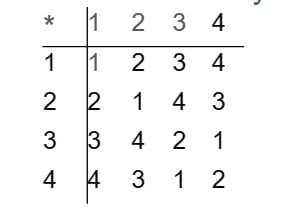
Which of the following is/are true:
A. 1 is the identity element
B. 3 is inverse of 4
C. 2 is generator for the group
D. The group is abelian group
Answers: A, B and D. Row and column 1 reproduce 1,2,3,4, so 1 is the identity. Both 3*4 and 4*3 equal 1, while 2*2=1 gives ord(2)=2, so 2 cannot generate four elements. The table is symmetric about its main diagonal, proving commutativity and therefore an abelian group.
Question 9 (MCQ)
GATE 2009
For the composition table of a cyclic group shown below

Which one of the following choices is correct?
A. a, b are generators
B. b, c are generators
C. c, d are generators
D. d, a are generators
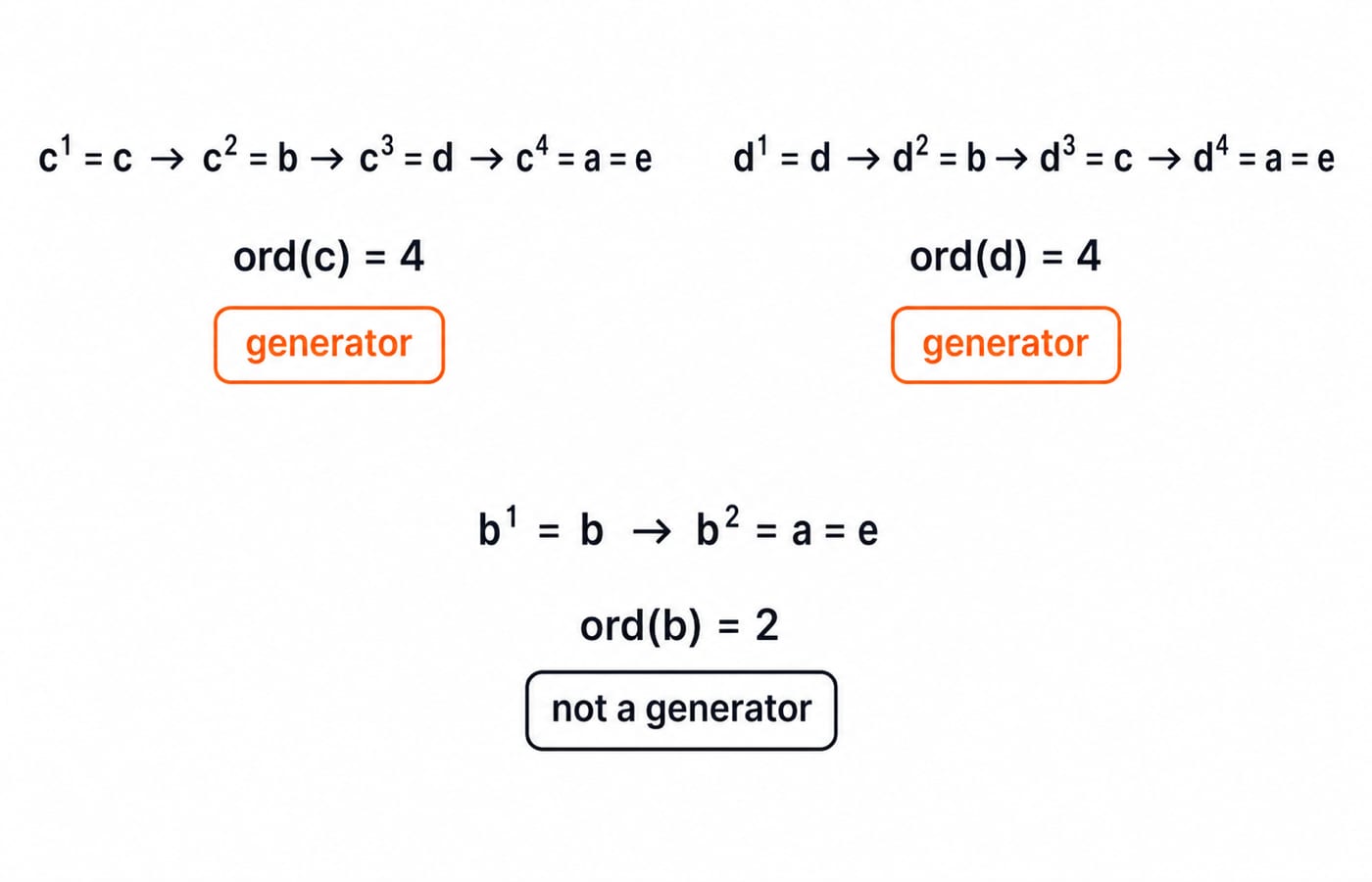
Answer: C. c, d are generators. The row and column for a reproduce all labels, so a is the identity, while b^2=a gives ord(b)=2. For c, the powers are c,b,d,a; for d, they are d,b,c,a. Both have order 4, so they are exactly the generators of this four-element cyclic group.
Generator-count traps and the complete answer check: Question 10
Question 10 (MSQ)
Which of the following is false about Cyclic Groups
A. If order of a Cyclic Group (G, *) is 15, then the number of generators are 9
B. Every subgroup of a Cyclic Group is Cyclic
C. A cyclic group of order N has a unique subgroup of every divisor of N
D. If an element a is generator in a Cyclic Group, then a⁻¹ is not a generator
Answers: A and D are false. phi(15)=15(1-1/3)(1-1/5)=8, so A's count of 9 is false. B and C are standard cyclic-group properties. If a is a generator, a^(-1) traverses the same elements in reverse and has the same order, so D is false too.
Keep these traps separate:
Find the least exponent, not merely an exponent that produces the identity.
Distinguish the group order from an element's order.
Lagrange gives divisibility; existence may require Cauchy's or Sylow's theorem.
phi(n)counts generators of a cyclic group of ordern.A symmetric Cayley table proves commutativity only after the table is known to describe a group.
Answer key: 1 C, 2 D, 3 = 4, 4 C, 5 A/C under the standard definition (source key C), 6 C, 7 D, 8 A/B/D, 9 C, 10 A/D.
Order of elements in groups: the short version and next step
First find e, then generate a,a^2,... until the first return to e. In C_n, use ord(g^k)=n/gcd(n,k), and count generators with phi(n). In a Cayley table, use the complete row and column evidence to identify the identity and inverses. That sequence turns notation into a repeatable method. Now redo Questions 3, 4, 8 and 9 without notes. They test four distinct skills: totient counting at n=8, Sylow reasoning at |G|=54, inverse detection on {1,2,3,4}, and power tracing on {a,b,c,d}. For another course route through group theory, use NTA-UGC-NET Paper - 2, then browse GATE CS Exam Preparation for the wider path.
Keep learning
Conditional Probability Questions with Solutions: 12-Question Practice Set
Practise 12 conditional probability questions on independence, restricted samples, Bayes' rule, draws and complements, with checked calculations.
20 Oct 20267 min readDiscrete Mathematics MCQs
Partial Order Relation MCQs: 12 Solved Poset and Total Order Questions
Solve 12 published partial order questions with fresh explanations covering posets, total orders, lattices, recursive comparisons, linear extensions and counterexamples.
12 Oct 20267 min readDiscrete Mathematics MCQs
Set Operations MCQs: 11 Solved Questions with Step-by-Step Explanations
Solve 11 set operations MCQs, then compare your decisive step with a fresh explanation covering counts, identities, complements and constructions.
Updated 8 Oct 20267 min readDiscrete Mathematics MCQs
Graph Traversal MCQs: 12 Solved Questions on Walks, Paths, Trails, Circuits and Connectivity
Attempt 12 graph traversal and connectivity questions, then check each answer through definitions, reachability, degree conditions and edge-count arguments.
Updated 3 Oct 20267 min readDiscrete Mathematics MCQs