Priority Scheduling MCQs: 12 Solved Questions with Explanations
Attempt 12 priority scheduling MCQs, then check step-by-step explanations covering timelines, waiting time, starvation remedies, fair share, and dispatch cost.
KnowledgeGate Team
Exam prep & CS education
16 Sep 20267 min read56 views
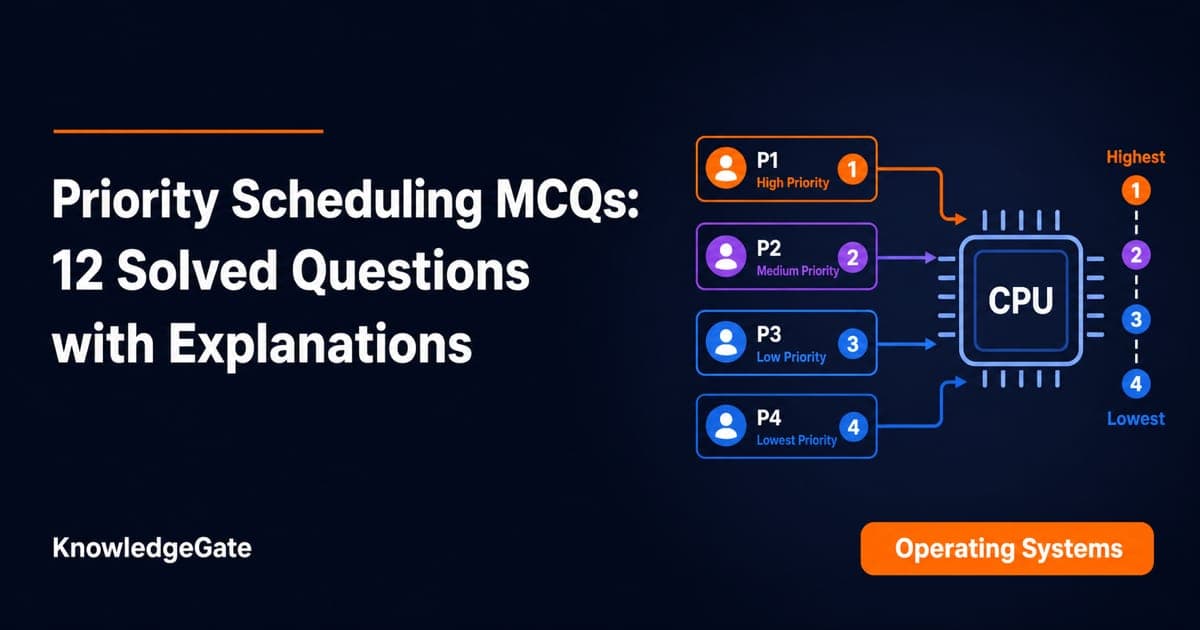
Priority scheduling orders ready processes according to their assigned priorities. Attempt all 12 questions before reading the explanations.
Set the rules before solving
Check the priority direction and whether preemption is allowed, then draw the execution order before calculating times. Use CPU Scheduling Basics and Criteria MCQs for cross-algorithm vocabulary and metric definitions. In priority scheduling, priority order determines the waiting-time trace, aging counters starvation, fair-share weights affect priority, and dispatch latency begins only after the scheduler selects a process.
Questions 1-2: preemptive versus non-preemptive behaviour
Question 1. A non-preemptive process
Asked in: Beltron Programmer 2025, Shift-1
In non-preemptive scheduling, a running process on the CPU will continue uninterrupted until it:
(a) exhausts its designated time quantum
(b) is interrupted by the system timer
(c) completes its required processing or voluntarily yields for I/O
(d) is superseded by a higher-priority arrival
Answer: (c) completes its required processing or voluntarily yields for I/O.
A running process leaves the CPU only when it finishes or blocks or yields; a higher-priority arrival cannot preempt it.
Question 2. A higher-priority arrival
Asked in: Beltron Programmer 2025, Shift-3
In a preemptive priority scheduling algorithm, what happens when a higher-priority process arrives while a lower-priority process is executing?
(a) Both processes are terminated.
(b) The CPU is switched to the higher-priority process.
(c) The system crashes.
(d) The lower-priority process continues to execute.
Answer: (b) The CPU is switched to the higher-priority process.
The lower-priority process returns to the ready queue with its remaining burst and resumes later.
Questions 3-4: calculate waiting time from the actual execution order
Question 3. Non-preemptive average waiting time
Asked in: Indian Space Research Organization 2009
Consider a set of 5 processes whose arrival time, CPU time needed and the priority are given below:
Process       Arrival Time   CPU Time Needed     Priority
              (in ms)

P1              0             10                 5
P2              0             5                  2
P3              2             3                  1
P4              5             20                 4
P5              10            2                  3
(smaller the number, higher the priority) If the CPU scheduling policy is priority scheduling without preemption, the average waiting time will be
(a) 12.8 ms
(b) 11.8 ms
(c) 10.8 ms
(d) 9.8 ms
Answer: (c) 10.8 ms.
The order is P2, P3, P4, P5, P1. Their waits are 0, 3, 3, 18, and 30 ms: 54/5 = 10.8 ms. P5 cannot preempt P4.
Question 4. Two processors and two priority orders
Asked in: GATE 2025, Computer Science, Set 1
A computer has two processors, 𝑀₁ and 𝑀₂. Four processes 𝑃₁, 𝑃₂, 𝑃₃, 𝑃₄ with CPU bursts of 20, 16, 25, and 10 milliseconds, respectively, arrive at the same time and these are the only processes in the system. The scheduler uses non-preemptive priority scheduling, with priorities decided as follows:
• 𝑀₁ uses priority of execution for the processes as, 𝑃₁ > 𝑃₃ > 𝑃₂ > 𝑃₄, i.e., 𝑃₁ and 𝑃₄ have highest and lowest priorities, respectively.
• 𝑀₂ uses priority of execution for the processes as, 𝑃₂ > 𝑃₃ > 𝑃₄ > 𝑃₁, i.e., 𝑃₂ and 𝑃₁ have highest and lowest priorities, respectively.
A process 𝑃ᵢ is scheduled to a processor 𝑀ₖ, if the processor is free and no other process 𝑃ⱼ is waiting with higher priority. At any given point of time, a process can be allocated to any one of the free processors without violating the execution priority rules. Ignore the context switch time. What will be the average waiting time of the processes in milliseconds
(a) 9.00
(b) 8.75
(c) 6.50
(d) 7.50
Answer: (a) 9.00.
𝑀₁ starts 𝑃₁ and 𝑀₂ starts 𝑃₂. At 16 ms, 𝑀₂ takes 𝑃₃; at 20 ms, 𝑀₁ takes 𝑃₄. Therefore 𝑃₁ and 𝑃₂ wait 0 ms, 𝑃₃ waits 16 ms, and 𝑃₄ waits 20 ms: (0 + 0 + 16 + 20)/4 = 9.00 ms.
Questions 5-6: periodic tasks and waiting-time-based priority
Question 5. Periodic tasks
Asked in: AMCAT 2025
Consider a uniprocessor system executing three tasks T1, T2 and T3, each of which is composed of an infinite sequence of jobs (or instances) which arrive periodically at intervals of 3, 7 and 20 milliseconds, respectively. The priority of each task is the inverse of its period, and the available tasks are scheduled in order of priority, with the highest priority task scheduled first. Each instance of T1, T2 and T3 requires an execution time of 1, 2 and 4 milliseconds, respectively. Given that all tasks initially arrive at the beginning of the 1st millisecond and task pre-emption’s are allowed, the first instance of T3 completes its execution at the end of _____________ milliseconds.
(a) 15
(b) 12
(c) 16
(d) 10
Answer: (b) 12.
Periods give T1 > T2 > T3. T3 runs at 4-6 and 10-12 after higher-priority jobs, completing its required 4 ms at 12 ms.
Question 6. Priority proportional to waiting time
Asked in: BARC 2013
A scheduling algorithm assigns priority proportional to the waiting time of a process. Every process starts with priority zero (the lowest priority). The scheduler re-evaluates the process priorities every T time units and decides the next process to schedule. Which one of the following is TRUE if the processes have no I/O operations and all arrive at time 0?
(a) This algorithm is equivalent to the first-come-first-serve algorithm.
(b) This algorithm is equivalent to the round-robin algorithm.
(c) This algorithm is equivalent to the shortest-job-first algorithm.
(d) This algorithm is equivalent to the shortest-remaining-time-first algorithm.
Answer: (b) This algorithm is equivalent to the round-robin algorithm.
At each T-unit review, waiting processes outrank the one that just ran. This rotates equal-length turns like round robin, independent of burst length.
Questions 7-8: diagnose starvation and apply aging
Question 7. Starvation of low-priority processes
Asked in: TPSC 2026, Programmer
Which CPU scheduling algorithm can cause starvation of low-priority processes?
(a) First Come First Serve (FCFS)
(b) Round Robin
(c) Priority Scheduling
(d) Shortest Job First (SJF)
Answer: (c) Priority Scheduling.
Continuous higher-priority arrivals can postpone a ready low-priority process indefinitely: starvation.
Question 8. Aging
Asked in: UGC NET 2012, Computer Science, December
The problem of indefinite blockage of low-priority jobs in general priority scheduling algorithm can be solved using
(a) Parity bit
(b) Aging
(c) Compaction
(d) Timer
Answer: (b) Aging.
Aging gradually improves a waiting job's effective priority until it can run, preventing indefinite blocking.
Questions 9-10: priority inversion and disadvantage wording
Question 9. Priority inversion
Asked in: Indian Space Research Organization 2013
Which of the following strategy is employed for overcoming the priority inversion problem?
(a) Temporarily raise the priority of lower priority level process
(b) Have a fixed priority level scheme
(c) Implement kernel pre-emption scheme
(d) Allow lower priority process to complete its job
Answer: (a) Temporarily raise the priority of lower priority level process.
Temporarily boosting the lock-holding low-priority process lets it finish its critical section, release the lock, and unblock the high-priority process.
Question 10. Read the negative wording
Asked in: TCS 2024
What is not a disadvantage of priority scheduling in operating systems?
(a) A low priority process might have to wait indefinitely for the CPU
(b) If the system crashes, the low priority systems may be lost permanently
(c) Interrupt handling
(d) Indefinite blocking
Answer: (c) Interrupt handling.
Interrupt handling uses priority ordering; it is not an inherent scheduling disadvantage. Options (a) and (d) describe starvation.
Questions 11-12: fair-share inputs and dispatch cost
Question 11. Fair-share scheduling inputs
Asked in: UGC NET 2017, Computer Science, January
Some of the criteria for calculation of priority of a process are : a. Processor utilization by an individual process. b. Weight assigned to a user or group of users. c. Processor utilization by a user or group of processes In fair share scheduler, priority is calculated based on :
(a) only (a) and (b)
(b) only (a) and (c)
(c) (a), (b) and (c)
(d) only (b) and (c)
Answer: (c) (a), (b) and (c).
Fair-share priority combines process CPU use, user or group CPU use, and the configured user or group weight.
Question 12. Dispatch latency
Asked in: Indian Space Research Organization 2020
Dispatch latency is defined as
(a) the speed of dispatching a process from running to the ready state
(b) the time of dispatching a process from running to ready state and keeping the CPU idle
(c) the time to stop one process and start running another one
(d) none of these
Answer: (c) the time to stop one process and start running another one.
Priority selection happens first. Dispatch latency is the subsequent hand-off: saving the old process state, restoring the selected process, and starting it.
Score the set and choose the next step
Revise missed concepts, then try the set again. For guided revision, continue with GATE Guidance by Sanchit Sir; for self-directed practice, choose another topic from the Operating System MCQ hub or browse the GATE category.
Keep learning

Segmentation and Hybrid MCQs: 10 Solved OS Questions with Explanations
Solve ten memory-management MCQs, then check the keyed answers, short reasoning paths, distractor traps, and worked address calculations.
Updated 3 Oct 20267 min readOperating System MCQs

Paging and TLB MCQs: 12 Solved Questions with Step-by-Step Explanations
Solve 12 Paging and TLB MCQs in a sequence that builds from page-table basics to address splits, TLB coverage, timing and fragmentation.
Updated 28 Sep 20268 min readOperating System MCQs

OS Types & Evolution MCQs: 12 Solved Questions with Explanations
Solve 12 published OS Types & Evolution questions. Each answer identifies the clue that separates batch, multiprogramming, time sharing and other OS models.
Updated 25 Sep 20268 min read83 viewsOperating System MCQs

Multilevel Paging MCQs: 12 Solved Questions with Explanations
Solve 10 MCQs and two NATs on multilevel paging. Each answer works through the address bits, table capacity or access-time path that decides the result.
Updated 24 Sep 20268 min readOperating System MCQs