CPU Scheduling Basics and Criteria MCQs: 12 Solved Questions with Explanations
Attempt 12 CPU scheduling MCQs, then check concise explanations, an FCFS metric map, and three calculations built carefully from units.
KnowledgeGate Team
Exam prep & CS education
Updated 26 Jul 20267 min read
Learners often remember FCFS, SJF and Round Robin but mix up preemption, dispatch latency, throughput, waiting time and CPU utilisation when the wording changes. The 12 questions below work through those terms, plus the optimisation criteria and queueing arithmetic that sit on top of them, drawn from RSSB, GATE, UGC NET, BEL, HTET, DSSSB, TPSC and ISRO papers set between 2002 and 2025. Attempt every question before reading its answer. Questions 10 to 12 carry arithmetic; on those, write the units beside every number before you divide, because a rate given per minute and a rate needed per second are the difference between the right option and a plausible wrong one.
For a wider route, browse CS fundamentals for exams and placements.
1. Fix the scheduling vocabulary before attempting the set
Keep this rule card nearby:
CPU scheduling chooses one process from the Ready state to use the CPU.
Non-preemptive scheduling lets the running process continue until it completes or blocks.
Preemptive scheduling can move a running process back to Ready so another process can run.
The dispatcher performs the hand-off, while dispatch latency is the time taken for that hand-off.
Non-preemptive does not mean no context switch. A switch still occurs when the current process completes or blocks.
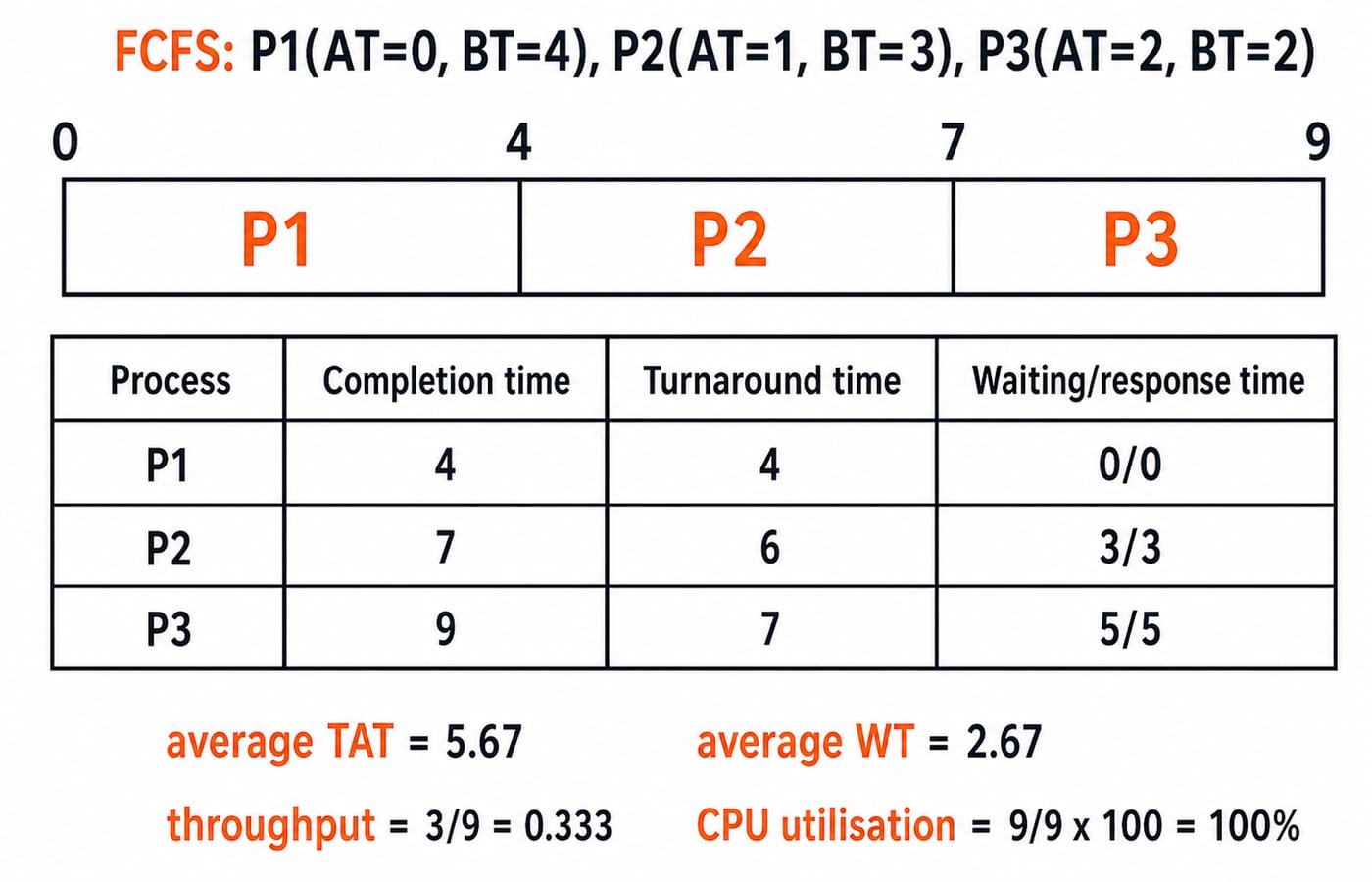
Now take P1(AT=0, BT=4), P2(AT=1, BT=3) and P3(AT=2, BT=2) under FCFS. The Gantt order is 0-4 P1 | 4-7 P2 | 7-9 P3.
Process | Completion time | Turnaround time, | Waiting time, | Response time, |
|---|---|---|---|---|
P1 | 4 | 4 | 0 | 0 |
P2 | 7 | 6 | 3 | 3 |
P3 | 9 | 7 | 5 | 5 |
Therefore, average turnaround time is (4 + 6 + 7) / 3 = 17/3 = 5.67 time units. Average waiting time is (0 + 3 + 5) / 3 = 8/3 = 2.67 time units. Throughput over the interval is 3/9 = 0.333 process per time unit, and CPU utilisation is 9/9 x 100 = 100% because there is no idle time or stated overhead.
2. Purpose and non-preemptive scheduling: Questions 1-2
Question 1, RSSB 2022
"CPU scheduling is the basis of –"
A. Multiprogramming operating system
B. Large memory sized systems
C. Multiprocessor systems
D. None of the mentioned
Answer: A. Multiprogramming operating system. Multiprogramming keeps more than one process available, so the operating system needs a policy to choose which ready process gets the CPU. Large memory alone does not create that requirement, and CPU scheduling is also necessary on a single-processor system.
Question 2, GATE 2002 and TPSC 2025
"Which of the following scheduling algorithms is non-preemptive?"
A. Round Robin
B. First-In First-Out
C. Multilevel Queue Scheduling
D. Multilevel Queue Scheduling with Feedback
Answer: B. First-In First-Out. FIFO here is FCFS: after the first ready process is dispatched, it retains the CPU until it completes or blocks. Round Robin uses time-quantum preemption, while feedback queues can move processes between levels; FIFO itself states no such preemption rule.
3. Preemption and dispatcher action: Questions 3-4
Question 3, UGC NET 2019
Identify the circumstances under which pre-emptive CPU scheduling is used:
(a)  A process switches from Running state to Ready state
(b)  A process switches from Waiting state to Ready state
(c)  A process completes its execution
(d)  A process switches from Ready to Waiting state
Choose the correct option:
A. (a) and (b) only
B. (a) and (d) only
C. (c) and (d) only
D. (a), (b), (c) only
Answer: A. (a) and (b) only. Running to Ready is direct preemption. Waiting to Ready can also trigger preemption when the newly ready process outranks the running one, while completion is a normal release of the CPU and Ready to Waiting is not a normal direct transition.
Question 4, BEL 2023
"The time dispatcher takes and for the dispatcher to stop one process and start another running is known as _____."
A. dispatch wasting time
B. dispatch latency
C. dispatch turnaround time
D. dispatch response time
Answer: B. dispatch latency. The question's phrasing is clumsy, but the concept it names is the elapsed time needed to stop one process, save or restore the required state, and start the selected process. Response time instead measures from a process's arrival or request until its first CPU response.
4. Throughput, response and starvation: Questions 5-6
Question 5, HTET 2024
"No. of programs processed by the system per unit time is called :"
A. Throughput
B. Scheduling
C. Interrupt
D. Processing
Answer: A. Throughput. Throughput is completed work per unit time, whereas turnaround time measures one process from arrival to completion. In the opening example, three completed processes in nine time units give 3/9 = 0.333 process per time unit.
Question 6, DSSSB 2021
Which of the following statement(s) is/are true about CPU scheduling algorithm?
 I. Shortest Remaining Time First scheduling may cause starvation.
 II. Round Robin is better than First Come First Serve in terms of response time.
A. Only I
B. Only II
C. Both I and II
D. Neither I nor II
Answer: C. Both I and II. A long process under SRTF can keep losing the CPU as shorter jobs arrive, so it may starve. Round Robin gives waiting processes an early slice instead of placing all of them behind one long FCFS burst, although a very small quantum adds context-switch overhead.
5. Fairness, optimisation criteria and algorithm families: Questions 7-9
Question 7, ISRO 2013
"A starvation free job scheduling policy guarantees that no job indefinitely waits for a service. Which of the following job scheduling policies is starvation free?"
A. Priority queuing
B. Shortest Job First
C. Youngest Job First
D. Round robin
Answer: D. Round robin. Under the standard finite-ready-set assumption, every ready process returns to a cyclic queue and receives a CPU slice. Priority queuing, SJF and Youngest Job First can postpone a process indefinitely unless an ageing or fairness mechanism is added.
Question 8, ISRO 2014
"Which of the following is not an optimization criterion in the design of a CPU scheduling algorithm?"
A. Minimum CPU utilization
B. Maximum throughput
C. Minimum turnaround time
D. Minimum waiting time
Answer: A. Minimum CPU utilization. Scheduling normally tries to keep the CPU productively busy, maximise throughput, and reduce turnaround and waiting. Circle the direction word, minimum or maximum, before judging the metric, because this option reverses the desired direction.
Question 9, GATE 2007
"Group 1 contains some CPU scheduling algorithms and Group 2 contains some applications. Match entries in Group 1 to entries in Group 2."
     Group I                          Group II
(P) Gang Scheduling              (1) Guaranteed Scheduling
(Q) Rate Monotonic Scheduling    (2) Real-time Scheduling
(R) Fair Share Scheduling        (3) Thread Scheduling
A. P-3, Q-2, R-1
B. P-1, Q-2, R-3
C. P-2, Q-3, R-1
D. P-1, Q-3, R-2
Answer: A. P-3, Q-2, R-1. Gang scheduling co-schedules related threads, rate-monotonic scheduling serves periodic real-time tasks, and fair-share scheduling allocates processor share across users or groups. Continue with Process Scheduling MCQs: 12 Solved Questions with Explanations when you want more algorithm and timeline practice.
6. Counting, queueing and utilisation calculations: Questions 10-12
Question 10, ISRO 2013
"A CPU scheduling algorithm determines an order for the execution of its scheduled processes. Given 'n' processes to be scheduled on one processor, how many possible different schedules are there? "
A. n
B. n²
C. n!
D. 2ⁿ
Answer: C. n!. A schedule is a permutation of all n distinct processes: there are n choices for the first slot, n-1 for the second, down to 1. For n=4, the count is 4 x 3 x 2 x 1 = 24. It is not 4² = 16 or 2⁴ = 16.
Question 11, UGC NET 2025
"What shall be the average waiting time per process if we know that 10 processes (on average) arrive every second and there are normally 20 processes in the queue?"
A. 03 seconds
B. 02 seconds
C. 18 seconds
D. 09 seconds
Answer: B. 02 seconds. Apply Little's Law to the waiting queue: Lq = lambda x Wq. Here, Lq = 20 processes and lambda = 10 processes/second, so Wq = Lq/lambda = 20/10 = 2 seconds. The process unit cancels, leaving seconds, not 0.5 second.
Question 12, ISRO 2011
"In a system using single processor, a new process arrives at the rate of six processes per minute and each such process requires seven seconds of service time. What is the CPU utilization?"
A. 70%
B. 30%
C. 60%
D. 64%
Answer: A. 70%. First convert the arrival rate: lambda = 6/60 = 0.1 process/second. With average service time S = 7 seconds/process, utilisation is rho = lambda x S = 0.1 x 7 = 0.7 = 70%. The process and second units cancel, and no context-switch overhead is added because the stem gives none.
7. Score the set and choose the next revision step
The answer strip is 1-A, 2-B, 3-A, 4-B, 5-A, 6-C, 7-D, 8-A, 9-A, 10-C, 11-B, 12-A. Questions 1-4 test scheduler and dispatcher vocabulary, Questions 5-9 test performance criteria and fairness, and Questions 10-12 test permutation, Little's Law and utilisation with units.
Use this 20-minute correction loop:
For every missed conceptual question, write one sentence explaining why your chosen distractor is wrong.
Recompute Questions 10-12 from a blank page without looking at the options.
Below 9, revisit the opening FCFS map. From 9 to 11, redo only the missed cluster. At 12, move to algorithm timelines instead of repeating definitions.
The short version
Identify the state transition, name the metric, and write the units before selecting an option. Use Operating Systems for GATE for the subject-level next step. GATE-focused readers can follow GATE Guidance by Sanchit Sir, while semester and placement learners can build the wider base through ZERO TO HERO.
Keep learning

Segmentation and Hybrid MCQs: 10 Solved OS Questions with Explanations
Solve ten memory-management MCQs, then check the keyed answers, short reasoning paths, distractor traps, and worked address calculations.
Updated 3 Oct 20267 min readOperating System MCQs
Paging and TLB MCQs: 12 Solved Questions with Step-by-Step Explanations
Solve 12 Paging and TLB MCQs in a sequence that builds from page-table basics to address splits, TLB coverage, timing and fragmentation.
Updated 28 Sep 20268 min readOperating System MCQs
OS Types & Evolution MCQs: 12 Solved Questions with Explanations
Solve 12 published OS Types & Evolution questions. Each answer identifies the clue that separates batch, multiprogramming, time sharing and other OS models.
Updated 25 Sep 20268 min read83 viewsOperating System MCQs

Multilevel Paging MCQs: 12 Solved Questions with Explanations
Solve 10 MCQs and two NATs on multilevel paging. Each answer works through the address bits, table capacity or access-time path that decides the result.
Updated 24 Sep 20268 min readOperating System MCQs