Segmentation and Hybrid MCQs: 10 Solved OS Questions with Explanations
Solve ten memory-management MCQs, then check the keyed answers, short reasoning paths, distractor traps, and worked address calculations.
KnowledgeGate Team
Exam prep & CS education
Updated 3 Oct 20267 min read
Segmentation questions can look like vocabulary tests, then suddenly demand a base-limit check, a fragmentation distinction, address-bit arithmetic, a hybrid table lookup, or a program-translation distinction. Attempt each question once without revealing the answer. Then review your misses by error type, because a definition error needs a different fix from an arithmetic or validation-order error.
1. Start with the unit being mapped: two segmentation basics
A segment is a variable-sized logical program unit, such as code, data, or stack. A page is fixed in size. Keep two questions separate: unit size identifies the memory-management technique, while contiguity describes how units are placed. The broader Operating Systems hub connects this distinction to the rest of memory management.
Question 1 (BPSC 2025)
Segmentation is a memory management technique in which memory is divided into:
A. Fixed-sized blocks of memory
B. Different types of data structures
C. Variable-sized blocks of memory
D. Non-contiguous blocks of memory
Answer: C. Variable-sized blocks of memory.
Logical segments follow program units, so their sizes can differ. D is tempting because segments may be placed separately, but it describes placement rather than the defining size property. Attempt Question 1 live.
Question 2 (UPPSC Polytechnic Lecturer 2024)
______ method is used to map logical addresses of variable length onto physical memory.
A. Paging
B. Overlays
C. Segmentation
D. More than one of the above
E. None of the above
Answer: C. Segmentation.
“Variable length” points directly to segments. Paging maps fixed-size pages, while overlays are a program-loading technique, not this address-translation scheme. The elimination rule is simple: variable length means check segmentation first. Attempt Question 2 live.
2. Base and limit: validate before adding the offset
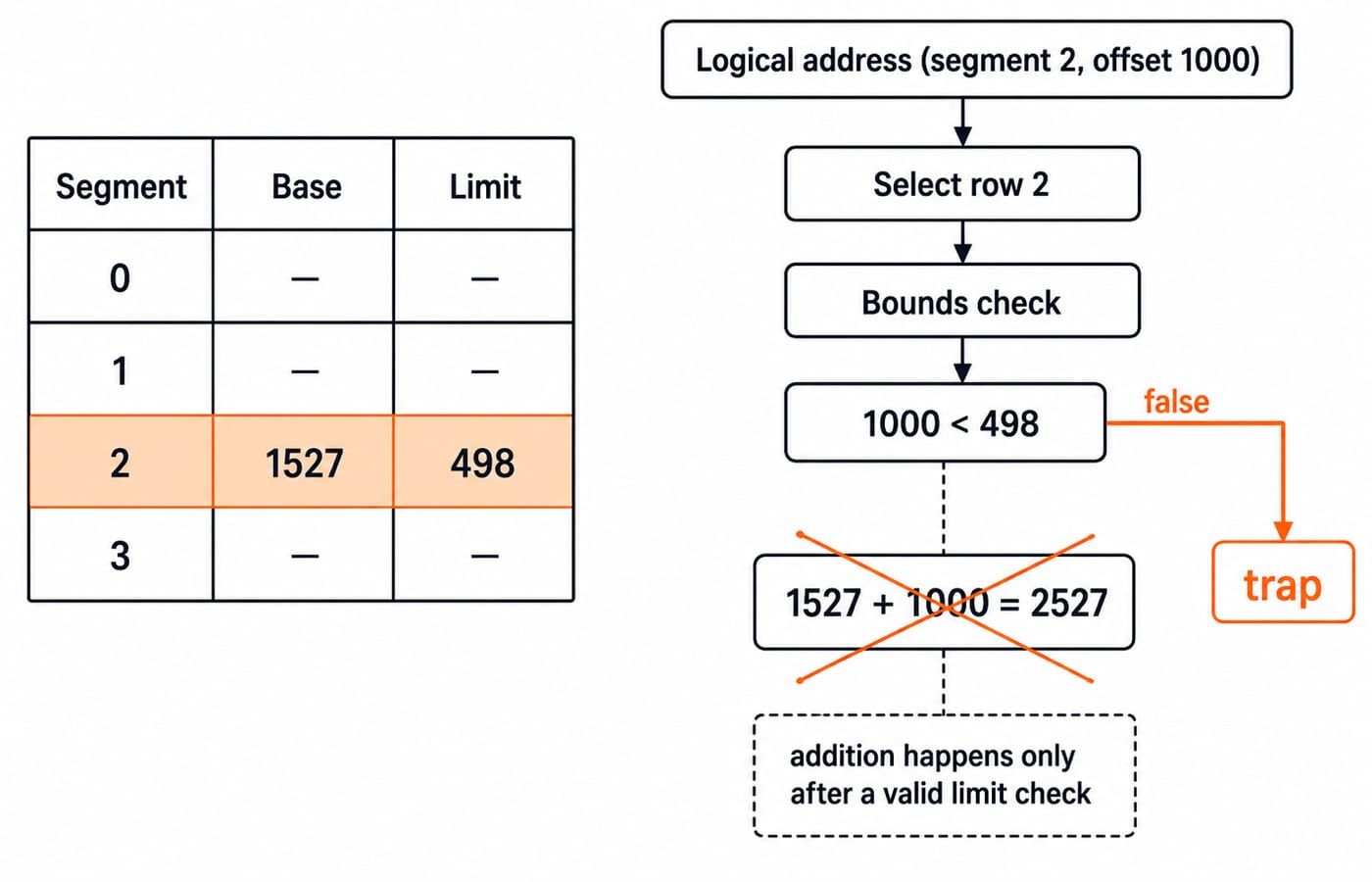
A logical address in segmentation has the form (segment, offset). Use the segment number to select a segment-table row. That row supplies a base and a limit. First test offset < limit. Only if that comparison is true should you calculate physical address = base + offset. If the check fails, the address is outside the segment and a trap is generated. Adding first is the classic trap because it can produce a plausible number for an invalid address.
Question 3 (UPPSC Polytechnic Lecturer 2024)
What is a segment base in segmentation?
A. The starting address of a segment in physical memory
B. The starting address of a segment in virtual memory
C. The ending address of a segment in physical memory
D. More than one of the above
E. None of the above
Answer: A. The starting address of a segment in physical memory.
The base is the physical starting address recorded for that segment. A valid offset is added to it only after the limit check. Attempt Question 3 live.
Question 4 (ISRO 2014)
Consider the following segment table in segmentation scheme:
SegmentID    Base     Limit
   0          200      200
   1          500      12510
   2          1527     498
   3          2500     50
What happens if the logical address requested is -Segment Id 2 and offset 1000?
A. Fetches the entry at the physical address 2527 for segment Id2
B. A trap is generated
C. Deadlock
D. Fetches the entry at offset 27 in Segment Id 3
Answer: B. A trap is generated.
Read row 2: base 1527, limit 498. Test 1000 < 498. This is false, so the logical address is invalid and the hardware generates a trap. Cross out 1527 + 1000 = 2527: addition must not happen after a failed limit check. Attempt Question 4 live.
3. Internal versus external fragmentation
Internal fragmentation is unused space inside an allocated region. External fragmentation is free space split into holes between allocated regions. Fixed-size paging avoids external fragmentation in physical allocation, but the last page can still contain unused space. Variable-sized segmentation can leave scattered holes, so it is exposed to external fragmentation.
Question 5 (NIACL AO IT Specialist 2019)
When a program is allocated a memory hole that is bigger than needed, then it is called:
A. Internal fragmentation
B. Page fault
C. Segmentation
D. External fragmentation
Answer: A. Internal fragmentation.
Under the question's allocation wording, the unused part lies inside the region granted to the program, so it is internal fragmentation. A separate unusable hole between allocated regions would be external fragmentation. Attempt Question 5 live.
Question 6 (UGC NET 2006)
The memory allocation scheme subjected to external fragmentation is
A. Segmentation
B. Swapping
C. Demand Paging
D. Multiple contiguous fixed partitions
Answer: A. Segmentation.
Variable-sized physical allocations can leave scattered free holes, which creates external fragmentation. Demand paging uses equal-sized frames, so it avoids external fragmentation, though its last page can have internal fragmentation. Attempt Question 6 live.
4. Address-bit numericals: segment bits plus offset bits
For byte-addressable memory with power-of-two values, use segment bits = log2(number of segments) and offset bits = log2(bytes per segment). Add the two fields for the total logical-address width. Convert KB to bytes before taking the logarithm.
Question 7 (ISRO 2015)
If there are 32 segments, each size 1 k bytes, then the logical address should have
A. 13 bits
B. 14 bits
C. 15 bits
D. 16 bits
Answer: C. 15 bits.
32 = 2^5, so the segment field needs 5 bits. 1 KB = 1024 bytes = 2^10 bytes, so the offset needs 10 bits. Therefore, the total is 5 + 10 = 15 bits. Attempt Question 7 live.
Question 8 (UPPSC Polytechnic Lecturer 2018)
If there are 64 segments, each of size 2KB, then how many bits should a logical address have?
A. 11 bits
B. 6 bits
C. 5 bits
D. 17 bits
Answer: D. 17 bits.
64 = 2^6, so the segment field needs 6 bits. 2 KB = 2048 bytes = 2^11 bytes, so the offset needs 11 bits. The total is 6 + 11 = 17 bits. A and B are component-only distractors: 11 is only the offset, and 6 is only the segment field. Attempt Question 8 live.
5. Program translation roles: do not confuse compiler, linker, and loader
The compiler translates source-level units. The assembler emits object code. The linker resolves references and combines object modules. The loader places the executable in memory and establishes its runtime mapping. For this question, follow the runtime allocation model the exam key uses rather than assuming one toolchain convention holds everywhere.
Question 9 (ISRO 2023)
As part of segmentation memory allocation strategy, which of the following assigns segment numbers for various segments of a program like code segment and data segment?
A. Compiler
B. Assembler
C. Loader
D. Linker
Answer: C. Loader.
Under the question's model, the loader places program segments in memory and sets up the mapping represented by the segment table. The linker instead resolves symbols and combines object modules. Attempt Question 9 live.
6. Bridge to hybrid translation and inverted page tables
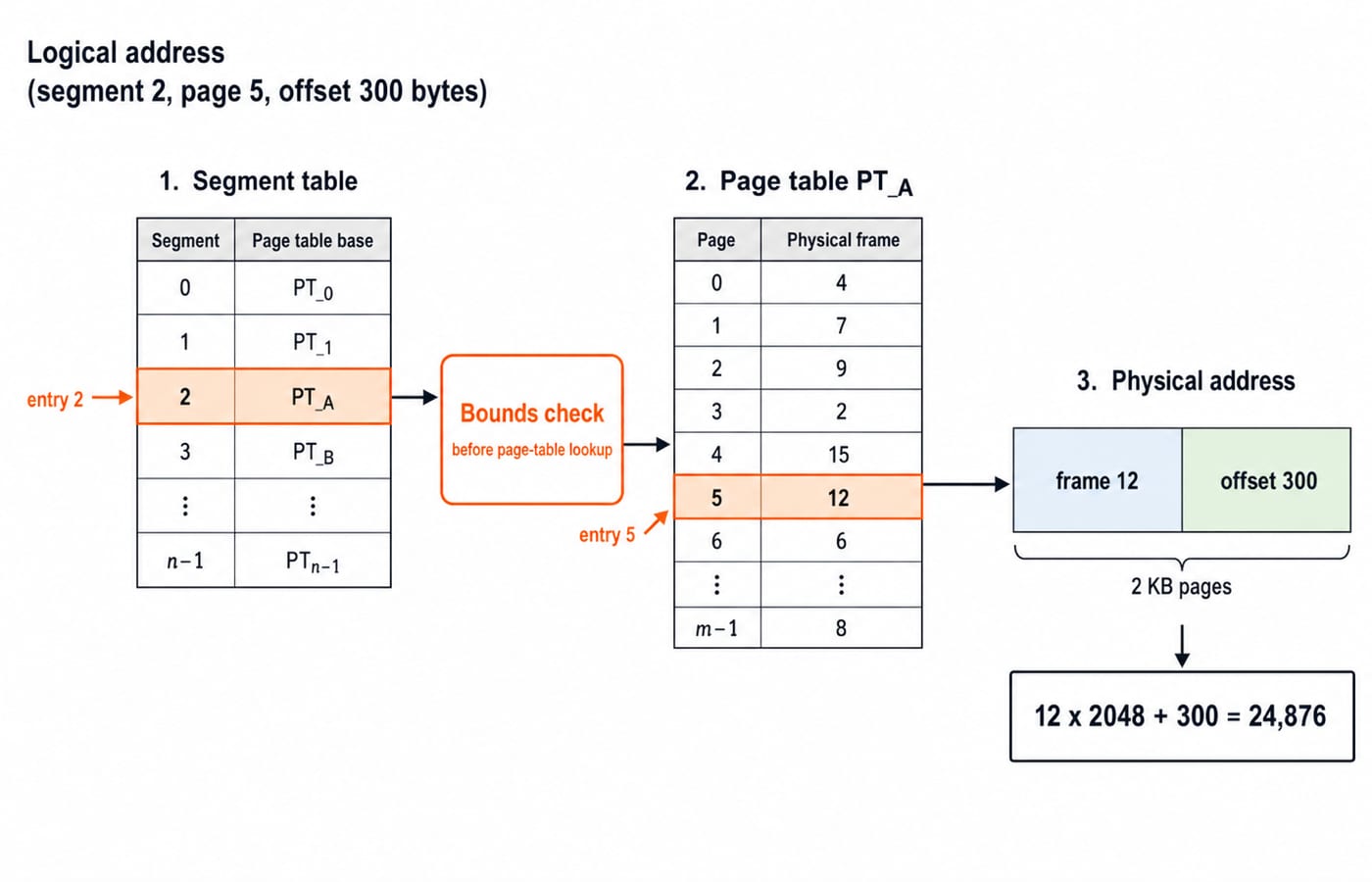
Segmented paging divides a logical address into segment number, page number, and offset. The segment number selects a segment-table entry, which identifies that segment's page table. The page number selects a page-table entry, which supplies a physical frame. Bounds and presence checks must pass before an address is produced.
For example, take a 2 KB page and logical address (segment 2, page 5, offset 300 bytes). Segment-table entry 2 points to PT_A, and PT_A[5] = frame 12. Since 2 KB = 2048 bytes, the physical address is 12 x 2048 + 300 = 24,576 + 300 = 24,876.
Question 10 (MPPSC Assistant Professor 2025)
Inverted page tables are primarily used to
A. Reduce the overhead of maintaining multiple page tables
B. Simplify the Translation Lookaside Buffer (TLB)
C. Minimize internal fragmentation
D. Support segmentation
Answer: A. Reduce the overhead of maintaining multiple page tables.
A conventional design can maintain a page table for each process. An inverted page table is organised around physical frames, reducing page-table storage. Lookup may become more complex and often uses hashing, so simplifying the TLB is not its purpose. Its structure does not remove last-page waste and is not primarily a segmentation mechanism. Attempt Question 10 live.
7. Score the set by error type, then choose the next practice step
Classify each miss before doing another mixed set:
Questions | Error type | What to revise |
|---|---|---|
1 and 2 | Unit-size errors | Variable-sized segments versus fixed-size pages |
3 and 4 | Validation-order errors | Check the limit before adding the base |
5 and 6 | Fragmentation errors | Waste inside a region versus holes between regions |
7 and 8 | Powers-of-two errors | Segment bits, byte offset bits, and unit conversion |
9 and 10 | System-role or table-purpose errors | Loader roles and why inverted tables save space |
Use the Operating System MCQs hub for another practice path. If one group remains weak, rebuild the concept with GATE Guidance by Sanchit Sir. Once you can solve this set without revealing answers, move to the GATE Test Series. The GATE category is the broader route to related courses and test series.
Keep learning
Paging and TLB MCQs: 12 Solved Questions with Step-by-Step Explanations
Solve 12 Paging and TLB MCQs in a sequence that builds from page-table basics to address splits, TLB coverage, timing and fragmentation.
Updated 28 Sep 20268 min readOperating System MCQs
OS Types & Evolution MCQs: 12 Solved Questions with Explanations
Solve 12 published OS Types & Evolution questions. Each answer identifies the clue that separates batch, multiprogramming, time sharing and other OS models.
Updated 25 Sep 20268 min read83 viewsOperating System MCQs
Multilevel Paging MCQs: 12 Solved Questions with Explanations
Solve 10 MCQs and two NATs on multilevel paging. Each answer works through the address bits, table capacity or access-time path that decides the result.
Updated 24 Sep 20268 min readOperating System MCQs
LOOK and C-LOOK Algorithm MCQs: 10 Solved Questions with Explanations
Solve 10 LOOK and C-LOOK MCQs, from core definitions to complete service-order and seek-distance calculations, with a fresh explanation for every answer.
Updated 22 Sep 20267 min readOperating System MCQs