

Artificial Neural Networks Interview Questions and Answers: 10 Fundamentals with a Worked Forward Pass
Prepare ten core ANN interview answers, then follow one 2-2-1 network from weighted sums to a forward prediction and a loss-reducing parameter update.
KnowledgeGate Team
Exam prep & CS education
Updated 4 Nov 20266 min read
A strong artificial neural network answer connects vocabulary to computation. A neuron forms a weighted sum, activations add nonlinearity, and training moves from a forward prediction to a gradient update. The same 2-2-1 network makes each step checkable on a whiteboard.
Artificial Neural Networks interview definition: ANN and a neuron
Q1. What is an artificial neural network?
An artificial neural network, or ANN, is a layered, parameterised function made of connected computational units. The input layer receives features, one or more hidden layers transform them, and the output layer predicts. Weights control connection strength, biases shift each unit's response, and activation functions introduce nonlinearity.
The biological-neuron analogy is useful intuition, but the mathematical model does not reproduce a brain. It learns weights and biases from data. For a deeper architecture-first explanation, use Artificial Neural Networks: Worked Examples for GATE.
Q2. What exactly does one artificial neuron compute?
One neuron first computes a pre-activation, then applies an activation:
z = w^T x + b, followed by a = phi(z).
Let the input be x = (2, -1), the parameter vector be w = (0.5, 1.5), and the bias be b = 0.2.
z = (0.5)(2) + (1.5)(-1) + 0.2 = 1 - 1.5 + 0.2 = -0.3
With ReLU, the output is a = max(0, -0.3) = 0. Here x is the input, w and b are parameters, z is the pre-activation, and a is the neuron output.
ANN architecture interview questions: weights, bias and hidden layers
Q3. Why does a neuron need a bias?
A bias shifts an activation threshold or decision boundary instead of forcing it through the origin. Take x = (1, 2) and w = (0.4, -0.1). Then w^T x = 0.4 - 0.2 = 0.2.
Without a bias, a threshold-at-zero classifier returns class 1. With b = -0.3, z = 0.2 - 0.3 = -0.1, so it returns class 0.
Q4. How is a perceptron different from a multilayer neural network?
A perceptron is one linear decision unit, usually followed by a step function. A multilayer perceptron, or MLP, contains hidden layers with nonlinear activations, so it can build intermediate features.
Input | XOR output |
|---|---|
|
|
|
|
|
|
|
|
No single straight decision boundary separates both positive XOR points from both negative points. A hidden layer can create features that make the final separation possible.
ANN activation-function interview questions: why nonlinearity matters
Q5. Why are activation functions needed?
Stacking linear layers without a nonlinear activation still produces one linear map:
W2(W1x + b1) + b2 = (W2W1)x + (W2b1 + b2)
Inserting a nonlinear phi between the layers lets the network represent patterns such as XOR that one line cannot separate.
Q6. When would you use step, sigmoid, tanh or ReLU?
Using step(z) = 1 for z >= 0, the four functions give:
Function |
|
|
| Typical role |
|---|---|---|---|---|
Step |
|
|
| Basic perceptron decision |
Sigmoid |
|
|
| Binary-output probability |
tanh |
|
|
| Zero-centred hidden output |
ReLU |
|
|
| Efficient hidden-layer training |
Sigmoid is interpretable at a binary output, but its gradient becomes small in saturated regions. ReLU is common in hidden layers, yet no activation is universally best.
ANN forward-pass interview question: solve a 2-2-1 network
Q7. Can you calculate one forward pass?
Use inputs x1 = 1 and x2 = 0.5. For hidden neuron h1:
z1 = (1)(0.6) + (0.5)(-0.2) + 0.1 = 0.6, so h1 = ReLU(0.6) = 0.6.
For hidden neuron h2:
z2 = (1)(-0.4) + (0.5)(0.8) - 0.1 = -0.1, so h2 = ReLU(-0.1) = 0.
The output logit and sigmoid probability are:
z_o = (0.6)(0.7) + (0)(-0.5) - 0.2 = 0.22
p = 1 / (1 + e^-0.22) = 0.5548
Because 0.5548 >= 0.5, the thresholded prediction is class 1.
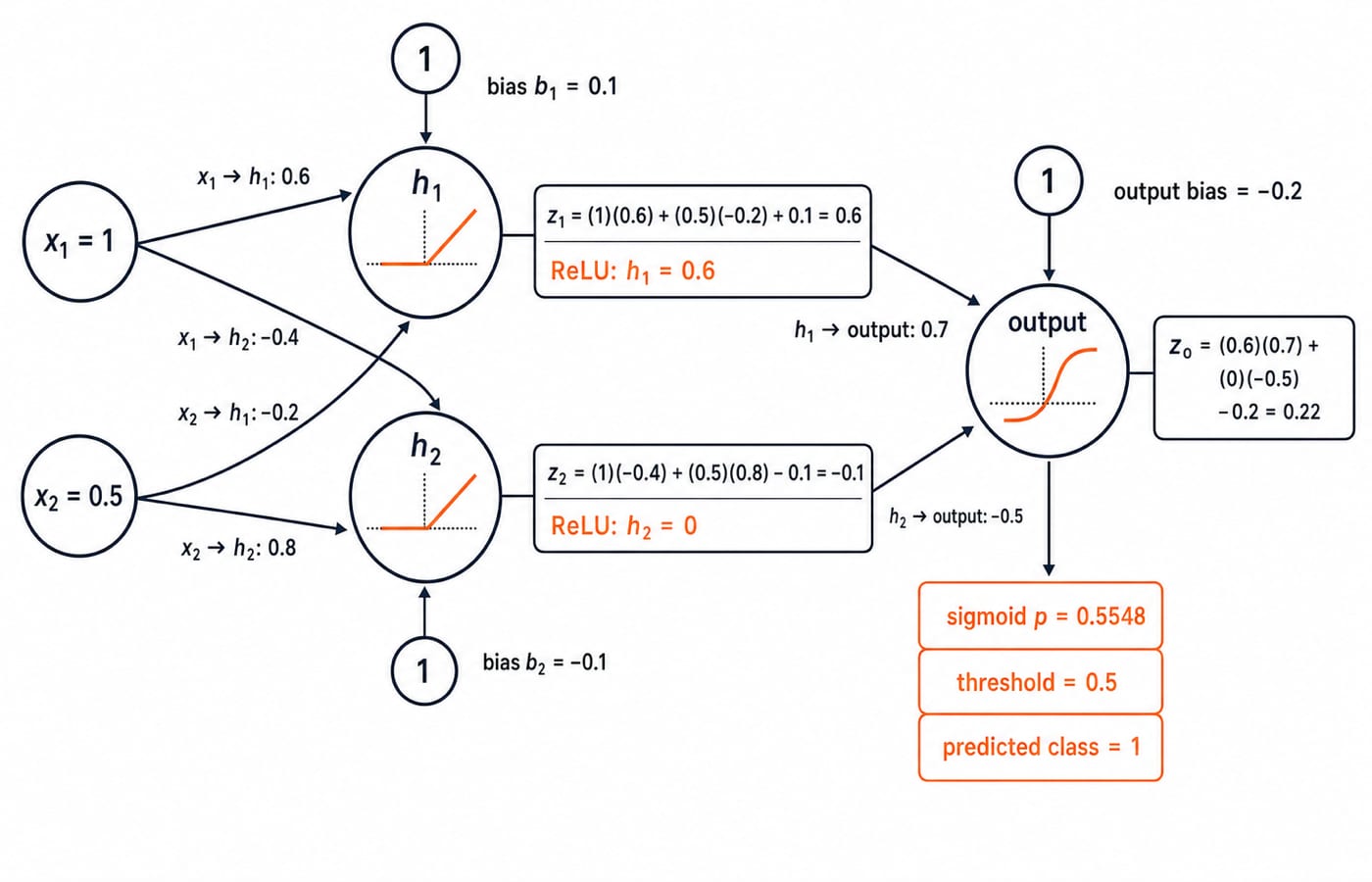
Attach every weight to the correct edge, add each bias once, and apply the activation only after the weighted sum. Keep the probability separate from the thresholded class. For more calculation practice, work through Artificial Neural Networks MCQs: 10 Solved Questions.
ANN backpropagation interview question: one gradient-descent update
Q8. How do backpropagation and gradient descent train this network?
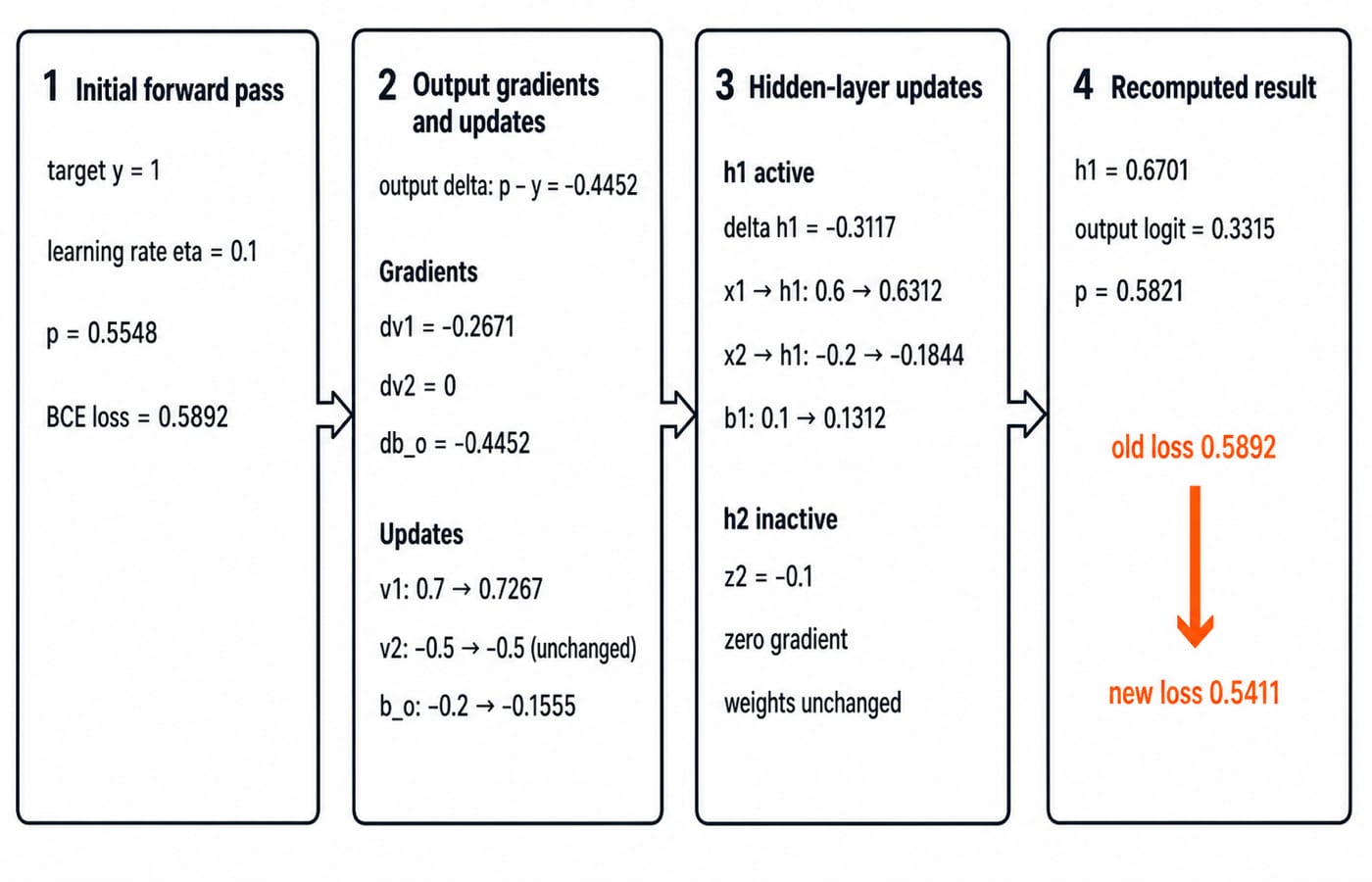
Backpropagation applies the chain rule to compute gradients. The optimiser then uses those gradients to update parameters. Continue Q7 with target y = 1, binary cross-entropy and learning rate eta = 0.1:
L = -ln(0.5548) = 0.5892, and dL/dz_o = p - y = -0.4452.
Using old weights for every gradient, the output gradients are dL/dv1 = (-0.4452)(0.6) = -0.2671, dL/dv2 = (-0.4452)(0) = 0, and dL/db_o = -0.4452. A simultaneous update gives v1: 0.7 -> 0.7267, v2: -0.5 -> -0.5, and b_o: -0.2 -> -0.1555.
Because z1 = 0.6, ReLU'(z1) = 1. Its hidden delta is (-0.4452)(0.7)(1) = -0.3117, giving w_x1,h1: 0.6 -> 0.6312, w_x2,h1: -0.2 -> -0.1844, and b1: 0.1 -> 0.1312. Because z2 = -0.1, ReLU'(z2) = 0, so all h2 input weights and its bias stay unchanged.
Recomputing gives h1 = 0.6701, output logit 0.3315, probability 0.5821, and loss 0.5411. The step lowered the loss from 0.5892.
If the concepts and calculations need a structured pass, continue with Artificial Intelligence (AI).
ANN interview traps: vanishing gradients and overfitting
Q9. What are vanishing and exploding gradients?
Backpropagated gradients contain products of local derivatives across layers. In a toy four-layer chain, four factors of 0.25 give 0.25^4 = 0.00390625, so the signal shrinks. Four factors of 1.5 give 1.5^4 = 5.0625, so it grows.
Suitable activations, careful initialisation and normalisation help control these effects. Skip connections can improve gradient flow in deeper networks. ReLU helps in many settings, but it does not eliminate every gradient problem.
Q10. How do you recognise and reduce overfitting?
Consider a toy run at epoch 80: training loss is 0.05 and training accuracy is 99%, while validation loss is 0.62 and validation accuracy is 74%. The widening train-validation gap signals memorisation rather than reliable generalisation.
Collect or augment representative data, reduce model capacity, add L2 regularisation or dropout, and stop at the best validation checkpoint. Underfitting looks different: both training and validation performance remain poor.
Keep three corrections interview-ready:
An ANN is one family of models, not a synonym for all AI.
Backpropagation computes gradients; the optimiser performs the update.
A high training score alone does not establish generalisation.
Artificial Neural Networks interview answer strategy: the short version and next step
For a direct fundamentals round, give Q1 as a definition, formula and application in about 30 seconds. For a whiteboard follow-up, expand to the Q7 forward pass. For a deeper product-style follow-up, continue to Q8 and explain why the loss decreased. Service-based and product-based interviews vary, so prepare concise definitions and derivations instead of memorising company stereotypes.
Use this six-line recall sequence:
Weighted sum -> bias
Activation
Forward prediction -> probability -> thresholded class
Loss
Backpropagated gradient
Optimiser update
Browse the Placement Preparation & Coding track for the wider interview path. If concepts and calculations are the gap, use the AI course linked above. If delivery, resume review or mock-interview practice is the gap, use the Interview & Resume Preparation Course. Choose the next step that matches the weakness you can now name.
Keep learning
Artificial Neural Networks Explained: Forward Pass, Worked Example and Exam Question Patterns
Build a small 2-2-1 neural network, calculate every value in its forward pass, and learn how activations, loss, training and parameter counts become exam tasks.
Updated 25 Aug 20265 min read76 viewsML & Data Science
Artificial Neural Networks MCQs: 10 Solved Questions with Explanations
Attempt ten practice questions on artificial neural networks, check your answers against the explanations, and use one worked neuron to connect inputs, weights, bias, and activation.
Updated 30 Oct 20268 min read78 viewsComputer Networks MCQs

Artificial Neural Networks: Complete Guide with Worked Examples for GATE and Interviews
Turn ANN diagrams into numbers. Work through a neuron, activation derivatives, OR and XOR, one gradient update, backpropagation and parameter counts.
Updated 2 Aug 20267 min read53 viewsML & Data Science
Neural Network Architectures: Layers, Forward Passes and Worked Examples
Learn to read dense, convolutional and recurrent network diagrams as calculations. Count parameters, follow an exact 2-2-1 forward pass, and see what sharing changes.
Updated 4 Nov 20266 min readML & Data Science