Set Operations MCQs: 11 Solved Questions with Step-by-Step Explanations
Solve 11 set operations MCQs, then compare your decisive step with a fresh explanation covering counts, identities, complements and constructions.
KnowledgeGate Team
Exam prep & CS education
Updated 8 Oct 20267 min read
Set notation is compact, which is why a reversed difference, missed triple overlap, or undefined universe changes the answer. Inclusion-exclusion handles overlapping counts; membership algebra handles identities; concrete witnesses settle interval and existence claims.
Choose an option and write one decisive line before reading each explanation. Name the method first: counting, identity reduction, membership counterexample, or construction.
The mixed operator-basics and ordered-pair diagnostic belongs to Set Operations and Cartesian Product MCQs. Its divisibility, E-F-G difference, and P-Q-R identity checkpoints also appear here. That earlier set combines them with Cartesian products; here they isolate inclusion-exclusion, region reduction, and counterexample construction alongside three-set, interval, and existence problems.
Set operations formula card before the MCQs
Operation | Membership test | Region meaning | Cardinality fact |
|---|---|---|---|
| In A or B or both | Both circles |
|
| In both | Shared overlap | Count once |
| In A, not B | A-only |
|
| In exactly one | Exclusive regions |
|
| In U, not A | Outside A |
|
Read each row as an element test. Union uses OR, intersection uses AND, and difference adds NOT to the second set. Difference is directional: A-B and B-A normally select different regions. A complement is meaningful only after U is fixed. For three sets, add singles, subtract pairs, then restore the triple.
For three sets, |A∪B∪C|=|A|+|B|+|C|-|A∩B|-|B∩C|-|A∩C|+|A∩B∩C|.
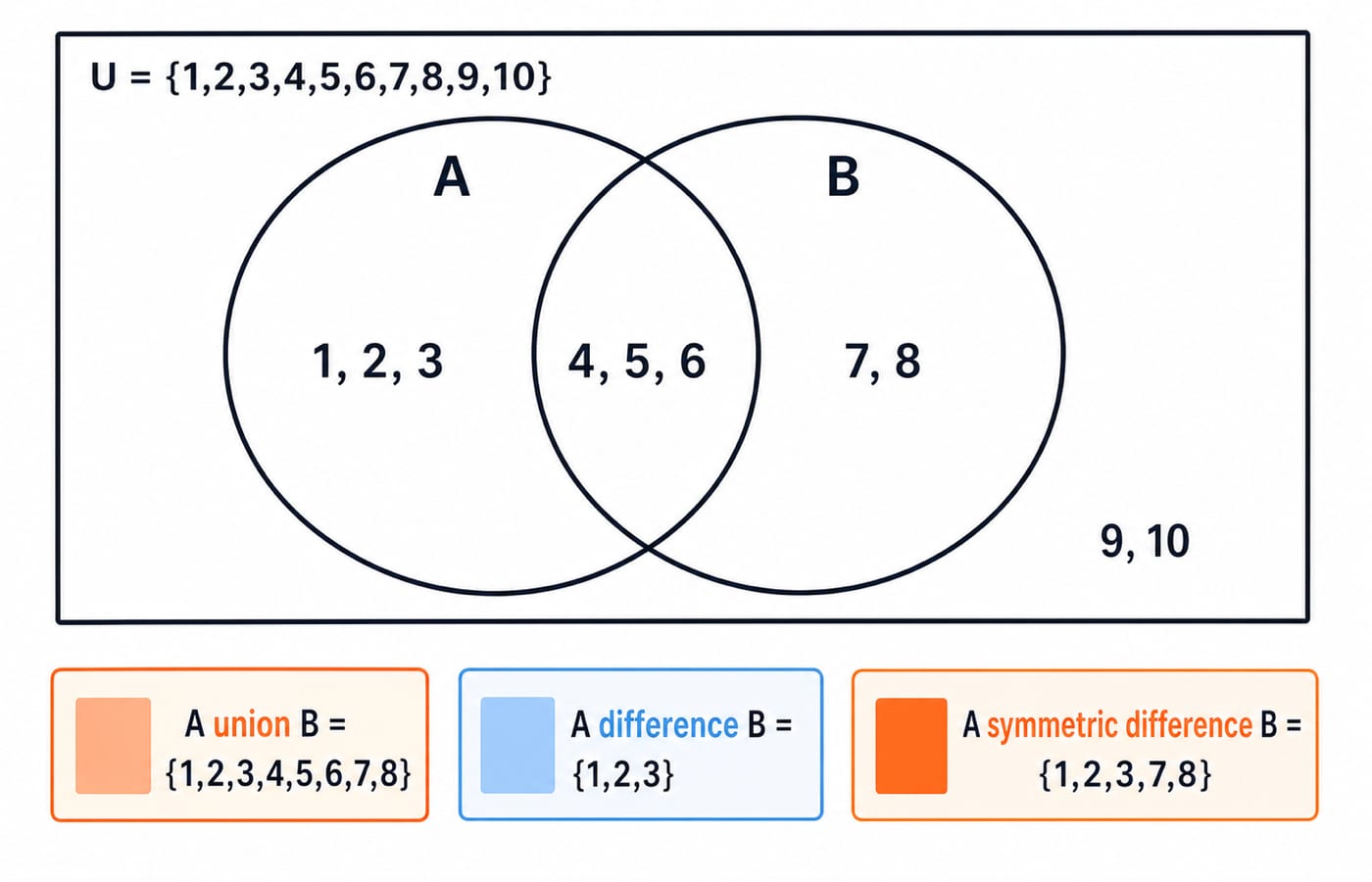
Take U={1,2,3,4,5,6,7,8,9,10}, A={1,2,3,4,5,6} and B={4,5,6,7,8}. Then A∪B={1,2,3,4,5,6,7,8}, A∩B={4,5,6}, A-B={1,2,3}, B-A={7,8}, AΔB={1,2,3,7,8}, and Ac={7,8,9,10} relative to U. Check: |A∪B|=6+5-3=8. Use Set Theory and Relations Explained for GATE for a slower prerequisite, or Engineering Mathematics for GATE for structured mathematics.
Set operations MCQs 1-3: inclusion-exclusion and region counts
Question 1
GATE 2004, Information Technology
In a class of 200 students, 125 students have taken the Programming Language course, 85 students have taken the Data Structures course, and 65 students have taken the Computer Organization course.
Also, 50 students have taken both Programming Language and Data Structures, 35 students have taken both Data Structures and Computer Organization, 30 students have taken both Programming Language and Computer Organization, and 15 students have taken all three courses.
How many students have not taken any of the three courses?
A. 15
B. 20
C. 25
D. 35
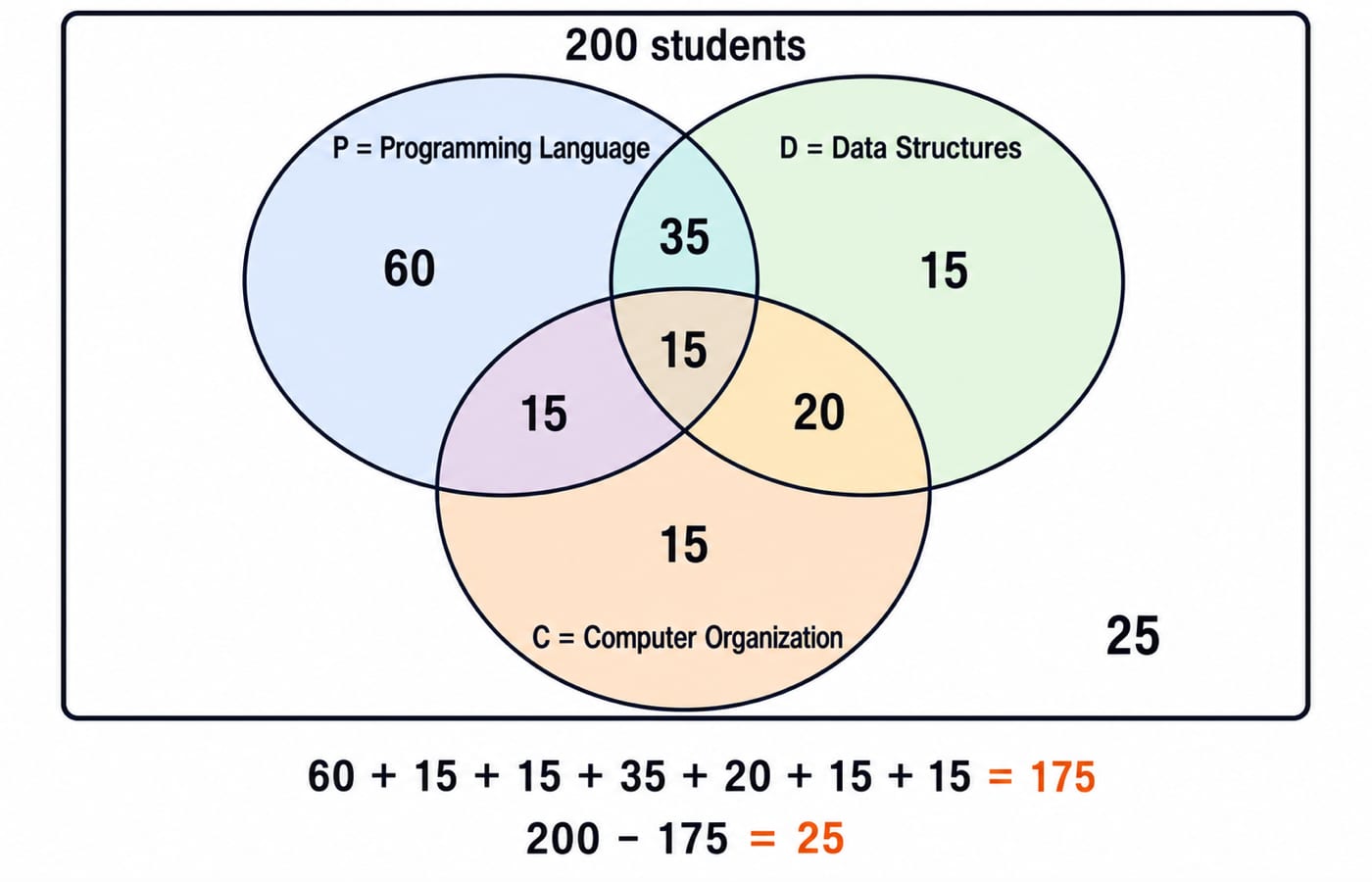
Answer: C. 25. Let the sets be P, D and C. Then |P∪D∪C|=125+85+65-50-35-30+15=175, so 200-175=25. Check the disjoint regions: P-only 60, D-only 15, C-only 15, pair-only 35, 20, 15, and triple 15. They total 175.
Question 2
GATE 2006, Information Technology
What is the cardinality of the set of integers X defined below? X = {n | 1 ≤ n ≤ 123, n is not divisible by either 2, 3 or 5}
A. 28
B. 33
C. 37
D. 44
Answer: B. 33. The single counts are floor(123/2)=61, floor(123/3)=41, floor(123/5)=24; pair overlaps are 20, 12, 8; and the triple overlap is 4. Thus the excluded union has 61+41+24-20-12-8+4=90 integers. The complement has 123-90=33.
Question 3
GATE 1998
In a room containing 28 people, there are 18 people who speak English, 15 people who speak Hindi and 22 people who speak Kannada. 9 persons speak both English and Hindi, 11 persons speak both Hindi and Kannada whereas 13 persons speak both Kannada and English. How many people speak all the three languages?
A. 9
B. 8
C. 7
D. 6
Answer: D. 6. Assuming all 28 people speak at least one of the three languages, the union size is 28. Let the triple intersection be x. Then 28=18+15+22-9-11-13+x=22+x, so x=6. The triple is restored once because the pair subtractions remove all three copies from the single-set totals.
Set operations MCQs 4-5: set difference identities
Question 4
GATE 2005
Let A, B and C be non-empty sets and let X = (A - B) - C and Y = (A - C) - (B - C). Which one of the following is TRUE?
A. X = Y
B. X ⊂ Y
C. Y ⊂ X
D. none of these
Answer: A. X = Y. X=A∩Bc∩Cc. Also, Y=A∩Cc∩(Bc∪C). Its A∩Cc∩C branch is empty, leaving Y=A∩Bc∩Cc. Both mean in A, but in neither B nor C.
Question 5
GATE 2006
Let E, F and G be finite sets. Let X = (E ∩ F) - (F ∩ G) and Y = (E - (E ∩ G)) - (E - F). Which one of the following is true?
A. X ⊂ Y
B. X ⊃ Y
C. X = Y
D. X - Y ≠ φ and Y - X ≠ φ
Answer: C. X = Y. First, X=E∩F∩Gc. Also, E-(E∩G)=E∩Gc and E-F=E∩Fc. Hence Y=E∩Gc∩(Ec∪F)=E∩F∩Gc. Finiteness is unnecessary.
Set operations MCQs 6-7: symmetric difference and complement
Question 6
GATE 2006, Information Technology
Let P, Q and R be sets let Δ denote the symmetric difference operator defined as PΔQ = (P U Q) - (P ∩ Q). Using Venn diagrams, determine which of the following is/are TRUE?
1. PΔ (Q ∩ R) = (P Δ Q) ∩ (P Δ R)
2. P ∩ (Q ∩ R) = (P ∩ Q) Δ (P Δ R)
A. 1 only
B. 2 only
C. Neither 1 nor 2
D. Both 1 and 2
Answer: C. Neither 1 nor 2. For statement 1, take (P,Q,R)=(1,1,0): left 1, right (1Δ1)∩(1Δ0)=0. For statement 2, take (0,1,1): left 0, right (0∩1)Δ(0Δ1)=1. Each counterexample defeats its identity.
Question 7
GATE 2008
If P, Q, R are subsets of the universal set U, then the value of following expression is
(P ∩ Q ∩ R) ∪ (Pc ∩ Q ∩ R) ∪ Qc ∪ Rc
A. Qc U Rc
B. P U Qc U Rc
C. Pc U Qc U Rc
D. U
Answer: D. U. The first regions factor to (P∪Pc)∩Q∩R=Q∩R. De Morgan gives Qc∪Rc=(Q∩R)c. Therefore (Q∩R)∪(Q∩R)c=U.
Set operations MCQs 8-9: union partitions and infinite sets
Question 8
GATE 1996
Let A and B be sets and let Ac and Bc denote the complements of the sets A and B. The set (A - B) ∪ (B - A) ∪ (A ∩ B) is equal to.
A. A ∪ B
B. Ac ∪ Bc
C. A ∩ B
D. Ac ∩ Bc
Answer: A. A ∪ B. The A-only, B-only and shared regions fill both circles. Check: {1,2,3}∪{7,8}∪{4,5,6}={1,2,3,4,5,6,7,8}=A∪B.
Question 9
GATE 1993
Let S be an infinite set S1, S2, ..............., Sn be sets such that S1 ∪ S2 ∪ ... ∪ Sn = S Then,
A. At least one of the set Si is a finite set
B. Not more than one of the set Si can be finite
C. At least one of the sets Si is an infinite set
D. Not more than one of the sets Si can be infinite
Answer: C. At least one of the sets Si is an infinite set. If every Si were finite, the union would have at most m1+m2+...+mn elements, finite because n is finite. That contradicts S. Several sets may be infinite, so D is too restrictive.
Set operations MCQs 10-11: interval overlap and existence statements
Question 10
GATE 2000
X, Y and Z are closed intervals of unit length on the real line. The overlap of X and Y is half a unit. The overlap of Y and Z is also half a unit. Let the overlap of X and Z be k units. Which of the following is true?
A. k must be 1
B. k must be 0
C. k can take any value between 0 and 1
D. None of the above
Answer: D. None of the above. Fix Y=[0,1]. X and Z can each be [-0.5,0.5] or [0.5,1.5]. The same choice gives k=1; opposite choices give k=0, since one point has zero length. Neither is forced, and intermediate values are unavailable.
Question 11
GATE 2001
Consider the following statements:
S1: There exists infinite sets A, B, C such that A ∩ (B ∪ C) is finite.
S2: There exists two irrational numbers x and y such that (x+y) is rational.
Which of the following is true about S1 and S2?
A. Only S1 is correct
B. Only S2 is correct
C. Both S1 and S2 are correct
D. None of S1 and S2 is correct
Answer: C. Both S1 and S2 are correct. Let A be even integers, B odd integers, and C positive odd integers. All are infinite, but A∩(B∪C)=φ. Also, sqrt(2) and -sqrt(2) are irrational, while their sum is rational 0.
What these set operations MCQs test and what to do next
Region counts require inclusion-exclusion; difference identities collapse by rewriting A minus B as A intersected with the complement of B; membership bits expose false symmetric-difference and complement identities. Finite-union proofs, interval placements, and explicit witnesses settle the remaining constructions.
Retry a missed question in four steps:
Mark it as
counting,identity,membership counterexampleorconstruction.Redo it without looking at the options.
State the one decisive line aloud.
Revisit it after two days.
Remember the traps: pair counts usually include the triple, A - B is directional, complement requires U, and one counterexample defeats a universal identity.
The short version
Name the disjoint regions, translate difference into intersection with a complement, apply inclusion-exclusion, and test identities with membership bits. Use GATE Guidance by Sanchit Sir as the broader structured GATE CS route, then practise the type you missed.
Keep learning
Conditional Probability Questions with Solutions: 12-Question Practice Set
Practise 12 conditional probability questions on independence, restricted samples, Bayes' rule, draws and complements, with checked calculations.
20 Oct 20267 min readDiscrete Mathematics MCQs
Order of Elements in Groups MCQs: 10 Solved Objective Questions
Build a reliable method for finding element orders, then apply it to 10 bank questions, including NAT, MSQ and two composition-table problems.
Updated 16 Oct 20267 min readDiscrete Mathematics MCQs
Partial Order Relation MCQs: 12 Solved Poset and Total Order Questions
Solve 12 published partial order questions with fresh explanations covering posets, total orders, lattices, recursive comparisons, linear extensions and counterexamples.
12 Oct 20267 min readDiscrete Mathematics MCQs
Graph Traversal MCQs: 12 Solved Questions on Walks, Paths, Trails, Circuits and Connectivity
Attempt 12 graph traversal and connectivity questions, then check each answer through definitions, reachability, degree conditions and edge-count arguments.
Updated 3 Oct 20267 min readDiscrete Mathematics MCQs