Number System in Digital Electronics: Base Conversion, Complements and Binary Arithmetic
Learn one dependable method for positional values, decimal fractions, binary grouping, complements, subtraction and signed overflow, with every step checked.
KnowledgeGate Team
Exam prep & CS education
Updated 18 Aug 20266 min read
Learners often memorise separate rules for binary, octal and hexadecimal, then lose marks when a question mixes a fraction, fixed bit width and signed arithmetic. Begin instead with positional value and preserve it through every conversion. One rule, digit times place weight, generates the rest: divide and take remainders for an integer, multiply and take carries for a fraction, group three bits for octal and four for hexadecimal, and invert and add one to turn subtraction into addition. No conversion table is needed at any step.
Start with positional notation and legal digits
A number system with base r permits digits from 0 to r - 1. Binary permits only 0 and 1. (101101.01)_2 is valid, while (10201)_2 is invalid because digit 2 does not exist in base 2.
The value of a numeral is N = Σ(d_i × r^i). Positions to the left of the radix point use non-negative powers, and positions to the right use negative powers. For example:
(110101.011)_2
= 1×2^5 + 1×2^4 + 1×2^2 + 1×2^0 + 1×2^-2 + 1×2^-3
= 32 + 16 + 4 + 1 + 0.25 + 0.125
= (53.375)_10
The radix point merely separates the two sets of powers.
Convert decimal integers and fractions without guesswork
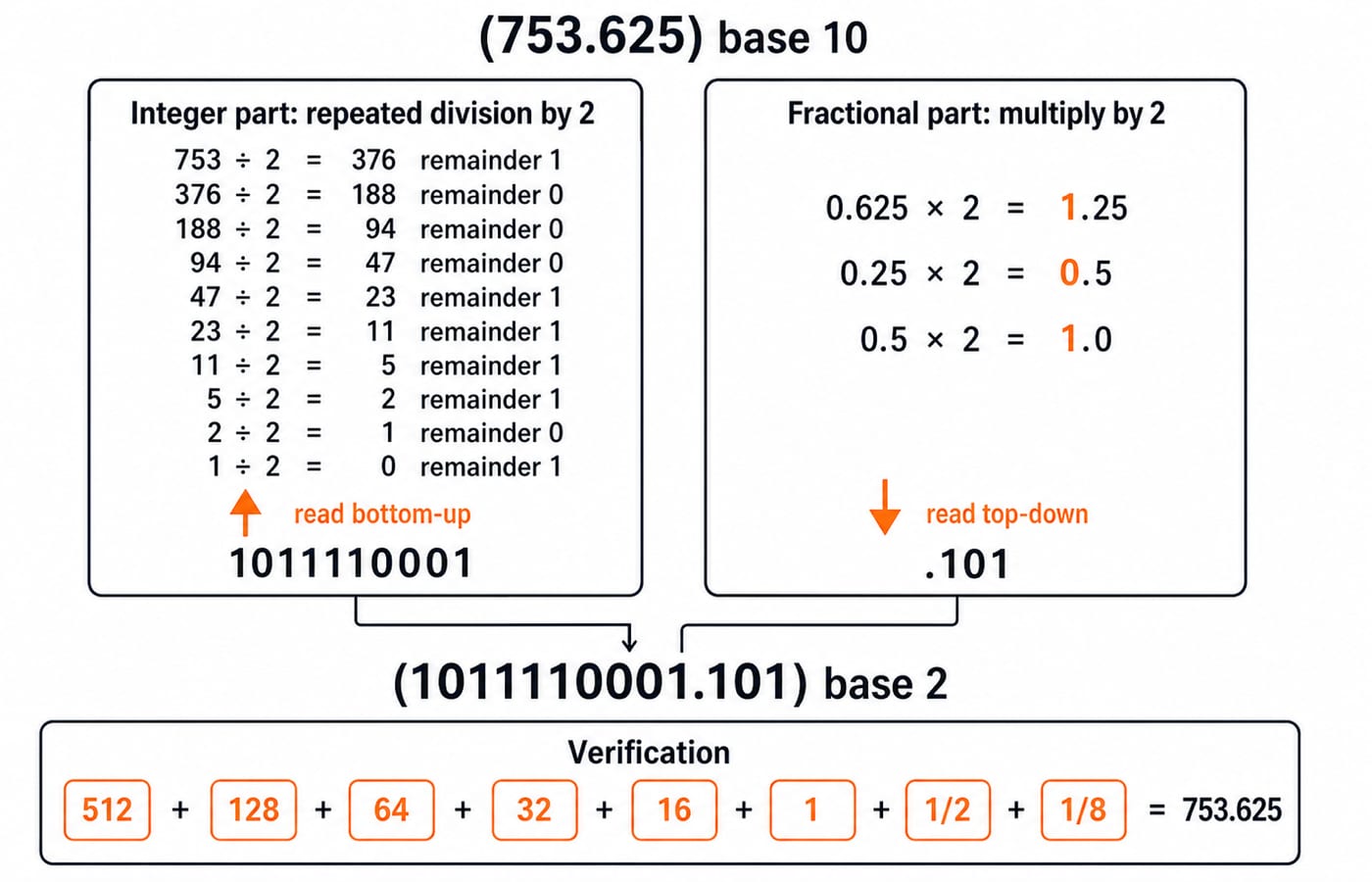
For an integer, repeatedly divide by the target base. Each division reveals the current least significant digit, so read remainders bottom-up. For a fraction, repeatedly multiply by the target base. Each multiplication reveals the next digit after the radix point, so read integer parts top-down.
Convert (753.625)_10 to binary. The integer part gives:
Division | Quotient | Remainder |
|---|---|---|
753 ÷ 2 | 376 | 1 |
376 ÷ 2 | 188 | 0 |
188 ÷ 2 | 94 | 0 |
94 ÷ 2 | 47 | 0 |
47 ÷ 2 | 23 | 1 |
23 ÷ 2 | 11 | 1 |
11 ÷ 2 | 5 | 1 |
5 ÷ 2 | 2 | 1 |
2 ÷ 2 | 1 | 0 |
1 ÷ 2 | 0 | 1 |
Reading upward gives 1011110001. Now convert the fraction:
0.625 × 2 = 1.25, so the first digit is1and the new fraction is0.25.0.25 × 2 = 0.5, so the next digit is0and the new fraction is0.5.0.5 × 2 = 1.0, so the final digit is1and the process stops.
Therefore, (753.625)_10 = (1011110001.101)_2. Expanding the result verifies it: 512 + 128 + 64 + 32 + 16 + 1 + 1/2 + 1/8 = 753.625.
Use grouping for binary, octal and hexadecimal
Group binary in threes for octal and fours for hexadecimal. Start at the radix point and pad only at the outside edges.
For the same value, octal grouping is 1 011 110 001 . 101, which gives (1361.5)_8. Hexadecimal grouping is 0010 1111 0001 . 1010, which gives (2F1.A)_16. Thus:
(753.625)_10 = (1011110001.101)_2 = (1361.5)_8 = (2F1.A)_16
The wider survey of coded representations, BCD and Gray code among them, sits in Number Systems and Base Conversions: GATE Worked Examples.
Grouping is not a universal shortcut. To convert (2314)_5 to base 7, first find its value:
2×5^3 + 3×5^2 + 1×5 + 4 = 250 + 75 + 5 + 4 = 334
Repeated division of 334 by 7 produces remainders 5, 5, 6. Reading upward gives (655)_7. The reverse check is 6×49 + 5×7 + 5 = 294 + 35 + 5 = 334.
Interpret a bit pattern before applying complements
A fixed-width pattern has no signed meaning until its representation is stated. For eight bits, unsigned values range from 0 to 255, while two's-complement values range from -128 to 127. Sign-magnitude uses the first bit as a sign, one's complement forms a negative by inverting every bit, and two's complement inverts every bit and adds 1.
The pattern 11010000 means 208 when unsigned but -48 in two's complement. Start with +48 = 00110000. Invert it to obtain 11001111, then add 1 to obtain 11010000. Applying the same operation again returns 00110000, confirming magnitude 48.
Two's complement has one zero and an extra negative value, unlike one's complement, which has positive and negative zero.
Perform binary subtraction and diagnose overflow
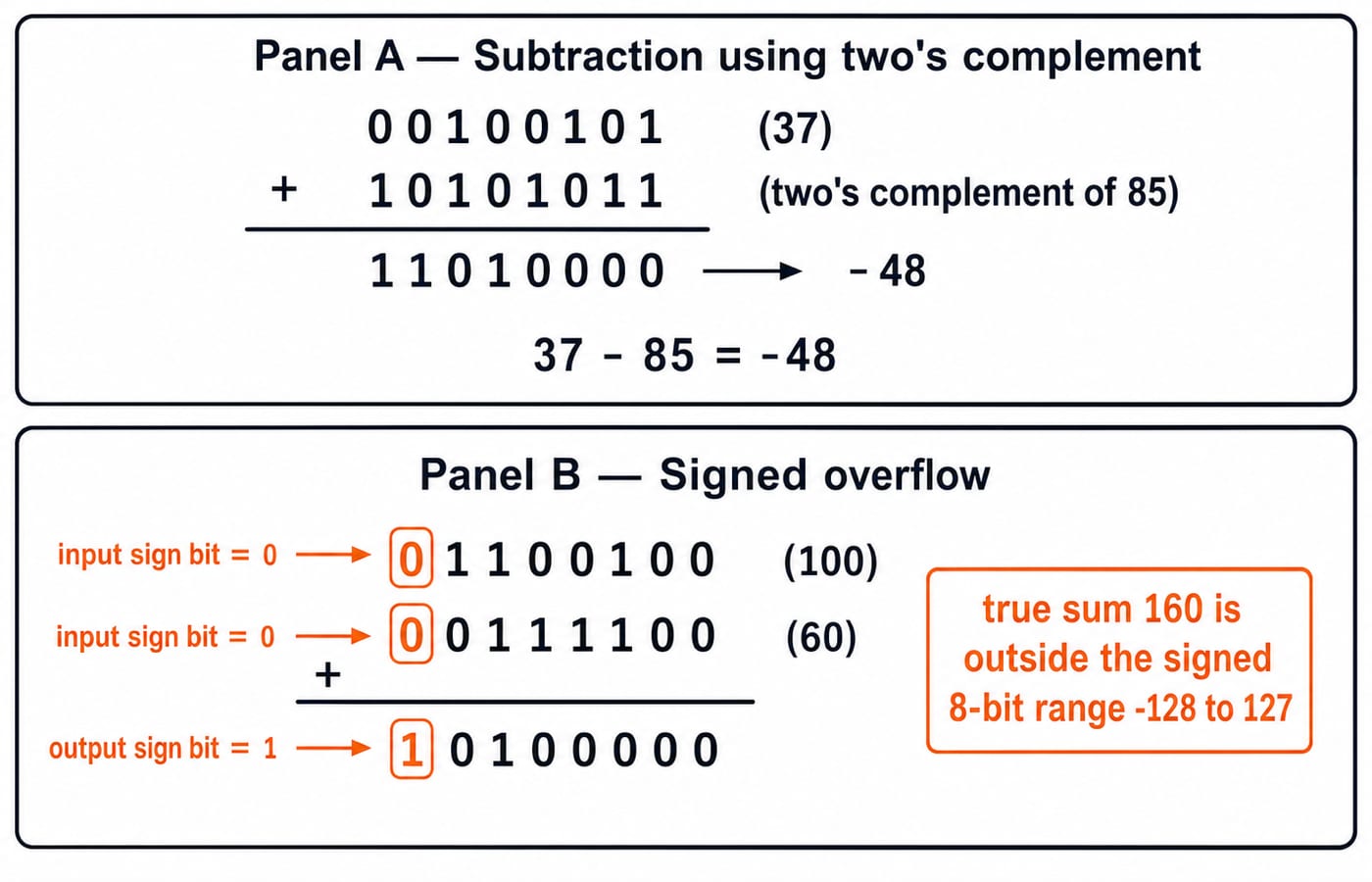
To calculate 37 - 85 in eight-bit two's complement, encode both magnitudes:
37 = 0010010185 = 01010101Invert
85:10101010Add
1:10101011Add:
00100101 + 10101011 = 11010000
The result decodes to -48. The decimal check is 37 - 85 = -48, which fits the eight-bit signed range.
Carry-out and signed overflow are different tests. Consider 100 + 60:
01100100 + 00111100 = 10100000
Both operands are positive, but the result has sign bit 1, which signals signed overflow. The true sum 160 is outside -128 to 127, so 10100000 is not a valid positive signed answer.
The reverse case exists too. Add -1 and +1 in eight bits: 11111111 + 00000001 = 1 00000000. A carry leaves the most significant position, yet the signed answer 0 is correct, so nothing overflowed. Carry-out reports an unsigned range problem. Signed overflow needs two operands of the same sign and a result whose sign differs from theirs, which is why it can never happen when the signs disagree.
Avoid the traps that make correct methods fail
Trap | Consequence | Correction |
|---|---|---|
Using a digit illegal in the base | The numeral itself is invalid | Check every digit against |
Reading integer remainders top-down | The place values are reversed | Read division remainders bottom-up |
Grouping from the left edge | Octal or hexadecimal groups become misaligned | Start at the radix point and move outward |
Padding a fractional group on the left | The fraction's value changes | Pad fractional groups only on the right |
Dropping leading zeros | The fixed width and sign can change | Preserve all stated bits during signed work |
Treating carry-out as signed overflow | A signed answer may be judged incorrectly | Check operand and result signs, plus the signed range |
Before accepting an answer, ask four questions: Are all digits legal in the stated base? Did I preserve the bit width? Does reconversion reproduce the original value? Does the signed decimal result fit the stated range?
How GATE-style questions combine these ideas
Four constructions recur: a chained conversion followed by arithmetic, of the kind (2314)_5 into base 7 demands; a fixed-width pattern that means nothing until its representation is named, like 11010000; an addition that asks whether signed overflow occurred, like 100 + 60; and a missing digit shared between two equivalent bases. Check the current official GATE syllabus or bulletin for cycle-specific scope rather than relying on an old topic list.
The missing-digit type yields to positional expansion on both sides. Solve (1x1)_8 = (69)_16. The right side is 6×16 + 9 = 105. The left side is 64 + 8x + 1, so 8x = 40 and x = 5. Grouping confirms it: 105 is 1101001 in binary, which pads to 001 101 001 and reads as (151)_8, and to 0110 1001, which reads as (69)_16. Both digits are legal in their own bases, 5 in base 8 and 9 in base 16, so the answer stands.
Now try one: in eight-bit two's complement, is 01110100 + 00110100 valid? The operands are 116 and 52, so the true sum is 168. Their binary sum is 10101000. Two positive inputs produced a negative sign bit, and 168 exceeds 127, so signed overflow occurred. The GATE Test Series is where that recognition gets drilled under a clock.
The short version and the next practice step
Identify the base and legal digits. Expand positional values, convert integer and fractional parts separately, preserve width for signed work, and test overflow against the representation. Reconversion quickly exposes quiet errors.
A practical ladder is five pure conversions, five complement or subtraction questions, and five mixed-interpretation questions from the 200 plus Number System items in our Digital Electronics question bank. For a structured full-subject path, continue with GATE Guidance by Sanchit Sir, or browse the broader GATE catalogue. Once number representation is secure, Boolean algebra and K-map minimization is the natural next symbolic-logic lesson, followed by combinational circuits as the hardware application.
Keep learning
Functional Completeness in Digital Logic: NAND, NOR and Worked Examples
Learn what makes a Boolean operator set complete, how NAND and NOR recover a standard basis, and how to verify a four-gate NAND construction.
Updated 2 Oct 20266 min readDigital Logic
Boolean Function Counts: Formulas, Worked Examples and Exam Traps
Build the master Boolean-function formula from output choices, then learn how common restrictions change the count through combinations, pairing and inclusion-exclusion.
Updated 27 Sep 20266 min readDigital Logic

Analog-Digital Conversion Basics: ADC, DAC, Worked Examples and Exam Patterns
Build ADC and DAC basics from one consistent transfer model, then practise code selection, reconstruction error, flash and SAR conversion, and bit-depth calculations.
Updated 25 Sep 20266 min readDigital Logic

Universal Realization with NAND and NOR Gates: Concepts, Worked Example and Exam Patterns
Learn why NAND and NOR are universal, then implement one three-variable function using four NAND gates and four NOR gates with verified input traces.
Updated 23 Sep 20265 min readDigital Logic