Binary, Octal and Hexadecimal: Worked Conversions, Arithmetic and GATE Exam Traps
Follow one value across four bases, then add unlike radices safely and verify the result through binary grouping and decimal place value.
KnowledgeGate Team
Exam prep & CS education
Updated 19 Aug 20265 min read
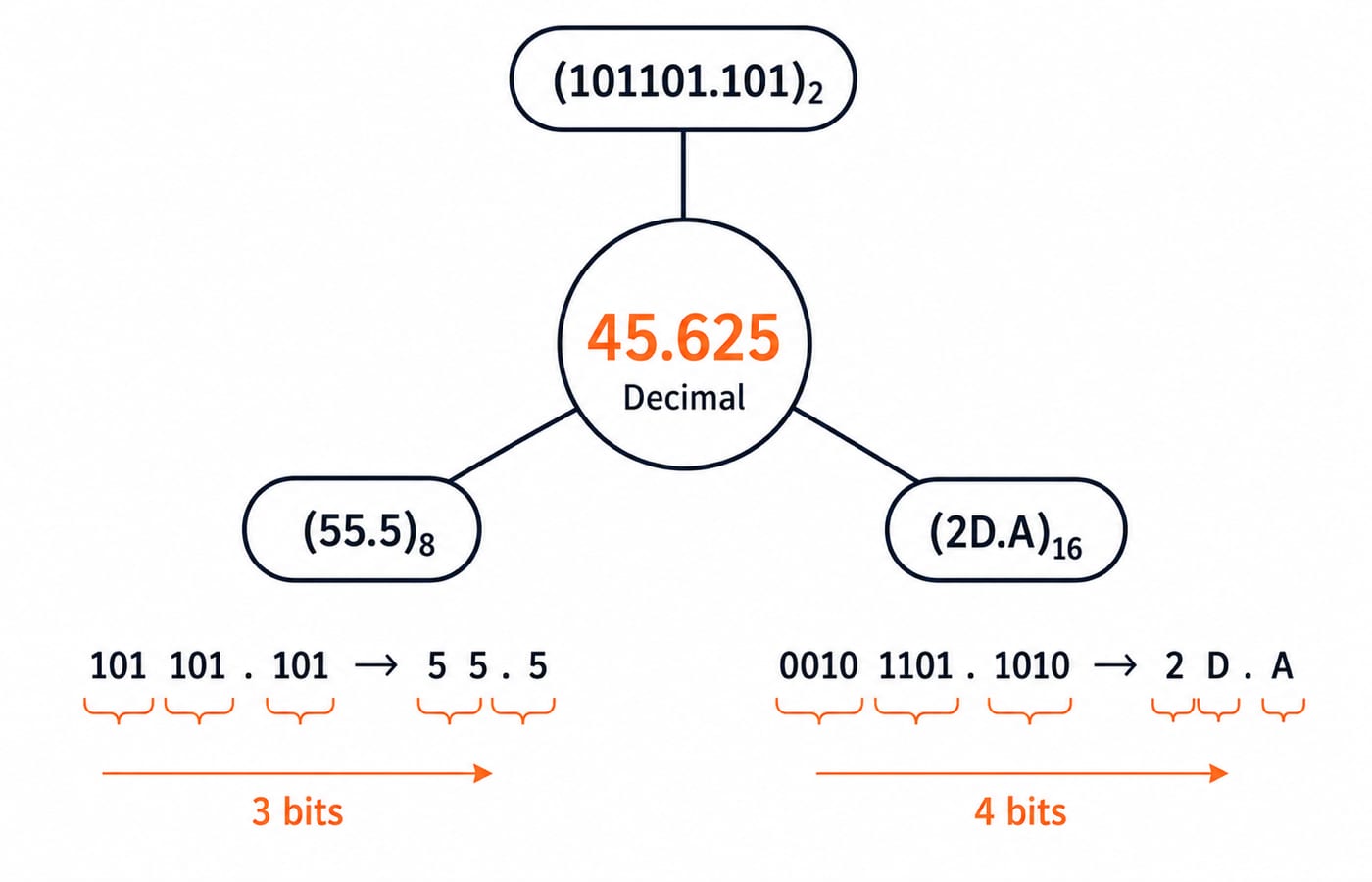
Decimal conversion can feel manageable until a radix point, leading padding or a carry across bases appears. Then speed and accuracy often disappear together. The single value 45.625 is (101101.101)_2, (55.5)_8 and (2D.A)_16, and adding (2D.A)_16 to (17.4)_8 lands on 61.125 by two independent checks. For complements, signed ranges, BCD and Gray code, read Number Systems and Base Conversions.
1. Binary, octal and hexadecimal begin with radix and place value
In a base, or radix, r, a digit d_i at position i contributes d_i x r^i. Positions right of the radix point use r^-1, r^-2 and so on.
System | Base | Valid digits | Positional weight | Binary group size |
|---|---|---|---|---|
Binary | 2 |
| 2^i | 1 bit |
Octal | 8 |
| 8^i | 3 bits |
Hexadecimal | 16 |
| 16^i | 4 bits |
One octal digit is exactly 3 bits because 8 = 2^3. One hexadecimal digit is exactly 4 bits because 16 = 2^4; here A = 10 through F = 15.
For (2D.A)_16, place value gives 2 x 16^1 + 13 x 16^0 + 10 x 16^-1 = 32 + 13 + 0.625 = 45.625. The numeral is valid. By contrast, (128)_8 contains illegal digit 8, (1G)_16 contains illegal digit G, and (101102)_2 contains illegal digit 2. The GATE CS Exam Preparation category places this topic in the wider Digital Logic learning route.
2. Binary to octal and hexadecimal conversion uses bit groups, not decimal
Group bits from the radix point outwards. Use 3 bits per octal digit and 4 per hexadecimal digit. Add zeros only at the far left of the integer part or far right of the fraction; edge padding does not change the value.
Convert (101101.101)_2 directly:
Octal:
101 101 . 101 -> 5 5 . 5, so the result is(55.5)_8.Hexadecimal:
0010 1101 . 1010 -> 2 D . A, so the result is(2D.A)_16.
Now verify by place value. (101101.101)_2 = 32 + 8 + 4 + 1 + 1/2 + 1/8 = 45.625. Also, (55.5)_8 = 5 x 8 + 5 + 5/8 = 45.625, and (2D.A)_16 = 2 x 16 + 13 + 10/16 = 45.625. The .5 in (55.5)_8 means 5/8, not one half.
3. Decimal to binary conversion separates the integer and fractional algorithms
Reverse the route by treating 45 and 0.625 separately. Repeated division gives:
45/2 = 22 remainder 1
22/2 = 11 remainder 0
11/2 = 5  remainder 1
5/2  = 2  remainder 1
2/2  = 1  remainder 0
1/2  = 0  remainder 1
Read the remainders upward to obtain 101101. For the fraction, multiply repeatedly by 2:
0.625 x 2 = 1.25  -> bit 1, remainder 0.25
0.25  x 2 = 0.5   -> bit 0, remainder 0.5
0.5   x 2 = 1.0   -> bit 1, terminate
Read those bits downward to get .101. Therefore 45.625 = (101101.101)_2. Only now regroup: 101 101 . 101 -> (55.5)_8, while 0010 1101 . 1010 -> (2D.A)_16. Routing octal and hexadecimal through binary uses fixed groups, so it is shorter and less error-prone than running separate decimal algorithms.
4. Mixed-base arithmetic: add (2D.A)_16 and (17.4)_8
Never add unlike radices column by column. Convert both operands to one common base. Binary is convenient because every source digit expands into a fixed group:
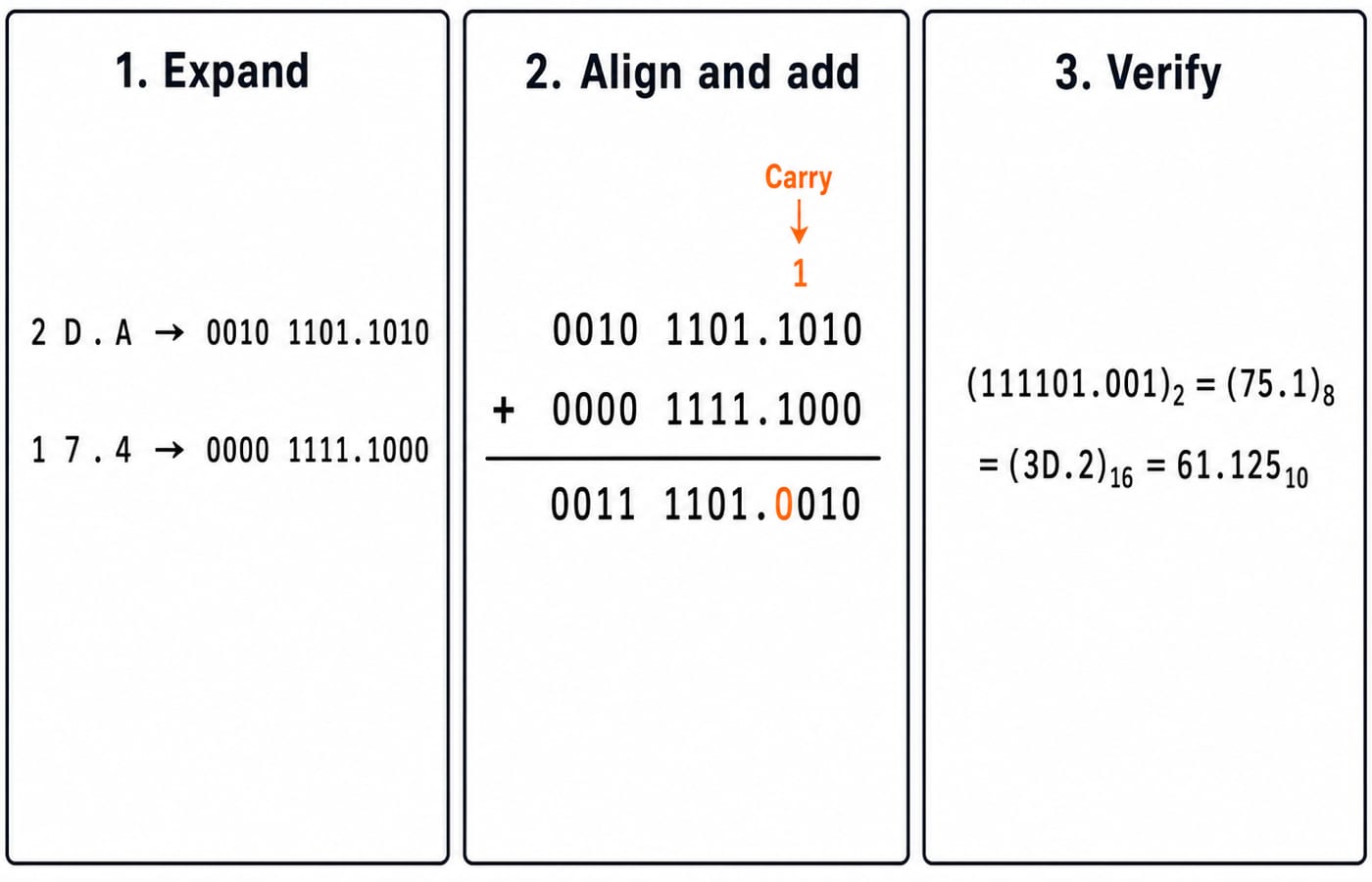
(2D.A)_16 = 0010 1101.1010_2
(17.4)_8 = 001 111.100_2 = 0000 1111.1000_2 after alignment.
  0010 1101.1010
+ 0000 1111.1000
= 0011 1101.0010
The fractional sum .1010 + .1000 is 1.0010, so 1 carries into the integer part. Trimming only edge zeros gives (111101.001)_2. Regrouping produces (75.1)_8 and (3D.2)_16.
Check independently in decimal: (2D.A)_16 = 45.625, while (17.4)_8 = 8 + 7 + 4/8 = 15.5. Their sum is 61.125. The results agree because (3D.2)_16 = 3 x 16 + 13 + 2/16 = 61.125 and (75.1)_8 = 7 x 8 + 5 + 1/8 = 61.125. A disagreement points to grouping or carry handling. Combinational Circuits: MUX, Decoders, Adders shows where bit-level addition is implemented in logic.
5. Binary, octal and hexadecimal questions test five repeatable moves
The official GATE 2026 CS syllabus lists number representations and computer arithmetic under Digital Logic. Practise these five checks:
Direct regrouping:
(735)_8 = (111011101)_2 = (1DD)_16.Radix solving:
(132)_b = 56_10givesb^2 + 3b + 2 = 56, so b^2 + 3b - 54 = 0, which factors as(b + 9)(b - 6) = 0; the valid base isb = 6, because a radix must be a positive integer larger than every digit it uses, which rules out the root b = -9.Legality:
(128)_8is invalid because octal has no digit8.Equality:
(111111)_2 = (77)_8 = (3F)_16 = 63_10.Mixed arithmetic:
(2D.A)_16 + (17.4)_8 = (3D.2)_16 = 61.125_10.
Attempt them in a fixed order: validate digits, mark the radix point, use grouping when the bases are powers of two, otherwise use positional expansion or repeated division and multiplication, then verify in decimal. KnowledgeGate has over 100 practice questions on binary, octal and hexadecimal conversion.
6. Binary, octal and hexadecimal traps: padding, radix fractions, repeating bits and carries
Grouping from the left edge: For hexadecimal,
101101.101must become0010 1101 . 1010. Padding belongs outside the value, never between significant bits.Reading a radix fraction as decimal:
.5_8 = 5/8 = 0.625_10, while.5_16 = 5/16 = 0.3125_10. The same symbol has a different positional weight in each base.Assuming every finite decimal fraction terminates in binary: Starting with
0.1_10, repeated multiplication by 2 produces bits0, 0, 0, 1, 1, after which the remainder returns to0.2. Thus0.1_10 = 0.000110011..._2. Floating Point Representation: IEEE 754 Format explains how finite precision stores such repeating values.Carrying as though the base were 10: In any base, a carry is one unit of the next positional weight. Run a decimal value check, as we did for
61.125.
7. Binary, octal and hexadecimal in the short version
Keep this six-line checklist beside your practice sheet:
Validate every digit.
Mark the radix point.
Use 3-bit octal groups.
Use 4-bit hexadecimal groups.
Pad only at the outer edges.
Verify one route by place value.
The locked results are 45.625_10 = 101101.101_2 = 55.5_8 = 2D.A_16 and (2D.A)_16 + (17.4)_8 = 111101.001_2 = 75.1_8 = 3D.2_16 = 61.125_10.
Use GATE Guidance by Sanchit Sir if you want number systems placed inside a complete subject-wise GATE sequence.
Self-test: Convert (6B.C)_16 to binary and octal, then add (13.2)_8.
Answer check: First conversion:
(6B.C)_16 = (1101011.11)_2 = (153.6)_8 = 107.75_10. Final sum:(77)_16 = (1110111)_2 = (167)_8 = 119_10.
Keep learning

Functional Completeness in Digital Logic: NAND, NOR and Worked Examples
Learn what makes a Boolean operator set complete, how NAND and NOR recover a standard basis, and how to verify a four-gate NAND construction.
Updated 2 Oct 20266 min readDigital Logic
Boolean Function Counts: Formulas, Worked Examples and Exam Traps
Build the master Boolean-function formula from output choices, then learn how common restrictions change the count through combinations, pairing and inclusion-exclusion.
Updated 27 Sep 20266 min readDigital Logic

Analog-Digital Conversion Basics: ADC, DAC, Worked Examples and Exam Patterns
Build ADC and DAC basics from one consistent transfer model, then practise code selection, reconstruction error, flash and SAR conversion, and bit-depth calculations.
Updated 25 Sep 20266 min readDigital Logic

Universal Realization with NAND and NOR Gates: Concepts, Worked Example and Exam Patterns
Learn why NAND and NOR are universal, then implement one three-variable function using four NAND gates and four NOR gates with verified input traces.
Updated 23 Sep 20265 min readDigital Logic