Number Representation in Digital Electronics: Conversions, Complements and Worked Examples
Learn number representation through exact conversions, signed encodings, binary arithmetic, special codes, fixed point and IEEE 754 worked examples.
KnowledgeGate Team
Exam prep & CS education
Updated 11 Aug 20266 min read
A bit pattern has no single value until you know its base, width, signedness, and encoding. The eight bits 11010110 can mean unsigned 214, signed-magnitude -86, one's-complement -41, or two's-complement -42. None of those four readings is a different calculation. They are one byte under four encoding rules, and picking the wrong rule is the most common way marks go missing on this topic.
Number representation starts with base, width, and interpretation
In a positional representation of base r, each digit contributes digit x r^position. Valid digits run from 0 to r - 1, and positions after the radix point use negative powers. For example:
(101101.101)2 = 32 + 8 + 4 + 1 + 1/2 + 1/8 = 45.625.
Before decoding, ask four questions: What is the base? What width is fixed? Is the value unsigned or signed? Is the encoding positional binary, BCD, Gray, fixed point, or floating point? Thus 00111011 as ordinary binary is 59, while decimal 59 in BCD is 0101 1001 because each decimal digit is encoded separately.
For n bits, unsigned values range from 0 to 2^n - 1. Signed magnitude and one's complement range from -(2^(n-1) - 1) to +(2^(n-1) - 1). Two's complement ranges from -2^(n-1) to 2^(n-1) - 1. At eight bits, these are 0..255, -127..127, and -128..127 respectively.
Base conversion across binary, octal, and hexadecimal
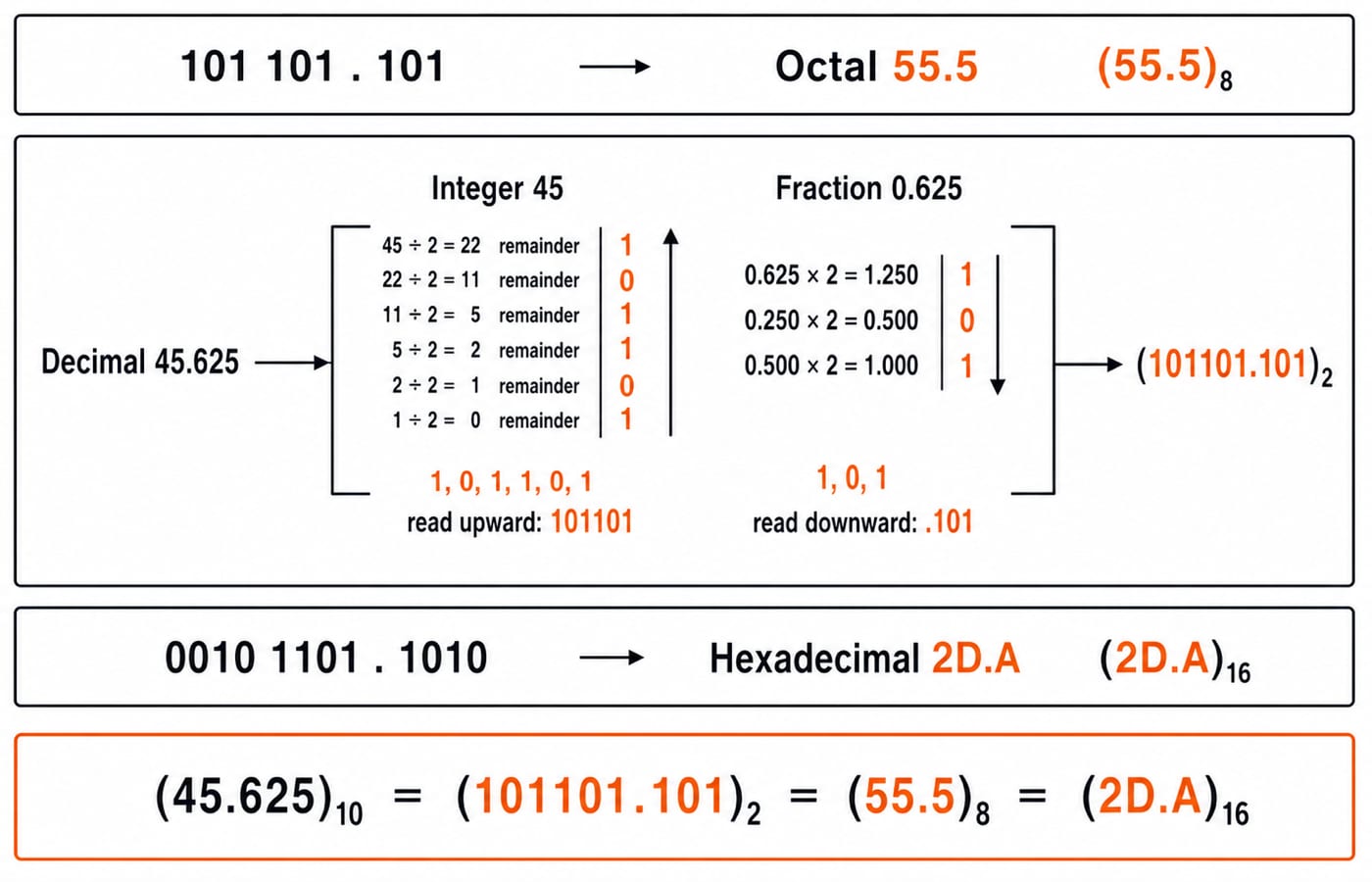
Convert (45.625)10 by treating the two parts separately. Repeated division gives:
45 / 2 = 22 r1, 22 / 2 = 11 r0, 11 / 2 = 5 r1, 5 / 2 = 2 r1, 2 / 2 = 1 r0, 1 / 2 = 0 r1.
Reading the remainders upward gives 101101. For the fraction, 0.625 x 2 = 1.25, 0.25 x 2 = 0.5, and 0.5 x 2 = 1.0. Reading the integer parts downward gives .101. Therefore:
(45.625)10 = (101101.101)2.
Group binary digits in threes to get 101 101 . 101 = (55.5)8. Group in fours after padding to get 0010 1101 . 1010 = (2D.A)16. Check: 2 x 16 + 13 + 10/16 = 45.625.
For unrelated bases, decimal is a dependable bridge. (132.2)4 = 1 x 4^2 + 3 x 4 + 2 + 2/4 = 30.5, and (30.5)10 = (11110.1)2. Use the number systems and base conversions guide when you want more practice on this method.
Signed magnitude, one's complement, and two's complement
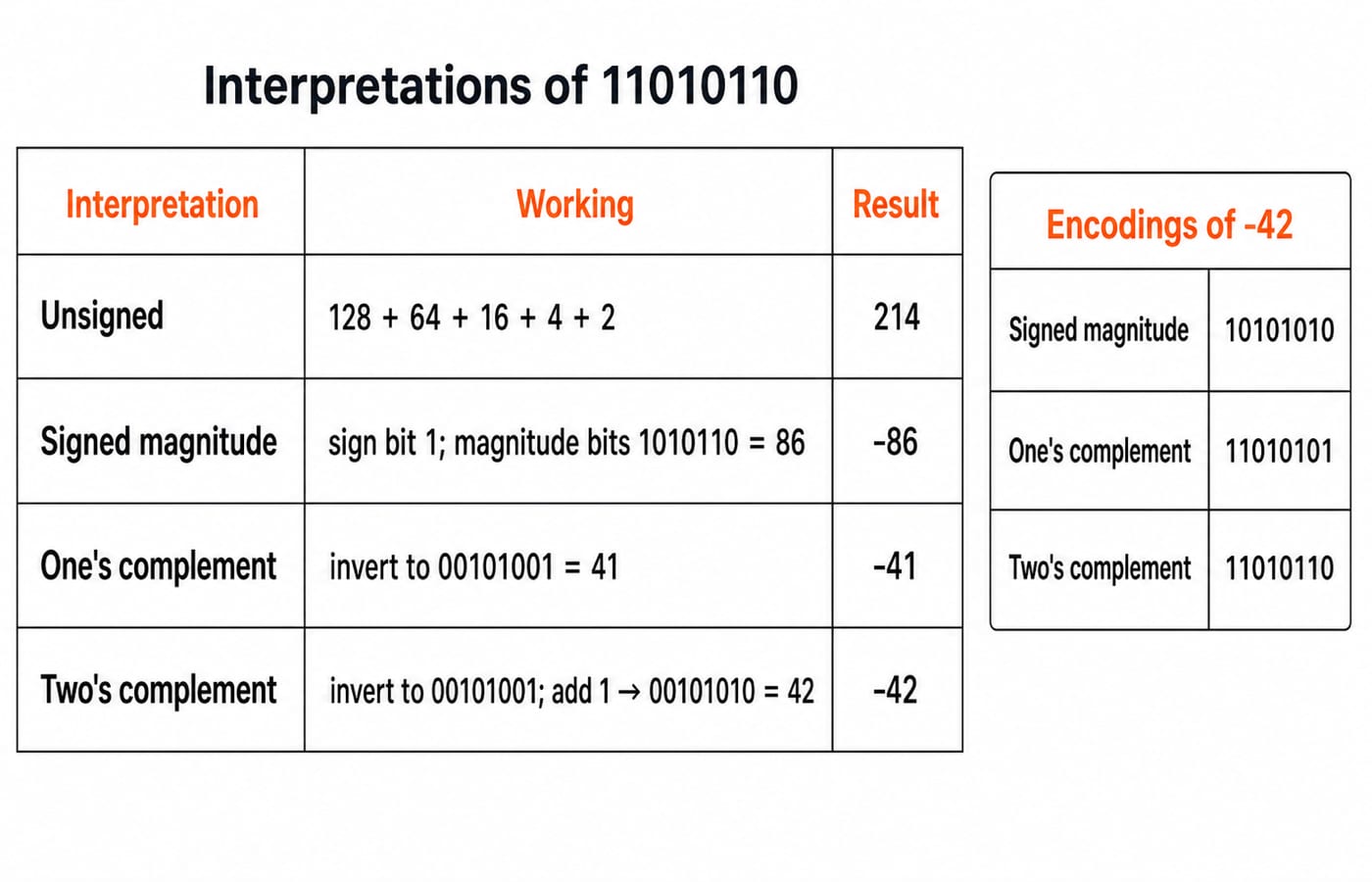
Start with eight-bit +42 = 00101010. Signed magnitude stores -42 as 10101010. One's complement inverts every bit to get 11010101. Two's complement adds one, giving 11010110. Signed magnitude and one's complement each have positive and negative zero. Two's complement has one zero and gains one extra negative value.
Now decode 11010110 under four interpretations:
Unsigned:
128 + 64 + 16 + 4 + 2 = 214.Signed magnitude:
-(64 + 16 + 4 + 2) = -86.One's complement: invert to
00101001 = 41, so the value is-41.Two's complement: invert to
00101001, then add one to get00101010 = 42, so the value is-42.
Width must be preserved. Sign-extending eight-bit -42 gives sixteen-bit 11111111 11010110, or hexadecimal FFD6. Zero-extension produces 00000000 11010110, which represents +214, so it changes the value.
Binary subtraction, carry, and signed overflow
Compute 23 - 41 with eight-bit two's complement. Write 23 = 00010111 and 41 = 00101001. Invert 41 to 11010110, then add one, so -41 = 11010111. Now:
00010111 + 11010111 = 11101110.
Invert the result and add one: 11101110 -> 00010001 -> 00010010 = 18. Therefore the result is -18, matching decimal subtraction.
Carry and signed overflow answer different questions. For eight-bit signed arithmetic:
100 + 60 = 01100100 + 00111100 = 10100000.
There is no ninth-bit carry, but two positive operands produced a negative sign bit. Overflow occurred, and the stored pattern decodes to -96, not the mathematical sum 160, which is outside -128..127.
Unsigned overflow uses carry out of the most significant bit. Two's-complement signed overflow occurs when equal-sign operands produce an opposite-sign result, or when carry into and out of the sign bit differ. Discard a final carry in two's-complement addition, but never use it as the signed-overflow test.
BCD, Excess-3, and Gray code are encodings
Decimal 59 is ordinary binary 00111011. In 8421 BCD it is 0101 1001. Excess-3 adds 3 to each digit first: 5 -> 8 -> 1000 and 9 -> 12 -> 1100, giving 1000 1100. In BCD, nibbles 1010 through 1111 are invalid decimal digits.
For binary 10110, Gray code is binary XOR (binary >> 1):
10110 XOR 01011 = 11101.
Reverse cumulatively. Gray 11101 gives binary bits 1, 1 XOR 1 = 0, 0 XOR 1 = 1, 1 XOR 0 = 1, and 1 XOR 1 = 0, recovering 10110.
BCD keeps decimal digits explicit. Excess-3 is a digit code with useful complement properties. Adjacent Gray values differ in one bit. None is merely "base 10 in binary".
Fixed-point and floating-point representations
Consider an eight-bit signed two's-complement fixed-point format with four fractional bits. Scale 5.625 by 16: 5.625 x 16 = 90, and 90 = 01011010. The stored pattern is 01011010, read with the implied point as 0101.1010. Its step size is exactly 1/16 = 0.0625, and its range is -8 to 7.9375.
For IEEE 754 single precision, (13.25)10 = (1101.01)2 = 1.10101 x 2^3. The sign is 0. The biased exponent is 3 + 127 = 130 = 10000010. The 23-bit fraction is 10101000000000000000000. Joining the fields gives 0 10000010 10101000000000000000000, or hexadecimal 0x41540000.
Fixed point offers a constant step over a limited range. Floating point uses sign, exponent, and fraction for wider dynamic range, but most real values require rounding. An all-ones exponent identifies infinity or NaN. An all-zero exponent covers zero and subnormal values.
Number representation question forms and the rules that prevent errors
What is the smallest two's-complement width that holds every integer from -75 through 60? Seven bits cover only -64..63, so -75 does not fit. Eight bits cover -128..127, so eight is the answer.
The pattern 11111111 is another useful check. It is unsigned 255, two's-complement -1, one's-complement negative zero, and signed-magnitude -127. It is invalid as two-digit BCD because both 1111 nibbles exceed 1001.
Questions commonly test base conversion, ranges, complement arithmetic, carry versus overflow, code conversion, or fixed and floating-point fields. Preserve the stated width, sign-extend negative two's-complement values with ones, keep decimal digits separate in BCD, retain fractional zeros while grouping, and test signed overflow independently of final carry. The KnowledgeGate question bank carries over 170 questions on number representation, enough to meet every one of these forms several times over. Continue with the Boolean algebra and K-map guide, then study combinational circuits as the next Digital Electronics concept.
Number representation in the short version
Interpretation comes before arithmetic.
Place values explain every base.
Two's complement is the standard signed-arithmetic tool.
Carry and signed overflow answer different questions.
BCD and Gray are codes, not bases.
Fixed and floating point trade range against resolution and precision.
As a self-check, reproduce (45.625)10 = (101101.101)2, decode 11010110 as two's-complement -42, and explain why 100 + 60 overflows eight-bit signed arithmetic. For structured preparation, use GATE Guidance by Sanchit Sir, practise under time limits with the GATE Test Series, and browse the current GATE category. Do not stop at reading: redo each conversion without looking at the answer.
Keep learning
Functional Completeness in Digital Logic: NAND, NOR and Worked Examples
Learn what makes a Boolean operator set complete, how NAND and NOR recover a standard basis, and how to verify a four-gate NAND construction.
Updated 2 Oct 20266 min readDigital Logic
Boolean Function Counts: Formulas, Worked Examples and Exam Traps
Build the master Boolean-function formula from output choices, then learn how common restrictions change the count through combinations, pairing and inclusion-exclusion.
Updated 27 Sep 20266 min readDigital Logic
Analog-Digital Conversion Basics: ADC, DAC, Worked Examples and Exam Patterns
Build ADC and DAC basics from one consistent transfer model, then practise code selection, reconstruction error, flash and SAR conversion, and bit-depth calculations.
Updated 25 Sep 20266 min readDigital Logic

Universal Realization with NAND and NOR Gates: Concepts, Worked Example and Exam Patterns
Learn why NAND and NOR are universal, then implement one three-variable function using four NAND gates and four NOR gates with verified input traces.
Updated 23 Sep 20265 min readDigital Logic