Loops in C: for, while and do-while with worked examples
Learn how C loops initialise, test, execute and update. Trace complete programs, diagnose common bugs and practise choosing the right loop.
KnowledgeGate Team
Exam prep & CS education
Updated 23 Jul 20266 min read

You may know how to make C execute a statement once, but repeating it safely requires a clear model. Every C loop has the same four moving parts: initialise the state, test a condition, run the body, update the state. A loop stops only because its body changes the value the test reads, so every loop you write needs either a condition that eventually turns false or a deliberate infinite-loop design.
Loops in C: the four parts of controlled repetition
A loop repeatedly executes code while a condition permits it. Read any loop in this order: initialise the state, test the condition, run the body, and update the state. A for or while loop tests before entering the body, while a do-while loop tests after one execution.
int i = 1;
while (i <= 3) {
    printf("%d ", i);
    i++;
}
The first test sees i=1, so the loop prints 1 and updates i to 2. The next two passes print 2 and 3. The update after the third pass makes i=4; now i <= 3 is false. The exact output is 1 2 3. If you omit i++, i remains 1 and the loop does not terminate.
The Coding & DSA Courses for Placements page places this skill in a wider programming path. Loops are where most beginner C programs first go wrong, because a single missing update turns a correct algorithm into a program that never finishes.
The for loop in C: count when the range is known
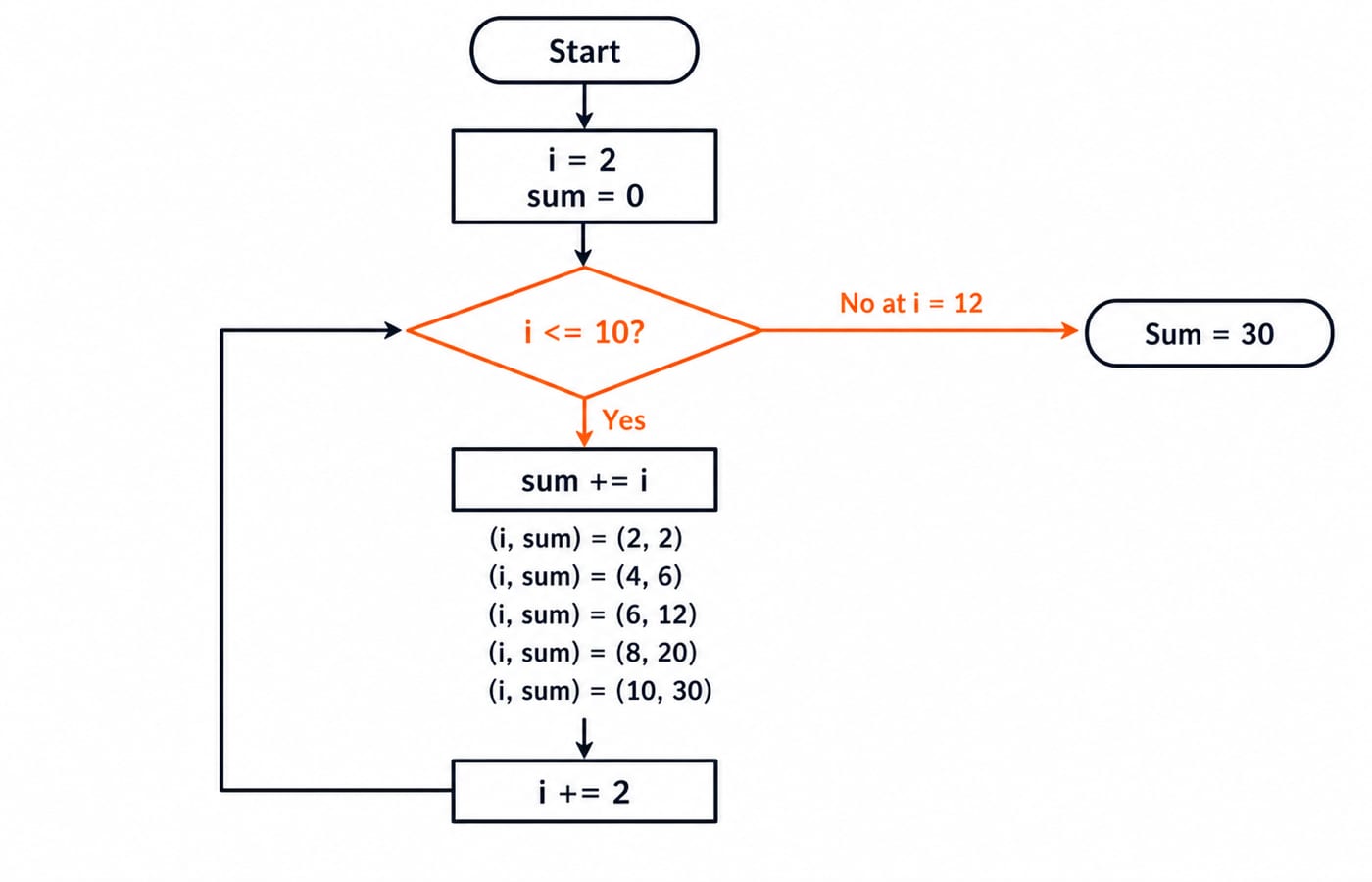
The grammar is for (initialisation; condition; update) { body }. Initialisation runs once, the condition is tested before every pass, and the update runs after each completed pass. These fields directly represent the initialise, test and update parts of the model; the block supplies the body.
#include <stdio.h>

int main(void) {
    int i, sum = 0;
    for (i = 2; i <= 10; i += 2) {
        sum += i;
    }
    printf("Sum = %d\n", sum);
    return 0;
}
|
|
|
|---|---|---|
2 | 0 | 2 |
4 | 2 | 6 |
6 | 6 | 12 |
8 | 12 | 20 |
10 | 20 | 30 |
After the fifth update, i=12, so 12 <= 10 is false. The program prints Sum = 30.
The while loop in C: repeat until changing data says stop
A while loop is usually clearer when you cannot know the number of passes in advance. Its condition describes the state in which repetition should continue, and its body must move that state towards false.
#include <stdio.h>

int main(void) {
    int n = 4827, sum = 0, digit;

    while (n > 0) {
        digit = n % 10;
        sum += digit;
        n /= 10;
    }

    printf("Digit sum = %d\n", sum);
    return 0;
}
|
|
| next |
|---|---|---|---|
4827 | 7 | 7 | 482 |
482 | 2 | 9 | 48 |
48 | 8 | 17 | 4 |
4 | 4 | 21 | 0 |
For positive integers, integer division by 10 removes the final digit. Once n=0, n > 0 is false, so the exact output is Digit sum = 21.
The do-while loop in C: run once before checking
The exact form is do { body } while (condition);. Notice the required semicolon after the condition. This loop is exit-controlled, unlike the entry-controlled while, because its body runs before the first test.
#include <stdio.h>

int main(void) {
    int choice;

    do {
        printf("1. Continue\n");
        printf("2. Exit\n");
        scanf("%d", &choice);
    } while (choice != 2);

    return 0;
}
With the fixed input stream 1 and then 2, the menu appears twice. The first check sees choice != 2 as true; the second sees it as false and exits. If the first input is 2, the menu still appears exactly once. Use do-while only when that first execution is part of the requirement, such as showing a menu before accepting an exit choice.
Nested loops in C: trace rows outside and columns inside
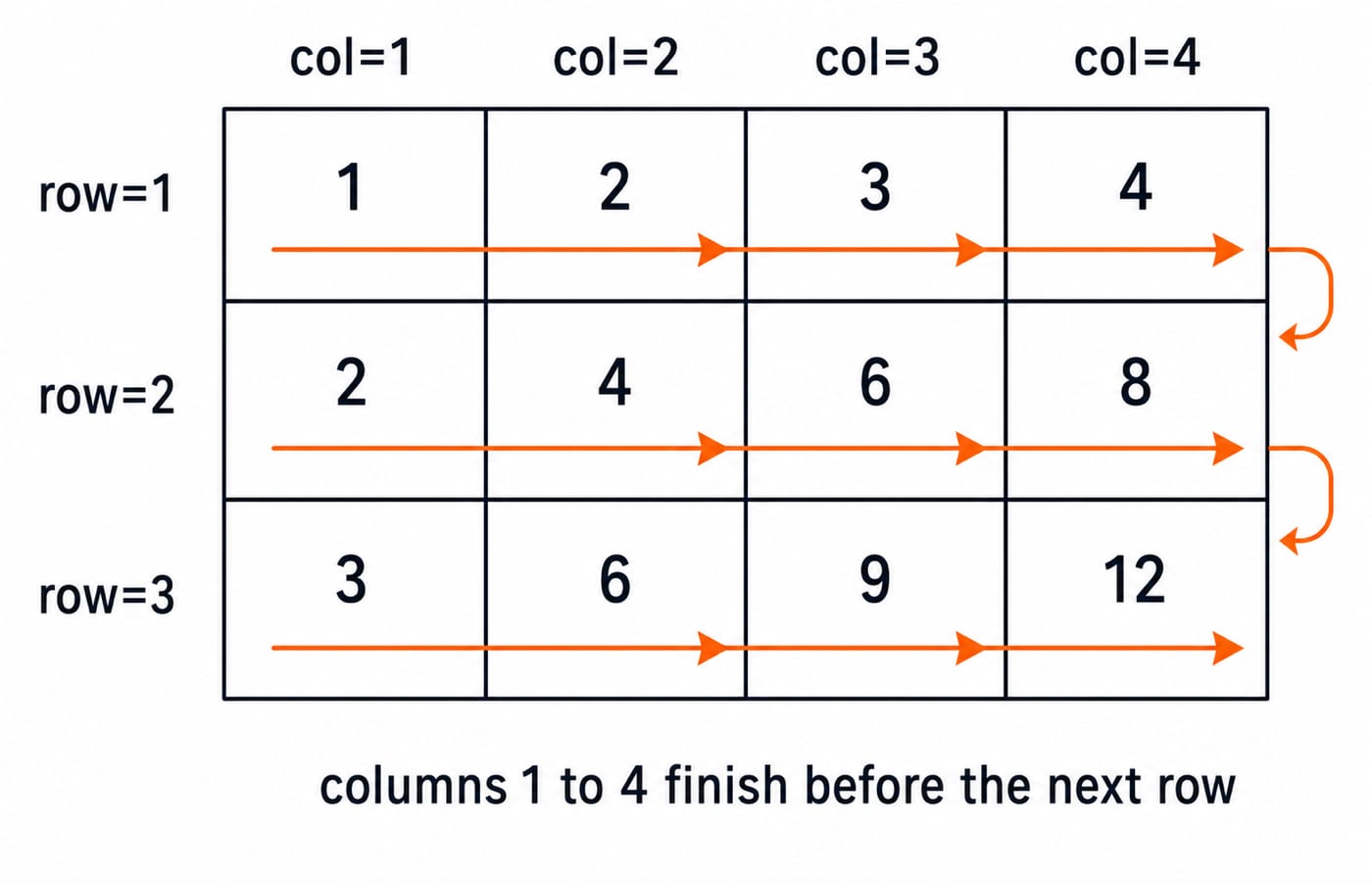
For every single outer-loop pass, the inner loop completes all its passes. This program runs rows 1 to 3 outside and columns 1 to 4 inside.
#include <stdio.h>

int main(void) {
    int row, col;

    for (row = 1; row <= 3; row++) {
        for (col = 1; col <= 4; col++) {
            printf("%d ", row * col);
        }
        printf("\n");
    }

    return 0;
}1 2 3 4
2 4 6 8
3 6 9 12The inner body executes 3 x 4 = 12 times. That concrete count is the bridge to Time Complexity & Asymptotic Notation: Big-O, where loop growth becomes the main question.
Loop control and common C loop errors
continue skips the rest of the current pass, while break exits the nearest loop completely.
for (i = 1; i <= 8; i++) {
    if (i == 3) continue;
    if (i == 7) break;
    printf("%d ", i);
}
The output is 1 2 4 5 6. At 3, continue still leads to the for update. At 7, break exits before printing or updating again.
Trap and cause | Observed result | Correction |
|---|---|---|
Using | Starting at 1 prints only 1 through 4 | Use |
Omitting | The tested value never changes, causing an infinite loop when the condition stays true | Update the controlling state in the body |
Writing | The semicolon forms an empty loop, so the intended body is not controlled | Remove the stray semicolon and keep the update inside the body |
Writing | The expression assigns 5, a nonzero value, so it remains true | Use |
One warning about output questions. An expression like i = i++ writes to i twice in a single unsequenced expression, which the C standard leaves undefined, so no printed value is the correct answer for it. Trace only loops whose updates happen in a defined order.
How loops in C are tested, plus three exercises
Assessments commonly ask you to trace output, count iterations, repair a boundary or update bug, choose a loop form, or count a nested body. Sorting Algorithms: Complexity and Comparison is a useful next application because sorting relies on repeated passes.
Decide which loop form fits each of these, then trace it on paper before reading the answers:
Sum the digits of
9054.Print values from 10 down to 2 in steps of 2.
Use nested loops with row counts 1, 2, 3 and 4, printing one
*for each inner pass.
The first answer is 18, and it wants a while loop because the pass count depends on how many digits the number has: take % 10, add the digit, and apply /= 10 until n becomes 0. The second uses for (i = 10; i >= 2; i -= 2) and prints 10 8 6 4 2. The third uses outer row=1..4 and inner col=1..row:
*
**
***
****
It prints 1+2+3+4 = 10 stars. Hand-trace each control variable before compiling.
Loops in C: the short version and next step
Use for for a clear counter range, while for condition-led repetition with an unknown pass count, and do-while when the body must run at least once. Before trusting any loop, identify which variable changes and why the condition will eventually become false.
The C Programming Course is a structured next step if you want the full C sequence. For one final check, retype the even-sum program, change the upper bound from 10 to 14, predict 56, then compile and confirm.
Keep learning
C++ unordered_map and unordered_set: Hashing, Equality and a Custom-Key Frequency Counter
Build a correct mental model for C++ unordered containers, then trace a custom-key counter through a real collision without merging distinct keys.
Updated 2 Oct 20266 min readC++

C++ STL Containers: Choose by Access Pattern, Mutation Cost and Ownership
Choose a C++ STL container from the workload, not from habit. Trace sequence operations, keyed counts, invalidation and object lifetime through exact examples.
Updated 27 Sep 20266 min readC++

C++ STL Algorithms: Sort, Search, Transform and Clean Data in One Pipeline
Trace nine sensor readings through sort, lower_bound, transform, erase-remove and accumulate, with every iterator rule and intermediate value explained.
Updated 25 Sep 20266 min readC++
C++ std::vector Internals: Growth, Capacity, Reallocation and Iterator Invalidation
Learn how std::vector manages contiguous storage, why an append can relocate every element, and which iterators, pointers and references survive each mutation.
Updated 24 Sep 20266 min readC++