

Loops in C++: for, while and do-while with Step-by-Step Examples
Trace how C++ loops test, execute and update. Compare a zero-iteration case, understand copies and references, and practise predicting outputs without losing track of break or continue.
KnowledgeGate Team
Exam prep & CS education
Updated 20 Nov 20266 min read
C++ offers classic for, while, and do-while loops, and each places its condition, body, and update at a different point. The traces below add 1 through 4, compare an initially false condition, and show how continue differs from break. This C++ treatment adds range-based traversal and copies versus references; Loops in C: for, while and do-while with worked examples covers the C syntax counterpart. It is a practical starting point among our Coding & Skills tutorials and courses.
C++ loops: choose by when they check and what repeats
An iteration is one pass through a loop body. With i = 1, the condition i <= 4 decides whether to continue, and ++i advances the counter. An update can also decrement a value or change another part of the state.
Loop | Check or traversal | Minimum body entries | Convenient for |
|---|---|---|---|
Classic | Check before body | 0 | Counters and indices |
| Check before body | 0 | Condition-driven work |
| Check after body | 1 | Work before checking |
Range-based | Visit each element | 0 for an empty range | Whole-range traversal |
These are readability choices. A for loop does not require a known iteration count, and a while loop can count precisely.
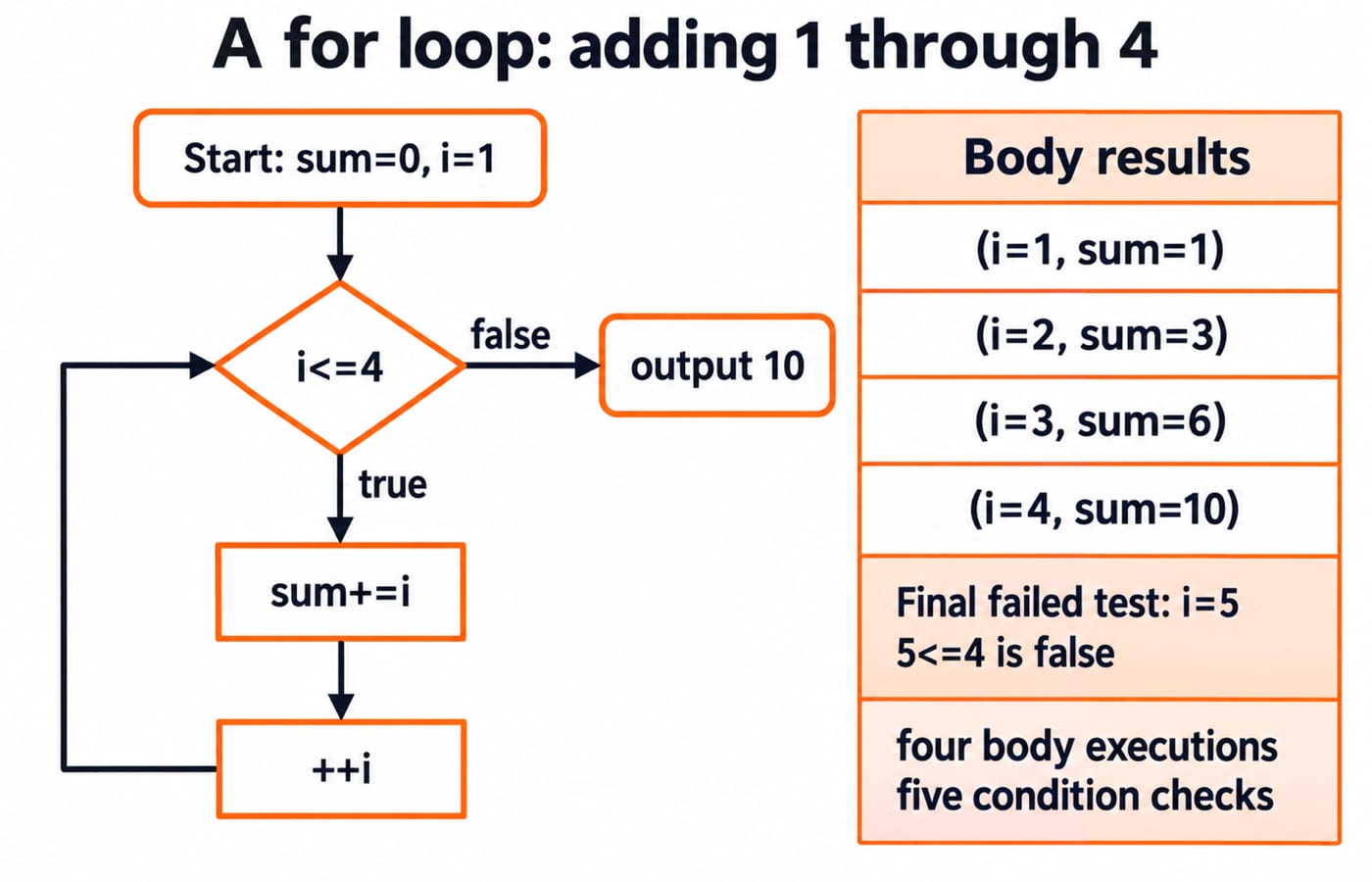
Trace a for loop: add 1, 2, 3 and 4
This complete program accumulates each counter value in sum:
#include <iostream>

int main() {
    int sum = 0;
    for (int i = 1; i <= 4; ++i) {
        sum += i;
    }
    std::cout << sum << '\n';
}
The output is 10. Initialisation happens once. After that, the condition, body and update repeat in that order, following the C++ working draft's iteration rules.
i at test | i <= 4 | sum before | sum after body | i after update |
|---|---|---|---|---|
1 | true | 0 | 1 | 2 |
2 | true | 1 | 3 | 3 |
3 | true | 3 | 6 | 4 |
4 | true | 6 | 10 | 5 |
5 | false | 10 | not executed | not executed |
Read the additions as 0+1=1, 1+2=3, 3+3=6, then 6+4=10. There are four body executions but five condition checks. The last check stops the loop; it adds nothing. The header's i is outside its scope after the loop.
Compare while and do-while using the same values
For each following snippet, use a fresh int main() with #include <iostream> above it.
The while version places initialisation before the loop and the update inside it:
int sum = 0, i = 1;
while (i <= 4) {
    sum += i;
    ++i;
}
std::cout << sum << ' ' << i << '\n';
It prints 10 5. Now move the check below the body:
int sum = 0, i = 1;
do {
    sum += i;
    ++i;
} while (i <= 4);
std::cout << sum << ' ' << i << '\n';
This also prints 10 5. Notice the required semicolon after the do-while condition.
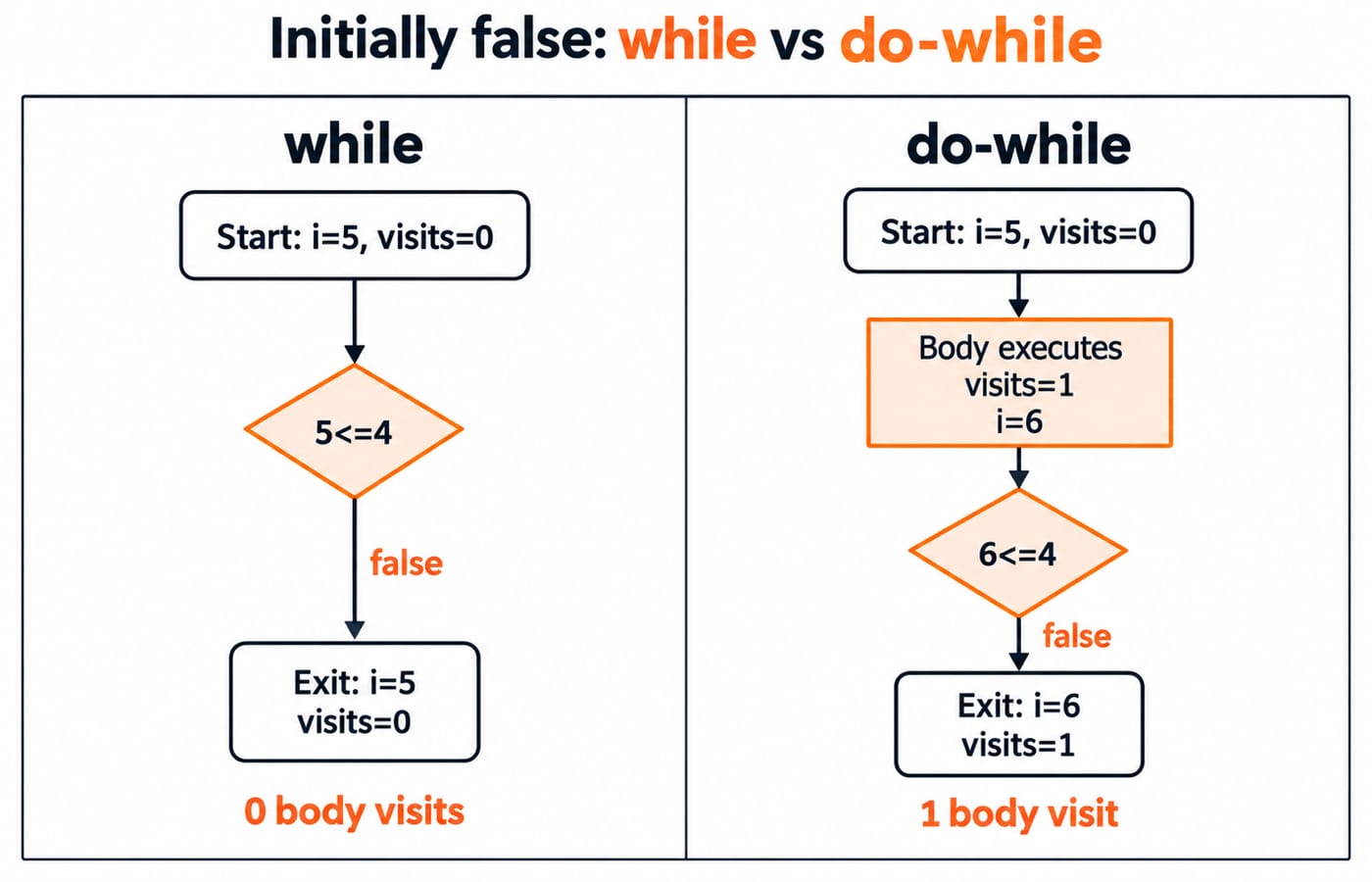
For a fresh boundary case, start with int i = 5, visits = 0;. Use condition i <= 4 and body { ++visits; ++i; }. A while finishes with visits=0, i=5; a do-while finishes with visits=1, i=6. Avoid do-while when an initially false condition must prevent all work. Readers comparing shared syntax can also study loops in C.
Use range-based for when you need every array element
Available from C++11, range-based for traverses elements without an explicit index:
int marks[] = {6, 8, 10};
int total = 0;
for (int mark : marks) {
    total += mark;
}
std::cout << total << '\n';
The total moves 0 -> 6 -> 14 -> 24, so this prints 24.
On a fresh array, compare a copy with a reference:
int marks[] = {6, 8, 10};
for (int mark : marks) {
    mark += 2;
}
for (int& mark : marks) {
    mark += 2;
}
The first loop leaves {6,8,10} unchanged: mark is a copy. The second changes the array to {8,10,12}: int& names the original element. Use the C++ learning path to place arrays and references in context.
Follow break and continue without losing the update
Predict which values reach the output statement:
for (int i = 1; i <= 6; ++i) {
    if (i == 3) { continue; }
    if (i == 5) { break; }
    std::cout << i << ' ';
}
The output values are 1 2 4. At 3, continue skips printing but still reaches ++i. At 5, break exits before printing or updating; 6 is never reached.
The working draft's continue statement targets the innermost loop's continuation point: the update in classic for, or the condition in while and do-while. Its break statement exits the nearest enclosing loop or switch, not an entire function or every nested loop.
Here is a safe while adaptation:
int i = 0;
while (i < 6) {
    ++i;
    if (i == 3) { continue; }
    if (i == 5) { break; }
    std::cout << i << ' ';
}
It also prints 1 2 4. Updating before the possible continue preserves progress here.
Fix boundary, update and empty-body mistakes
Off-by-one access: for int a[] = {6,8,10};, valid indices are 0, 1 and 2. Using i <= 3 while indexing attempts a[3]. That is undefined behaviour, not a guaranteed crash or predictable value. Use i < 3.
Skipped update: examine this faulty loop:
int i = 1;
while (i <= 3) {
    if (i == 2) { continue; }
    std::cout << i;
    ++i;
}
It sends 1 to the output stream, then stays at i=2: every continue skips ++i. Ensure progress before every such jump, as in the previous section.
Accidental semicolon: this loop has an empty body:
int i = 0;
for (; i < 3; ++i);
{
    std::cout << i;
}
It prints 3 once because the separate block runs after the loop. Remove the header's trailing semicolon to print 012. The do-while terminator, by contrast, is required.
Practise the output-tracing skills used in assessments
These are original practice tasks. Predict the final values before reading the answers.
int s = 0;
for (int i = 2; i <= 8; i += 2) {
    s += i;
}
Answer: s=20: 0+2=2, 2+4=6, 6+6=12, 12+8=20.
int n = 0;
do {
    ++n;
} while (n < 0);
Answer: n=1. The body runs before the false test 1 < 0.
int count = 0;
for (int r = 1; r <= 2; ++r) {
    for (int c = 1; c <= 3; ++c) {
        if (c == 2) { break; }
        ++count;
    }
}
Answer: count=2. The visited pairs are (1,1), (1,2), (2,1), (2,2). Each c=1 adds one; each c=2 breaks only the inner loop, following the working-draft rule above.
Record initial state, condition, executed statements and next state. This makes your reasoning checkable.
Short version and your next practice step
Use classic for for an explicit counter, while for checking before work, do-while when one body entry is needed, and range-based for for elements. Choose readable control flow instead of memorising a known-count versus unknown-count rule.
Now sum the even values in {3,4,7,8} with a range-based loop, using continue to skip odd values. Expect 12: the total moves 0 -> 4 -> 12. Then try an indexed version.
For an optional structured next step, explore the Coding for Placements course.
Keep learning

Loops in C: for, while and do-while with worked examples
Learn how C loops initialise, test, execute and update. Trace complete programs, diagnose common bugs and practise choosing the right loop.
Updated 23 Jul 20266 min read88 viewsC++

Loops and Iteration in C: for, while, do-while, Worked Traces and Exam Patterns
Learn a four-checkpoint method for tracing C loops, then apply it to sums, nested loops, break, continue, off-by-one errors and exam-style iteration counts.
Updated 27 Oct 20266 min readC Programming & Data Structures
Loops in Java Tutorial: for, while, do-while and Worked Examples
Build one reliable control-flow model for every Java loop. Trace runnable examples, avoid boundary and update errors, and practise counting executions.
Updated 15 Sep 20266 min readJava

Python Control Flow and Loops: if, for, while and Worked Traces
Learn to trace Python branches and loops without skipping a state change. Worked examples cover GCD, break and continue, loop else, nested loops, and common mistakes.
Updated 30 Oct 20265 min readPython