Logic Families & Hardware MCQs: 12 Solved Questions
Attempt 12 logic-family MCQs, then check concise explanations covering semiconductor basics, TTL voltages, CMOS, ECL, propagation delay, DCTL and figure of merit.
KnowledgeGate Team
Exam prep & CS education
Updated 24 Aug 20267 min read

TTL input thresholds, TTL output levels and the 5 V supply range are three different quantities, but they are easy to mix up. CMOS, RTL, DCTL and ECL can also become fragile one-line rankings instead of a useful mental model. The way out is to hold two facts per family at once: which transistor technology it is built on, and what that technology costs in propagation delay and power. Attempt each item before reading its explanation, and redo the two arithmetic steps yourself. The broader Digital Logic guide sets the surrounding context.
1. Build the logic-family map before solving
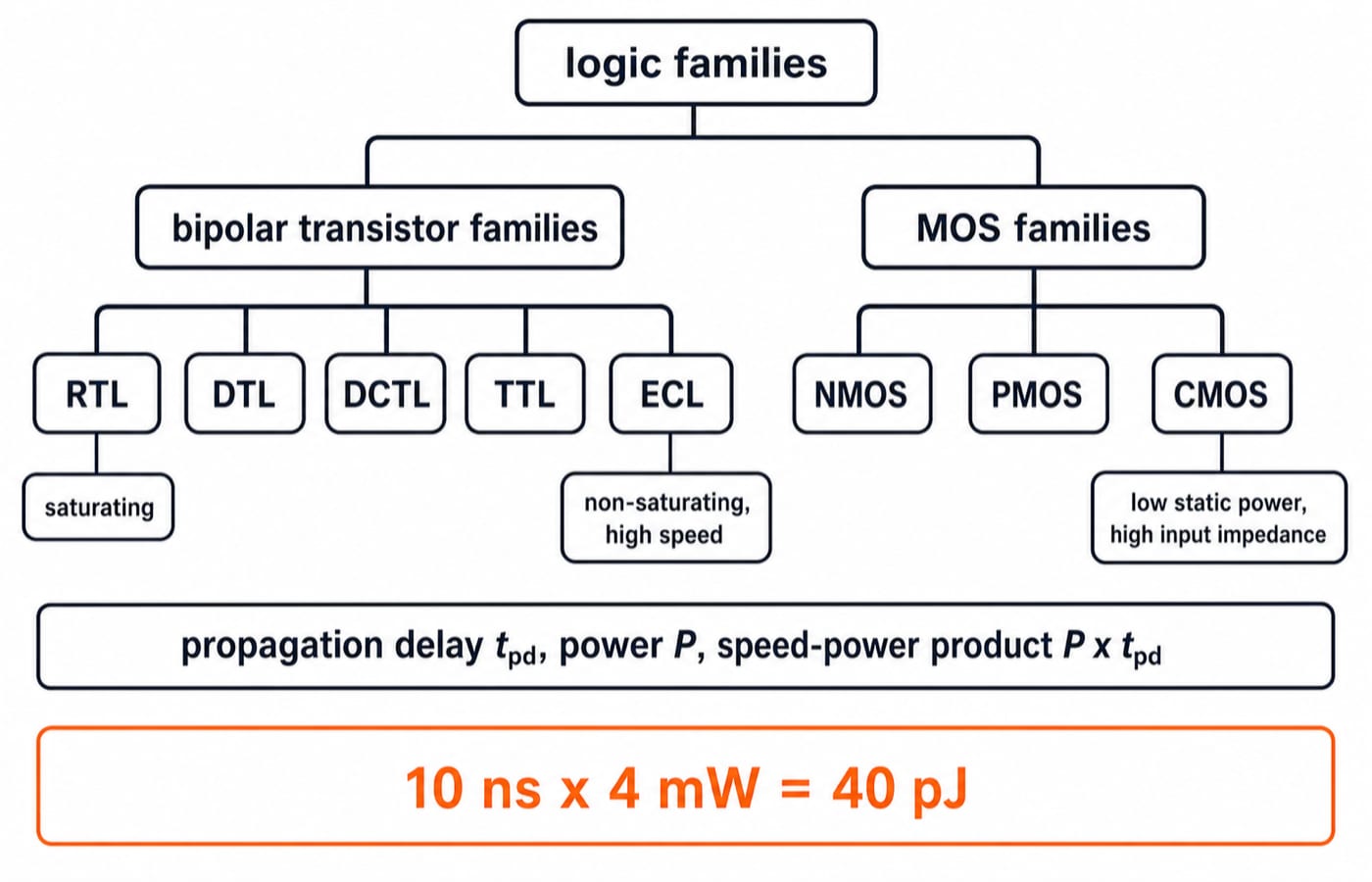
Start with two branches. RTL, DTL, DCTL, TTL and ECL are bipolar families. NMOS, PMOS and CMOS are MOS families. Compare them using supply and logic levels, propagation delay, power dissipation, input impedance and integration density. One label such as "fast" or "low power" never tells the whole story.
The common figure of merit is the speed-power product, P x t_pd. For a hypothetical IC with average propagation delay t_pd = 10 ns and power dissipation P = 4 mW:
P x t_pd = (4 x 10^-3 W)(10 x 10^-9 s)
= 40 x 10^-12 J = 40 pJ
The units reduce to joules because a watt is a joule per second. A lower speed-power product is preferable when the same definition and operating conditions are used. This is a combined metric, so the fastest device by delay alone need not have the best product.
2. Semiconductor hardware foundations
Question 1
Source: BPSC 2023.
Which of the following natural elements is the primary element in computer chips?
CarbonSiliconIronMore than one of the aboveNone of the above
Answer: Option 2, Silicon. Silicon is a semiconductor whose conductivity can be controlled through doping. This creates p-type and n-type regions that can be combined into transistor structures. Carbon and iron can appear in electronic materials or hardware, but they are not the primary semiconductor material intended here.
Question 2
Source: Indian Space Research Organization 2011.
When n-type semiconductor is heated?
number of electrons increases while that of holes decreasesnumber of holes increases while that of electrons decreasesnumber of electrons and holes remain the samenumber of electron and holes increases equally
Answer: Option 4. Heating generates electron-hole pairs. If thermal energy creates 100 additional pairs, the material gains 100 electrons and 100 holes. Electrons remain the majority carriers because of donor doping, but the thermally generated increases are equal.
3. TTL output, input and supply-voltage MCQs
Question 3
Sources: Indian Space Research Organization 2007 and BEL 2007.
For the TTL logic family, the approximate output levels for logic 0 and logic 1 are:
0.1 and 5V0.6 and 3.5 V0.9 and 1.75 V-1.75 and 0.9 V
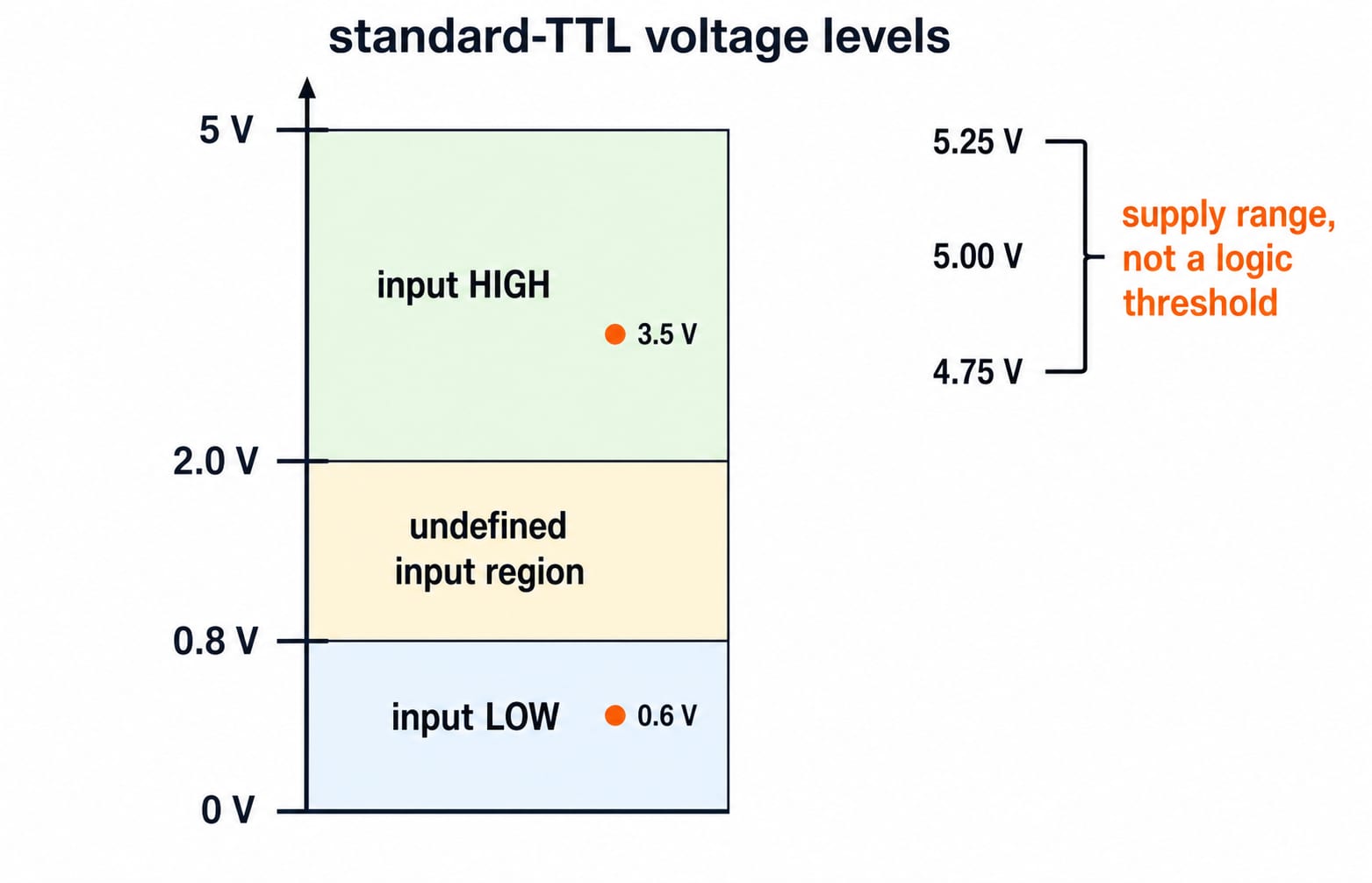
Answer: Option 2. The word "approximate" matters: 0.6 V is the LOW value and 3.5 V is the HIGH value intended by this item. The 5 V figure is the nominal TTL supply, not the usual HIGH output in this choice set. The negative-voltage pair is not standard for ordinary TTL.
Question 4
Source: CDAC CCAT 2017.
What is the voltage range of TTL family for detecting an input high signal?
3 - 15 V2 - 18V-0 to -15 V2 – 5 V
Answer: Option 4. Standard TTL recognises an input HIGH from about 2 V upward within its 5 V supply environment. For example, V_in = 3.3 V is in the HIGH range. By contrast, V_in = 1.2 V lies between the usual 0.8 V LOW ceiling and 2.0 V HIGH floor, so it must not be labelled reliably HIGH or LOW.
Question 5
Source: Bihar STET 2025.
What is the typical operating voltage range for the standard TTL logic family?
1.8 V to 3.3 V4.75 V to 5.25 V5.0 V to 12 V-5.0 V to 5.0 V
Answer: Option 2. A nominal 5.00 V supply with +/-5% tolerance has a deviation of 5.00 x 0.05 = 0.25 V. The lower limit is 5.00 - 0.25 = 4.75 V, and the upper limit is 5.00 + 0.25 = 5.25 V. This supply interval is different from the input-HIGH interval in Question 4 and the approximate output pair in Question 3.
4. CMOS, MOS and bipolar-family MCQs
Question 6
Source: Indian Space Research Organization 2011.
Logic family popular for low power dissipation
CMOSECLTTLDTL
Answer: Option 1, CMOS. Its complementary pull-up and pull-down networks mean that, in a stable ideal state, one network is off. Static power is therefore low compared with continuously conducting alternatives. Real CMOS still consumes dynamic power while switching, commonly modelled as proportional to C V^2 f, so "low power" does not mean zero power.
Question 7
Source: UPLT 2026.
Which of the following logic families use bipolar transistors?
NMOSCMOSGaAsTTL
Answer: Option 4, TTL. TTL expands to transistor-transistor logic and is based on bipolar junction transistors. NMOS and CMOS are MOSFET families. GaAs names a semiconductor material or technology in this option set, not the bipolar logic family being asked for.
5. ECL speed and transistor-saturation MCQs
Question 8
Source: UGC NET 2017.
ECL is the fastest of all logic families. High speed in ECL is possible because transistors are used in difference amplifier configuration, in which they are never driven into ____.
Race conditionSaturationDelayHigh impedance
Answer: Option 2, Saturation. ECL steers current through a differential pair and keeps the transistors out of saturation. Avoiding stored charge reduces the time required to leave the conducting state, which is the device-level reason this item associates ECL with high switching speed. Race condition and high impedance do not complete that explanation.
Question 9
Source: DSSSB 2021.
Which of the following statements is/are correct?
I. RTL is a saturated bipolar logic family.
II. ECL is a non-saturated bipolar logic family.
Only IOnly IIBoth I and IINeither I nor II
Answer: Option 3, Both I and II. Statement I is correct because RTL uses bipolar transistors as saturated switches. Statement II is also correct because ECL keeps its bipolar devices in the active, non-saturated region. This connects directly to Question 8: saturation is not a synonym for "bipolar," since two bipolar families can deliberately use different operating regions.
6. Delay, DCTL and speed-power-product MCQs
Question 10
Source: BPSC 2023.
Which characteristic of IC in Digital Circuits represents a function of the switching time of a particular transistor?
Fan-outFan-inPropagation delayMore than one of the aboveNone of the above
Answer: Option 3, Propagation delay. Propagation delay is the elapsed time between an input transition and the corresponding output transition. If the input crosses its reference level at 20 ns and the output crosses at 32 ns, the observed delay is 32 ns - 20 ns = 12 ns. Fan-in and fan-out count connections rather than elapsed switching time.
Question 11
Source: DSSSB 2021.
What is the full form of DCTL in logic family?
Direct-coupled transistor logicDiode-coupled transistor logicDirect-circuit transistor logicDirect-circuit threshold logic
Answer: Option 1, Direct-coupled transistor logic. The acronym expands term by term: direct-coupled transistor logic. "Direct-coupled" is the discriminator because stages connect without the diode input network that would suggest DTL.
Question 12
Source: DSSSB 2021.
Which of the following is correct regarding figure of merit of an IC?
Propagation delay time − powerPropagation delay time ÷ powerPropagation delay time × powerPropagation delay time + power
Answer: Option 3. The figure of merit is the speed-power product, P x t_pd. For IC A, (4 x 10^-3 W)(10 x 10^-9 s) = 40 x 10^-12 J = 40 pJ. For IC B, (25 x 10^-3 W)(2 x 10^-9 s) = 50 x 10^-12 J = 50 pJ. IC B is faster by propagation delay alone, but IC A has the lower speed-power product because 40 pJ < 50 pJ.
For a mixed set spanning every digital-electronics subtopic, continue with the Digital Electronics MCQs hub.
7. Score the set and choose the next revision step
Silicon is the chip material, and heating an n-type sample adds electrons and holes in equal numbers. Questions 3 to 5 separate three TTL quantities that are often merged: output levels of roughly 0.6 V and 3.5 V, an input-HIGH window of 2 V to 5 V, and a supply range of 4.75 V to 5.25 V. CMOS is the low-power MOS family and TTL is bipolar, while RTL saturates its transistors and ECL deliberately does not. Propagation delay is the input-to-output transition time, 12 ns in the worked example, DCTL expands to direct-coupled transistor logic, and the figure of merit is the product P x t_pd, which made the slower 40 pJ part the better one.
Use this as a study diagnostic, not an official cutoff:
10 to 12 correct: move to mixed Digital Electronics MCQs.
7 to 9 correct: revise the TTL voltage diagram and the bipolar/MOS map.
0 to 6 correct: rebuild the family table and calculate both numerical examples before retrying.
Re-solve only the missed group after 48 hours, then take another mixed set. For a GATE-oriented Digital Electronics sequence, use GATE Guidance by Sanchit Sir. For a broader CS-fundamentals route, use Zero to Hero. The GATE CS category is useful for course navigation. Your immediate next step is simple: record which group you missed, recalculate the 12 ns, 40 pJ and 50 pJ examples, and return to that group first.
Keep learning
Special Logic Circuits MCQs: 12 Solved Questions on Adders, Encoders, PLA and DAC
Solve 12 special logic circuits MCQs covering recognition, hardware counts, Boolean identities and numerical calculations. Each answer includes the reasoning you should reproduce in an exam.
19 Sep 20268 min read69 viewsDigital Electronics MCQs
Function Equivalence MCQs: 12 Solved Boolean Algebra Problems
Solve 12 function-equivalence questions step by step, from De Morgan's law and absorption to minterm sets, counterexamples and a four-option MSQ.
Updated 17 Sep 20268 min readDigital Electronics MCQs

CLA & Arithmetic Logic MCQs: 10 Solved Questions with Explanations
Solve ten CLA and arithmetic logic MCQs with compact workings for carry equations, timing paths, hardware sizing and operand-pair counting.
Updated 16 Sep 20267 min readDigital Electronics MCQs
Sync Counter Design MCQs: 11 Solved Questions on Modulus, State Sequences and Excitation Logic
Solve 11 synchronous-counter questions covering modulus boundaries, repeated outputs, common-clock tracing, excitation equations, enables and composite states.
Updated 14 Sep 20267 min readDigital Electronics MCQs