Left Factoring in Compiler Design: Prefix Rules, Worked Grammars and Exam Traps
Learn how to find a useful common prefix, factor a grammar to a fixed point, preserve empty suffixes, and test what the result does and does not prove.
KnowledgeGate Team
Exam prep & CS education
Updated 23 Aug 20265 min read
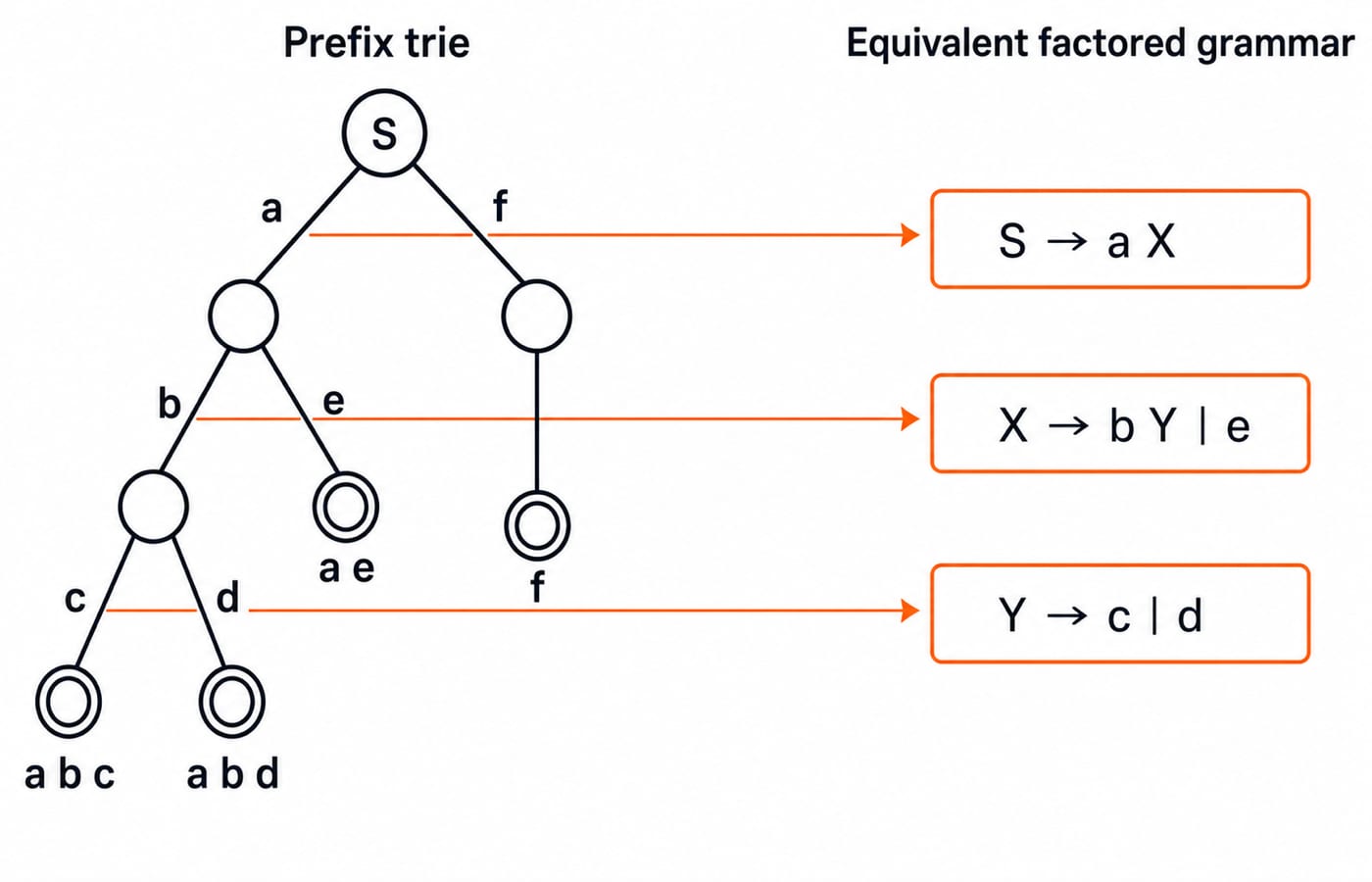
A grammar may look simple, yet a predictive parser can get stuck when alternatives such as a b c, a b d and a e all begin with a. The next input symbol does not reveal which production to choose. Left factoring reorganises such alternatives so the parser can consume the shared part first. Left factoring extracts the longest useful common prefix, repeats the transformation to a fixed point, and may still leave the result ambiguous or non-LL(1).
Left factoring and common prefixes: the exact idea
A string x is a prefix of y when y = xz for some string z, which may be empty. The prefixes of a b c are epsilon, a, a b and a b c. The longest common prefix of a b c and a b d is a b. Across a b c, a b d and a e, it is only a.
Suppose a context-free grammar has
A -> alpha beta1 | alpha beta2 | gammaThe alternatives beginning with non-empty alpha form one complete group, while gamma does not begin with it. Rewrite this as:
A -> alpha A' | gamma
A' -> beta1 | beta2
The parser consumes alpha before choosing a suffix, preserving L(A) while changing only grammar shape. This prefix logic also appears in GATE CS exam preparation.
Left factoring worked example: two passes to a fixed point
Start with:
S -> a b c | a b d | a e | fThe first three share a; after it, the first two share b. Extract a:
S -> a X | f
X -> b c | b d | e
Two X alternatives still begin with b, so factor again:
S -> a X | f
X -> b Y | e
Y -> c | d
X and Y are fresh non-terminals. Here e is a terminal, not epsilon.
Derive every terminal string from the result:
S => a X => a b Y => a b c
S => a X => a b Y => a b d
S => a X => a e
S => f
Both grammars generate {a b c, a b d, a e, f}. Factoring postpones choice without changing this set.
Left factoring when one alternative is the whole prefix
If an alternative equals the common prefix, its suffix is empty:
A -> a b | a b c | a b d | xThe a b suffixes are epsilon, c and d. Therefore:
A -> a b R | x
R -> epsilon | c | d
Dropping epsilon would remove a b. Verify all strings:
A => a b R => a b
A => a b R => a b c
A => a b R => a b d
A => x
After a b, $ selects R -> epsilon, c selects R -> c, and d selects R -> d. In a larger grammar, FOLLOW(R) governs epsilon, not automatically $. FIRST and FOLLOW conditions still determine whether the grammar is LL(1).
Left factoring helps predictive choice, but does not guarantee LL(1)
Consider:
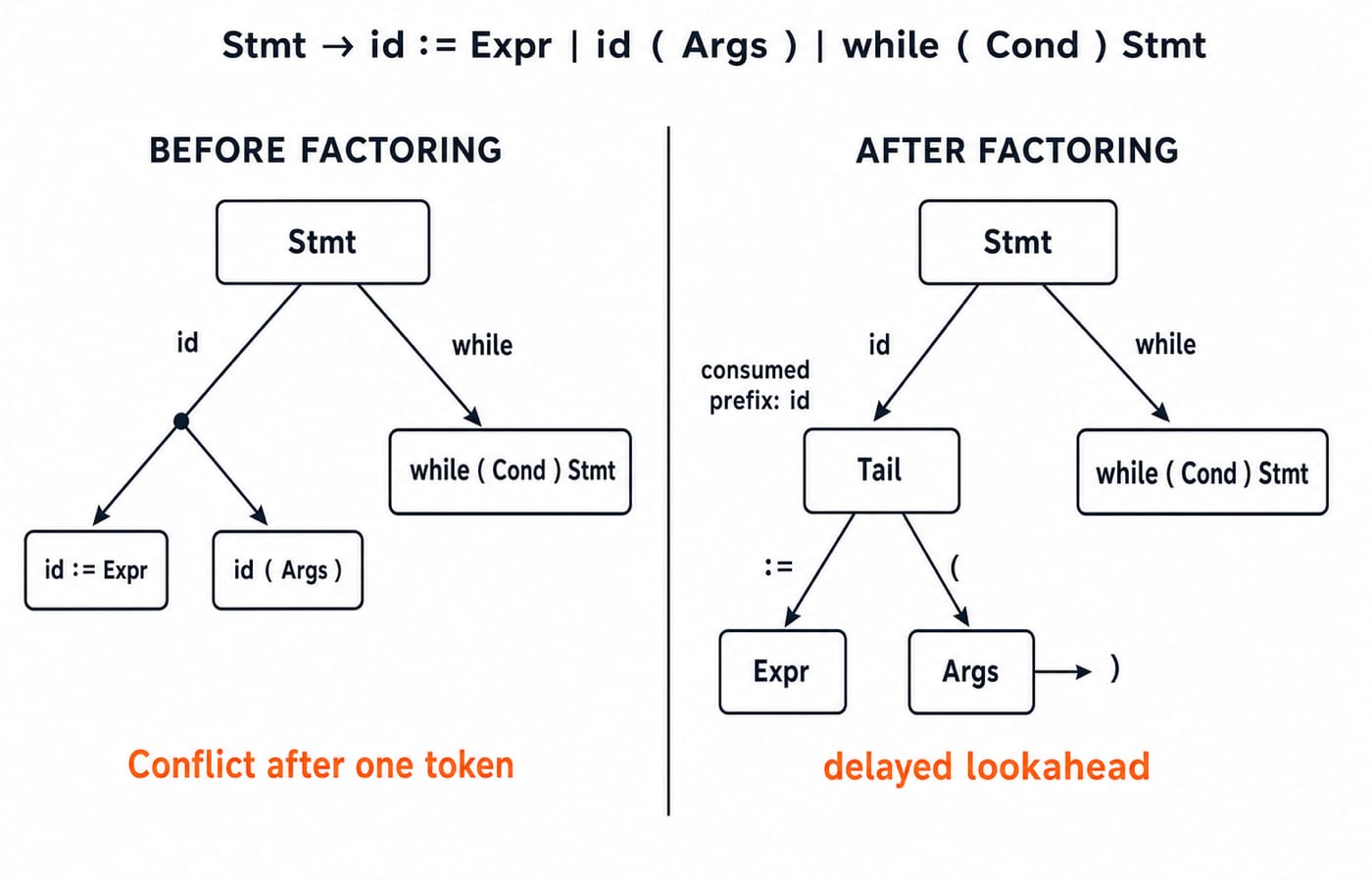
Stmt -> id := Expr | id ( Args ) | while ( Cond ) StmtLookahead id matches two alternatives. Factor them:
Stmt -> id Tail | while ( Cond ) Stmt
Tail -> := Expr | ( Args )
After id, the parser uses := or ( to select Tail. This top-down benefit is introduced in Parsing in Compiler Design: Top-Down and Bottom-Up Explained. Bottom-up parsers do not necessarily require the transformation.
This fixes the choice at Stmt, but LL(1) requires disjoint predictive sets everywhere. If two Tail alternatives began with (, further factoring or redesign would be needed. With epsilon, FIRST and FOLLOW conflicts must be absent.
Left factoring traps: longest prefix, left recursion and ambiguity
Test these common claims carefully:
Claim | Verdict | Reason |
|---|---|---|
Factor any pair once and stop | False | A helper may still share a prefix, as |
Always choose the longest common prefix across every alternative | False as phrased | Keep unrelated alternatives outside the group. Group the three |
Left factoring removes left recursion | False |
|
A left-factored grammar is unambiguous | False | Factoring preserves the language and delays choice. It is not an ambiguity-removal procedure. |
A dangling-else warning:
S -> if E then S else S | if E then S | otherIt factors to S -> if E then S S' | other and S' -> else S | epsilon, yet else association can remain ambiguous without another rule or grammar design.
Expand each helper into its caller. Check that every original alternative returns, no suffix vanished, and every non-terminal was rescanned for a common prefix.
Left factoring exam patterns and a reliable solving routine
Typical tasks ask for a longest prefix, an equivalent grammar, helper counts, a missing epsilon, the difference from left-recursion removal, or whether factoring proves LL(1).
Use this four-step routine on the main example:
Sort
a b c,a b d,a eandfby starting symbol.Group the three
aalternatives and extractaintoX.Rescan
X, then extractbintoY.Stop when no pair under one non-terminal shares a non-empty prefix. Back-expand to recover
{a b c, a b d, a e, f}.
For practice, use Context-Free Grammar MCQs: 11 Solved CFG, CFL, PDA. KnowledgeGate has about 3 live practice questions on Left Factoring & Prefixes. This indicates practice depth, not exam frequency.
Left factoring in the short version and the next step
Use this recall ladder:
Find alternatives of one non-terminal sharing a non-empty prefix.
Extract that prefix into one production.
Put suffixes in a fresh non-terminal, including
epsilonfor an empty suffix.Repeat to a fixed point.
For a self-check, reproduce both passes for S -> a b c | a b d | a e | f, derive all four strings, then factor A -> a b | a b c | a b d | x without losing R -> epsilon.
For Compiler Design sequenced with the CS syllabus, use GATE Guidance by Sanchit Sir. Next, solve both transformations unaided and verify by back-expansion.
Keep learning
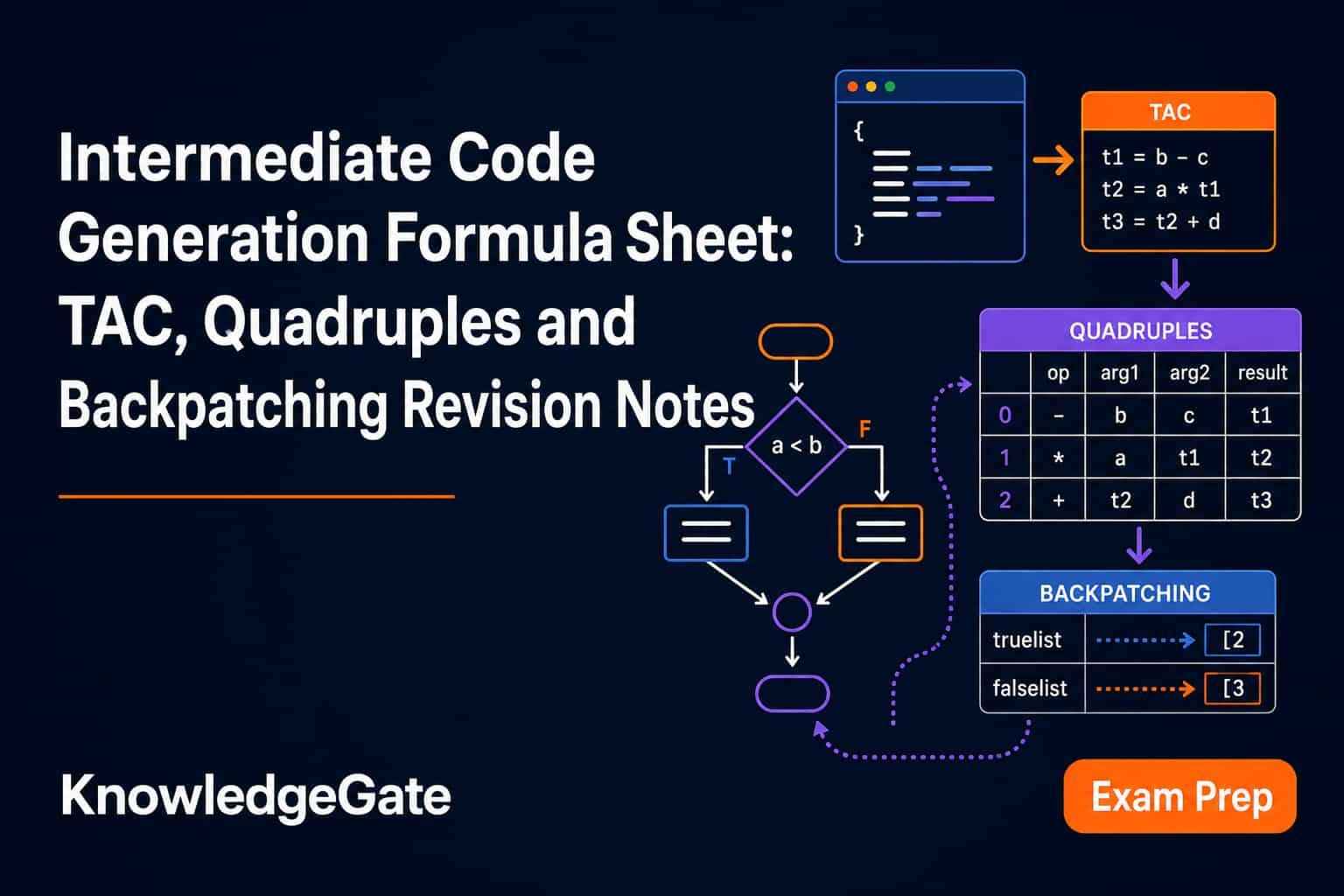
Intermediate Code Generation Formula Sheet: TAC, Quadruples and Backpatching Revision Notes
Revise intermediate code generation through compact formulas, representation tables and verified traces. Follow one expression from TAC to DAG reuse, then patch a Boolean branch exactly.
Updated 27 Oct 20266 min readCompiler Design
Grammar and CFG Formula Sheet: Rules, Worked Example and GATE Revision Notes
Revise CFGs in problem-solving order through precise rules, use cues, one consistent worked grammar, an LL(1) table, normal forms and a final audit routine.
Updated 26 Oct 20266 min readCompiler Design
Grammar and CFG Mistakes for GATE: 7 Traps and How to Fix Them
Seven small grammars expose the errors that make CFG answers go wrong, with reproducible checks for classification, ambiguity, FIRST sets and CNF.
Updated 24 Oct 20265 min readCompiler Design

Code Optimization Mistakes in Compiler Design: How to Avoid Losing GATE Marks
A rewrite that looks familiar is not necessarily safe. Trace six common optimization errors, learn why each one changes program meaning, and use a five-step check before accepting an answer.
Updated 22 Oct 20265 min readCompiler Design