Context-Free Grammar MCQs: 11 solved questions on CFG, CFL and PDA
Context-free grammar solved MCQs with explanations: 11 GATE PYQs on CFGs, the Chomsky hierarchy, CFL closure properties, pushdown automata and decidability.
KnowledgeGate Team
Exam prep & CS education
12 Jul 20267 min read
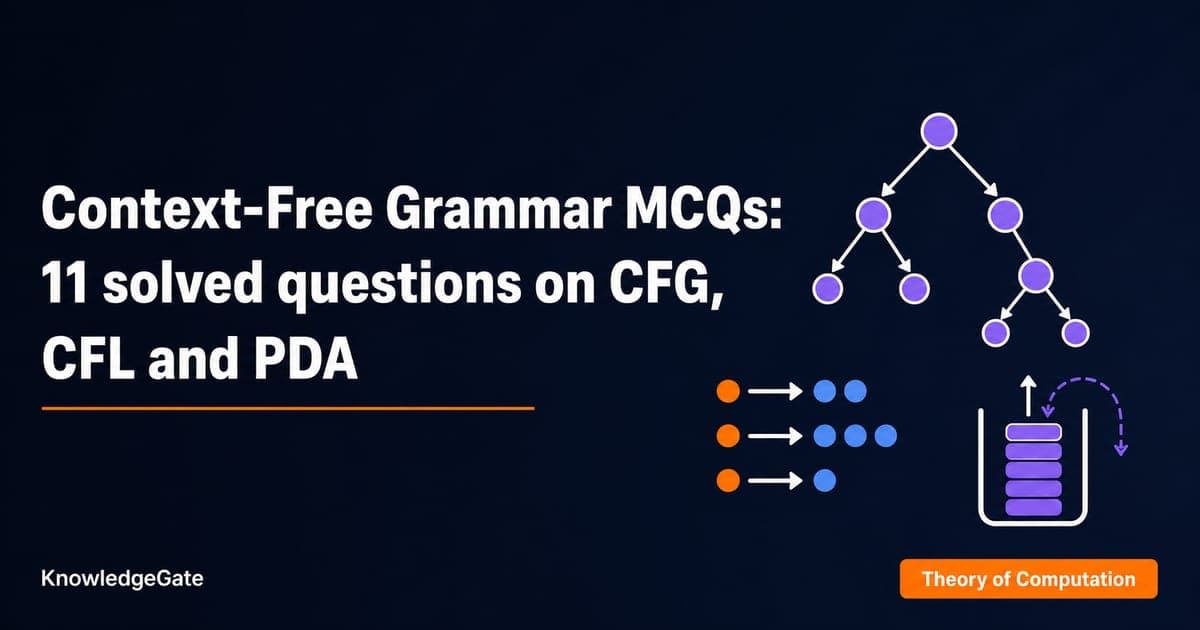
Context-free grammars sit one level above regular languages, and GATE tests that boundary hard: what a CFG can and cannot generate, which closure properties survive, and where deterministic and nondeterministic pushdown automata part ways. The eleven previous-year questions that follow run from GATE 1999 to GATE 2014 and fall into three blocks: where a language actually lands in the Chomsky hierarchy, which operations preserve context-freeness, and which questions about a grammar a machine can answer at all. Attempt each one first, then read the answer, and open the solution link when you want the derivation in full. If a result feels unfamiliar, the Context-Free Grammars and Pushdown Automata deep dive and the Theory of Computation learn module build the whole ladder from regular up to recursive.
Related reading: language closure MCQs and grammars and pushdown automata.
Context-free grammars and the Chomsky hierarchy
Q1. The C language is (GATE 2002)
(a) a context-free language
(b) a context-sensitive language
(c) a regular language
(d) fully parsable only by a Turing machine
Answer: (b). The syntax of C is largely context-free, which is why parsers use CFGs, but the full set of valid C programs is not. Rules like "an identifier must be declared before use, with a compatible type" depend on context that a CFG cannot enforce. Those context-dependent constraints push the language into the context-sensitive class (see the full solution).
Q2. Let L be the language generated by the grammar S → 0S0 | 00. Which of the following is true? (GATE 2000)
(a) L = 0⁺
(b) L is regular but not 0⁺
(c) L is context free but not regular
(d) L is not context free
Answer: (b). Starting from S, the rule S → 0S0 adds a zero on each side, and S → 00 closes with two zeros, so every string has an even number of zeros and at least two of them. That is the regular language (00)⁺, easily captured by a finite automaton. It is regular but not all of 0⁺, since odd-length strings of zeros are excluded (see the full solution).
Q3. The grammar S → aSa | bSb | a | b over {a, b} generates the set of (GATE 2009)
(a) all palindromes
(b) all odd length palindromes
(c) strings that begin and end with the same symbol
(d) all even length palindromes
Answer: (b). The base rules S → a and S → b produce single symbols, which are palindromes of length one. Each recursive rule wraps the same symbol around both ends, preserving the palindrome property and adding two to the length. Because every string keeps a single symbol at the exact centre, only odd-length palindromes are generated (see the full solution).
Q4. Which one of the following statements is FALSE? (GATE 2004)
(a) There exist context-free languages such that every grammar generating them is ambiguous
(b) An unambiguous CFG always has a unique parse tree for each string it generates
(c) Both deterministic and nondeterministic pushdown automata always accept the same set of languages
(d) A finite set of strings over an alphabet is always a regular language
Answer: (c). Deterministic pushdown automata recognize only the deterministic context-free languages, while nondeterministic PDAs recognize all context-free languages, and the deterministic class is a strict subset. So the two models are not equally powerful, which makes (c) the false statement. The other three are standard true facts, including the existence of inherently ambiguous context-free languages (see the full solution).
Context-free languages and closure
Q5. Context-free languages are closed under (GATE 1999)
(a) union, intersection
(b) union, Kleene closure
(c) intersection, complement
(d) complement, Kleene closure
Answer: (b). Context-free languages are closed under union, concatenation and Kleene closure, because you can combine or repeat their grammars directly. They are not closed under intersection or complement in general, which is why any option pairing those fails. Only union with Kleene closure lists two operations that both preserve context-freeness (see the full solution).
Q6. Which of the following statements is true? (GATE 2001)
(a) If a language is context free it can always be accepted by a deterministic pushdown automaton
(b) The union of two context-free languages is context free
(c) The intersection of two context-free languages is context free
(d) The complement of a context-free language is context free
Answer: (b). Union preserves context-freeness: give the two grammars disjoint variable sets and add a new start symbol with S → S₁ | S₂. Intersection genuinely fails, and the standard witness is {aⁿ bⁿ cᵐ} ∩ {aᵐ bⁿ cⁿ} = {aⁿ bⁿ cⁿ}, a language no CFG generates. Complement then fails as a consequence: closure under complement plus closure under union would force closure under intersection, by De Morgan. And not every CFL is deterministic, so (a), (c) and (d) are all false (see the full solution).
Q7. Let L be a context-free language and M a regular language. Then the language L ∩ M is (GATE 2006)
(a) always regular
(b) never regular
(c) always a deterministic context-free language
(d) always a context-free language
Answer: (d). Although two context-free languages need not have a context-free intersection, intersecting a CFL with a regular language always stays context free. The construction runs the PDA for L and the finite automaton for M in a product, which is still a PDA. So L ∩ M is always context free, though not necessarily regular or deterministic (see the full solution).
Q8. Let L = L1 ∩ L2, where L1 = { aᵐ bᵐ c aⁿ bⁿ | m, n ≥ 0 } and L2 = { aⁱ bʲ cᵏ | i, j, k ≥ 0 }. Then L is (GATE 2009)
(a) not recursive
(b) regular
(c) context free but not regular
(d) recursively enumerable but not context free
Answer: (c). L2 permits only a's, then b's, then c's, so nothing may follow the c. Every L1 string has the shape aᵐ bᵐ c aⁿ bⁿ, so the tail aⁿ bⁿ has to vanish and n = 0. The intersection is therefore exactly { aᵐ bᵐ c | m ≥ 0 }. A PDA accepts that by pushing each a and popping one per b, so it is context free; no finite automaton can hold an unbounded count of a's, so it is not regular (see the full solution).
Pushdown automata and decision properties
Q9. Which of the following problems is undecidable? (GATE 2007)
(a) Membership problem for CFGs
(b) Ambiguity problem for CFGs
(c) Finiteness problem for finite automata
(d) Equivalence problem for finite automata
Answer: (b). Whether a given context-free grammar is ambiguous, meaning some string has two distinct parse trees, has no general decision algorithm. The other three are all decidable: membership by parsing, and finiteness and equivalence for finite automata by standard state-based procedures. So ambiguity of CFGs is the undecidable one (see the full solution).
Q10. Which one of the following problems is undecidable? (GATE 2014)
(a) Deciding if a given context-free grammar is ambiguous
(b) Deciding if a given string is generated by a given CFG
(c) Deciding if the language of a given CFG is empty
(d) Deciding if the language of a given CFG is finite
Answer: (a). The same undecidable problem returns seven years later. There is no algorithm that decides, for every CFG, whether it is ambiguous; the standard proof reduces the Post Correspondence Problem to it. Membership, emptiness and finiteness of a CFG are all decidable by parsing and reachability arguments (see the full solution).
Q11. The language accepted by a pushdown automaton whose stack is limited to 10 items is best described as (GATE 2002)
(a) context-free
(b) regular
(c) deterministic context-free
(d) recursive
Answer: (b). A PDA gets its extra power from an unbounded stack. Cap the stack at 10 items and the number of possible stack contents becomes finite, so pairing the finite control with the finitely many stack configurations yields an ordinary finite automaton. A bounded-stack PDA therefore recognizes only regular languages (see the full solution).
How context-free languages are examined
The pattern is stable from GATE 1999 to GATE 2014. The grammar block (Q1 to Q4) tests where a language actually lands in the Chomsky hierarchy and the fact that deterministic PDAs are strictly weaker than nondeterministic ones. The closure block (Q5 to Q8) is almost pure recall backed by one construction, and the table below is very nearly the whole of what gets asked. The decision block (Q9 to Q11) rewards knowing that CFG ambiguity is undecidable while membership, emptiness and finiteness are not, plus the neat result that a bounded stack collapses a PDA to regular power. Equivalence is the one to keep straight: decidable for finite automata, which is what Q9 leans on, and undecidable for context-free grammars.
Operation | Context-free languages |
|---|---|
Union | Closed |
Concatenation | Closed |
Kleene closure | Closed |
Reversal | Closed |
Intersection with a regular language | Closed |
Intersection of two CFLs | Not closed |
Complement | Not closed |
Difference of two CFLs | Not closed |
If a question caught you out, the fix is conceptual, not more drilling. Work through the Context-Free Grammars and Pushdown Automata deep dive again, then take the full previous-year sets inside GATE Guidance by Sanchit Sir. Solve, revisit the ones you missed, and return a week later; the second pass is where the closure table and the decidability list become automatic.
Keep learning
Closure Properties MCQs: 12 Solved Regular Language PYQs with Explanations
Solve 12 regular-language PYQs with proofs, counterexamples, and step-by-step transformations. The set targets the quantifier traps that make closure questions difficult.
13 Sep 20268 min readTheory of Computation MCQs
Grammar Design via Regex MCQs: 12 Solved PYQs with Explanations
Solve 12 grammar and regex PYQs by tracing productions, removing dead branches, tracking symbol counts and proving membership with exact derivations.
12 Sep 20268 min readTheory of Computation MCQs
Decision Properties MCQs: 10 Solved CFG and PDA Questions
Solve ten Decision Properties MCQs by separating the input model from the property being tested, then checking the relevant algorithm or undecidability result.
11 Sep 20268 min readTheory of Computation MCQs
Closure Properties MCQs for Turing Machines: 12 Solved Questions
Test the closure rules that separate decidable and Turing-recognisable languages. These 12 solved MCQs show how complement, difference, dovetailing, and countability shape the answers.
Updated 9 Sep 20268 min readTheory of Computation MCQs