You know both language names, but now your team must choose one for a real JVM service. Syntax taste is a weak decision rule. Null safety, Java interoperability, async control flow, build tooling, runtime compatibility and team ownership decide the trade-off; the wider Coding & Skill Development catalog is useful only after this JVM boundary is clear.
Start with the decision boundary: language choice is not JVM choice
Both implementations are JVM applications and must satisfy the same contract: ticket 42, title Payment callback failed, nullable assignee, queue depth 7, and active worker count 3. The language affects expression and compiler checks. The JVM target, framework, libraries, packaging and deployment remain separate choices. This does not imply equal binaries, identical performance or automatic source compatibility.
Judge the options on six axes: null handling, ceremony, reuse of Java code, async control flow, build-chain fit and team familiarity. Measure throughput and memory on the packaged application because a small syntax sample cannot prove either language faster. A mature Java service with Java-skilled maintainers has real switching costs. A greenfield service or bounded module may justify Kotlin when nullable data and async orchestration dominate. Both conclusions are conditional.
Match the null-safety example instead of comparing slogans
The same value can be represented with a Java record or a Kotlin data class. The Java record requires a project baseline that supports records.
record Ticket(long id, String title, String assignee) {}

String owner = ticket.assignee() == null
    ? "UNASSIGNED"
    : ticket.assignee().toUpperCase(Locale.ROOT);
String output = "#" + ticket.id() + " | " + ticket.title() + " | " + owner;data class Ticket(val id: Long, val title: String, val assignee: String?)
val owner = ticket.assignee?.uppercase() ?: "UNASSIGNED"
val output = "#${ticket.id} | ${ticket.title} | $owner"Run each with Ticket(42, "Payment callback failed", null). Both must produce #42 | Payment callback failed | UNASSIGNED. Change only the assignee to "Asha", and both must produce #42 | Payment callback failed | ASHA.
Kotlin's null-safety documentation defines the String? distinction, safe call and Elvis operator used here. Kotlin makes this nullable contract visible in the type. Plain Java needs a convention, explicit checks or selected annotation tooling. Kotlin still permits null failures through !!, explicit exceptions and Java platform types. For the Java side, String Handling in Java extends the discussion of Java-specific string behaviour.
Test Java interoperability at a real call boundary
Suppose the codebase already contains this utility:
static int totalDelayMs(int attempts, int stepMs) {
    int total = 0;
    for (int i = 1; i <= attempts; i++) total += i * stepMs;
    return total;
}
For attempts = 3 and stepMs = 200, the loop adds 1 x 200 + 2 x 200 + 3 x 200, or 200 + 400 + 600 = 1200. A Java caller and the positional Kotlin call RetryPolicy.totalDelayMs(3, 200) must both print Retry delay: 1200 ms. Kotlin's Java-interoperability documentation explains this direct calling boundary.
Direct use of an ordinary Java API is common, but inspect platform types, checked-exception expectations, bean conventions, generated code and nullability annotations at every boundary. Test that boundary with real fixtures, not stubs alone. Kotlin data classes and Java records both reduce value-carrier ceremony, but their generated members and language rules differ. Concise declarations do not settle identity, mutation or encapsulation decisions.
Compare coroutines with a Java completion-stage flow
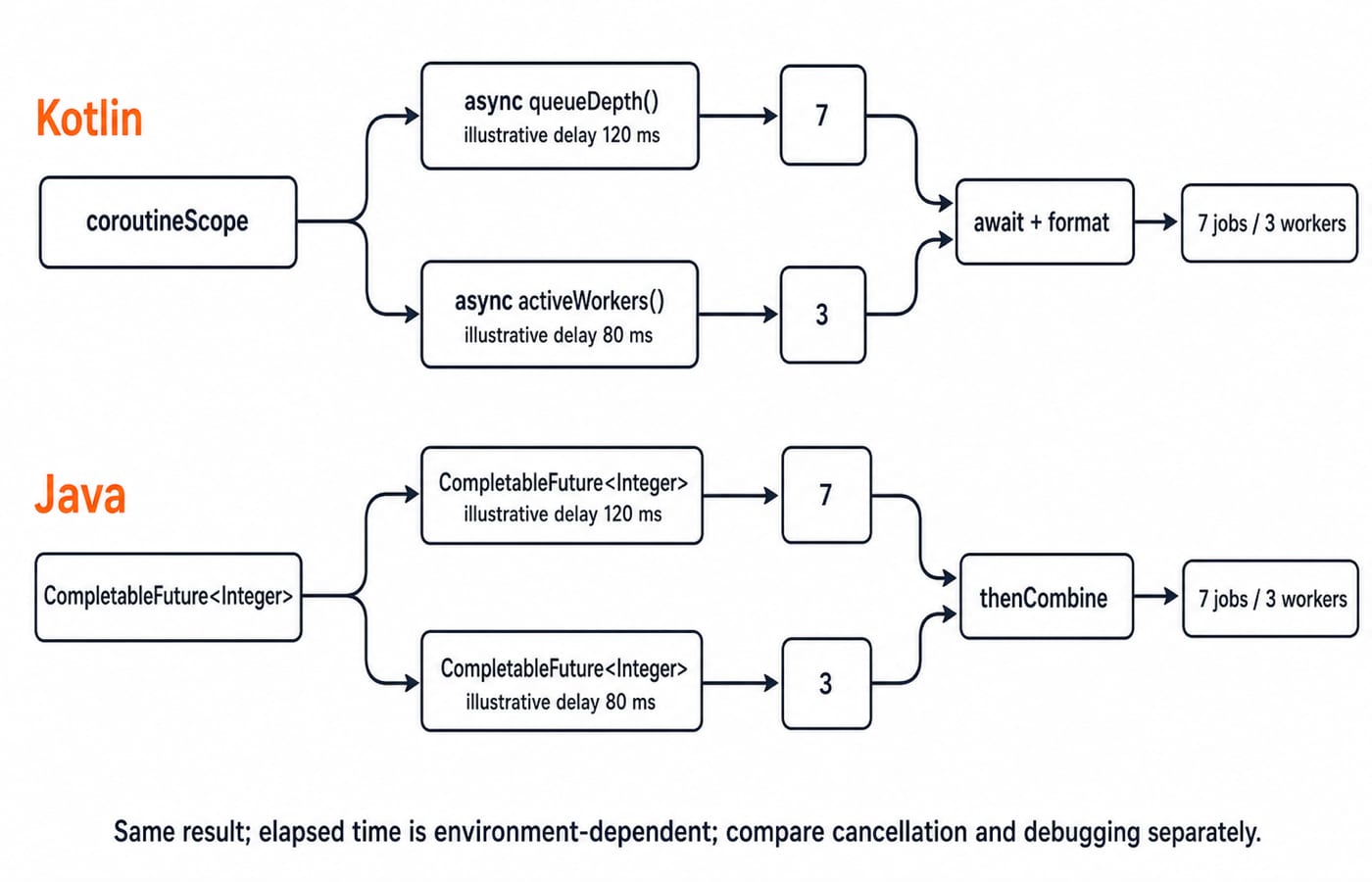
Use deterministic helpers for the returned values: queueDepth() has an illustrative 120 ms delay and returns 7; activeWorkers() has an 80 ms delay and returns 3.
val line = coroutineScope {
    val depth = async { queueDepth() }
    val workers = async { activeWorkers() }
    "${depth.await()} jobs / ${workers.await()} workers"
}CompletableFuture<Integer> depth = queueDepth();
CompletableFuture<Integer> workers = activeWorkers();
CompletableFuture<String> line = depth.thenCombine(
workers, (d, w) -> d + " jobs / " + w + " workers");Both paths print 7 jobs / 3 workers. Kotlin documents coroutineScope, async, suspension and structured cancellation in its coroutines overview. kotlinx.coroutines is a library dependency, and not every Kotlin function is a coroutine. Oracle defines completion-stage combination in the CompletableFuture API.
The delays are fixtures, not benchmark results. Completion is not guaranteed at exactly 120 ms, and coroutines do not make CPU-bound work faster. Compare readability, cancellation, error propagation and debugging in the actual framework. Confirm which dispatcher or executor owns blocking work during debugging.
Audit build tooling and runtime compatibility before migration
Turn compatibility into a build checklist:
Fix the chosen JDK, target bytecode, and Java and Kotlin compiler settings.
Add the Kotlin Gradle plugin and standard library to the runtime classpath.
Add the coroutine dependency only where it is used.
Check annotation processors or KSP/kapt equivalents, framework proxy and reflection requirements, test discovery, static analysis, packaging and CI cache behaviour.
Use RetryPolicy as a smoke test. Clean-build the Java utility, compile the Kotlin caller against it, run the test expecting 1200, package the application, then repeat the process in CI. Successful IDE execution does not verify the deployable artifact.
Kotlin can compile to JVM bytecode and interoperate with Java, but every library, processor and plugin is not equally smooth. Pilot one bounded module or vertical slice before a repository-wide migration. Record build time, binary size, failure diagnostics and rollback behaviour from the same pipeline.
Use a JVM adoption scorecard instead of inventing precision
Record observed evidence from the same Ticket #42 pilot. A lead, tie or blocker is easier to defend than numerical weights borrowed from another team.
Factor | Java evidence | Kotlin evidence | Current lead |
|---|---|---|---|
Null contract | The explicit check prints UNASSIGNED, but plain String does not encode nullable intent. | String? encodes nullable intent; Java platform types still need an audit. | Kotlin |
Existing Java API | The native call returns 1200 in the current build. | The direct Kotlin call returns 1200; platform-type and exception expectations remain. | Tie after the boundary test |
Async flow | thenCombine returns 7 jobs / 3 workers; cancellation still needs a test. | coroutineScope returns the same line; dispatcher and cancellation still need tests. | Pending cancellation test |
Team ownership | Current maintainers can debug and operate it. | Kotlin ownership must be proved in review and on-call work. | Java until the pilot |
Build artifact | The existing Java artifact passes CI. | The mixed artifact must pass compiler, processor, proxy and packaging checks. | Java until CI is green |
When nullable DTOs and structured cancellation dominate a greenfield service, Kotlin leads if the mixed build and cancellation tests pass. When migration cost, current maintainers, annotation processors and rollback speed dominate, Java leads until the pilot removes those risks. The winner changes because the decision boundary changes, not because arbitrary weights were adjusted.
If the unresolved question is service versus script, Go vs Python: Choose for Services, Scripts and Team Speed compares workload type, deployment and two workload-specific matrices. Here the unresolved question is narrower: whether Kotlin can enter a Java ecosystem without losing Java reuse, mixed-build reliability or operational ownership.
Catch the traps that interviews and design reviews expose
Keep each claim inside its boundary:
Shorter syntax does not guarantee clearer architecture.
Kotlin null safety is not a no-NPE guarantee.
Java interoperability is not source equivalence.
Coroutines are not automatically faster threads.
Java familiarity does not remove explicit null-handling work.
A mixed-language build must pass CI, not merely run in an IDE.
Shallow reasoning is exposed by four checks: predict both outputs for assignee = null and assignee = "Asha"; explain String versus String?; calculate 200 + 400 + 600; and explain why the async sample proves equal results but not elapsed-time superiority. Use the linked first-party Kotlin and Oracle documentation for authoritative behaviour.
Choose for the codebase you actually have
Choose Kotlin when visible null contracts and coroutine-heavy orchestration materially help and the team can own the toolchain. Choose Java when existing code, build compatibility and team fluency dominate. Keep useful Java libraries, pilot the Ticket #42 slice, and benchmark the packaged application. Use Java for Java fundamentals and DSA using Java for later Java-based algorithm practice. Neither link evidences Kotlin coverage. Revisit every scorecard row after the pilot, then prototype the highest-risk boundary.