BPSC Prelims Previous-Year Analysis: Subject-wise Question Distribution and What to Read First
Use recent official BPSC CCE prelims papers to decide what to read first. The method builds a qualitative priority ladder, a six-week drill and an error log that drives revision.
KnowledgeGate Team
Exam prep & CS education
Updated 11 Aug 20267 min read
Most BPSC prelims aspirants read every subject with the same intensity and run out of time before their strongest scoring areas become dependable. Previous-year papers give you a better order. They reveal where the paper repeatedly leans, so you can decide what to master first without pretending that any subject is safe to ignore.
Related reading: BPSC Prelims syllabus and BPSC eligibility and exam pattern.
1. Why equal reading is the wrong default
The BPSC CCE prelims syllabus is broad, but your preparation time is finite. Giving an equal week to every block sounds balanced, yet it ignores two practical facts: subjects do not appear with identical emphasis, and your own error rate is not identical across subjects.
Previous-year analysis turns a syllabus list into a priority list. It cannot predict the next paper question by question, but it does show which blocks recur strongly and which weak areas keep costing you marks. The goal is never to delete a subject. It is to set the sequence and depth of the first pass, then let test evidence move things around.
2. Why PYQ-first beats syllabus-first
A syllabus defines the boundary of examinable content. It does not tell you how often a commission has recently sampled each corner of that boundary. If you wait to finish every textbook before opening a paper, you lose the evidence that should have shaped your reading.
Begin with official papers from several recent cycles. Attempt them even if much of the syllabus is unfinished, and record for every question whether you answered correctly, guessed correctly, guessed wrongly or left it. Why PYQs beat question banks explains why this diagnostic value is different from solving an unlimited set of generic questions.
Use the official BPSC website for papers and commission material. Any subject count you rely on has to come from the specific papers you analysed, never from an unattributed infographic.
3. The subject blocks and how to count their share yourself
The CCE prelims syllabus names its own blocks, so use those as your labels rather than inventing a scheme. It covers general science, current events of national and international importance, the history of India together with Bihar's role in the national movement, geography including the geography of Bihar, Indian polity and economy including post-independence changes in Bihar's economy, and general mental ability. Bihar is not a bonus block bolted on at the end. It is written into the history, geography and economy entries themselves, which is why most aspirants add one extra column, Bihar GK, and send any Bihar-specific question there whatever its subject.
Structurally the CCE prelims has been a single objective General Studies paper, 150 questions in two hours in recent cycles, and it works as a screening stage: prelims marks do not carry into the final merit list. Confirm the pattern, the marking scheme and the syllabus text in the official notification for your own cycle before you plan around any of them.
A percentage table is worth trusting only when it names the papers behind it, and the commission publishes no topic-wise blueprint. So the distribution you plan against has to be one you count. Download the last five or six official CCE prelims papers from the BPSC website, open a sheet with one row per year and one column per label, and tag every question with exactly one of them before you total anything. Two or three focused evenings are enough, and the tagging teaches you how BPSC frames its questions.
Three rules keep the tally honest. One label per question: decide once whether a Bihar economy question sits under economy or under Bihar GK, write that rule at the top of the sheet, and never move a question later to tidy a trend. Tag by what you needed to know to answer, not by the noun the question mentions. And record two numbers per block, questions asked and questions you got right, because a block carrying thirty questions you handle well is a smaller problem than one carrying fifteen you keep losing.
Then read the sheet in two directions. Down a column you see whether a block's share holds steady across years or swings. Across a row you see whether one paper was unusual. A block that stays large in every year you counted is a first-tier commitment. One that is large once and modest otherwise earns a controlled pass, not a rebuilt timetable. Recount before you plan against the totals, and if you pass them to anyone, pass the paper list with them.
4. What to read first, the priority order
Use three tiers for the first preparation pass.
Tier 1: polity, Bihar static GK and current affairs. Start here because the syllabus itself protects this block: Bihar is written into the history, geography and economy entries, current events carry an entry of their own, and polity supplies the institutional vocabulary that governance-flavoured current-affairs questions assume. Treat it as first tier until your own tally says otherwise. Build clear basics in constitutional institutions and governance, keep a separate Bihar notebook, and run a current-affairs revision loop.
Tier 2: modern history, including Bihar, then geography. These subjects reward a structured timeline and map-based revision. Connect national movements to Bihar rather than treating state history as an appendix.
Tier 3: economy, then general science. Cover fundamentals and recurring applications first. Do not abandon them because their share varies. Give them a controlled first pass, then promote a weak subtopic when your PYQ log shows repeated losses.
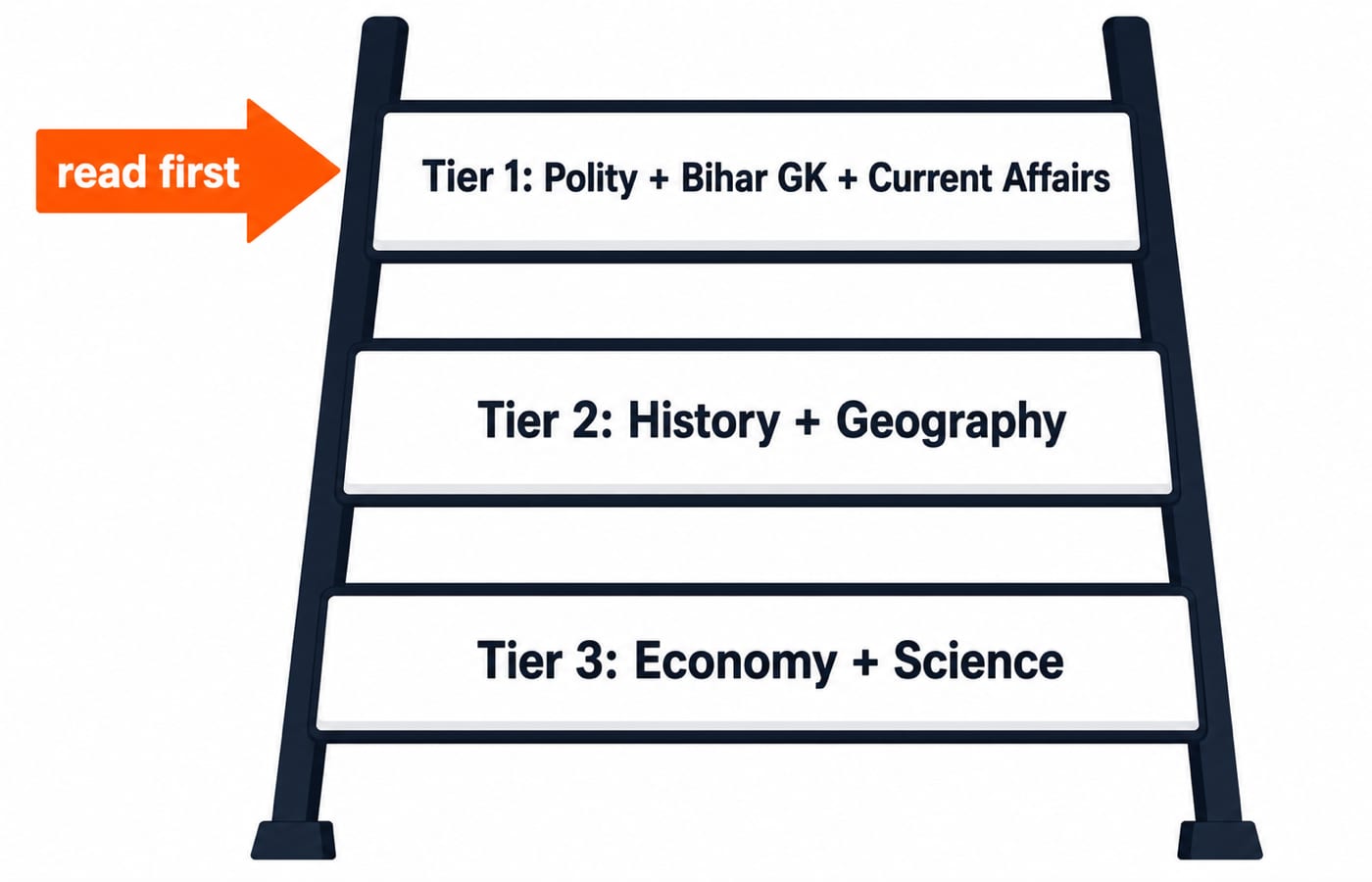
This ladder sets the opening order, not the final amount of study. General mental ability sits outside it deliberately: it rewards short timed sets rather than reading, so run those alongside whichever tier you are on rather than queueing them behind it. If a recent paper is unusually science-heavy, add a science revision block, but do not overturn a multi-paper pattern because of one paper.
5. A concrete PYQ-drilling plan
Use about six weeks to move from diagnosis to full-paper execution. Aim for roughly two papers a week, first reorganised by subject and later attempted in their original form.
Weeks 1 and 2: classify and diagnose
Take several recent official papers and tag every question with one of the syllabus labels. Solve all polity questions together, then Bihar GK, current affairs, history, geography, economy, science and general mental ability. The grouping makes repeated concepts visible. Start an error log with four fields: source paper, topic, why you missed it, and the exact revision action.
Weeks 3 and 4: repair by priority
Re-read Tier 1 topics where the log shows concept gaps. For a factual miss, write the smallest useful correction. For a reasoning miss, explain why each rejected option was wrong. Continue with Tier 2 and Tier 3, but spend time in proportion to repeated errors rather than page count.
Weeks 5 and 6: restore the full paper
Attempt papers in their original sequence under the duration stated for that paper or the current notified format. This tests question switching, decision speed and guess control. Review the same day. In the final two weeks, protect the timed full-paper attempts even if reading has slipped.
Review the error log weekly. A solved paper creates familiarity; a reviewed error creates a correction. Track whether a repeated topic moves from wrong to correct without guessing. That change is stronger evidence of progress than the number of pages completed.
6. Handling current affairs the right way
Use a rolling current-affairs window, broadly the six to twelve months relevant to your target cycle, and confirm the expected scope from official papers and the current syllabus. Combine national and international events with a dedicated Bihar stream.
Make one compact page of notes per study day or session. Each note should answer: what happened, why it matters, which static topic it connects to, and what Bihar angle exists. Then compress the week's pages into a short revision sheet. The method in SSC CGL general awareness approach transfers well to this mix of static knowledge and current events, although BPSC needs a much stronger Bihar layer.
7. The analysis traps to avoid
Memorising answers instead of concepts: a repeated theme can return with new framing or options.
Ignoring Bihar-specific material: generic national notes leave a major part of the paper underprepared.
Overreacting to one year: a science-heavy or economy-heavy paper is data, not the whole trend.
Mixing sources silently: count only papers you can identify, and keep your subject labels stable.
Skipping timed attempts: subject-wise drilling builds knowledge, while full papers train selection and pace.
If you miss days, preserve Tier 1 revision and the scheduled full-paper attempts. Reduce duplicate reading before cutting the feedback loop that tells you what is still weak.
8. The short version and your next step
Let several recent official prelims papers set your reading order. Begin with polity, Bihar GK and current affairs, then modern history and geography, followed by economy and science. Drill subject-wise, keep a reason-based error log, and finish with timed full papers.
KnowledgeGate does not currently list a BPSC CCE course, so keep your paper set, notification and study decisions tied to official BPSC material. If you are also preparing for other government recruitment exams, the govt jobs category lists the structured courses on offer. And if you are actually targeting BPSC TRE (teacher recruitment, a different exam with its own pattern and papers), start from the govt teaching jobs category instead.
Keep learning
Browsers and Search Engines MCQs: 9 Solved Questions with Explanations
Solve nine published browser and search engine questions, check each answer, and rebuild the browser, cache, crawler and indexing distinctions that exam distractors blur.
Updated 6 Oct 20267 min readTeaching Recruitment (Computer Science)
IT Act, 2000 Explained: Key Sections, Digital Signatures and Worked Exam Examples
Build an exam-ready map of the IT Act, then apply it to an exact digital-signature walkthrough and a section 43, 66, 66C and 66D caselet.
Updated 2 Oct 20266 min readTeaching Recruitment (Computer Science)
Emerging Trends Introduction MCQs: 12 Solved Questions with Explanations
Solve 12 Emerging Trends Introduction questions with clear answer logic, exam-year labels and a compact trap check for focused revision.
Updated 27 Sep 20268 min readTeaching Recruitment (Computer Science)
MS Word Basics MCQs with Answers: 12 Solved Questions Explained
Work through 12 MS Word questions covering everyday commands, page layout, formatting, links, file features and mail merge. Each answer explains the decisive clue and the closest distractor.
Updated 25 Sep 20267 min readTeaching Recruitment (Computer Science)