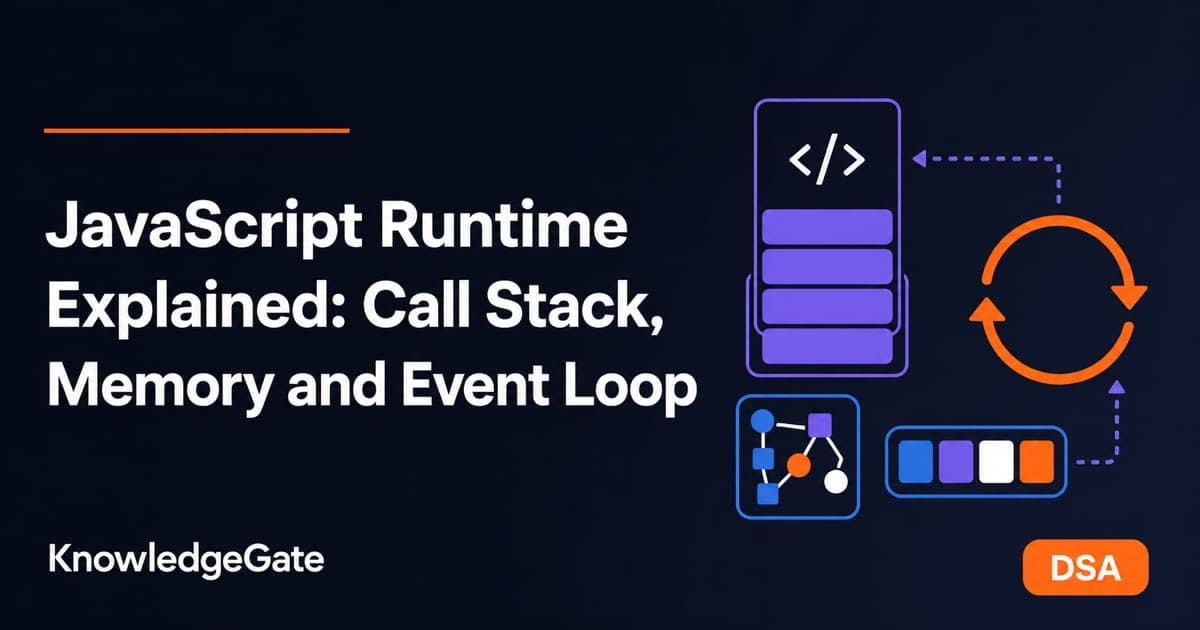
JavaScript reads like a sequence of lines, yet terms such as engine, call stack, heap, Web APIs and event loop can make execution sound mysterious. A zero-delay timer waits because the runtime processes its callback according to scheduling rules.
JavaScript, the engine and the runtime are different layers
JavaScript is the language and defines what code means. An engine parses and executes it. A runtime combines the engine with an environment and host capabilities, such as the DOM and timers in a browser or file-system APIs in Node.js.
Host APIs are not automatically part of JavaScript. This program uses features available in both environments:
const learner = "Asha";
const solved = 18;
console.log(learner + " solved " + solved);
Its output in a modern browser console and Node.js is:
Asha solved 18By contrast, document.title comes from a browser page and normally produces ReferenceError: document is not defined in Node.js. Versions and host APIs differ, so identify the target environment.
JavaScript belongs within a wider Coding & Skills path. For the surrounding browser concepts, connect this model to Web Technologies for Teaching Exams: HTML and HTTP.
What happens from JavaScript source text to a result
An engine parses source text, validates syntax, produces executable instructions and runs them in the current execution context. Modern engines may interpret and optimise code, but strategies differ. This portable model is more useful than calling JavaScript interpreted-only.
Trace this example one line at a time:
const base = 7;
const doubled = base * 2;
const total = doubled + 3;
console.log(total);
The value trace is base = 7, then doubled = 7 * 2 = 14, then total = 14 + 3 = 17. The final output is 17.
A syntax failure stops parsing: const = 7; is not a valid declaration. A runtime failure happens later: const amount = 42; amount(); parses, but calling the number produces a TypeError.
For each line ask: what value is created, where can it be reached by name, and what operation is scheduled or completed next?
Values, bindings and a safe JavaScript memory model
A variable is a binding to a value. Primitive assignment copies the value. Object assignment preserves the same identity unless you construct a separate object.
let threshold = 20;
let copiedThreshold = threshold;
copiedThreshold = 24;

const learner = { name: "Asha", score: 18 };
const sameLearner = learner;
sameLearner.score += 4;
const copiedLearner = { ...learner, score: learner.score + 3 };

console.log(threshold, copiedThreshold);
console.log(learner.score, sameLearner.score, copiedLearner.score);
The exact output is:
20 24
22 22 25
copiedThreshold starts at 20, then receives 24, so threshold stays 20. learner and sameLearner reach the same object. Adding 4 changes its score from 18 to 22 for both. Spread creates a separate top-level object with score 22 + 3 = 25.
Object spread is shallow, so nested objects can still be shared. Describing active calls as a stack and objects as heap data is a useful picture, not a specification guarantee about physical storage. Unreachable values become eligible for runtime-managed cleanup, but its exact timing is not a program contract.
The call stack traces synchronous execution
The call stack is the last-in, first-out record of active calls. Consider this complete program:
function double(n) {
  return n * 2;
}

function addBonus(score) {
  const doubled = double(score);
  return doubled + 3;
}

console.log(addBonus(7));
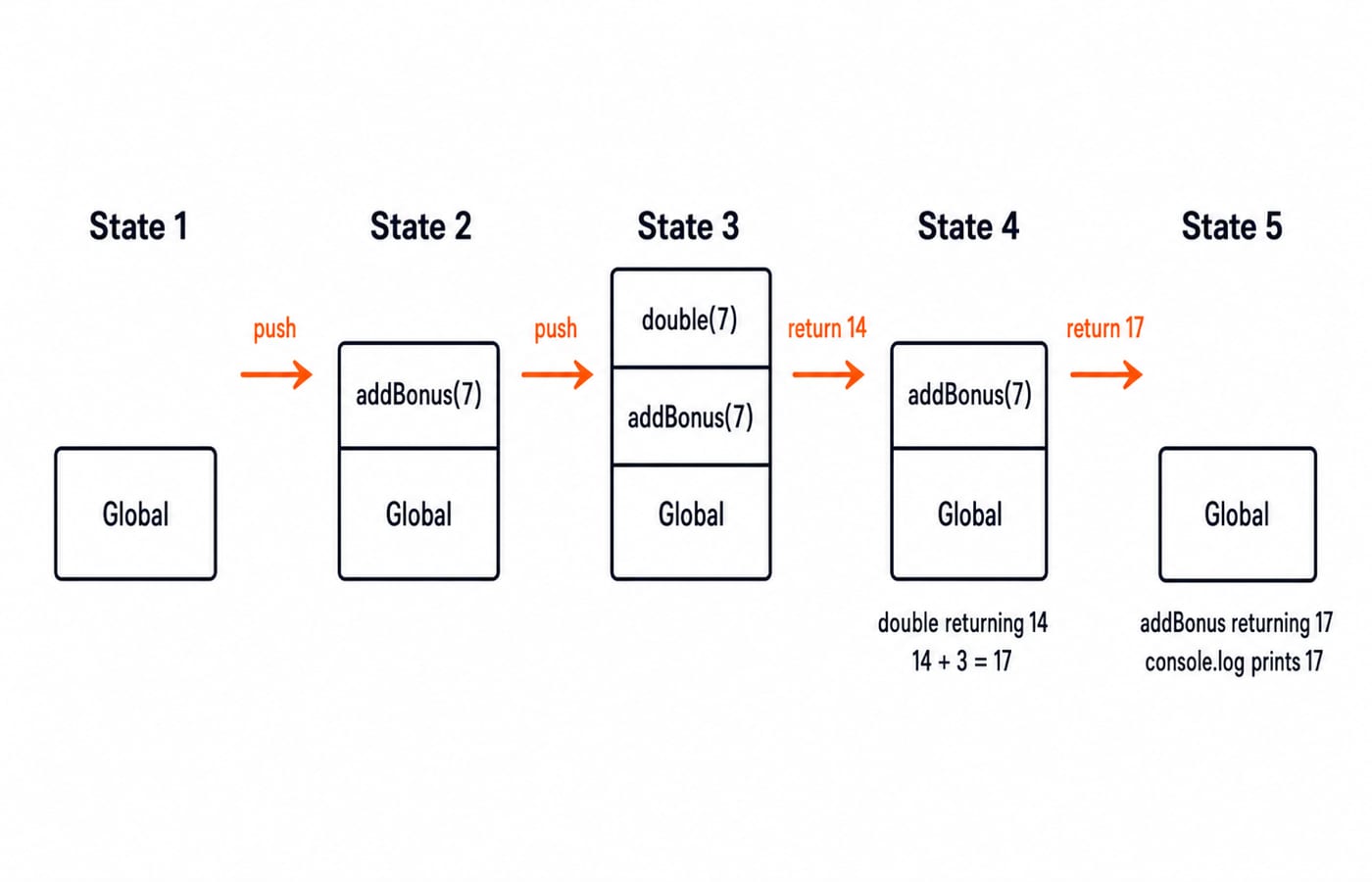
Global code calls addBonus(7) and pushes its frame. It calls double(7), placing that frame on top. double computes 7 * 2 = 14, returns and leaves. addBonus computes 14 + 3 = 17, returns and leaves. console.log prints 17.
Recursion uses the same mechanism. function recurse() { recurse(); } keeps adding frames until the stack limit is exceeded. Do not run it merely to obtain an error message or call-depth number, because those details are engine-specific.
The event loop changes asynchronous output order
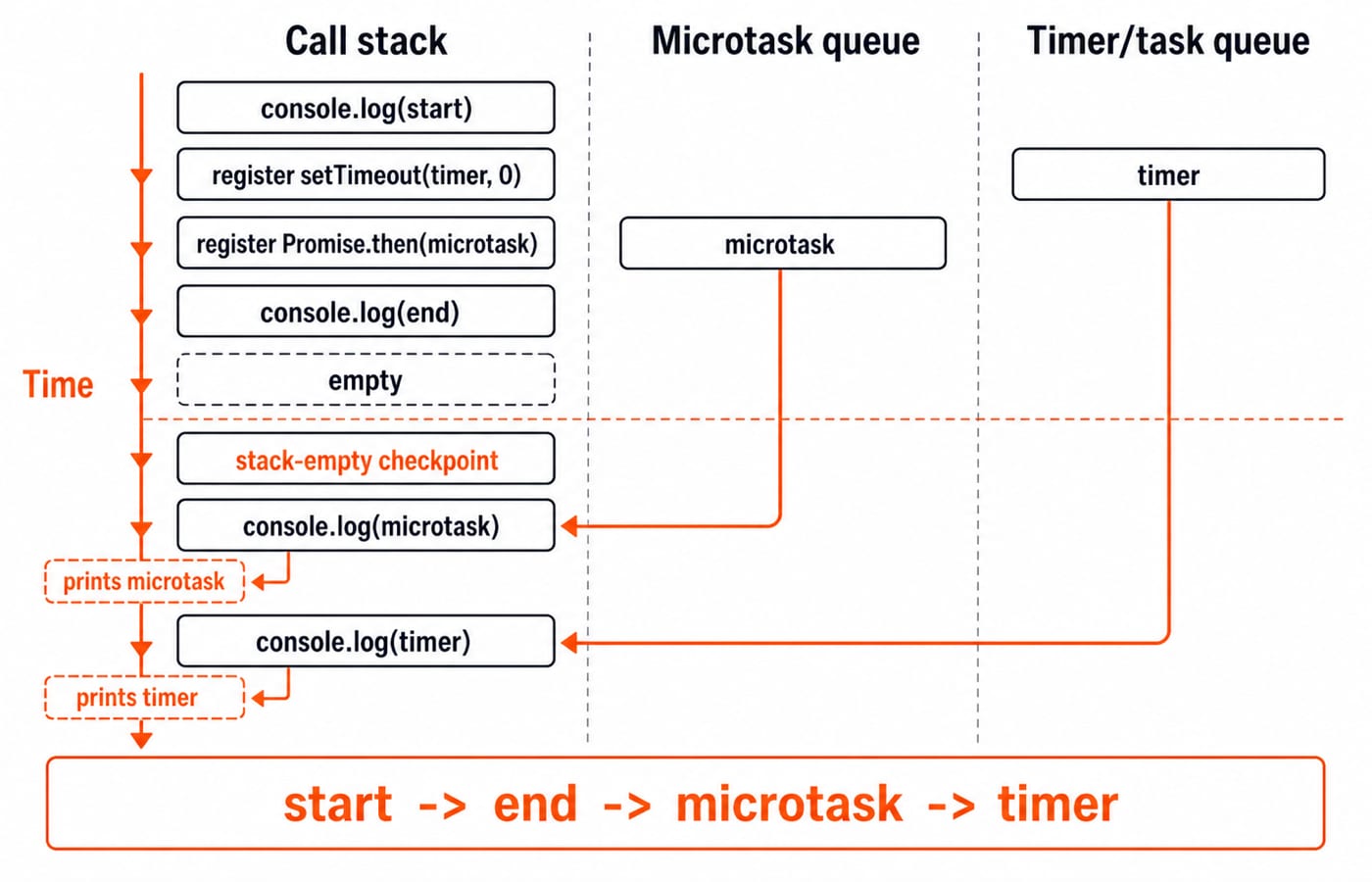
Run this in a modern browser console:
console.log("start");

setTimeout(() => console.log("timer"), 0);

Promise.resolve().then(() => console.log("microtask"));

console.log("end");
The exact output is:
start
end
microtask
timer
The first and last logs run synchronously. The host registers the timer, while the resolved promise queues a microtask. Once the stack empties, the runtime drains that microtask before taking the timer task. Therefore microtask appears first.
A delay of 0 is a minimum scheduling request, not a promise of immediate execution, exact elapsed time or interruption of the stack. A queued callback is not automatically a separate thread.
Common JavaScript runtime mistakes and corrections
Treating host features as universal makes
document.titlefail in Node.js. Check the runtime and its APIs.Believing
setTimeout(callback, 0)interrupts synchronous work gives wrong output predictions. Let the stack finish, and prevent long CPU work from blocking responsiveness.Assuming
const second = firstclones an object causes shared mutations. Choose an intentional shallow or deep copy.
const amount = 42; amount(); produces a TypeError because the value is not callable. Fix the data flow, not the symptom. console.log(missingScore); produces a ReferenceError because no reachable binding exists. Define it or correct its name or scope.
Saying JavaScript is single-threaded is incomplete when a runtime can coordinate host work. Saying all objects live on the heap is a conceptual shortcut, not a portable storage guarantee. Observable order, identity and scope are the dependable ideas.
How assessments test the JavaScript runtime model
Assessments commonly ask you to predict output, identify runtime-specific APIs, trace aliases, distinguish ReferenceError from TypeError, and order synchronous work, microtasks and timer tasks. Confirm any named exam's specifics in its current official syllabus or notification.
Try these answer-first checks:
let value = 5; function bump(n) { n += 2; return n; } const result = bump(value); console.log(value, result);prints5 7. The parameter receives the primitive value5, becomes7, and leaves the outervalueunchanged.const first = { score: 6 }; const second = first; second.score = 9; console.log(first.score, second.score);prints9 9because both bindings reach the same object.console.log(1); setTimeout(() => console.log(2), 0); Promise.resolve().then(() => console.log(3)); console.log(4);prints1 4 3 2in the modern-browser context established earlier.
Moving the promise registration below console.log(4) still gives 1 4 3 2, because the synchronous stack finishes before the microtask. After these traces, use Coding Round Strategy for Placements to turn output reasoning into broader coding-round practice.
JavaScript runtime: the short version and next step
Reconstruct the model in five lines: the language defines the code's meaning. The engine executes it. The runtime supplies the surrounding environment. The call stack tracks active synchronous calls. Microtasks and tasks run after the current stack empties according to their scheduling rules. Redraw start -> end -> microtask -> timer from memory.
Now retype addBonus, change the input from 7 to 9 and the bonus from 3 to 5, then predict 9 * 2 + 5 = 23 before running it. Change the timer delay from 0 to 10; the promise microtask still appears first in this example, although the timer has no guaranteed exact firing time.
For a structured beginner route through the language, continue with the Complete JavaScript course. Once HTML, CSS and JavaScript fundamentals feel comfortable, the MERN Stack course is the later full-stack route.