RBI Grade B Last 60 Days Plan: What to Revise, When to Mock
Make the final 60 days useful with a realistic time budget, recall practice and mocks you actually review. This General-cadre plan keeps a small Phase II habit alongside Phase I revision.
KnowledgeGate Team
Exam prep & CS education
Updated 26 Oct 20264 min read
More notes and more mocks can crowd out the work that matters: correcting recurring errors. This countdown combines recall, reviewed mocks and a lighter final week for RBI Grade B (DR) General candidates who already have a foundation and are approaching their own Phase I date. It maintains a small Phase II habit; it cannot build both stages from zero, and DEPR/DSIM candidates need different plans.
Set your baseline before spending the next 60 days
Define D-60 as 60 days before your Phase I date, D-1 as the preceding day and D0 as exam day.
Check before starting: Match your General-cadre notification, syllabus and information handout through RBI recruitment notices. Use that cycle's timings and section rules, not borrowed IBPS or SBI settings. This countdown and its allocations are editorial recommendations, not an RBI timetable.
On D-60, take a baseline mock. Record attempted, correct, wrong, skipped-but-solvable and time spent by section. Keep an error ledger with topic, cause, corrective task and retest date; avoid universal “safe attempts”.
Use the broader RBI Grade B preparation strategy for the overall sequence. If most basics remain unfamiliar, choose a smaller repair list before adopting this workload.
Reserve 24 hours a week, including recovery time
Start with five weekdays × 3 hours = 15 hours, Saturday 5 hours and Sunday 4 hours: 15 + 5 + 4 = 24 available hours.
Work | Weekly hours |
|---|---|
Recall and current-affairs consolidation | 7 |
Targeted aptitude practice | 4 |
Phase II maintenance | 3 |
Mocks, review and error retests | 8 |
Catch-up or rest | 2 |
Total | 24 |
24 available hours − the 2-hour reserve = 22 planned study hours.
Miss one three-hour weekday and availability becomes 24 − 3 = 21 hours. Move two hours of priority work into the existing reserve and drop one optional practice hour. The original 22 study hours become 21, with no reserve left and no borrowing from sleep.
For a mock-heavy week, move two hours from targeted practice to mocks: 7 + 2 + 3 + 10 + 2 = 24. If actual test time plus review exceeds that bucket, reduce mock frequency.
Divide the countdown into four revision blocks
Count both endpoints in each block. The baseline belongs inside the first block, not on an extra day.
Countdown | Days | Focus and deliverable |
|---|---|---|
D-60 to D-46 | 15 | Diagnose and repair: ranked repair list |
D-45 to D-22 | 24 | Recall and mixed practice: closed-book recall sheets |
D-21 to D-8 | 14 | Rehearse: tested attempt order within permitted section rules |
D-7 to D-1 | 7 | Taper: short final revision pack |
The count is 15 + 24 + 14 + 7 = 60 days.
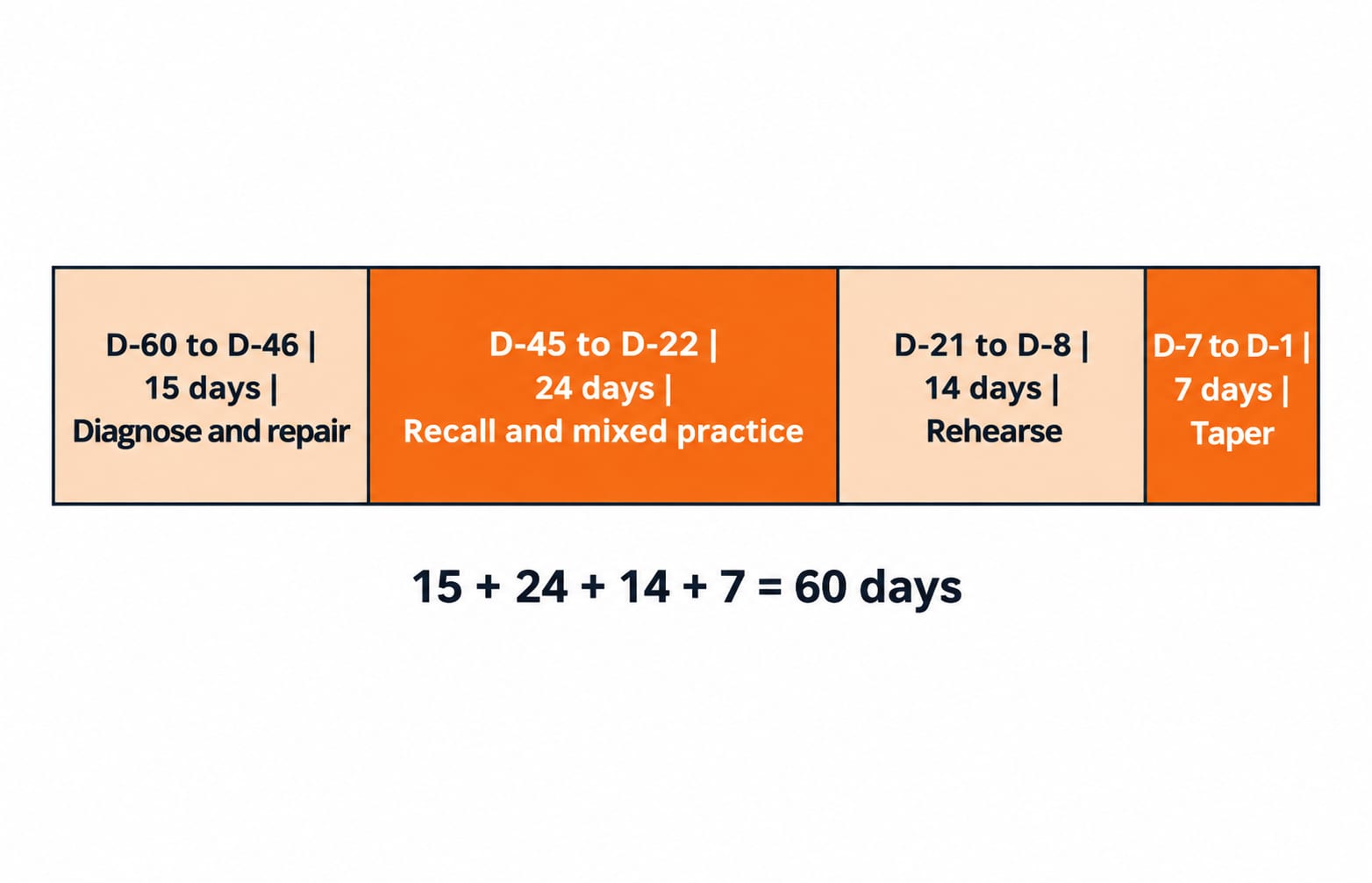
Use the RBI Grade B syllabus guide to check topic coverage, with your official notification as the authority. Rank repairs by recurrence and whether you can fix them within the available time.
Revise through recall and keep Phase II work alive
Close your notes before checking what you remember. For a 20-item current-affairs set, record:
D-50: 12 correct; 12 ÷ 20 × 100 = 60%.
D-47: 16 correct; 16 ÷ 20 × 100 = 80%.
D-43: 18 correct; 18 ÷ 20 × 100 = 90%.
Turn the remaining two weak items into questions instead of rereading all 20 equally.
For economic or banking updates, record the issuing institution, release date, central fact and why it matters. Check facts against primary releases.
Split Phase II maintenance into three 60-minute sessions: 20 minutes recalling a studied economic, financial or management concept, 25 drafting a short response and 15 checking structure and factual support. Each totals 60 minutes; three total 180 minutes, or 3 hours. Compress it before Phase I if necessary, then rebuild around the next stage's actual date.
Increase mocks only when review is complete
Try this conditional full-mock schedule:
First block: D-60 and D-53.
Second block: D-45, D-38, D-31 and D-24.
Third block: D-21, D-17, D-14 and D-10.
Final block: D-7, optional rehearsal.
That is at most 2 + 4 + 4 + 1 = 11 mocks, including the baseline.
Before the next mock, finish review and one corrective drill. Budget the actual handout-based test duration and a separate review block. Replace a scheduled mock with targeted review when the ledger remains unfinished.
On other days, use the existing practice allocation for weak sections. Compare like-for-like accuracy and repeated errors.
Turn one mock's errors into the next two days' work
Take a hypothetical 40-question practice set: 30 attempted, 24 correct, 6 wrong and 10 left.
Attempt accuracy = 24 ÷ 30 × 100 = 80%. Meanwhile, 24 ÷ 40 × 100 = 60% is the correct fraction of the whole set.
Classify the six errors: three concept gaps, two rushed calculations and one misread qualifier.
Day 1: revise gaps for 30 minutes, practise slow checked calculations for 20, and reread qualifiers for 10. Total: 60 minutes.
Day 2: take a fresh mixed retest for 20 minutes and compare errors for 10. Total: 30 minutes.
Use existing repair/review allocations. Inspect the ten skips too. If four become solvable untimed, flag them for selection practice. Record evidence of correction, not just the score.
Taper in the final week and choose one next action
After the optional D-7 rehearsal, use D-6 to D-3 for recall sheets and repaired errors, with no new full mocks. Keep D-2 and D-1 light: suggested ceilings of two hours and one hour within the weekly budget. Check documents, route and sleep routine.
Compare Banking & Insurance preparation resources only if a gap needs support. The IBPS PO Prelims course for overlapping aptitude practice has IBPS scope. Use existing suitable resources without starting a whole course now.
Today, book the baseline and prepare your error ledger.
Keep learning
RBI Grade B Preparation: 7 Common Mistakes and Practical Fixes
Daily lectures can leave important learning gaps untouched. Diagnose seven preparation mistakes with worked examples, then repair your concept practice, revision, mock analysis and weekly schedule.
27 Oct 20265 min readBanking Exams
RBI Grade B Preparation Mistakes: 7 Habits to Fix Before Your Next Mock
Watching lessons regularly can still leave the same mock errors untouched. Audit seven preparation habits and use simple drills to test recall, improve written answers and repair recurring mistakes.
24 Oct 20265 min readBanking Exams

RBI Grade B Previous Year Analysis: Recurring Topics and Study Priorities
Use recurring topic families to choose what to revise, then let your errors decide the time allocation. Work through DI, reasoning and reading examples before building a practical weekly plan.
22 Oct 20264 min readBanking Exams
RBI Grade B Exam Pattern and Marking Scheme: Phases, Scores and Penalties
Clearing Phase I and earning final-merit marks are different jobs. Understand the General-cadre stages, section timers and score calculations before planning your next mock.
18 Oct 20265 min readBanking Exams