IBPS SO IT Officer Preparation Mistakes: 7 Fixes Before They Cost Selection
Avoid seven preparation errors that hide weak recall, neglected sections and repeated mock mistakes. Use worked planning examples to build a repairable study system.
KnowledgeGate Team
Exam prep & CS education
Updated 27 Oct 20265 min read
You can finish technical lectures, collect mock scores and still lose ground because your preparation system never exposes stale assumptions, neglected sections, weak recall or unanalysed errors. These seven mistakes show why that happens, what it damages and what to do instead. Before using any timetable, confirm your cycle on the official IBPS site and use the IBPS PO and SO IT exam preparation hub for the wider learning route.
1. Preparing from an old pattern instead of the live IBPS notice
Saved videos, old PDFs and search snippets are convenient but risky. A changed stage, test, timing, marking rule or eligibility condition can invalidate a mock routine.
Run a 15-minute source audit before planning. Record exactly eight fields: cycle, stage, tests, questions and marks, section timings, wrong-answer rule, qualifying rule, and dates/documents. Check the detailed notification, corrigenda, information handout or call letter, then the relevant official result or interview notice. Mark missing fields TBD; never fill them from memory or a future-dated document.
2. Studying only technical subjects and postponing other sections
IT graduates often prefer DBMS, networks and programming, postponing language and aptitude. Your audit decides which tests and qualification rules apply. Neglecting a required test can stop progression despite strong Professional Knowledge.
For an illustrative 18-hour week, assign 8 hours to technical study, 3 to reasoning, 2 to quantitative aptitude, 1 to English, 2 to timed mixed practice and 2 to analysis. The check is 8 + 3 + 2 + 1 + 2 + 2 = 18 hours. If English is weaker than quantitative aptitude, move 1 hour from quant to English. Do not take it from analysis. The IBPS SO IT Prelims Preparation Course can supply structure, but this split is a planning example, not official weightage.
3. Hopping between sources and learning technical topics randomly
New playlists feel productive but create duplicate notes and prerequisite gaps.
With 6 hours for DBMS, a weak plan spends 2 hours on each of 3 sources and answers 0 questions. A better plan uses 2 hours for the relational model and keys, 2 for functional dependencies and normalisation, 1 for transactions, and 1 for a 30-question check. Both total 6 hours, but only one exposes learning gaps.
For 14 days, cap each topic at 1 concept source, 1 question source and 1 error log. A check with 21 correct, 6 wrong and 3 skipped gives 21 + 6 + 3 = 30 and 6 + 3 = 9 gaps. Start with those 9. The prerequisite-first Computer Science study order sequences the syllabus.
4. Counting watched lectures as mastery
Completion bars reward recognition, but timed questions demand recall. Recognising a join definition does not guarantee retrieval.
Use a 45-minute block: 10 minutes closed-book recall, 20 minutes for 15 questions and 15 minutes for correction. A result of 8 correct, 5 wrong and 2 skipped accounts for 15, while 5 + 2 = 7 items enter the error log. Reattempt those 7 tomorrow. A result of 6 correct and 1 wrong accounts for all 7.
Call a topic usable only after two fresh 15-question sets each reach at least 12/15, an illustrative 80% retrieval threshold. KnowledgeGate has more than 1,800 published IBPS-tagged questions, though not all are IT Officer-specific.
5. Taking mocks without turning errors into repair work
An unreviewed mock repeats misconceptions, reading errors and guesses. Raw score alone cannot define the next study block.
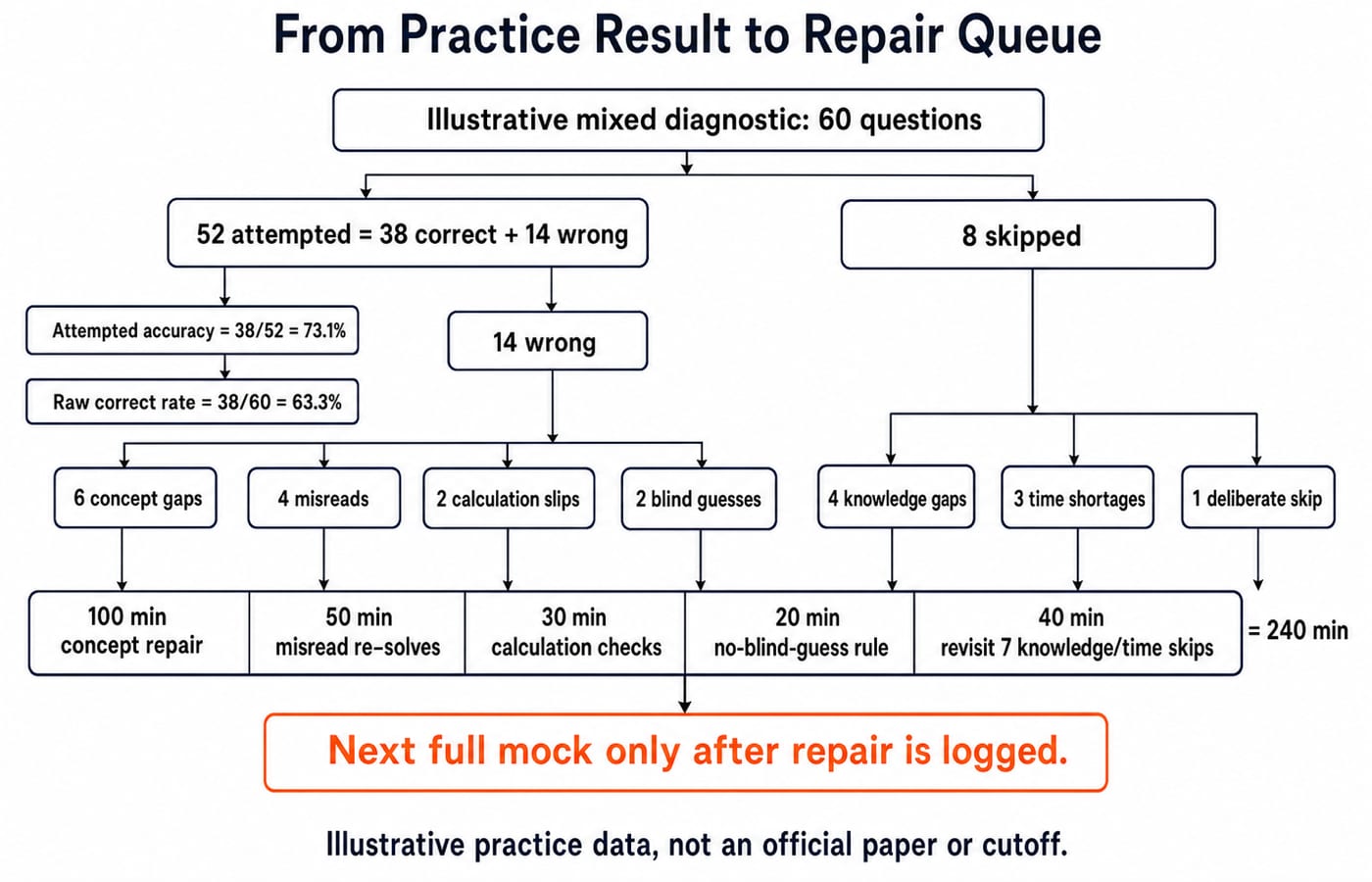
In an illustrative 60-question mixed diagnostic, 52 attempts contain 38 correct and 14 wrong, with 8 skipped. Attempted accuracy is 38 / 52 = 73.1%; raw correct rate is 38 / 60 = 63.3%, rounded to one decimal. Check: 38 + 14 = 52 and 52 + 8 = 60.
Split the 14 wrong answers into 6 concept gaps, 4 misreads, 2 calculation slips and 2 blind guesses. Split the 8 skipped into 4 knowledge gaps, 3 time shortages and 1 deliberate skip. Now create a 240-minute repair block:
100 minutes to reteach the 6 concept gaps
50 minutes to re-solve the 4 misreads slowly
30 minutes to check the 2 calculation slips
20 minutes to write and test a no-blind-guess rule
40 minutes to revisit the 7 knowledge-gap or time-shortage skips
The sum is 100 + 50 + 30 + 20 + 40 = 240 minutes. Repair the deliberate skip only if it was a bad decision. Log repairs before another full mock.
6. Copying safe-attempt claims and guessing without evidence
Social posts turn one candidate's attempts or predicted cutoff into a universal target. This encourages low-confidence answers, while your source audit supplies penalties and qualifying rules.
Build a personal confidence table from your last 32 uncertain attempts. In this illustrative split, 20 blind guesses produce 5 correct and 15 wrong, so accuracy is 5 / 20 = 25%. Another 12 two-option eliminations produce 8 correct and 4 wrong, so accuracy is 8 / 12 = 66.7%, rounded to one decimal place. The sample reconciles as 20 + 12 = 32.
Record why each uncertain answer was attempted. These rates are neither a cutoff nor a selection guarantee. Do not convert them into marks without verified current values and penalties from IBPS.
7. Planning with no recovery buffer and waiting too long for the next stage
A timetable filled to 100% breaks after one missed day. Waiting for a result before preparing for a confirmed next stage can also create an avoidable restart. Any transition must remain conditional on your live notice and actual result.
If an 18-hour week ends at 14 hours, the backlog is 18 - 14 = 4 hours. Keep the next week capped at 18 hours: 14 core + 2 recovery + 2 buffer = 18. Drop the remaining 2 backlog hours or replace them with the weakest diagnostic item. Do not create a 22-hour punishment week.
For an illustrative three-day interview bridge, spend 90 minutes on Day 1 verifying your resume, projects and documents. On Day 2, explain 5 technical ideas for 18 minutes each, so 5 × 18 = 90 minutes. On Day 3, prepare 6 HR answers for 15 minutes each, so 6 × 15 = 90 minutes. The bridge totals 90 + 90 + 90 = 270 minutes. Use the IBPS SO IT Officer interview question guide when that stage applies.
The short version
Verify the cycle, protect required areas, cap sources, retrieve, analyse mocks and keep a buffer. Use the IBPS SO IT Mains Preparation Course only for a matching next stage. This system cannot promise selection, but it can stop avoidable mistakes.
Keep learning
IBPS SO IT Officer Last 60 Days Plan: Daily Revision and Mock Schedule
Turn the final 60 days into a repeatable cycle of diagnosis, focused revision, timed practice, mock analysis, repair, retesting, and a calm taper.
Updated 25 Oct 20265 min readIBPS Exams
IBPS Clerk Cutoff Trends: Set a Defensible Target Score
Turn comparable official cutoff values into a practical working target, then use mock accuracy and consistency to decide what to repair next.
Updated 24 Oct 20264 min readIBPS Exams
IBPS SO IT Officer Syllabus: What to Study for Each Section
Separate the official IBPS exam structure from the detailed study map. See what to cover for English, Reasoning, Quantitative Aptitude, Professional Knowledge and Descriptive English.
Updated 21 Oct 20264 min readIBPS Exams
IBPS SO IT Officer Preparation Strategy: A 16-Week Phase-by-Phase Plan
Turn 18 weekly hours into a realistic IBPS SO IT Officer plan, from the first diagnostic to mock repair, tapering and a conditional next-stage bridge.
Updated 17 Oct 20266 min readIBPS Exams