IBPS PO Preparation Mistakes: 7 Errors That Cost Final Selection
Hard work is not enough when attempt counts, new resources and rigid timetables hide weak accuracy. Replace seven common errors with measurable habits.
KnowledgeGate Team
Exam prep & CS education
Updated 4 Oct 20265 min read
Many IBPS PO aspirants work hard but organise preparation around completion, attempt counts and motivational timetables. Selection-oriented study instead demands a current stage map, accuracy, error correction and a plan that survives a missed day. Here are seven mistakes in one useful pattern: why it happens, what goes wrong and the corrective habit, followed by a flexible ten-week plan.
For current stage names, sections, timings, scoring, cutoffs, eligibility, dates, vacancies and final-selection rules, use the official IBPS website. Recheck the latest CRP PO/MT notice for every cycle.
Mistake 1: Preparing for a generic bank exam instead of the current IBPS PO route
Why it happens: Common Quant, Reasoning and English material makes every component appear equally urgent.
What goes wrong: Early-stage speed improves while later-stage depth and other named components receive no regular work.
Corrective habit: Build a one-page map with five columns: component exactly as named in the current notice, stage, qualifying or merit role, timing or rule, and weekly practice block. Introduce every official value with, “The current IBPS CRP PO/MT notification specifies...” Change the map when the notice changes.
Use the IBPS PO Exam Pattern: Stage-by-Stage Prep Priority Map as a planning aid, not official authority. Every Sunday, spend 30 minutes mapping the coming week's work to live rows.
Mistake 2: Chasing attempts before measuring accuracy
Why it happens: Attempt count is immediately visible, so activity feels like progress.
What goes wrong: Uncertain guesses and rushed reading can increase faster than correct answers. Consider two hypothetical mocks:
Practice result | Attempted | Correct | Wrong | Attempted accuracy |
|---|---|---|---|---|
Mock A | 82 | 61 | 21 | 61 / 82 = 74.4% |
Mock B | 76 | 64 | 12 | 64 / 76 = 84.2% |
Mock B has 6 fewer attempts, but 3 more correct answers and 9 fewer wrong answers.
Corrective habit: Use two passes. First, attempt questions with a visible method. Then revisit marked items. Skip one if no defensible first step appears after 20 seconds. This is a study heuristic, not an IBPS timing rule.
Do not raise your attempt target until accuracy is at least 80% in three consecutive comparable sets and no single error type causes more than 40% of a set's errors.
Mistake 3: Taking mocks without paying the analysis cost
Why it happens: A mock feels complete when the timer stops.
What goes wrong: Concept, selection, calculation and reading failures repeat. Tag every item by topic before drawing conclusions. The IBPS PO Paper Analysis: Topic-wise Weightage Method turns those tags into a useful review.
Mock B's 12 wrong answers contain 4 concept, 3 poor-selection, 3 calculation and 2 rushed-reading errors. Check: 4 + 3 + 3 + 2 = 12.
Allocate the next 300 minutes accordingly:
90 minutes for concept repair
75 minutes for set-selection drills
60 minutes for calculation drills
45 minutes for slow-reading drills
30 minutes for a blind retest
The total is 90 + 75 + 60 + 45 + 30 = 300 minutes.
Corrective habit: Log the question or topic, error category, wrong thought, correct rule, redo date and retest result. Replace “careless” with an observable cause such as “copied 46 as 64” or “spent 7 minutes on one set before checking alternatives”.
Mistake 4: Giving favourite and weak areas equal time
Why it happens: Familiar work feels productive.
What goes wrong: Strong areas gain little while the weakest keeps limiting performance. After confirming these component names in the current notice, consider three separate 50-question sets: Reasoning 41/50 = 82%, English 39/50 = 78% and Quant 28/50 = 56%.
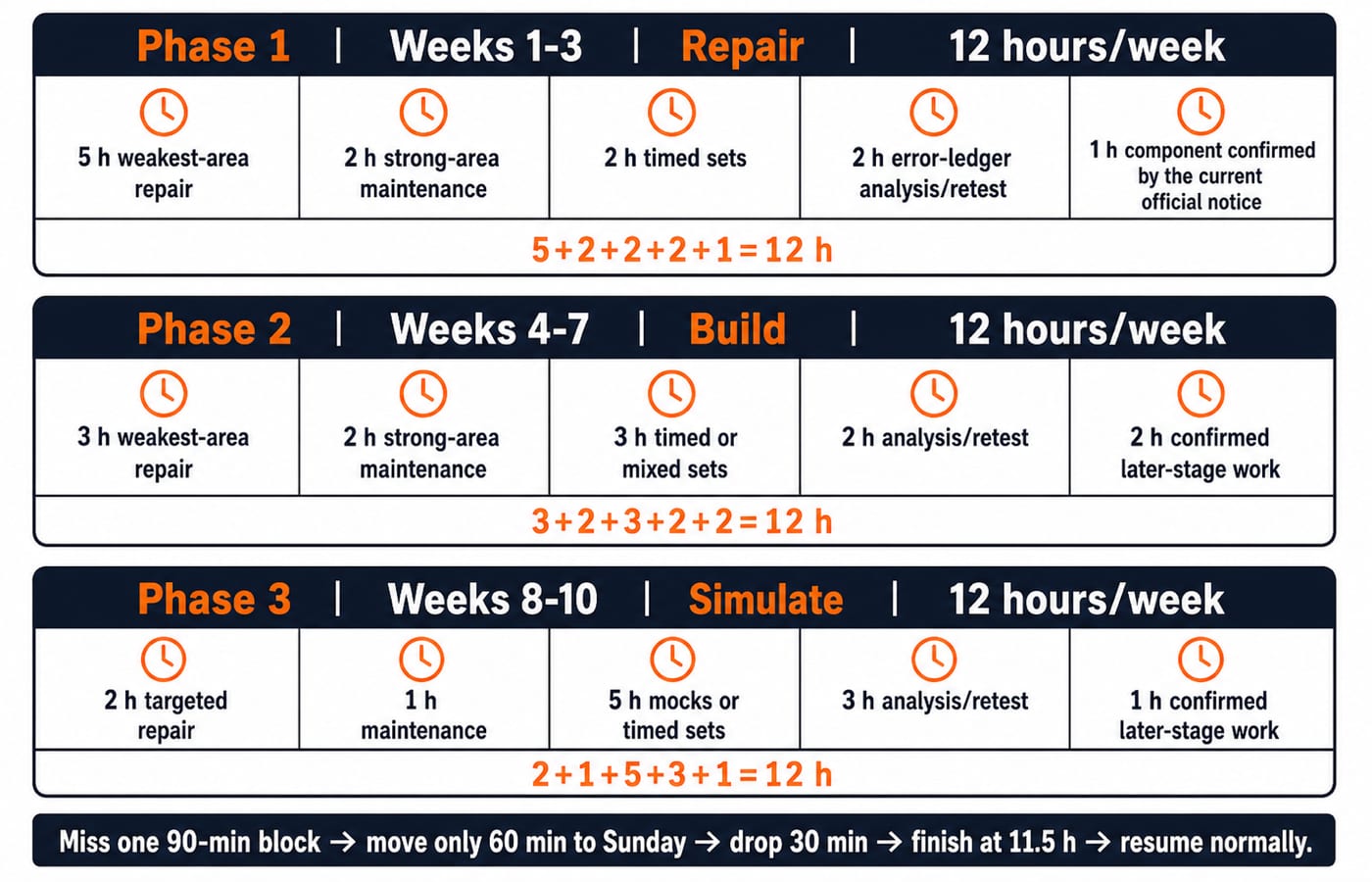
Corrective habit: Allocate 12 hours from the data: 5 hours Quant repair, 2 Reasoning maintenance, 2 English maintenance, 2 cross-section ledger retests and 1 official-stage-specific hour. Check: 5 + 2 + 2 + 2 + 1 = 12.
Keep the 5-hour repair share until Quant reaches at least 70% in two consecutive 30-question sets with no repeated concept error. Here, 70% is a diagnostic threshold for this plan, not an official cutoff or selection benchmark.
Mistake 5: Collecting resources instead of revising one error set
Why it happens: A new PDF, channel or shortcut sheet feels like progress.
What goes wrong: Recognition improves, but recall and transfer remain weak.
Corrective habit: Cap each topic at one concept source, one question source and one error ledger. A course may supply concepts, but cannot replace practice and review.
Run a 14-day loop. On Day 0, attempt 40 questions: 27 correct, 9 wrong and 4 unattempted. On Day 2, redo the 13 wrong or unattempted items and record 10 correct and 3 wrong. On Day 7, score 16/20 on a mixed set. On Day 14, take a blind retest and score 13/15.
Keep repairing until Day 14 reaches at least 12/15 without the same concept error. At 11/15, schedule another 30-minute repair and retest, not a fourth resource.
Mistake 6: Postponing later-stage work until an earlier result arrives
Why it happens: Anything beyond the immediate stage feels optional.
What goes wrong: Work that needs accumulation gets compressed into a stressful window.
Corrective habit: Check the current notice. Only if it confirms these components, reserve 120 weekly minutes: 60 for current and banking awareness notes, 30 for descriptive writing and 30 for interview and personal-profile preparation.
Define outputs. Awareness produces 10 one-line facts and 3 why-it-matters notes. Writing produces one response with a 5-minute outline, 20-minute draft and 5-minute edit. Interview work produces 3 spoken answers of 90 seconds each, recorded and revised once. Reassign any block the notice does not support.
Mistake 7: Following a timetable with no missed-day recovery rule
Why it happens: The timetable assumes every day will go perfectly.
What goes wrong: One missed session triggers doubling, sleep loss and abandonment.
Corrective habit: Use a 12-hour week: Tuesday 90 minutes, Wednesday 60, Thursday 90, Friday 60, Saturday 180 and Sunday 240. Check: 90 + 60 + 90 + 60 + 180 + 240 = 720 minutes = 12 hours.
If Tuesday's 90-minute session is missed, move only its highest-priority 60 minutes to Sunday and let 30 minutes go. The week becomes 690 minutes, or 11.5 hours. Never push Sunday beyond 300 minutes, never double the next weekday, and protect mock analysis before new content.
The short version and your seven-day restart
Map the current notice. Improve accuracy before attempts. Analyse mocks until their errors are repairable. Let data choose the weak-area share, revise before collecting, and maintain confirmed later-stage work.
Restart over seven days: Day 1, official stage map for 60 minutes; Day 2, diagnostic for 90; Day 3, audit for 90; Days 4 and 5, repair for 90 each; Day 6, timed set for 120; Day 7, analysis and next-week planning for 180. The total is 60 + 90 + 90 + 90 + 90 + 120 + 180 = 720 minutes = 12 hours.
For first-stage foundations, explore IBPS PO Prelims. For deeper later-stage work confirmed by your map, consider IBPS PO Mains. The Banking & Insurance Exam Preparation category is the broader hub. Match the resource to your diagnosed gap, then return to the ledger.
Keep learning
IBPS PO Last 60 Days Plan: Revision, Mocks and Error Repair
Turn the final 60 days into a measured cycle of diagnosis, revision, mocks, retests and tapering, with worked schedules for a realistic 14-hour week.
Updated 29 Sep 20264 min readIBPS Exams
IBPS PO Cutoff Trends: Set a Defensible Target Score
Learn how to separate IBPS PO cutoff history by cycle, stage, category and denominator, then turn comparable Main values into a transparent practice target.
Updated 25 Sep 20265 min readIBPS Exams
IBPS PO Previous Year Analysis: Recurring Question Formats and Attempt Priorities
See what genuinely recurs across IBPS PO papers, solve representative format drills, and turn your own accuracy and speed into a practical attempt priority.
Updated 24 Sep 20265 min readIBPS Exams
IBPS PO Preparation Strategy: A 16-Week Plan for Prelims and Mains
Turn 16 weeks into a workable IBPS PO routine. This plan shows how to divide study time, analyse drills, repair errors and retain Mains continuity.
Updated 23 Sep 20265 min readIBPS Exams