

IBPS Clerk Preparation Mistakes: 6 Errors That Cost Selections
Study hours alone do not fix a leaking score. Use six worked examples to replace stale patterns, unmeasured practice and attempt chasing with an evidence-led plan.
KnowledgeGate Team
Exam prep & CS education
Updated 8 Nov 20265 min read
Daily study leaks marks when plans follow an old pattern, count hours without analysing errors, and chase attempts without a score ledger. The useful audit is simple: identify the cause, record what failed, and assign one repair. “IBPS Clerk” is the familiar term, but the CRP-CSA XV detailed notification dated 12 September 2025 calls the post Customer Service Associate; it supplies specifics, while your cycle's notice and information handout at ibps.in take precedence.
The earlier IBPS PO Preparation Mistakes article handles the PO route and its seven-day restart. For Clerk/CSA, focus on the current CSA notice, sectional timing, worked score ledgers and a small Mains bridge.
1. Mistake 1: Preparing from a remembered pattern instead of the current IBPS source
Why it happens: Old tables are convenient. What goes wrong: You rehearse invalid timing. What to do instead: Make a card for cycle, post, stage, sections, section time, penalty, documents and source date. Mark gaps “confirm”.
A shared-pool run uses 12 + 28 + 20 = 60 minutes for English, Numerical Ability and Reasoning Ability. The dated notice lists three separately timed 20-minute Prelims tests, so no 8-minute English transfer exists. Practise 20 + 20 + 20 = 60 minutes with hard stops. IBPS Exam Preparation is useful, but cannot replace the official notice.
2. Mistake 2: Counting study hours without measuring where the score leaks
Why it happens: Hours feel concrete. What goes wrong: Work repeats while the largest loss survives. What to do instead: Build an error ledger after timed sets.
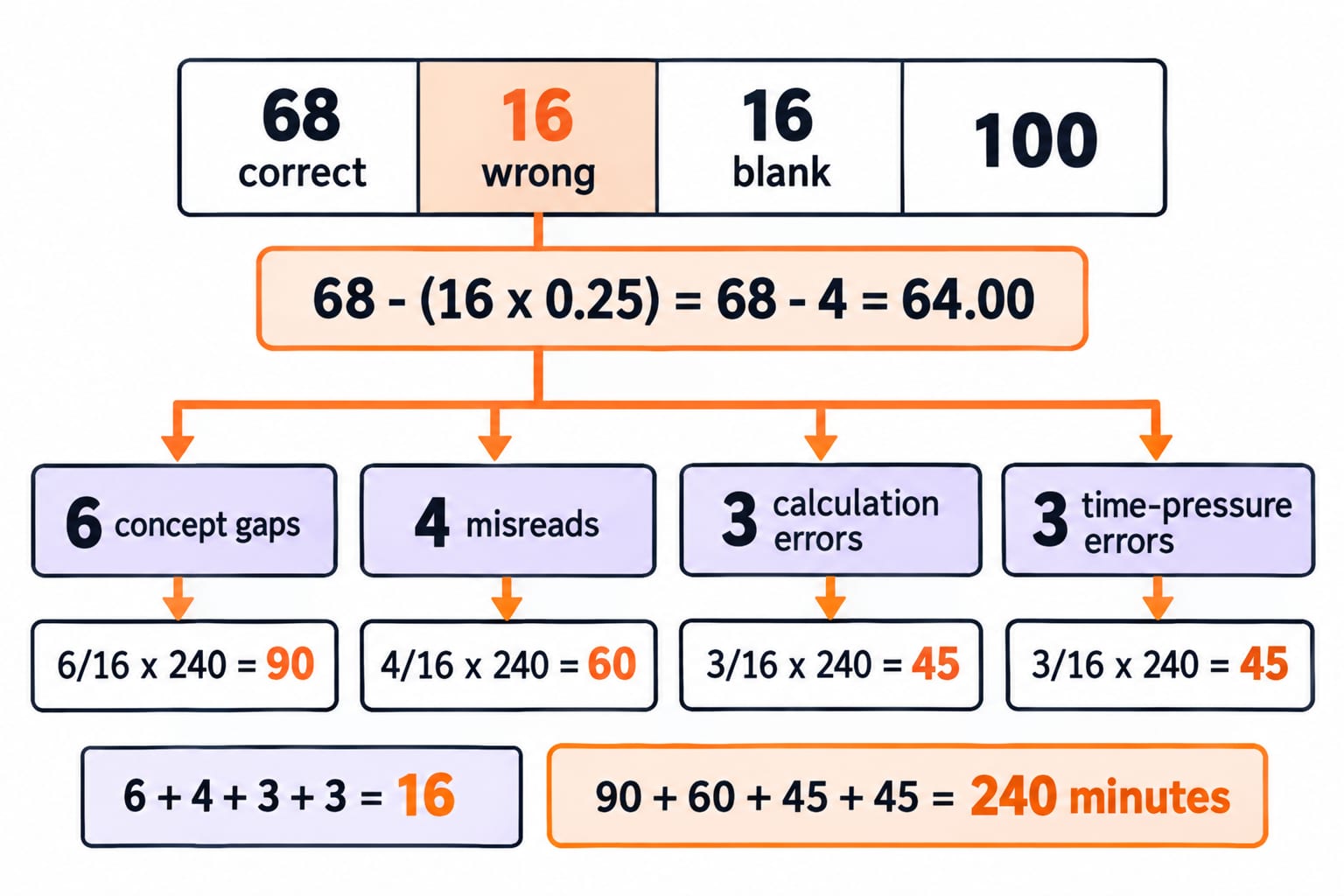
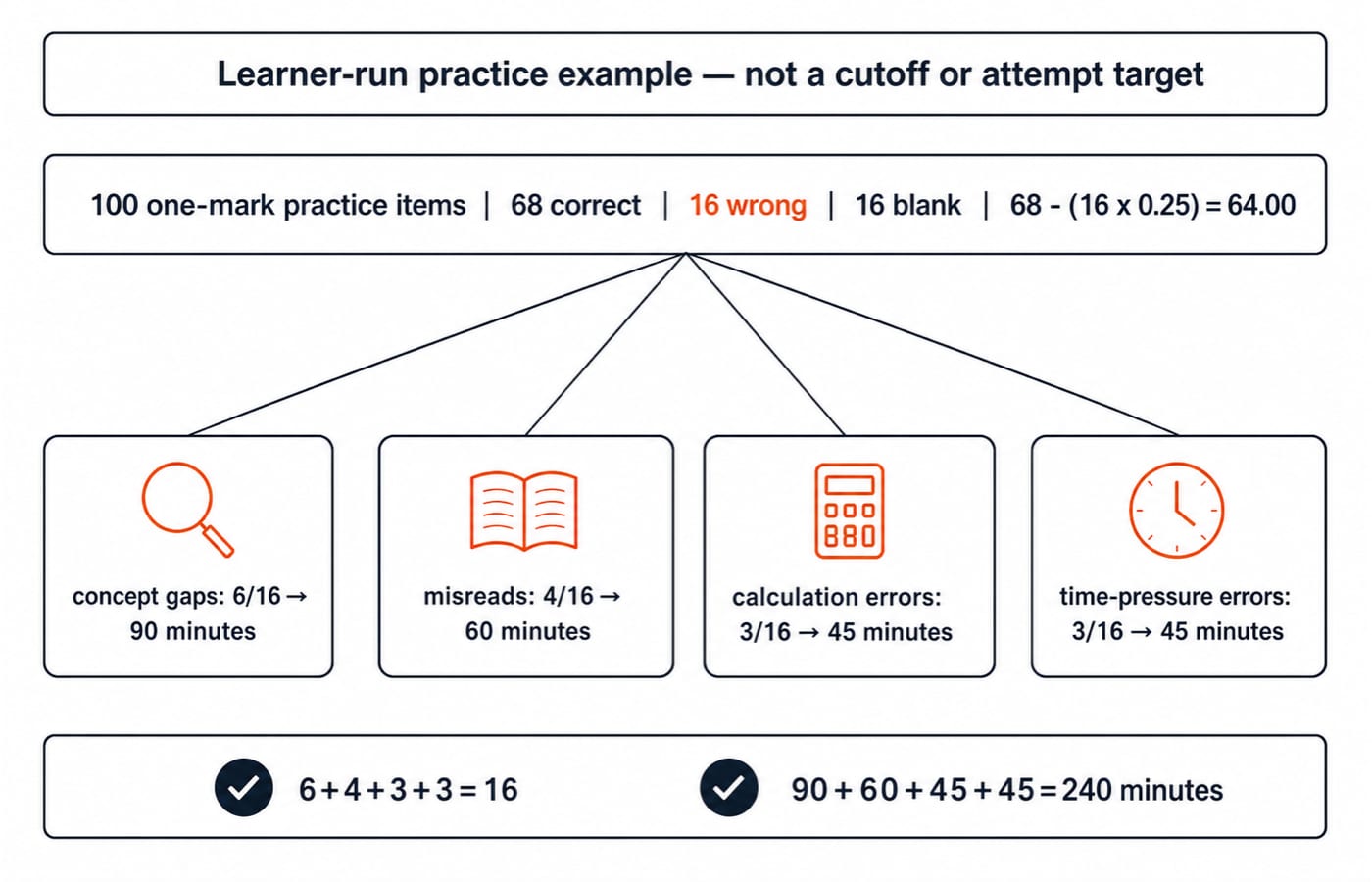
In a learner-run 100-item, one-mark mock, 68 correct + 16 wrong + 16 blank = 100. Illustrating the dated notice's one-fourth penalty gives 68 - (16 x 0.25) = 68 - 4 = 64.00. Split the 16 wrong answers: 6 concept gaps + 4 misreads + 3 calculation errors + 3 time-pressure errors.
Allocate 240 minutes: 6/16 x 240 = 90, 4/16 x 240 = 60, and 3/16 x 240 = 45 for each remaining group. Check: 90 + 60 + 45 + 45 = 240 minutes. Revise after the next mock. The IBPS Clerk CSA 2026 Prelims Course is optional.
3. Mistake 3: Chasing the highest attempt count instead of corrected score
Why it happens: Attempts are visible. What goes wrong: Guesses can lower corrected score. What to do instead: Record attempts, correct, wrong, blank and accuracy together. Never borrow a target.
In an 80-item, one-mark practice set, A attempts 70: 54 correct, 16 wrong, 10 blank. Score: 54 - (16 x 0.25) = 50.00; accuracy: 54/70 x 100 = 77.1%. B attempts 64: 56 correct, 8 wrong, 16 blank. Score: 56 - (8 x 0.25) = 54.00; accuracy: 56/64 x 100 = 87.5%.
B attempts 6 fewer yet scores 54 - 50 = 4 more. Set a stop-loss: flag at your time threshold, return if permitted, then adjust after two sets.
4. Mistake 4: Splitting weekly time equally after mocks show unequal weaknesses
Why it happens: Equal time looks tidy. What goes wrong: It masks unequal errors. What to do instead: Protect base section time, then divide repairs using two mocks.
In a learner-designed 12 hours = 720 minutes week, reserve 360 for two timed sets with reviews, and 360 for repair. Given 14 Quantitative + 6 Reasoning + 4 English = 24 errors, allocate 14/24 x 360 = 210 minutes, 6/24 x 360 = 90 minutes, and 4/24 x 360 = 60 minutes. Check: 210 + 90 + 60 = 360.
Use the repair shares to set each week’s phases.
5. Mistake 5: Using question volume as a substitute for PYQ and review quality
Why it happens: Volume feels productive. What goes wrong: Wrong methods accelerate and guesses stay hidden. What to do instead: Mark items confident correct, guessed correct, wrong or blank. Reattempt the last three groups without notes.
Use the IBPS-filtered practice pool to separate Clerk-relevant work from broad banking material. Filter each set by post, stage, topic and syllabus, then keep only items whose explanations you can review.
For 100 learner-run questions at 54 seconds each, 100 x 54 = 5,400 seconds = 90 minutes. Flag 20 wrong + 10 guessed correct = 30. Review: 30 x 4 = 120 minutes. Reattempt: 30 x 2 = 60 minutes. Total: 90 + 120 + 60 = 270 minutes = 4 hours 30 minutes. Keep the correction record. Why PYQs Beat Buying Another Question Bank explains PYQ review.
6. Mistake 6: Treating Prelims and Mains as two unrelated preparation projects
Why it happens: The nearer stage consumes the week. What goes wrong: Mains starts abruptly. The dated notice says Main marks, not Preliminary marks, determine that cycle's final merit. Check your cycle. What to do instead: Keep a narrow Mains bridge.
A learner-designed 15-hour week can assign 9 hours to Prelims, 3 to a Mains bridge and 3 to review: 9 + 3 + 3 = 15 hours, or 60% + 20% + 20% = 100%. This ratio is not official; rebuild after Prelims.
Choose an awareness file, higher-depth data set, or reviewed reasoning set. The IBPS Clerk CSA 2026 Mains Course is optional. Alternatively, use three hours with current-source topics and a correction log.
7. The short version: Run a six-hour IBPS Clerk selection-risk audit
Risk | Evidence to produce | Repair |
|---|---|---|
Stale source | Dated cycle card | Confirm against ibps.in |
Invalid timing habit | Three hard section stops where required | Redo timed practice |
Hours without evidence | Scored error ledger | Allocate repair minutes |
Attempt chasing | Corrected-score comparison | Set a personal stop-loss |
Volume without learning | Flagged-item reattempt | Keep a correction record |
Stage delay | One narrow Mains bridge | Schedule it before the week begins |
Budget minutes as follows: source card 20, section-timed practice under the cited pattern 60, error classification 90, targeted repair 120, flagged-item reattempt 60, and bridge scheduling 10. Check: 20 + 60 + 90 + 120 + 60 + 10 = 360 minutes = 6 hours.
Verify sources, score evidence, repair the largest leak, keep a Mains bridge.
Go deeper with the full courseIBPS PO Prelims
Keep learning
IBPS RRB PO Preparation Mistakes: 6 Costly Errors and Their Fixes
Hard work helps only when each mock changes the next week's plan. Use six measurable corrections to control weak areas, accuracy, revision and resources.
Updated 10 Nov 20265 min readIBPS Exams
IBPS PO Preparation Mistakes: 7 Errors That Cost Final Selection
Hard work is not enough when attempt counts, new resources and rigid timetables hide weak accuracy. Replace seven common errors with measurable habits.
Updated 30 Oct 20265 min readIBPS Exams
IBPS SO IT Officer Preparation Mistakes: 7 Fixes Before They Cost Selection
Avoid seven preparation errors that hide weak recall, neglected sections and repeated mock mistakes. Use worked planning examples to build a repairable study system.
Updated 30 Oct 20265 min readIBPS Exams

SSC MTS Preparation Mistakes: 7 Habits to Fix Before Your Next Mock
Watching lessons daily but repeating errors in mocks? Diagnose seven preparation habits with worked examples, then choose one repair to test over the coming week.
Updated 30 Oct 20265 min readSSC MTS