

IBPS RRB PO Last 60 Days Plan: Revision and Mock Taper
Turn the final 60 days into six controlled phases. Use mock evidence, targeted repair, a recoverable weekly timetable and a deliberate two-day taper.
KnowledgeGate Team
Exam prep & CS education
Updated 9 Nov 20265 min read
With 60 days left, the syllabus may still feel open while mock scores move without telling you why. Adding more tests can then crowd out the analysis that would improve the next one. Use six day-by-day phases, a worked mock audit, a 12-hour weekly template, a missed-days recovery rule and a final taper.
Phase loads, mock counts, audit numbers, accuracy checkpoints and attempt-order drills are self-set practice tools, not IBPS rules, cutoffs, score forecasts or attempt targets. Before using them, verify your applicable CRP RRB cycle, stage, syllabus, timing, marking and navigation rules, and test-day instructions in the current IBPS notice, information handout and call letter.
Day 60: check the stage and take one honest baseline
Create a one-page exam sheet with six blank fields: applicable CRP RRB cycle, next stage, sections or tests, official time arrangement, marking rule and test-day instructions. Copy the confirmed values from the IBPS Regional Rural Banks page before taking the baseline. The KnowledgeGate exam hub is a starting point for related preparation routes.
Take one full mock under those confirmed conditions. Record area | attempted | correct | wrong | accuracy | time used | error tags | unattempted reason. Accuracy is correct / attempted x 100. Use the stage-specific results to choose what gets repaired first; a later phase should increase analysis quality, not simply mock volume.
The IBPS PO Last 60 Days Plan: Revision, Mocks and Error Repair owns the general PO revision loop and mock-analysis method; this RRB PO version keeps the final 60 days tied to the confirmed RRB stage, the workload bands below and a separate taper. The IBPS RRB PO Preparation Strategy: A Phase-by-Phase Plan owns the 16-week runway, while this page starts at Day 60.
Map all 60 days into build, pressure, proof and taper phases
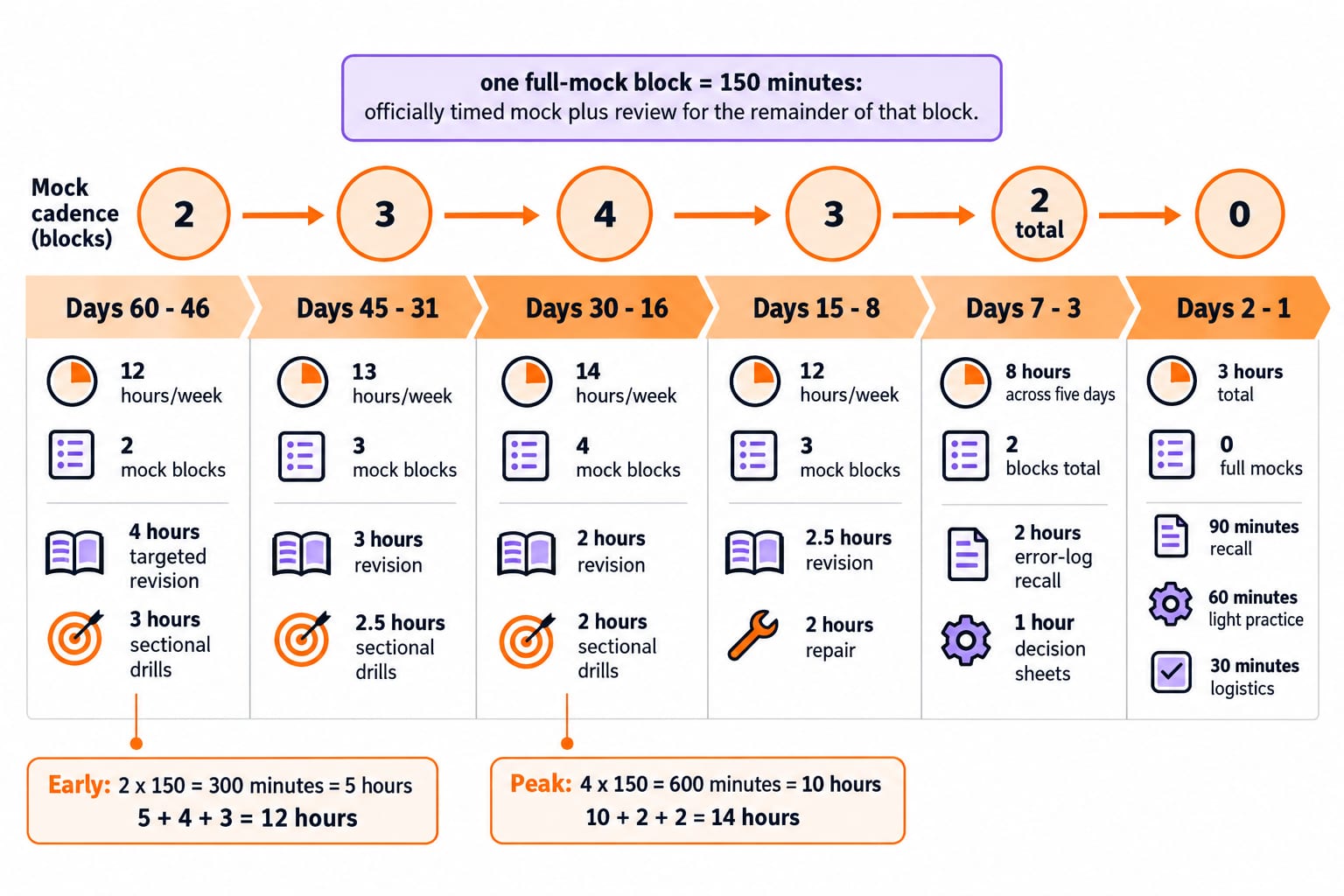
One 150-minute full-mock block is the officially timed mock plus review for the remainder of that block.
Phase | Total load | Mock blocks | Other work |
|---|---|---|---|
Days 60-46 | 12 hours/week | 2 | 4 hours targeted revision + 3 hours sectional drills |
Days 45-31 | 13 hours/week | 3 | 3 hours revision + 2.5 hours drills |
Days 30-16 | 14 hours/week | 4 | 2 hours revision + 2 hours drills |
Days 15-8 | 12 hours/week | 3 | 2.5 hours revision + 2 hours repair |
Days 7-3 | 8 hours across five days | 2 total | 2 hours error-log recall + 1 hour decision sheets |
Days 2-1 | 3 hours total | 0 | 90 minutes recall + 60 minutes light practice + 30 minutes logistics |
Early: 2 x 150 = 300 minutes = 5 hours, then 5 + 4 + 3 = 12 hours. Peak: 4 x 150 = 600 minutes = 10 hours then 10 + 2 + 2 = 14 hours. Keep the confirmed stage and baseline ledger beside this table while you adjust the load.
Worked mock audit: turn 11 errors into the next 135 minutes
In this worked learner example, reasoning has 34 attempted, 29 correct, 5 wrong, so 29/34 = 85.29%. Quantitative practice has 27 attempted, 21 correct, 6 wrong, so 21/27 = 77.78%. Combined, 61 attempted, 50 correct, 11 wrong gives 50/61 = 81.97%.
Tag all 11 errors without overlap: 4 calculation slips, 3 puzzle or arrangement setup errors, 2 reading errors and 2 low-confidence guesses. Check: 4 + 3 + 2 + 2 = 11. Schedule two 25-minute calculation drills, one 45-minute setup reconstruction, one 20-minute reading set and one 20-minute reattempt plus attempt-rule note. Thus, 25 + 25 + 45 + 20 + 20 = 135 minutes.
A comparison mock has 58 attempted, 51 correct, 7 wrong, or 51/58 = 87.93%. That is 1 more correct, 4 fewer wrong and 3 fewer attempts. Use the IBPS PO paper-analysis method for tagging; it covers IBPS PO, not RRB PO.
Build a 12-hour working-aspirant week that survives missed days
Plan in minutes: Monday 75, reasoning repair; Tuesday 75, quantitative repair; Wednesday 90, sectional plus review; Thursday 75, spaced revision; Friday 75, mixed set plus error log; Saturday 165, mock plus analysis; Sunday 165, second mock plus analysis. Total: 75 + 75 + 90 + 75 + 75 + 165 + 165 = 720 minutes = 12 hours.
If Tuesday and Thursday disappear, 75 + 75 = 150 minutes are lost. Recover the more important 75 by adding 25 each to Monday, Wednesday and Sunday. Drop the other block first. The week becomes 720 - 150 + 75 = 645 minutes = 10 hours 45 minutes.
Keep the officially timed mock, its analysis and the largest error repair. Drop a generic mixed drill first. Lost time changes volume, not sleep or plan integrity.
Revise by retrieval and error frequency, not by rereading everything
From the last two mocks, red means 3 or more errors or a repeated non-attempt, amber means 1-2 errors, and green means 0 errors with a clean method. In 120 minutes, give red 72, amber 36 and green 12. Check: 72 + 36 + 12 = 120, or 60% + 30% + 10%.
Try a 3-2-1 retrieval loop. On Day 0, a 20-question set gives 12 correct and 8 wrong. Reconstruct the method. Day 2 closed-book recall gives 16/20; Day 5 timed work gives 18/20; Day 10 ends with 5-minute decision-sheet recall. Here, 18/20 = 90% is the progression check.
Use a small confirmed-syllabus set with an error log after every session instead of random volume.
Raise mock frequency only while analysis quality holds, then taper
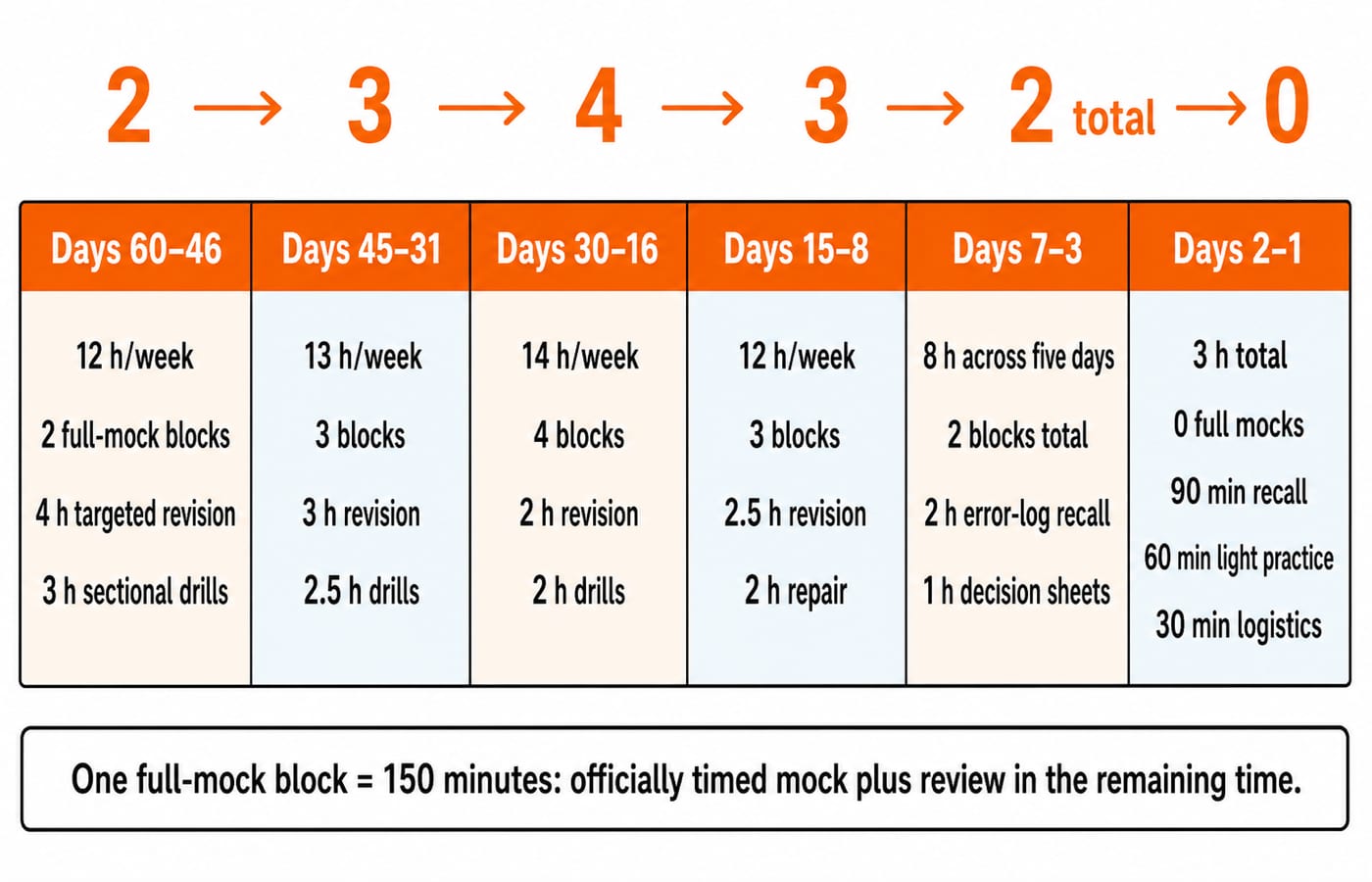
Follow 2 -> 3 -> 4 -> 3 -> 2 total -> 0. The peak is Days 30-16. The last fortnight deliberately removes volume so sleep, recall and decision quality stabilise. Count a mock only after classifying every wrong and important unattempted item before the next full mock.
If one mock yields 11 wrong + 9 important unattempted = 20 review items but only 12 are reviewed, completion is 12/20 = 60%. Finish the remaining 8 before adding a mock. Analysis quality, not a calendar target, controls the cadence.
Practise attempt order in a 20-minute sectional drill: 11 minutes for recognised items, 6 for medium items or sets and 3 for marked returns. 11 + 6 + 3 = 20.
The final 48 hours: protect recall, logistics and calm execution
On Day 2, use 90 minutes for formula, vocabulary and decision sheets, then 30 for the error log. On Day 1, spend 30 on familiar questions and 30 checking your call letter and test-day instructions. 90 + 30 + 30 + 30 = 180 minutes. Take no full mock or heavy topic.
In short, confirm the stage, follow six phases, repair mock errors, protect high-value work and taper from four weekly mock blocks to zero in the final two days. The IBPS PO Prelims Preparation Course is optional support for overlapping banking-aptitude skills, not an IBPS RRB PO course. Otherwise, build the Day 60 sheet and baseline ledger.
Go deeper with the full courseIBPS PO Prelims
Keep learning
SBI PO Last 60 Days Plan: Four Revision Phases and a Mock Taper
Turn each mock into a revision decision with a 60-day countdown, phased practice, protected analysis time, and a lighter final week.
Updated 30 Oct 20265 min readSBI Exams
IBPS PO Last 60 Days Plan: Revision, Mocks and Error Repair
Turn the final 60 days into a measured cycle of diagnosis, revision, mocks, retests and tapering, with worked schedules for a realistic 14-hour week.
Updated 30 Oct 20264 min readIBPS Exams

SSC CPO Last 60 Days Plan: Weekly Revision, Mock Review and Taper
Keep the final 60 days focused on errors that survive your mocks. This Paper I countdown budgets revision and review together, with recovery rules and a lighter final week.
Updated 30 Oct 20265 min readSSC CPO
IBPS Clerk Last 60 Days Plan: A 150-Hour Revision and Mock Strategy
Turn the final 60 days into a controlled sequence of diagnosis, revision, reviewed mocks, error repair and taper, with plans for both 150 and 100 hours.
Updated 11 Nov 20265 min readIBPS Exams