

IBPS Clerk Preparation Tips: A 16-Hour Weekly Study Plan
Finished lectures but still running out of time in practice? Build a repeatable week around reviewed drills, daily recall and early mains preparation, with room to recover missed work.
KnowledgeGate Team
Exam prep & CS education
Updated 12 Nov 20265 min read

You finish lectures, struggle to complete timed sets, and keep postponing mains awareness. This 16-hour weekly model combines daily retrieval, reviewed practice and a missed-day buffer. Treat the suggested eight-week runway as a starting plan to adapt to your level and actual exam calendar.
Map prelims and mains before choosing daily priorities
Recent IBPS CRP CSA notifications have specified a preliminary examination followed by a main examination for Customer Service Associate recruitment, commonly searched as IBPS Clerk. Use the applicable notification for the live pattern. The timers and targets here are self-imposed practice choices, not official standards or predicted scores.
Build English, numerical ability and reasoning foundations for prelims. Keep harder data interpretation (DI), longer reasoning sets and general/financial awareness in your mains preparation stream.
Use the Clerk prelims-to-mains section map to organise those priorities. Choosing which questions to attempt first within a section does not mean you can change the examination's section order or transfer unused sectional time.
Diagnose accuracy before adding more study hours
Start with this original practice diagnostic: three 20-question sets, each with a self-imposed 15-minute limit.
Set | Attempted | Correct | Wrong | Unattempted | Attempted accuracy |
|---|---|---|---|---|---|
Quant | 15 | 12 | 3 | 5 | 12/15 x 100 = 80% |
Reasoning | 16 | 14 | 2 | 4 | 14/16 x 100 = 87.5% |
English | 18 | 15 | 3 | 2 | 15/18 x 100 about 83.3% |
Overall, 49 attempts produce 41 correct answers: 41/49 x 100 about 83.7% accuracy, with 11 unattempted. Dividing 41 by all 60 questions measures coverage-plus-correctness, not attempted accuracy.
Label every wrong or unattempted question: concept gap, calculation/reading slip, time sink or strategic skip. Quant gets first repair priority here; let your own errors decide yours.
Fit the plan into a repeatable 16-hour week
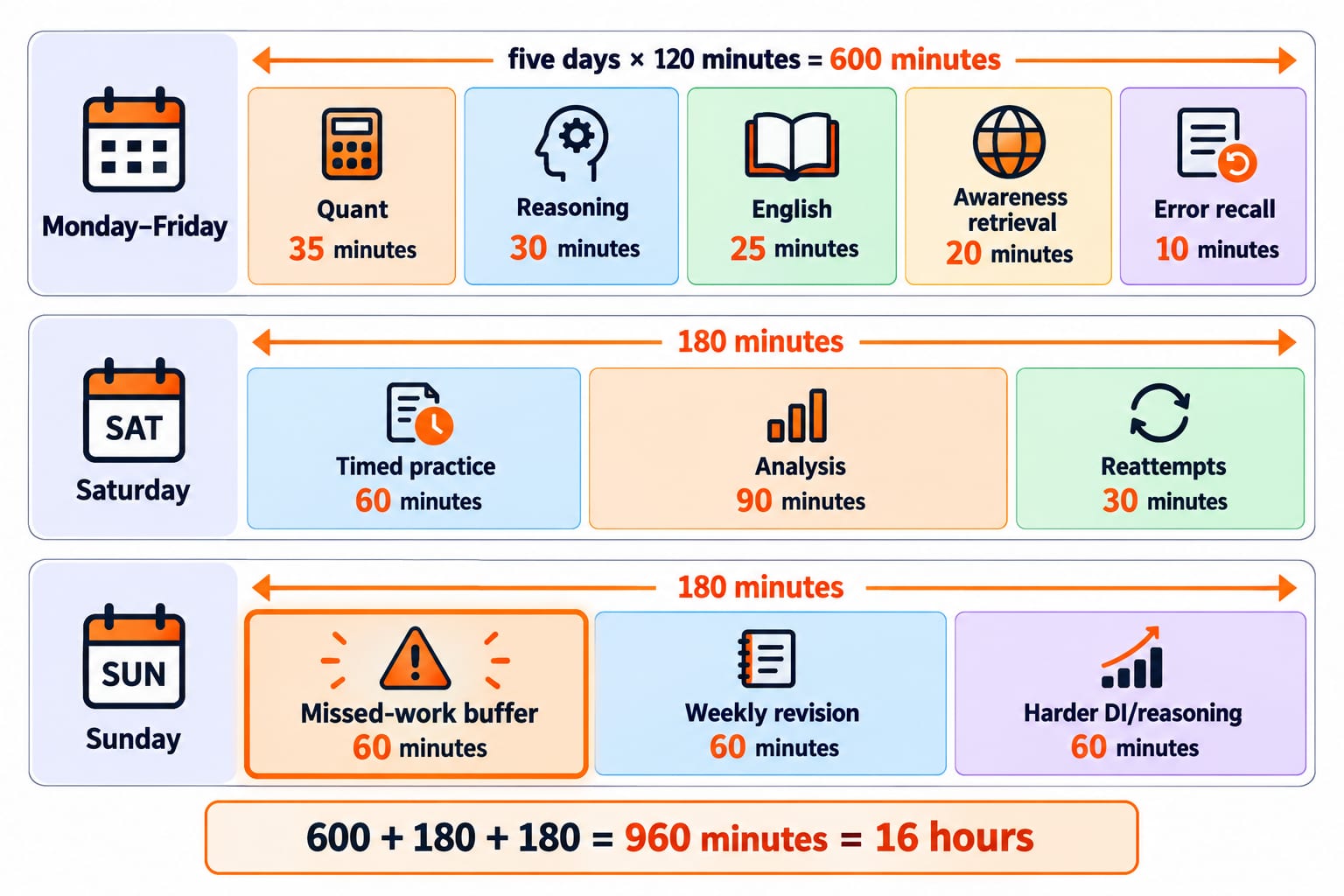
Days | Study blocks in minutes | Total |
|---|---|---|
Monday-Friday | Daily: quant 35, reasoning 30, English 25, awareness retrieval 20, error recall 10 | 5 x 120 = 600 |
Saturday | Mixed timed practice 60, analysis 90, closed-book reattempts 30 | 180 |
Sunday | Missed-work buffer 60, weekly revision 60, harder DI/reasoning 60 | 180 |
Weekday emphasis changes: Monday concepts, Tuesday single-topic practice, Wednesday mixed practice, Thursday timed sets, Friday re-solving errors. These fit inside the blocks. For awareness retrieval, close your notes and recall the event, institution and significance before checking.
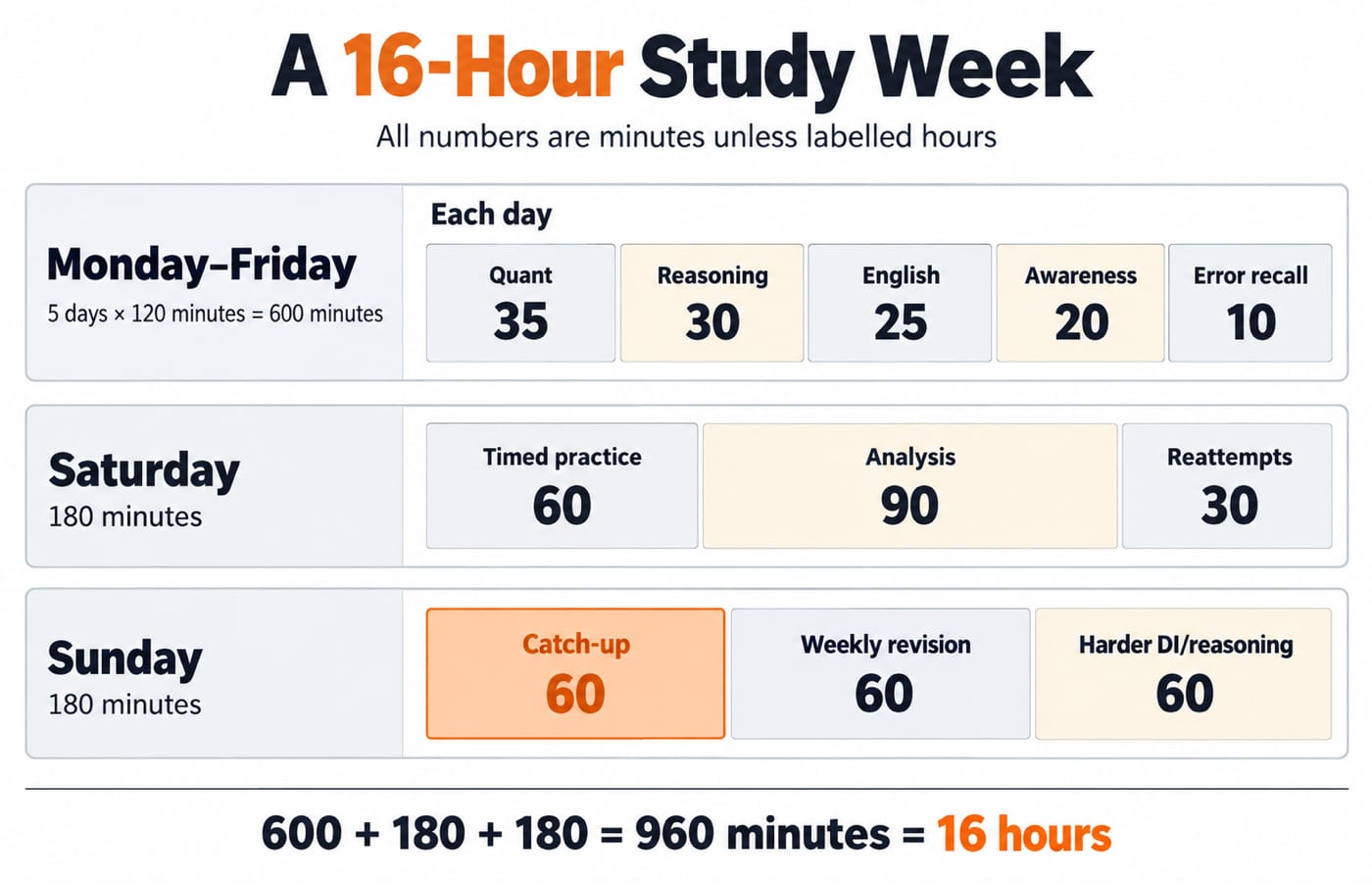
The total is 600 + 180 + 180 = 960 minutes, or 16 hours. Saturday's practice hour is not an official paper duration.
Miss Wednesday's 120 minutes? Recover the weakest-topic 60 minutes in Sunday's existing buffer; defer the other 60 to next week's buffer and drop optional sets. Actual study becomes 960 - 120 = 840 minutes, or 14 hours. The buffer creates no extra hours. Protect sleep and review.
Train speed with small, fully reviewed drills
Quant practice: a value rises from 800 to 920. Increase = 920 - 800 = 120. Percentage increase = 120/800 x 100 = 15%. Reverse check: 800 x 1.15 = 920. Using 120/920 x 100 about 13.04% compares the increase with the final value instead. Follow with comparable questions from the Clerk quant speed drills.
Reasoning practice: A, B, C and D occupy seats 1-4 left to right, facing north. A is immediately left of B; C occupies 4; D cannot occupy 1. Write these constraints first. A-B cannot occupy 3-4 because C occupies 4, or 2-3 because that leaves D at 1. Therefore: A1, B2, D3, C4.
English practice: “Each of the applicants have submitted the form” becomes “Each of the applicants has submitted the form”. The singular head “Each” takes “has”.
Try two comparable 10-question sets at 9/10 or better before reducing your timer from 12 to 11 minutes. Record accuracy and time separately.
Progress through eight weeks without abandoning mains
Weeks 1-2: diagnose and repair arithmetic, basic reasoning and sentence comprehension. Use Saturday's practice hour for section-sized sets.
Weeks 3-5: practise mixed timed sets and deliberate skips; retain weekday awareness and Sunday's harder set.
Weeks 6-8: rehearse the applicable official format and deepen review.
When prelims preparation is stable or your prelims sitting is over, change the weekday split: advanced quant/DI 30 + reasoning 30 + English 25 + awareness 25 + error recall 10 = 120 minutes. Start awareness before results.
Take full mocks in one unbroken sitting at the actual format's duration. On mock weeks, Saturday holds the mock, then analysis in the remaining time. Sunday's 60-minute buffer completes analysis and 30 minutes of closed-book reattempts. This preserves at least 90 minutes of analysis within 960 weekly minutes only if the mock takes at most 120 minutes. For a longer format, explicitly reallocate other blocks before booking it. If the buffer is needed for missed work, use section practice that week.
Turn mock review into the next week's priorities
Compare two original 20-question practice sets. Set A: 18 attempted, 14 correct, four wrong; accuracy = 14/18 x 100 about 77.8%. Set B: 17 attempted, 15 correct, two wrong; accuracy = 15/17 x 100 about 88.2%. One fewer attempt produces one more correct answer.
An error-log entry can read: “Percentage change; divided by final value; rewrite base x growth factor; redo after 1, 3 and 7 days.” For puzzles, record setup time and when you stopped producing new constraints. Test a 45-second no-progress skip trigger across three comparable practice sets before keeping it.
After diagnosing gaps, compare Banking & Insurance preparation resources and check each course's stage-specific scope. End review with two named repair topics, not another unanalysed mock.
Start with one week you can actually complete
Run the diagnostic, reserve five two-hour weekdays and two three-hour weekend blocks, and select two repair topics from your errors. If you have only eight hours weekly, retain the topic order and stretch the workload towards sixteen weeks. If you are within the final 60 days, use the IBPS Clerk last 60 days revision and mock plan for that compressed phase; this post owns the earlier foundation, eight-week runway and recovery buffer.
The IBPS Clerk CSA prelims course is a structured option for the prelims foundations discussed here. It does not replace checking your official notification or choosing suitable mains material. Start with a week you can complete and review.
Go deeper with the full courseIBPS PO Prelims
Keep learning

RRB NTPC Study Plan for Working Aspirants: A Realistic 12-Hour Week
A practical weekly timetable for employed RRB NTPC aspirants, with daily outputs, a 12-week cycle, diagnostic calculations and a no-debt recovery rule.
Updated 30 Oct 20266 min readRRB NTPC
IBPS Clerk Last 60 Days Plan: A 150-Hour Revision and Mock Strategy
Turn the final 60 days into a controlled sequence of diagnosis, revision, reviewed mocks, error repair and taper, with plans for both 150 and 100 hours.
Updated 11 Nov 20265 min readIBPS Exams

UGC NET Paper 1 Strategy for Computer Science Aspirants: A 10.5-Hour Weekly Plan
Protect Paper 1 from familiar CS work with a fixed seven-day cycle. The plan shows exactly how to learn, practise, review errors and recover missed blocks.
Updated 30 Oct 20265 min readNET Strategy & Updates

CAT Preparation for Working Professionals: A Sustainable 10-Hour Week
Build a repeatable CAT week around a full-time job, then use completed work and error patterns to decide what the next 600 minutes should contain.
Updated 30 Oct 20266 min readMBA Entrance (CAT)