COA for GATE: An 8-Week Topic-by-Topic Preparation Plan
Study Computer Organization and Architecture in prerequisite order with an adjustable 80-hour plan, checked numericals, timed practice, and a practical recovery rule.
KnowledgeGate Team
Exam prep & CS education
Updated 29 Aug 20265 min read73 views
COA feels like unrelated formulas until instruction flow, pipelines, memory and I/O follow dependency order. Study for 10 hours weekly, using a worked numerical and an error-led loop in every phase. A missed session shifts the calendar, not the standard; prerequisite dependencies set the sequence, and the current official syllabus sets the boundary.
1. COA for GATE starts with a scope map and a 60-minute diagnostic
The official GATE 2027 CS syllabus lists instruction sets and addressing modes; ALU and control-unit design; memory interfacing, hierarchy and cache mapping; I/O with interrupts and DMA; and instruction pipelining with hazards. Use the GATE CS preparation category for wider planning, while the official syllabus remains the source for examinable scope. The earlier COA syllabus areas and preparation order explains what belongs in the subject and where to place emphasis; the eight-week sequence below turns that scope into daily study work.
Prepare a 12-item, 60-minute baseline: two addressing, two ALU or control, three pipeline, three memory and two I/O questions. Score one point per item:
Score | Concepts | Examples | PYQs | Review |
|---|---|---|---|---|
0-4 | 5 hours | 2 hours | 1 hour | 2 hours |
5-8 | 4 hours | 2 hours | 2 hours | 2 hours |
9-12 | 2 hours | 2 hours | 4 hours | 2 hours |
Each route totals 10 hours. Choose the row that matches the diagnostic, then use five 2-hour sessions: two concepts, one numerical, one for PYQs, and one timed review plus error log. Diagnose for an hour, then label misses by topic and error type.
2. COA Weeks 1 and 2: instructions, addressing, ALU and control
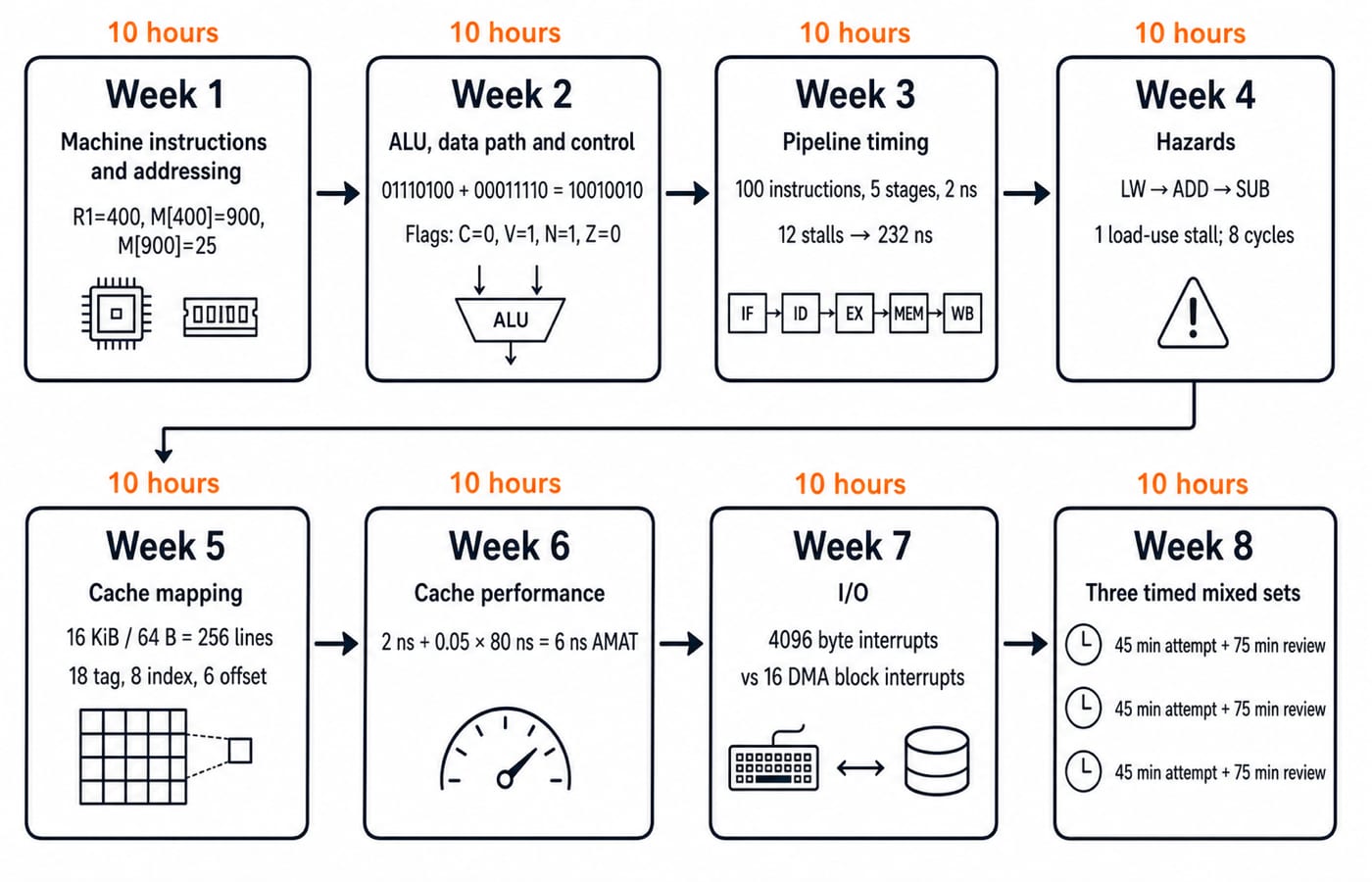
Week 1 uses four hours for instruction fields, flow and addressing modes. For two hours, trace a byte-addressed instruction whose address field is 400, with R1=400, M[400]=900, M[900]=25, PC after fetch =1000, displacement =24. Direct gives address 400, operand 900; memory-indirect gives 900, 25; register-indirect gives 400, 900; PC-relative gives 1000+24=1024. Give two hours to PYQs and two to corrections. See Addressing Modes and Instruction Formats for theory.
Week 2 uses four hours for ALU, signed values, flags, data path and control. Work 01110100 + 00011110: 116+30=146, low bits 10010010, or -110 signed. No carry gives C=0; positive inputs with a negative result give V=1; the sign bit gives N=1; nonzero gives Z=0. Give two hours each to this example, PYQs, and redrawing fetch, decode, execute and write-back. Move on only after reproducing both weeks' checks unaided.
3. COA Weeks 3 and 4: pipeline timing, then hazards
Week 3 uses four hours for latency, throughput, balance and cycle counts. A pipeline with five equal 2 ns stages running 100 instructions needs (5+100-1) x 2=208 ns. Its non-pipelined match needs 100 x 5 x 2=1000 ns, giving 1000/208=4.81 speedup. Twelve stalls give (5+100-1+12) x 2=232 ns and 1000/232=4.31. Give two hours each to this example, numericals, and formula checks with units.
Week 4 uses four hours for structural, data and control hazards. Grid LW R1,0(R2), ADD R3,R1,R4, SUB R5,R3,R6. With standard forwarding, load-use needs one stall; ADD forwards to SUB without another. Final write-back is cycle 8, matching 5+3-1+1=8. Give two hours each to the grid, PYQs, and classifying dependency, forwarding or count errors. Check by grid and formula.
4. COA Weeks 5 and 6: cache mapping and performance
Week 5 uses four hours for locality and caches. A 32-bit byte-addressed machine with a 16 KiB direct-mapped cache and 64-byte blocks has 16384/64=256 lines, giving six offset bits, eight index bits and 32-8-6=18 tag bits. Address 0x12345678 has tag 0x48D1, index 0x59=89, offset 0x38=56. Give two hours each to this example, PYQs, and rebuilding the split.
Week 6 uses four hours for replacement, writes, hits and penalties. With AMAT = hit time + miss rate x miss penalty, a 2 ns hit, 0.95 hit rate and 80 ns penalty give 2+0.05 x 80=6 ns. For 1,000 accesses, 1000 x 2=2000 ns plus 50 x 80=4000 ns; 6000/1000=6 ns again. Give two hours each to the example, numericals, and retesting. State the convention first. Retest the AMAT convention against a fresh miss-rate example before moving on.
5. COA Week 7: I/O interfaces, interrupts and DMA
Use four hours to compare the three transfer paths. With programmed I/O, the CPU polls device status and moves each item. With interrupt-driven I/O, the device signals readiness and the handler moves data. With DMA, the CPU configures a controller, the controller moves a block between device and memory, and an interrupt reports completion.
A 4 KiB example has 4,096 bytes. Assume interrupt-driven I/O raises one interrupt per byte, while DMA moves 256-byte blocks and interrupts once per block. The counts are 4,096 byte-level interrupts and 4096/256=16 interrupts, a ratio of 4096/16=256 for these stated transfer sizes. Give two hours each to this trace, PYQs, and redrawing method, mover, CPU involvement, notification and transfer shape.
6. COA Week 8: timed sets and error-led revision
Build three mixed sets covering addressing, ALU or data path, pipelines or hazards, cache fields or AMAT, and I/O. Each set samples the full COA sequence so weak transitions between topics become visible.
Use 10 hours: two sets take two hours each, split into a 45-minute attempt and 75-minute review; repair the weakest topic for three hours; take the final set with the same split; plan maintenance for one hour. The GATE Test Series offers optional practice. Re-solve wrong numericals, write a rule for guesses, and eliminate repeated error classes by the final set.
7. COA missed-day recovery: protect the sequence
Miss one session and run an 8-hour week: three concept hours, two for examples, two for PYQs and one for errors. Do not overload Sunday. Miss two sessions, or fall below six hours, and keep two hours each for concepts, examples and PYQs, then extend by one week.
Log question type, my wrong step, correct rule, fresh check, and retest date. Examples are using n x k x t instead of (k+n-1+stalls)t, writing 16 index bits for 256 lines instead of eight, and confusing 4,096 byte events with 16 DMA completions. Retest after 1, 3 and 7 days. Two failures turn the next concept session into repair.
8. COA for GATE in the short version
Instructions and addressing lead to ALU, data path and control; then pipelines and hazards; mapping leads to memory performance; I/O connects processor and device. Study for 8 x 10=80 hours, extending to nine weeks after recovery.
For four weeks, spend 30 minutes redrawing a concept map, 60 minutes on a mixed set and 60 minutes repairing errors. That is 2.5 hours weekly. Rotate addressing, pipeline, cache and I/O.
Use GATE Guidance by Sanchit Sir for a structured subject-wise route. If your overall plan works, keep this 80-hour sequence and your trusted practice source.
Keep learning
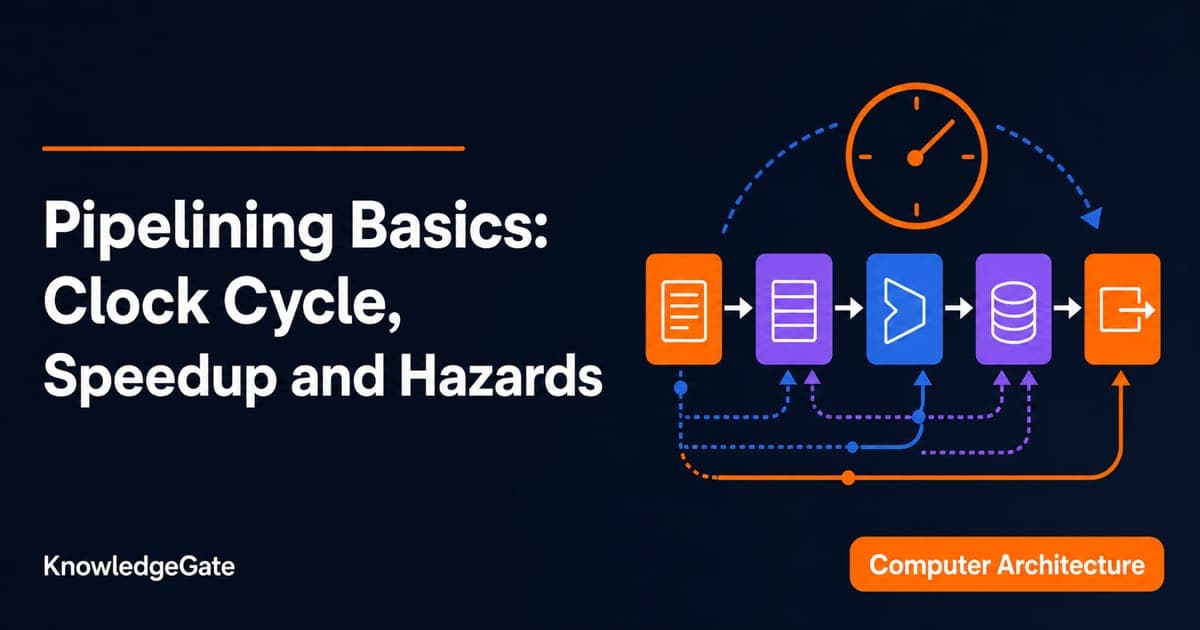
Pipelining Basics in Computer Architecture: Clock Cycle, Speedup and Hazard Worked Examples
Learn how to calculate a pipeline clock, fill and drain time, finite-batch speedup, latency, throughput, and the cost of a load-use stall.
Updated 23 Oct 20266 min readComputer Organization & Architecture

Data Manipulation Micro-Operations in COA: Arithmetic, Logic and Shift Operations Worked Step by Step
Learn a fixed-width method for tracing arithmetic, logic, and shift micro-operations. Every example tracks register values, result bits, carry, and overflow.
Updated 19 Oct 20265 min readComputer Organization & Architecture
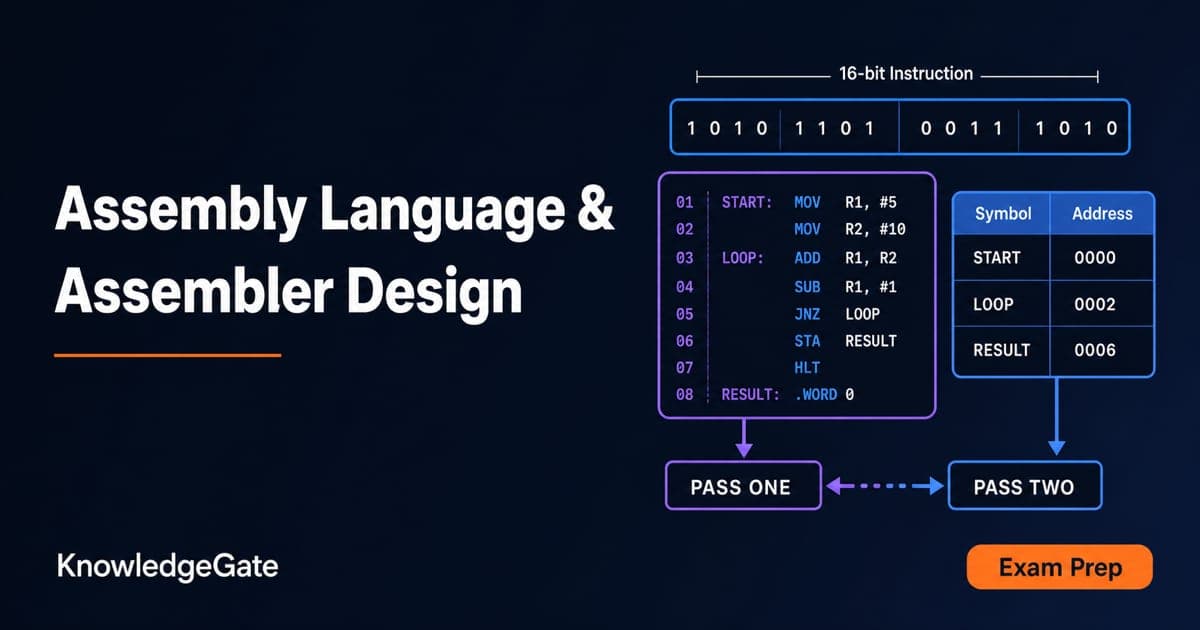
Assembly Language and Assembler Design: Two-Pass Translation with a Complete Worked Example
Follow a 16-bit Basic Computer program through pass one, pass two, hexadecimal encoding and execution, with every symbol, address and result shown.
Updated 15 Oct 20266 min readComputer Organization & Architecture
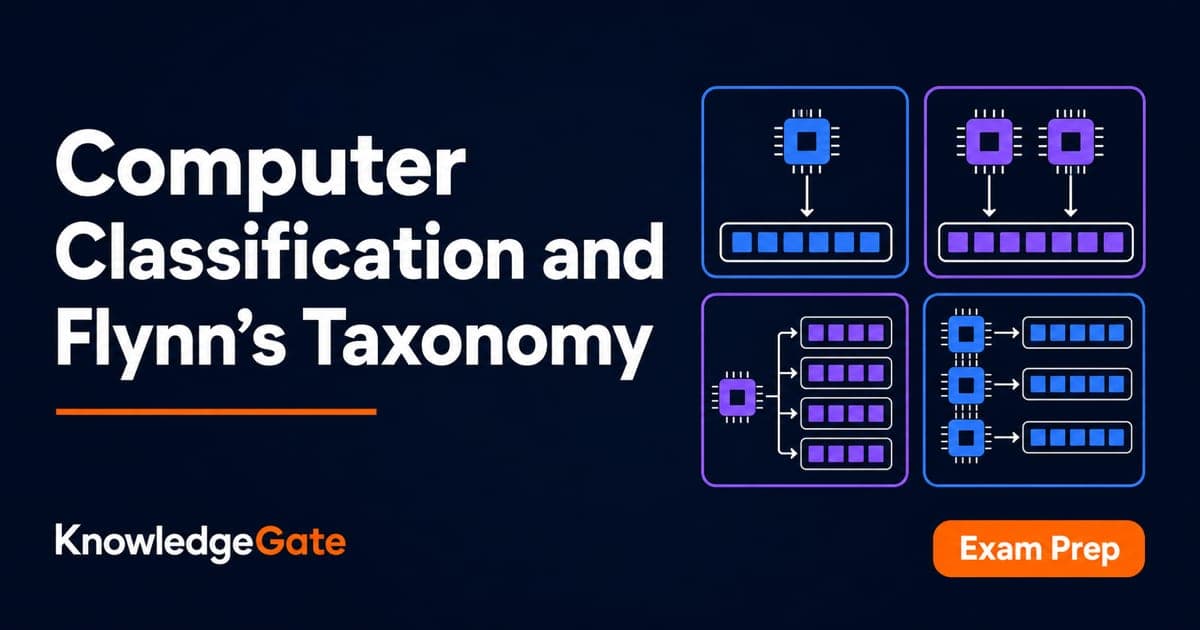
Computer Classification and Flynn’s Taxonomy: The Four Classes with a Worked Vector Example
A machine can belong to several computer classes at once. Learn the four classification axes, Flynn’s matrix, vector and multicore traces, and exam traps.
Updated 11 Oct 20266 min readComputer Organization & Architecture