Assembly Language and Assembler Design: Two-Pass Translation with a Complete Worked Example
Follow a 16-bit Basic Computer program through pass one, pass two, hexadecimal encoding and execution, with every symbol, address and result shown.
KnowledgeGate Team
Exam prep & CS education
Updated 15 Oct 20266 min read
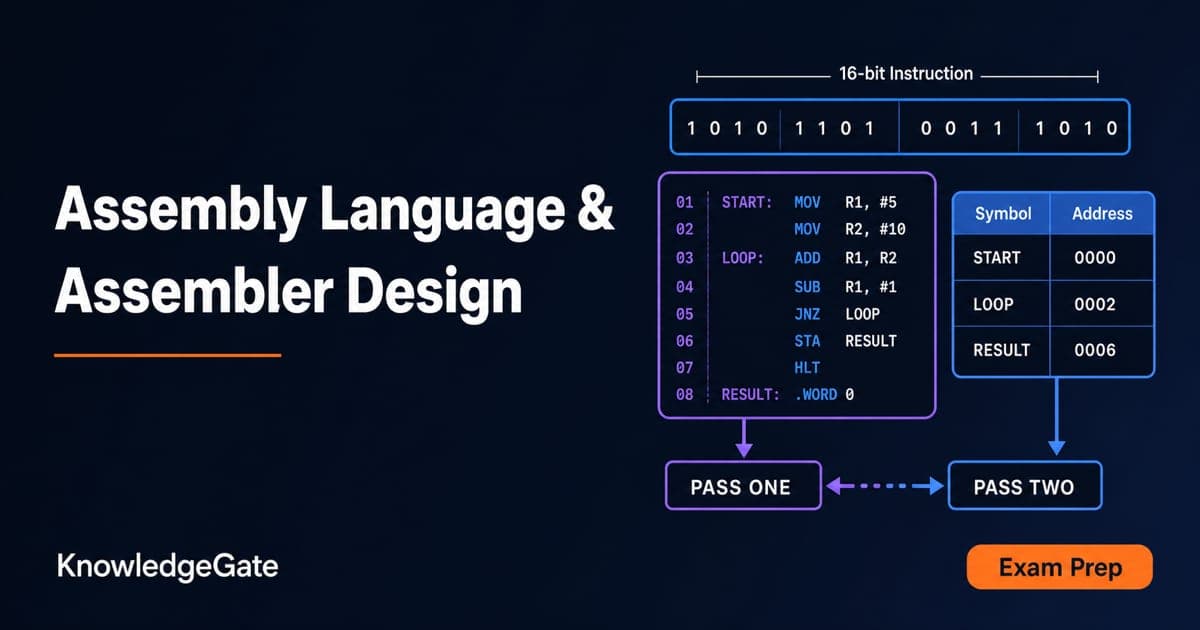
Reading a short assembly program is manageable until one question asks you to track the location counter, forward references, symbol addresses, instruction bits and signed data together. Then a simple program becomes five linked problems. A small 16-bit Basic Computer program goes through both assembler passes before execution. Use GATE CS Exam Preparation as the broader study hub around this lesson.
Assembly language and assembler design: source, translator and output
Machine language is the pattern of bits that the CPU executes. Assembly language gives those patterns symbolic mnemonics, labels and operands. An assembler translates each assembly statement into a machine word or performs the requested directive. It is not the CPU, which executes the result, and it is not a compiler, which normally translates a higher-level language.
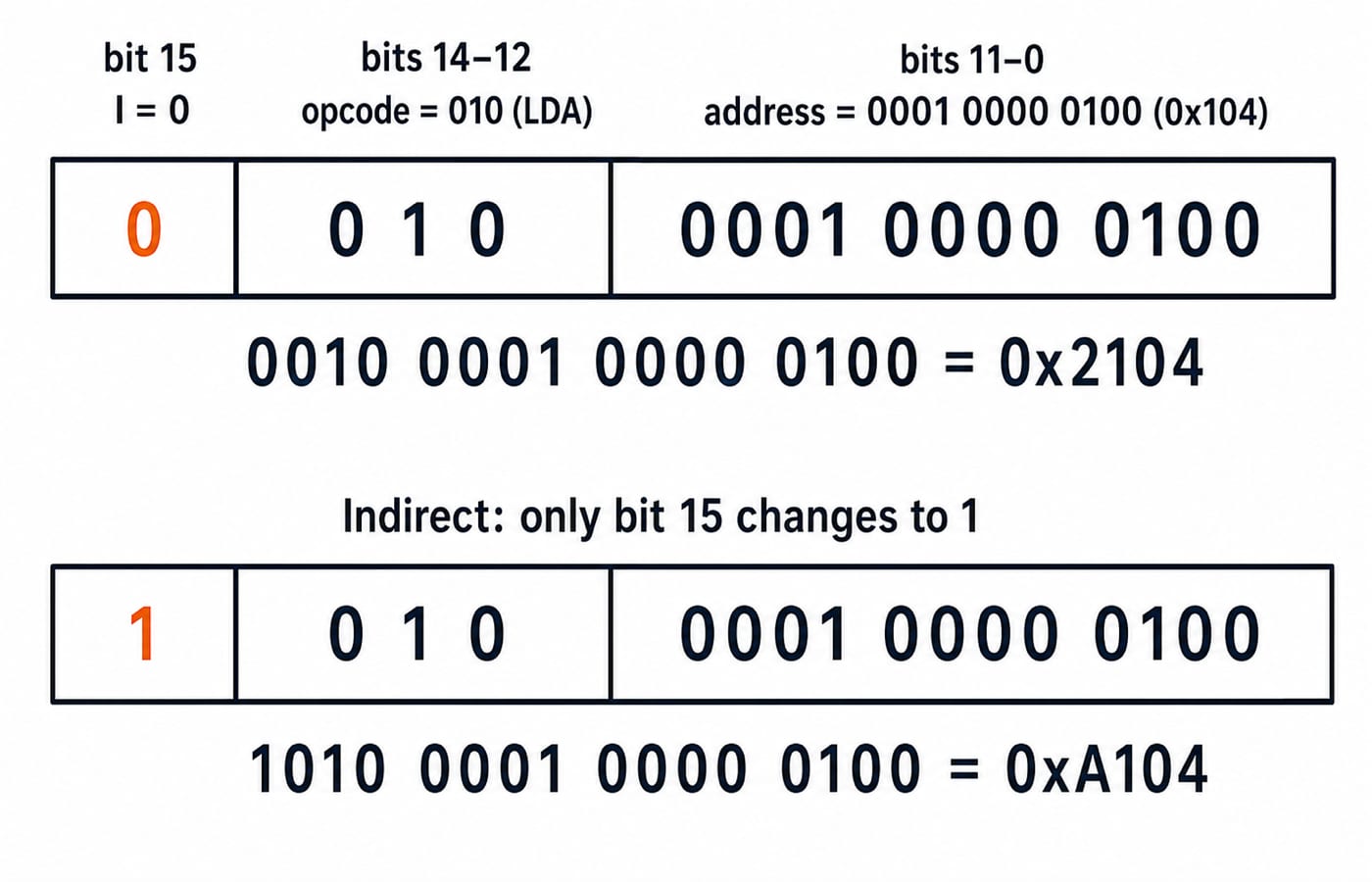
The teaching machine is a 16-bit Basic Computer with 4096 = 2^12 word locations, addressed from 0x000 to 0xFFF. In a memory-reference instruction, bit 15 is the indirect bit I, bits 14 to 12 hold a 3-bit opcode, and bits 11 to 0 hold the address. A memory cell is denoted as word[address].
The encoding rule is:
word = (I << 15) | (opcode << 12) | address
For LDA, opcode 010 is hexadecimal 2. Direct LDA 104 becomes 0x2104. Indirect LDA 104 I sets bit 15, adding 0x8000, so it becomes 0xA104. Addressing Modes and Instruction Formats explains why the same address field can be interpreted directly or indirectly.
Basic Computer assembly statements: mnemonics, labels and directives
The teaching assembler recognises four statement classes:
Statement class | Examples | What the assembler does | Consumes one memory word? |
|---|---|---|---|
Memory-reference instruction |
| Combines | Yes |
Register-reference instruction |
| Emits the fixed register-operation pattern | Yes |
I/O instruction |
| Emits the fixed I/O-operation pattern | Yes |
Directive |
| Controls placement, emits data, or stops processing | Only |
In FIRST, DEC 25, FIRST is the optional label, DEC is the directive and 25 is its operand. The comma belongs to the source syntax, not to the symbol name. Locations and instruction operands in the worked program are hexadecimal. DEC explicitly introduces a signed decimal constant, while HEX explicitly introduces a hexadecimal word.
ORG 100 sets the location counter to LC = 0x100 and emits no word. Every instruction, DEC line and HEX line occupies one 16-bit word and increments LC by one. END stops source processing and emits nothing. This teaching assembler uses one-word instructions; real instruction sets may use variable-length instructions.
Two-pass assembler design: build the symbol table first
The earlier Programming the Basic Computer (COA): Instruction Set, Assembly Language and Worked Examples owns the full 25-instruction model, loops, subroutines and I/O. The assembler-specific task is narrower: run the location counter, build SYMTAB and produce an address-object listing for one source program.
The assembler uses three tables. The mnemonic opcode table (MOT) includes LDA -> 2, ADD -> 1, STA -> 3, BUN -> 4 and the fixed word HLT -> 0x7001. A pseudo-op table describes ORG, DEC, HEX and END. The symbol table (SYMTAB) maps labels to addresses. Both passes read the source and maintain a location counter.
Pass one scans from the beginning. It applies ORG, enters each label with the current LC, rejects duplicate labels and increments LC only for statements that produce words. An operand such as FIRST may be used before it is defined because pass one records definitions instead of trying to emit its final address.
Pass two resets and rescans. It gets each mnemonic's bit pattern from the MOT, resolves symbolic operands through SYMTAB, converts DEC and HEX constants to 16-bit words, then emits address-object pairs. It must flag an undefined symbol, duplicate definition, illegal mnemonic, address outside 0x000 to 0xFFF, or constant that cannot fit the required word. A one-pass assembler can handle forward references only by keeping fix-up or backpatch records. Two complete scans keep forward-reference handling explicit.
Assembler pass one worked example: addresses and SYMTAB
The fixed source program is:
ORG 100
START,  LDA FIRST
        ADD SECOND
        STA RESULT
        BUN DONE
FIRST,  DEC 25
SECOND, DEC -7
RESULT, HEX 0000
DONE,   HLT
END
All entries in this pass-one table are hexadecimal:
Source statement | LC before | Label entered | LC after |
|---|---|---|---|
| none | none |
|
|
|
|
|
|
| none |
|
|
| none |
|
|
| none |
|
|
|
|
|
|
|
|
|
|
|
|
|
|
|
|
|
|
| none |
|
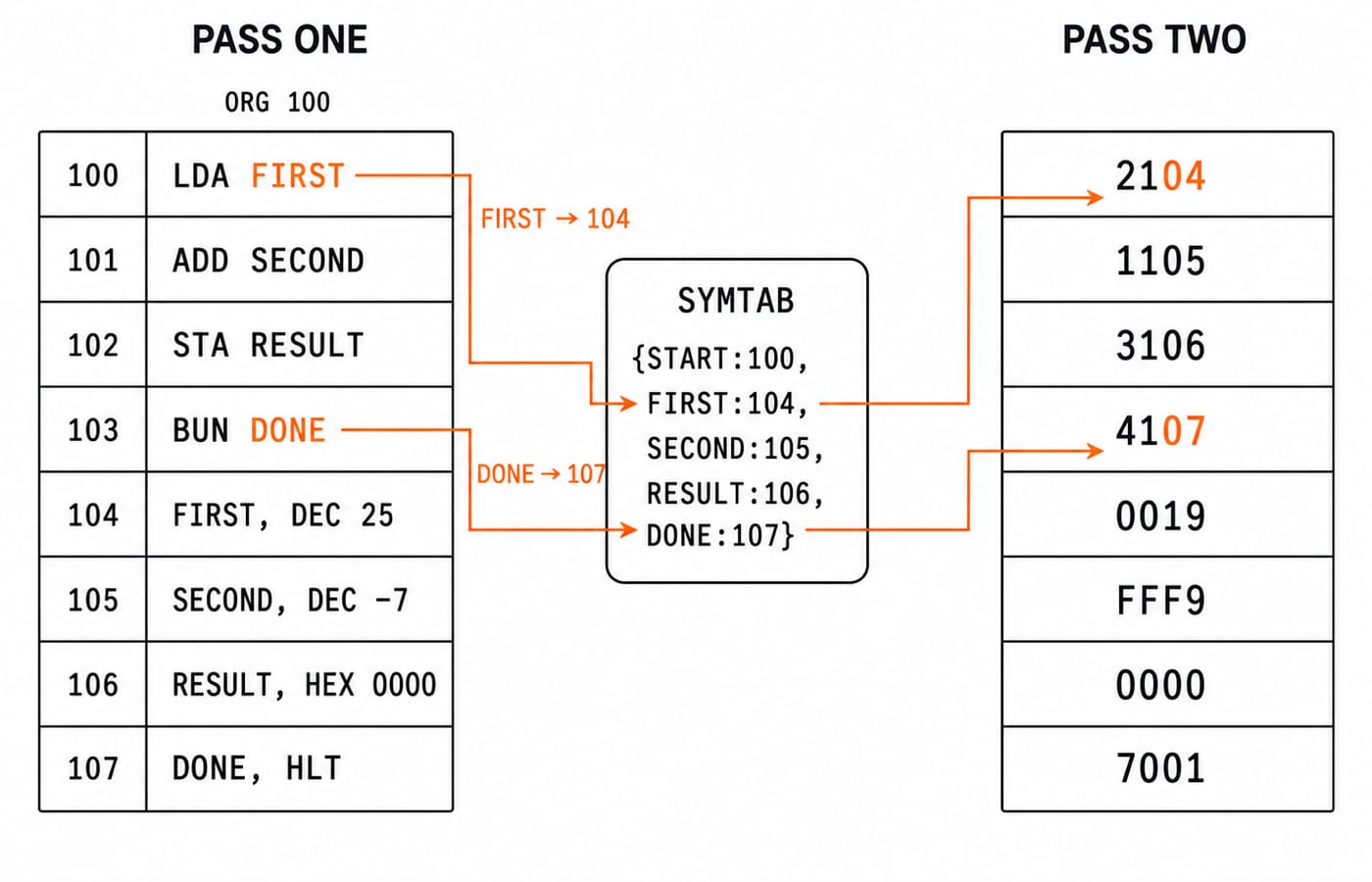
Thus ORG and END add no words, while the eight producing lines occupy 100 through 107. When first used, FIRST, SECOND, RESULT and DONE are forward references. The completed SYMTAB is START -> 100, FIRST -> 104, SECOND -> 105, RESULT -> 106, DONE -> 107.
Assembler pass two worked example: object code and execution
Pass two now resolves every operand and emits four hexadecimal digits per word:
Address | Source | Object word |
|---|---|---|
|
|
|
|
|
|
|
|
|
|
|
|
|
|
|
|
|
|
|
|
|
|
|
|
For LDA FIRST, I = 0, opcode 2, and SYMTAB[FIRST] = 0x104:
(0 << 15) | (2 << 12) | 0x104 = 0x2104
For BUN DONE, opcode 4 combined with 0x107 gives 0x4107. Decimal 25 is hexadecimal 0x0019. For -7, 16-bit two's complement is 0x10000 - 0x0007 = 0xFFF9. Review Number Systems and Base Conversions Explained if those conversions need a refresher.
Execution begins with PC = 0x100. LDA loads AC = 0x0019, which is 25. ADD computes 0x0019 + 0xFFF9 = 0x10012; discarding the carry beyond 16 bits leaves AC = 0x0012, which is 18. STA writes 0x0012 into word[0x106]. BUN loads PC = 0x107, and HLT stops. The final state is AC = 0x0012, word[0x106] = 0x0012, decimal result 18.
Assembly and assembler questions: solve by columns and avoid six traps
Common question forms ask you to calculate a word from opcode, I and address, build SYMTAB in pass one, emit object code in pass two, identify an undefined or duplicate symbol, translate a negative DEC constant, or trace the final register or memory value. More than 10 questions on assembly and assembler design are available in our practice bank.
Trap | Corrective check |
|---|---|
Treating a symbol's address as its stored value | Ask whether the field needs the address or |
Incrementing | Mark each line as word-producing or non-producing first. |
Counting a label as an extra word | A label names the current location; it occupies no separate location. |
Forgetting the indirect bit | If |
Writing decimal |
|
Keeping a seventeenth carry bit | Mask an addition to 16 bits before reading the final value. |
Use three scratch columns: LC/source, SYMTAB and object word. Finish the symbol table before encoding, then trace execution separately. For broader timed practice across the syllabus, the GATE Test Series is a good next stop.
Assembly and assembler design: the short version and next step
Use four steps: fix the machine format; run the location counter and build SYMTAB; encode each line after resolving its symbols; execute only if the question asks for the program result. The program's key values are FIRST = 104, DONE = 107, LDA FIRST = 2104, and the final decimal result is 18.
Keep the three work areas separate on paper, and assembler questions become a sequence of checkable transformations rather than one crowded calculation.
Keep learning
Data Manipulation Micro-Operations in COA: Arithmetic, Logic and Shift Operations Worked Step by Step
Learn a fixed-width method for tracing arithmetic, logic, and shift micro-operations. Every example tracks register values, result bits, carry, and overflow.
Updated 19 Oct 20265 min readComputer Organization & Architecture
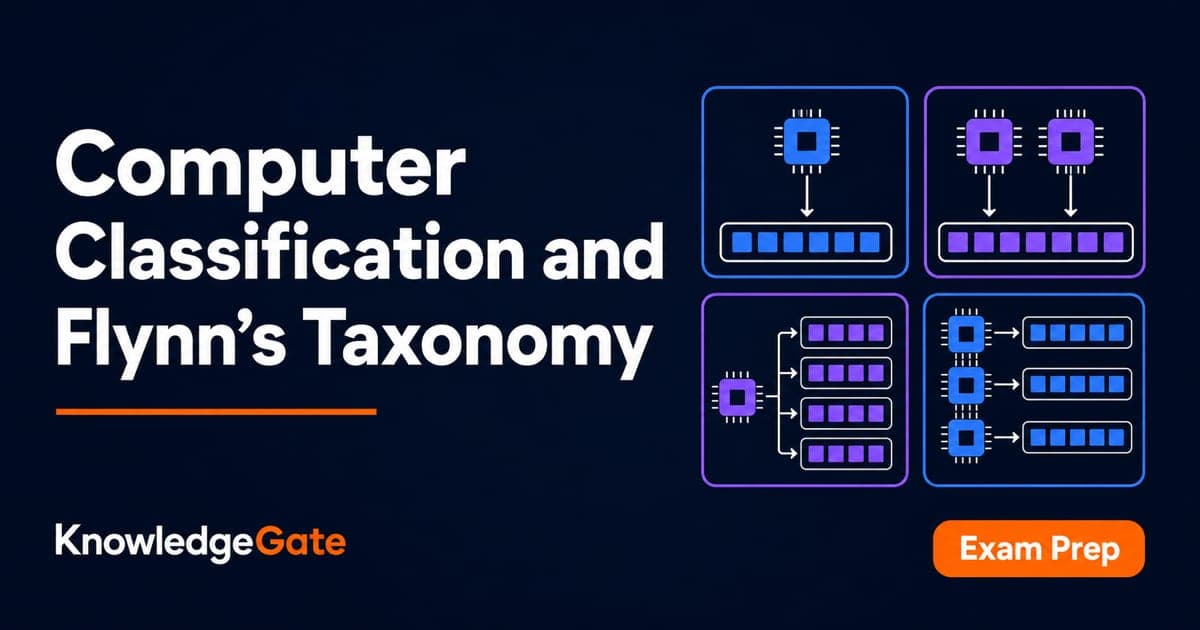
Computer Classification and Flynn’s Taxonomy: The Four Classes with a Worked Vector Example
A machine can belong to several computer classes at once. Learn the four classification axes, Flynn’s matrix, vector and multicore traces, and exam traps.
Updated 11 Oct 20266 min readComputer Organization & Architecture
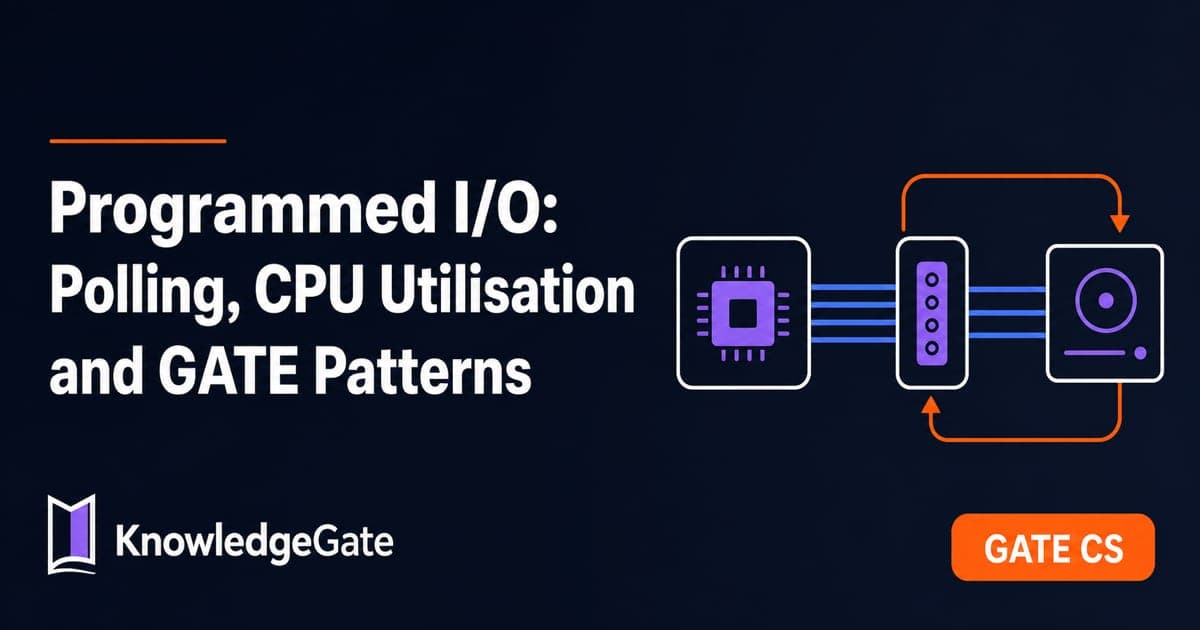
Programmed I/O: Polling, CPU Utilisation, Worked Examples and GATE Question Patterns
Follow one programmed-input transfer from control write to data read, then calculate how many polls one word costs and what a longer poll period buys.
Updated 7 Oct 20266 min readComputer Organization & Architecture
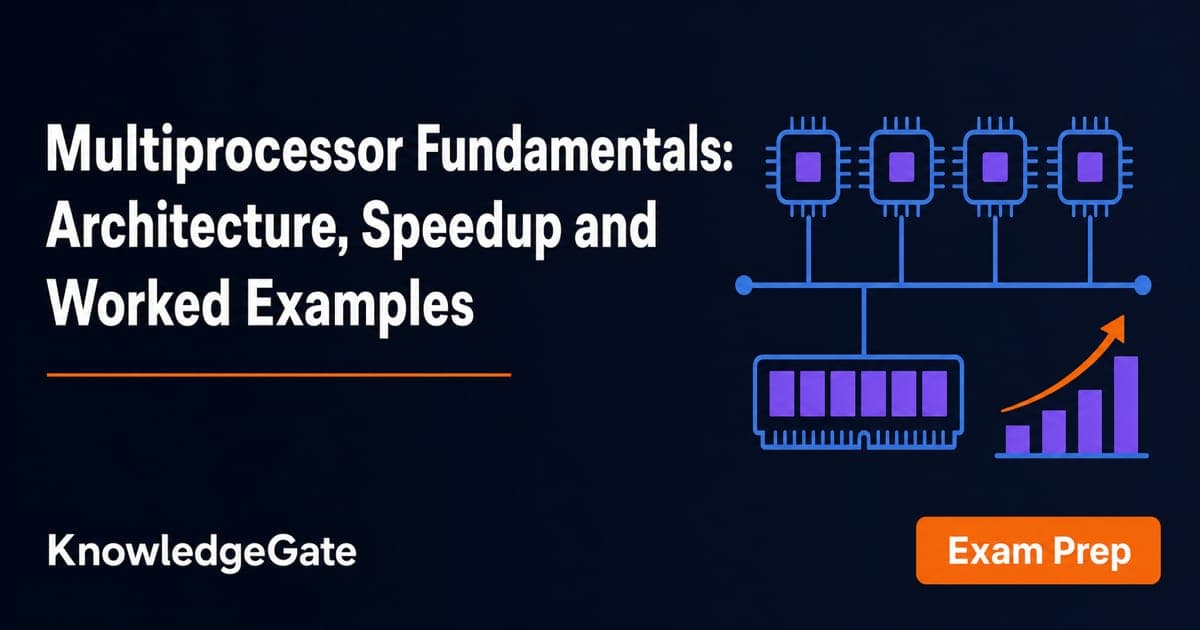
Multiprocessor Fundamentals: Architecture, Speedup and Worked Examples
Build a clear model of multiprocessor systems, then use it to calculate speedup and efficiency, trace a coherent write, and diagnose a lost update.
Updated 2 Oct 20265 min readComputer Organization & Architecture