Lattice MCQs: 12 Solved Questions on Join, Meet and Hasse Diagrams
Solve 12 lattice questions from basic definitions to divisor posets, complements, sublattices and the distributive law. Each answer names the decisive pair or identity.
KnowledgeGate Team
Exam prep & CS education
Updated 10 Sep 20267 min read

A poset can look tidy and still fail to be a lattice because one troublesome pair lacks a unique least upper bound or greatest lower bound. Join and meet questions become reliable only when you check that pair, not the overall shape. The decisive evidence is a specific pair or identity, whether the question concerns divisor lattices, Hasse diagrams, complements, sublattices or distributivity.
Open Questions 1-8 from the lattice practice-question set, and use the GATE CS preparation section for the wider Discrete Mathematics sequence.
Related reading: Lattices and Hasse diagrams and Lattice properties.
Lattice, join and meet: the pairwise test before the MCQs
A lattice is a poset in which every pair x,y has one join x ∨ y, the least common upper bound, and one meet x ∧ y, the greatest common lower bound. A join-semilattice guarantees only joins, while a meet-semilattice guarantees only meets. Bounded, complemented, distributive and Boolean classification is the focus of Lattice and Boolean Algebra MCQs. For join and meet existence, Hasse-diagram bounds and sublattice closure, use the pairwise method: name the common bounds and test uniqueness.
For D(12)={1,2,3,4,6,12} ordered by divisibility, meet is gcd and join is lcm: 4 ∧ 6=gcd(4,6)=2, 4 ∨ 6=lcm(4,6)=12, 3 ∧ 4=1, and 3 ∨ 4=12. In {1,2,3,4,6,9}, however, 4 and 9 have no common upper bound inside the set, so their join does not exist, although 4 ∧ 9=gcd(4,9)=1 does.
Use one fixed routine. For a comparable pair, the lower element is the meet and the higher element is the join. For an incomparable pair, list all common lower and upper bounds, then check for one greatest lower bound and one least upper bound.
Lattice MCQs 1-2: definition, semilattices and finite bounds
Question 1
The POSET [{1,2,3,4,6,9};/] is ____ ?
A. a lattice
B. a semi join lattice
C. a meet semi lattice
D. none of these
Answer: C. a meet semi lattice. Every pair's gcd is in the set, so every meet exists. But 4 and 9 have no common multiple there and hence no join. Only the meet-semilattice condition survives.
Question 2
Consider the following statements and choose the correct one. I.Every finite lattice has a least element II.Every POSET has a greatest element
A. Only S1
B. Only S2
C. Both S1 and S2
D. None of these
Answer: A. Only S1. Repeatedly meeting all elements of a finite lattice produces its least element. The two-element antichain {u,v} refutes Statement II because neither element is above the other.
Lattice MCQs 3-4: divisor-poset isomorphism and join laws
Question 3
Consider the following POSET: P1: ({1,2,4,6,9,12,15,18,22,26}, /) P2: ({1,2,3,6,11,22,33,66}, /) P3: ({1,3,5,7,15,21,35,105}, /) Which of the above POSET are isomorphic to (P(S), ⊆ ), where S = {a,b,c}
A. P1 and P2 only
B. P2 and P3 only
C. P1, P2 and P3
D. P1 and P3 only
Answer: B. P2 and P3 only. P(S) has 2^3=8 elements. P2 lists the divisors of 66=2×3×11, and P3 lists those of 105=3×5×7; prime-factor subsets give B3 in both cases. P1 has 10 elements and fails immediately.
Question 4
Let L be a lattice. Then for every a and b in L which one of the following is correct?
A. a v b = a ᴧb
B. a v ( b ᴧ c) = a
C. a v ( b v c) = b
D. a v (b v c) = (a v b) v c
Answer: D. a v (b v c) = (a v b) v c. This is associativity of join. In D(12), 2 ∨ (3 ∨ 4)=2 ∨ 12=12, and (2 ∨ 3) ∨ 4=6 ∨ 4=12. Absorption is a ∨ (a ∧ b)=a, not option B.
Lattice MCQs 5-6: diagnose a Hasse diagram and find complements
Question 5
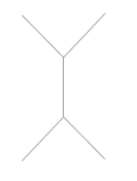
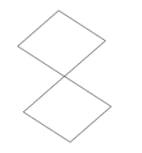
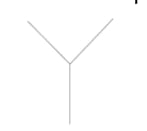
Which of the following is a lattice?
A.
B.
C.
D.
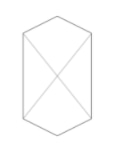
Answer: B, the second diagram. B's diamonds share a centre, giving every pair unique bounds. A lacks common upper and lower bounds across its arms; C's maximal arms have no join. D's lower-fork elements have two incomparable minimal upper bounds, so their join is not unique.
Question 6
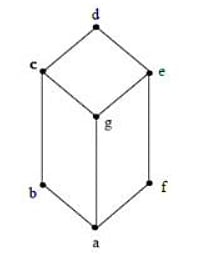
In the lattice defined by the Hasse diagram below, the complements of b, g, e respectively are
A. e,f;g;b;
B. e,f;does not exist;b;
C. e,f;does not exist;a;
D. None of these
Answer: B. e,f;does not exist;b;. With bottom a and top d, b∧e=a, b∨e=d, b∧f=a, and b∨f=d, so e and f complement b. No partner for g gives both extremes. Since e∧b=a and e∨b=d, b complements e. Complements need not be unique or universal.
Lattice MCQs 7-8: sublattices and closure under join and meet
Question 7
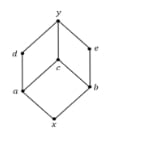
The hasse diagram of a lattice L = {x, a, b, c, d, e, y} is shown below. Which of the following subsets of ‘L’ are sub-lattices of L?
A. {x, a, c, y}
B. {x, d, c, y}
C. {x, a, e, y}
D. {x, a, b, y}
Answer: A and C. A is the chain x<a<c<y, so its operations stay inside it. In C, a∧e=x and a∨e=y. B omits d∧c=a, while D omits a∨b=c. Sublattices inherit L's operations; they do not recompute them after deletion.
Question 8
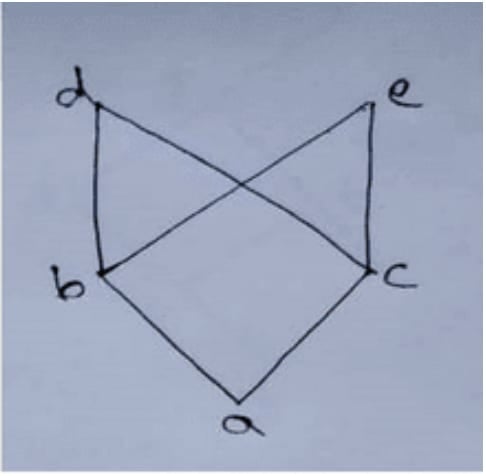
Consider the following hasse diagram, find which of the following is true?
A. it is a lattice
B. subset {a, b, c, d} is a lattice
C. subset {b, c, d, e} is a lattice
D. subset {a, b, c, e} is a lattice
Answer: B and D. Maximal elements d and e have no common upper bound, so the whole poset is not a lattice. The two selected subsets are diamonds, with b∧c=a and b∨c=d or e. Option C omits the required meet a.
Lattice MCQs 9-10: make a poset a lattice and count distributive triples
Question 9, GATE 2017 Set 2
Consider the set under partial ordering The Hasse diagram of the partial order is shown below.
The minimum number of ordered pairs that need to be added to to make a lattice is ______
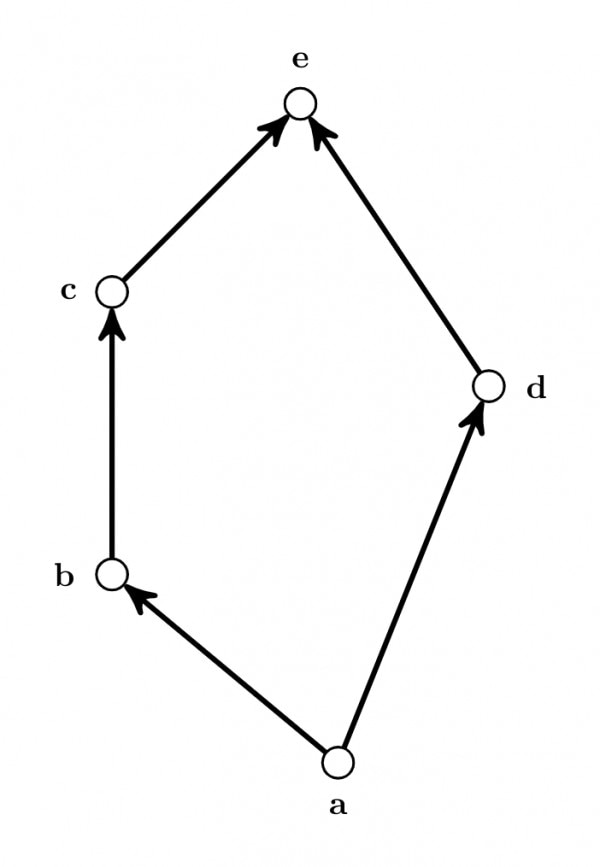
Answer: 0. Comparable pairs already have their meet and join. For the incomparable pairs, b∧d=a, b∨d=e, c∧d=a, and c∨d=e. Every pair is covered, so R needs no addition.
Question 10, GATE 2015 Set 1
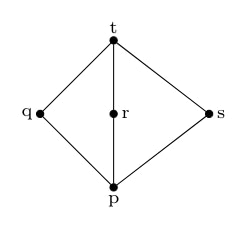
Suppose is a lattice represented by the following Hasse diagram:
For any , not necessarily distinct , and are join and meet of , respectively. Let be the set of all ordered triplets of the elements of . Let be the probability that an element chosen equiprobably satisfies . Then
A.
B.
C.
D.
Answer: D. 1/5 < p_r < 1. In M3, failure needs x to be one atom and y,z to be the other two in either order. That gives 3×2=6 failures among 5^3=125 triples and 125-6=119 successes. For x=q,y=r,z=s, the two sides are q and t. Hence p_r=119/125=0.952.
Lattice MCQs 11-12 and the short version
Question 11, GATE 2008 Information Technology
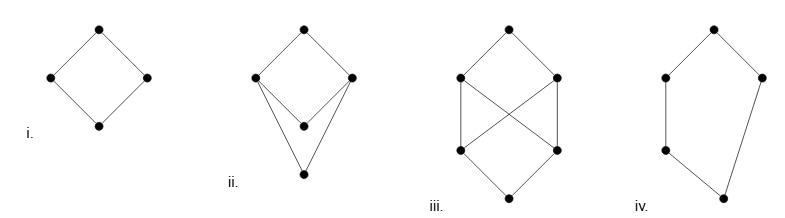
Consider the following Hasse diagrams.
Which all of the above represent a lattice?
A. (i) and (iv) only
B. (ii) and (iii) only
C. (iii) only
D. (i), (ii) and (iv) only
Answer: A. (i) and (iv) only. In (i), the incomparable middle pair has the bottom as meet and top as join. In chain (iv), lower and higher members supply the operations. The lower pair in (ii) reaches two minimal upper candidates, while the forked pair in (iii) also lacks one unique bound.
Question 12, GATE 1999
Let L be a set with a relation R that is reflexive, antisymmetric and transitive. Also, for every pair of elements a, b ∈ L, the least upper bound lub(a, b) and greatest lower bound glb(a, b) exist. Which of the following are true? a) L is a poset. b) L is a Boolean algebra. c) L is a lattice. d) None of the above.
A. a, b
B. a, c
C. only c
D. only b
Answer: B. a, c. The three relation properties make L a poset. Having a lub and glb for every pair makes it a lattice. Boundedness, complements and distributivity, needed for Boolean algebra, were not given.
The answer key and your next step
The compact key is 1-C, 2-A, 3-B, 4-D, 5-B, 6-B, 7-A+C, 8-B+D, 9-0, 10-D, 11-A, 12-B. The traps fall into four groups: a missing or non-unique join or meet, failure of sublattice closure, failure of both complement identities, and failure of distributivity.
Without looking back, reproduce four checks: why 4∨9 is missing in Question 1, why P2 and P3 each have eight divisors in Question 3, why d∧c=a defeats Question 7 option B, and why exactly six of 125 triples fail in Question 10.
Continue with Set Theory and Relations MCQs: 12 Solved for the neighbouring practice set. If you want the full Discrete Mathematics lesson sequence rather than isolated questions, use GATE Guidance by Sanchit Sir.
Keep learning
Graph Traversal MCQs: 12 Solved Questions on Walks, Paths, Trails, Circuits and Connectivity
Attempt 12 graph traversal and connectivity questions, then check each answer through definitions, reachability, degree conditions and edge-count arguments.
Updated 3 Oct 20267 min readDiscrete Mathematics MCQs
Planar Graphs MCQs: 12 Solved Questions on Kuratowski’s Theorem, Homeomorphism and Edge Bounds
Solve 12 planar graph questions, then check each answer through a forbidden-subdivision argument, a crossing-free redraw, or a short calculation.
Updated 28 Sep 20268 min readDiscrete Mathematics MCQs
Power Set and Cardinality MCQs: 12 Solved Questions with Explanations
Solve 12 power set questions, from direct enumeration and nested sets to inclusion chains, ordered pairs and recurrence-based counting.
25 Sep 20267 min readDiscrete Mathematics MCQs
Null Set, Universal Set, Subset and Proper Subset MCQs: 12 Solved Questions
Practise 12 MCQs on null sets, universal sets, subsets, proper subsets, complements and nested inclusion, with clear reasoning for every answer.
Updated 24 Sep 20267 min readDiscrete Mathematics MCQs