Lattice and Boolean Algebra MCQs: 10 Solved Questions on Bounded, Distributive and Complemented Lattices
Work through ten solved lattice problems in MCQ, MSQ, NAT and fill-blank form, with a four-test method for deciding whether a poset is a lattice or a Boolean algebra.
KnowledgeGate Team
Exam prep & CS education
Updated 29 Jul 20268 min read89 views
A diagram can represent a bounded poset without being a lattice, a complemented lattice without being distributive, or a lattice without being Boolean. The reliable order is to check the join and meet of every pair, identify 0 and 1, test both complement equations, and only then test distributivity. The ten questions below run exactly that sequence on real exam material, from GATE 1998 and 2005 to UGC NET 2018 and 2022, in MCQ, MSQ, NAT and fill-blank formats. The GATE CS Exam Preparation Courses & Test Series page carries the rest of the Discrete Mathematics sequence.
Lattice and Boolean algebra MCQs: the four-test checklist
Use the same four tests whenever a poset diagram appears:
Lattice: every pair of elements must have one unique greatest lower bound, its meet, and one unique least upper bound, its join.
Bounded: the lattice must have a least element 0 and a greatest element 1.
Complemented: for each element
x, someymust satisfy bothx ∨ y = 1andx ∧ y = 0.Boolean: the lattice must be bounded, distributive and complemented.
Meet and join come directly from lower and upper bounds, worked through in full in Lattices and Hasse Diagrams for GATE. Keep three anchors ready. The chain {0 < a < 1} is bounded, but a has no complement. The lattice M3 is bounded and complemented, but not distributive. The powerset P({1,2,3}) has 2^3 = 8 elements and is Boolean.
Bounded and complemented lattice MCQs
Question 1, MSQ
Open Question 1 in the KnowledgeGate question bank.
Consider the following statements: select the TRUE statements
A.
A finite lattice is always boundedB.
A bounded and complemented lattice may or may not be distributive latticeC.
Complemented lattice is a proper subset of bounded latticeD.
None of these
Answer: A, B and C. A finite lattice has a greatest element from the join of all its elements and a least element from their meet. M3 and a Boolean lattice make B true; the bounded, non-complemented chain {0 < a < 1} proves the proper class inclusion in C.
Question 2, MCQ
Open Question 2 in the KnowledgeGate question bank.
Consider the following statements which one of them is incorrect?
A.
A finite lattice is always boundedB.
A bounded and complemented lattice may or may not be distributive latticeC.
Complemented lattice is a proper subset of bounded latticeD.
None of these
Answer: D. The finite join-and-meet argument proves A; M3 and a Boolean lattice prove B; the three-element chain proves the proper inclusion in C. Since A, B and C are true, none is incorrect.
Boolean algebra cardinality, complements and direct products
A finite Boolean algebra is isomorphic to the powerset of its atoms, so its number of elements is 2^n. Complements are unique, intervals are complemented relative to their own bounds, and direct-product operations are evaluated coordinate by coordinate.
Question 3, UGC NET 2022
Open Question 3 in the KnowledgeGate question bank.
Q: Consider the following statements.
A : There exists a Boolean algebra with 5 elements
B : Every element of Boolean algebra has unique complement
C : If a Lattice ‘L’ is a Boolean algebra then ‘L’ is not relatively complemented
D : The direct product of two Boolean algebra is also a Boolean algebra
Choose the correct answer about the four statements given above.
A.
Only A and D are correctB.
Only B and D are correctC.
All statement are NOT correctD.
All statement are correct
Answer: B, only statements B and D are correct. Finite Boolean algebra sizes run 2, 4, 8, 16, ..., so 5 is excluded and statement A fails. Complements are unique and every interval is relatively complemented, making B true and C false. Direct products preserve the Boolean laws coordinate by coordinate, so D is true.
Question 4, UGC NET 2022 December
Open Question 4 in the KnowledgeGate question bank.
Consider the following statements:
A. There exists a Boolean algebra with ′5′ elements.
B. Every element of Boolean algebra has unique complement.
C. If a Lattice ' L ' is a Boolean algebra then ' L ' is not relatively complemented.
D. The direct product of two Boolean Algebras is also a Boolean algebra
Choose the correct answer about the four statements given above.
A.
Only A and D are correctB.
Only B and D are correctC.
All statements are NOT correctD.
All statements are correct
Answer: B, only statements B and D are correct. The same four statements come back with nothing changed but the punctuation, which is a fair signal to memorise the verdict on each. A is false because 5 ≠ 2^n for every non-negative integer n; B is true; C is false, because a Boolean algebra is relatively complemented; and D is true.
Hasse diagram MCQs: lattice, distributive lattice or Boolean algebra
Question 5, MCQ with diagram options
Open Question 5 in the KnowledgeGate question bank.
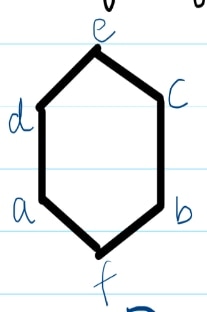
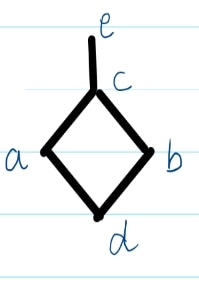
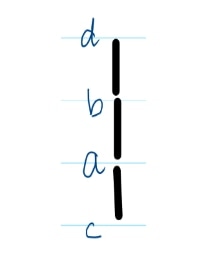
Which of the following lattices form the Boolean algebra?
A.
B.
C.
D.
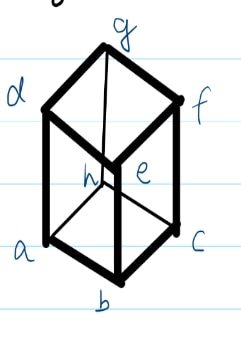
Answer: D. Option A permits non-unique complements, B is not complemented because a ∨ b = c ≠ e, so a and b have no complement, and C has internal elements without complements. Option D is the cube-shaped eight-element lattice, isomorphic to P({1,2,3}), so it is bounded, distributive and complemented.
Question 6, GATE 2005
Open Question 6 in the KnowledgeGate question bank.
The following is the Hasse diagram of the poset [{a, b, c, d, e}, ≤]
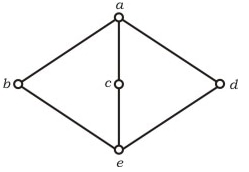
The poset is
A.
not a latticeB.
a lattice but not a distributive latticeC.
a distributive lattice but not a Boolean algebraD.
a Boolean algebra
Answer: B. Every pair in the diagram has a unique meet and join, so the poset is a lattice. The multiple-complement pattern among b, c and d cannot occur in a distributive lattice, where a complemented element has a unique complement. It is therefore a lattice but not a distributive lattice, and hence not a Boolean algebra.
Question 7, MCQ on a diagram
Open Question 7 in the KnowledgeGate question bank.
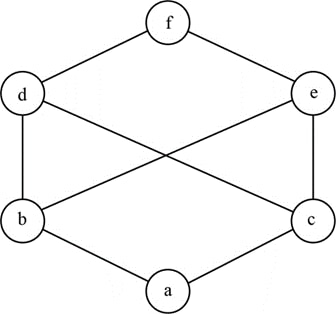
The below figure represents which kind of lattice?
A.
Bounded latticeB.
Distributive latticeC.
Boolean algebraD.
Non-lattice poset
Answer: D. For the pair b,c, d and e are two incomparable minimal upper bounds. Therefore, there is no least upper bound, so b ∨ c does not exist and the diagram is a non-lattice poset.
Complement-count questions in lattice diagrams
For a candidate x to complement a, both equations must hold. A candidate that reaches the top under join but fails to reach the bottom under meet is not a complement.
Question 8, NAT
Open Question 8 in the KnowledgeGate question bank.
Consider the following lattice
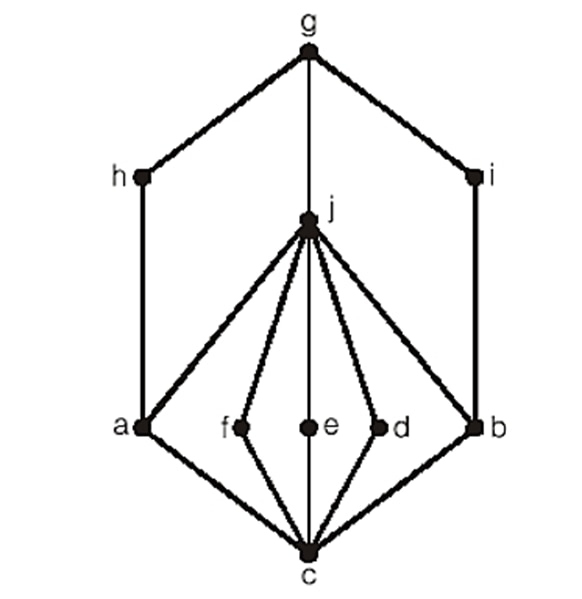
Find the number of complements for the element a
Answer: 1; the sole complement is i. The bottom is c and the top is g; a ∨ i = g and a ∧ i = c, so i passes both tests. The failures are a ∨ b = a ∨ d = a ∨ e = a ∨ f = j and a ∨ c = a. Also, a ∧ g = a; for h and j, the pairs are a ∨ h = h, a ∧ h = a, a ∨ j = j and a ∧ j = a, so none is another complement.
Question 9, GATE 1998, fill in the blank
Open Question 9 in the KnowledgeGate question bank.
The complement(s) of the element 'a' in the lattice shown in below figure is (are) _____
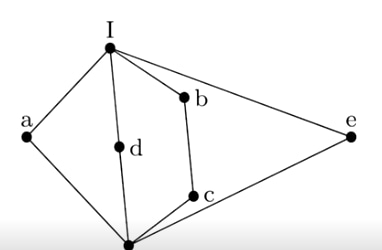
Answer: 4; the complements are b,c,d,e. With top 1 and bottom 0, the joins are a ∨ b = a ∨ c = a ∨ d = a ∨ e = 1. The meets are a ∧ b = a ∧ c = a ∧ d = a ∧ e = 0. Every one of the four named elements therefore satisfies both complement equations.
Order relations in Boolean algebra: transitivity, antisymmetry and strict order
Question 10, UGC NET 2018 December
Open Question 10 in the KnowledgeGate question bank.
The relation ≤ and > on a boolean algebra are defined as:
𝑥≤𝑦 if and only if 𝑥∨𝑦=𝑦
𝑥<𝑦 means 𝑥≤𝑦 but 𝑥≠𝑦
𝑥≥𝑦 means 𝑦≤𝑥 and
𝑥>𝑦 means 𝑦<𝑥
Considering the above definitions, which of the following is not true in the boolean algebra?
(i) If 𝑥≤𝑦 and 𝑦≤𝑧, then 𝑥≤𝑧
(ii) If 𝑥≤𝑦 and 𝑦≤𝑥, then 𝑥=𝑦
(iii) If 𝑥<𝑦 and 𝑦<𝑧, then 𝑥≤𝑦
(iv) If 𝑥<𝑦 and 𝑦<𝑧, then 𝑥<𝑦
Choose the correct answer from the code given below:
A.
(i) and (ii) OnlyB.
(ii) and (iii) OnlyC.
(iii) OnlyD.
(iv) Only
Answer: D, (iv) only. The relation x ≤ y defined by x ∨ y = y is a partial order on every Boolean algebra, so (i) is transitivity and (ii) is antisymmetry, and both are true. Elimination then decides it: option A calls (i) and (ii) untrue, option B calls (ii) untrue, and option C calls (iii) untrue even though x < y gives x ≤ y immediately. Only option D survives. Note that (iii) and (iv) as printed each restate part of their own hypothesis, so do not hunt for a subtle counterexample there; secure the two axioms, eliminate, and move on.
How exams test lattices and what to practise next
Keep the attempt order to four lines: verify every join and meet; locate 0 and 1; test both complement equations; then check distributivity or the Boolean cardinality rule 2^n.
In this set the split is clean. The two GATE items are diagram-driven: 2005 asks you to classify a Hasse diagram, 1998 asks you to count the complements of one element. The three UGC NET items are statement lists, two on Boolean cardinality, unique complements, relative complementation and direct products, and one on the order relation ≤ built from join. Diagram questions reward the four tests taken in order; statement questions reward the short list of facts above, held exactly.
Continue with Set Theory and Relations MCQs: 12 Solved (GATE) for adjacent practice. Then use Group Theory: Groups, Rings and Fields for GATE CS as the next algebraic-structures topic. For a structured route through the wider Discrete Mathematics sequence, follow GATE Guidance by Sanchit Sir.
Keep learning
Graph Traversal MCQs: 12 Solved Questions on Walks, Paths, Trails, Circuits and Connectivity
Attempt 12 graph traversal and connectivity questions, then check each answer through definitions, reachability, degree conditions and edge-count arguments.
Updated 3 Oct 20267 min readDiscrete Mathematics MCQs
Planar Graphs MCQs: 12 Solved Questions on Kuratowski’s Theorem, Homeomorphism and Edge Bounds
Solve 12 planar graph questions, then check each answer through a forbidden-subdivision argument, a crossing-free redraw, or a short calculation.
Updated 28 Sep 20268 min readDiscrete Mathematics MCQs
Power Set and Cardinality MCQs: 12 Solved Questions with Explanations
Solve 12 power set questions, from direct enumeration and nested sets to inclusion chains, ordered pairs and recurrence-based counting.
25 Sep 20267 min readDiscrete Mathematics MCQs
Null Set, Universal Set, Subset and Proper Subset MCQs: 12 Solved Questions
Practise 12 MCQs on null sets, universal sets, subsets, proper subsets, complements and nested inclusion, with clear reasoning for every answer.
Updated 24 Sep 20267 min readDiscrete Mathematics MCQs