HCLTech Recruitment Process and Test Pattern: Build Your Drive Map
Build a source-controlled HCLTech drive map from the current role page and invitation, then use worked diagnostics to prepare for each assigned stage.
KnowledgeGate Team
Exam prep & CS education
Updated 23 Oct 20265 min read
HCLTech's public hiring journey gives you a useful outer map, but it does not settle every fresher drive. Your invitation may insert, combine or omit an online assessment, while a role or campus route may name different skills. This guide turns those moving parts into a source-controlled plan using one fictional invitation. Start with company-specific placement preparation, but let the current official role page and invitation override remembered patterns and candidate reports.
HCLTech recruitment process: start with the official outer journey
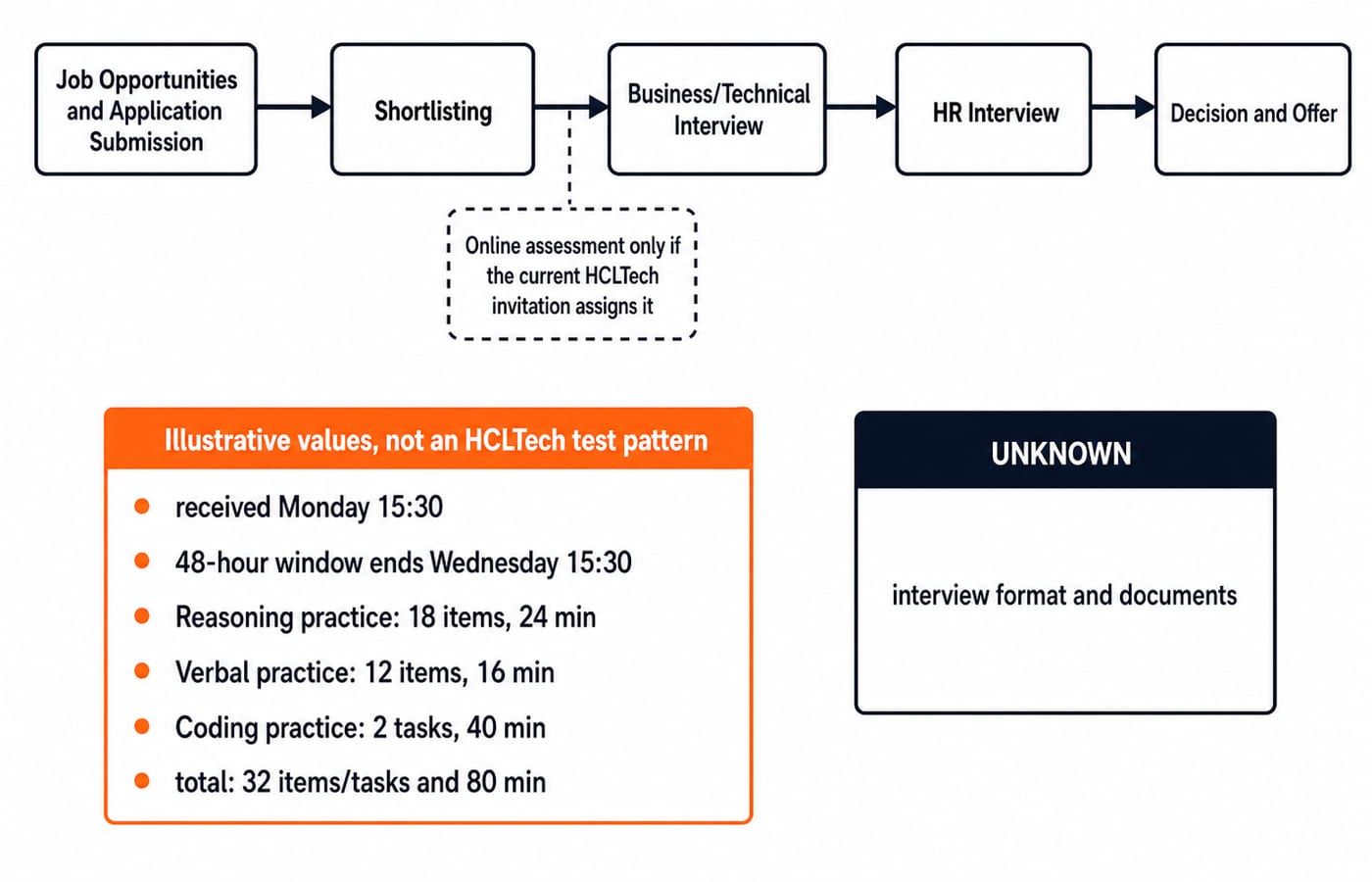
The HCLTech Careers hiring process names five checkpoints: Job Opportunities and Application Submission -> Shortlisting -> Business/Technical Interview -> HR Interview -> Decision and Offer. Application means submitting complete credentials, and shortlisting reviews role fit. Selected candidates may then demonstrate technical or business skills. HR explores goals, skills, strengths and interests. A positive decision may lead to an offer.
This outer journey is not a fixed fresher test pattern. If your invitation assigns an assessment, coding activity, communication check or another stage after shortlisting, place it exactly where HCLTech does. Candidates may not experience every checkpoint identically.
HCLTech test pattern: extract the invitation before preparing sections
Use a ten-field drive card: role title, job or requisition ID, hiring route, location, eligibility wording, assessment blocks, window and timer, platform or device rules, interview format, and documents or support contact. Copy exactly; mark omissions UNKNOWN.
An illustrative invitation, not an HCLTech notice, has its role, ID, route, location, eligibility and device fields copied. It arrives Monday at 15:30 with a 48-hour window. Practice blocks are reasoning, 18 items in 24 minutes; verbal, 12 in 16 minutes; and coding, 2 tasks in 40 minutes. The deadline is Wednesday at 15:30. Workload is 18 + 12 + 2 = 32 items or tasks; sitting time is 24 + 16 + 40 = 80 minutes. Interview format and documents or support contact remain UNKNOWN until HCLTech confirms them.
The TCS recruitment process guide uses the same mapping method, but none of its stages, timers or rules transfers to HCLTech.
Application and shortlisting: make every credential reconcile
Credential accuracy is the first readiness test. The current role page controls degree, branch, graduation batch, experience, location and academic rules. A generic eligibility table cannot replace it.
In a fictional eight-field audit, the source sheet lists Ananya Rao, GET-104, Noida, 2026, B.Tech CSE, CGPA 8.26, ananya.rao@example.com, and phone ending 4821. The form matches seven but shows 8.62, so readiness is 7/8, not complete. Correct it to the transcript value 8.26 and save the acknowledgement. Cross-check the form, resume, photo ID and academic record. Never convert CGPA, rename a degree or change a year without an authorised rule.
Online assessment, if assigned: measure accuracy before attempts
Only the invitation and assessment screen determine whether a test exists and what it contains. If they name aptitude, reasoning or verbal ability, the Aptitude for Placement course offers optional practice, not an official HCLTech pattern.
In a personal diagnostic, not an HCLTech score, a 40-item set gives 28 correct, 7 incorrect and 5 unattempted. Attempts are 28 + 7 = 35. Attempted accuracy, 28/35 x 100 = 80%, measures quality among attempts. Completion, 35/40 x 100 = 87.5%, measures coverage. Correct share, 28/40 x 100 = 70%, measures success across the full set.
Classify the seven errors as 3 concept, 2 reading and 2 time-selection mistakes. Repair them with 60 minutes for concepts, 30 to rewrite missed conditions, 30 for selection drills and 30 for a fresh retest. Check: 60 + 30 + 30 + 30 = 150 minutes.
Coding activity, if assigned: test the contract
Try this generic rehearsal, not a recalled HCLTech question: run-length encode consecutive characters. aaabbcaaa becomes a3b2c1a3; an empty string stays empty. Trace aaa -> a3, bb -> b2, c -> c1, aaa -> a3. Joining gives a3b2c1a3. One left-to-right pass takes O(n) time, with storage proportional to the output.
Test "" -> "", "a" -> "a1", "aaaa" -> "a4", "ab" -> "a1b1", and "aaabbcaaa" -> "a3b2c1a3". Check the permitted language, input and submission rules too.
For the fictional 40-minute block, use 5 minutes to read both tasks, 14 for each implementation and 7 for edge cases and resubmission. Check: 5 + 14 + 14 + 7 = 40. This is not an HCLTech task count or timer.
Business or technical interview: replace claims with evidence
HCLTech describes the business or technical interview as an opportunity to demonstrate skills, with questions that may span disciplines, puzzles and problems. The current role and interview communication decide the actual scope and format.
Build a fictional evidence card, then replace its data truthfully. An idempotency-key change gets 300 repeated POST trials. Duplicates fall from 21 to 2. Absolute reduction is 21 - 2 = 19. The rate moves from 21/300 x 100 = 7.0% to 2/300 x 100 = 0.7%, rounded. Relative reduction is 19/21 x 100 = 90.5%, rounded.
State the environment, change, result and limitation: this was a controlled test, not production traffic. The Infosys interview process guide offers a transferable evidence method, but its stages and questions do not describe HCLTech.
HR interview, decision and offer: keep the story consistent
HCLTech says HR explores your goals, skills, strengths and interests. Prepare truthful examples, not memorised adjectives. Keep dates, location constraints, ownership and availability consistent with the application.
In an illustrative STAR skeleton, a four-person project has 10 failing integration tests two days before review. The candidate runs a 25-minute triage, owns 6 failures and coordinates the other 4. The team restores a 20/20 passing suite. The answer distinguishes six personal fixes from the team result and gives one lesson: expose blockers early.
Only written HCLTech communication establishes a decision or offer. A completed interview, portal change or verbal hint is not a selection claim.
HCLTech recruitment process: a 150-minute audit and the short version
Run a candidate-owned audit: 20 minutes for the role and drive card, 45 for an aptitude or verbal set if assigned, 40 for coding if assigned, 30 for two truthful project explanations and 15 for one HR story plus logistics. Check: 20 + 45 + 40 + 30 + 15 = 150 minutes. This is not an HCLTech duration or a substitute for preparation.
Start with the official journey, insert only invited test blocks, reconcile credentials, diagnose practice and carry evidence into interviews. The Interview & Resume Preparation Course can structure resume, technical and HR rehearsal. It cannot define a private drive, replace HCLTech communication or guarantee progression.
Keep learning
Capgemini Coding Questions: 4 Patterns with Step-by-Step Solutions
Learn four transferable coding patterns through constructed Capgemini preparation examples. Each solution includes an invariant, complete trace, complexity and edge-case checks.
Updated 19 Oct 20266 min readCompany-Specific Prep
Capgemini Placement Preparation: An 8-Week Test-Matched Study Plan
Build an eight-week Capgemini preparation timetable from the route you are actually invited to take. Use two baselines and an error log to decide where every study hour goes.
Updated 15 Oct 20265 min readCompany-Specific Prep
Cognizant Recruitment Process and Test Pattern: What Each Stage Screens
Learn how to read a Cognizant drive invitation, map each possible stage to the skill it screens, and turn the stated test blocks into a focused study plan.
Updated 11 Oct 20265 min readCompany-Specific Prep
Accenture Recruitment Process and Test Pattern: Verify Every Stage
Build a personal stage map from the current Accenture role page and invitation. The guide includes worked checks for timing, application data, pacing, coding and mock repair.
Updated 7 Oct 20265 min readCompany-Specific Prep