Genetic Operators: Crossover and Mutation with Worked Examples and Exam Traps
Trace binary crossover and bit-flip mutation step by step, then see how order crossover and swap mutation keep a route permutation valid.
KnowledgeGate Team
Exam prep & CS education
Updated 4 Sep 20265 min read
Crossover diagrams look simple until cut positions, parent order, mutation probability, and chromosome encoding change the offspring. The difficulty is tracing every position without silently changing the rule. A complete binary trace exposes position errors, while a permutation trace shows why each encoding needs compatible operators.
Genetic operators: what crossover and mutation actually change
A chromosome encodes one candidate solution. A gene is a position, its allele is the value there, a population is a set of chromosomes, and fitness scores each candidate against the objective.
Selection is separate: it chooses parents or survivors. Crossover recombines selected parents, while mutation changes one or more genes after recombination. The loop is encode -> evaluate fitness -> select parents -> crossover -> mutate -> evaluate offspring, and it fits within broader preparation for the GATE CS Exam.
Crossover mainly explores combinations represented by the parents. Mutation can introduce a value or arrangement that the child did not contain. Neither operation guarantees better fitness. Evaluation and selection decide what the variation is worth.
One-point crossover: trace every bit in a binary example
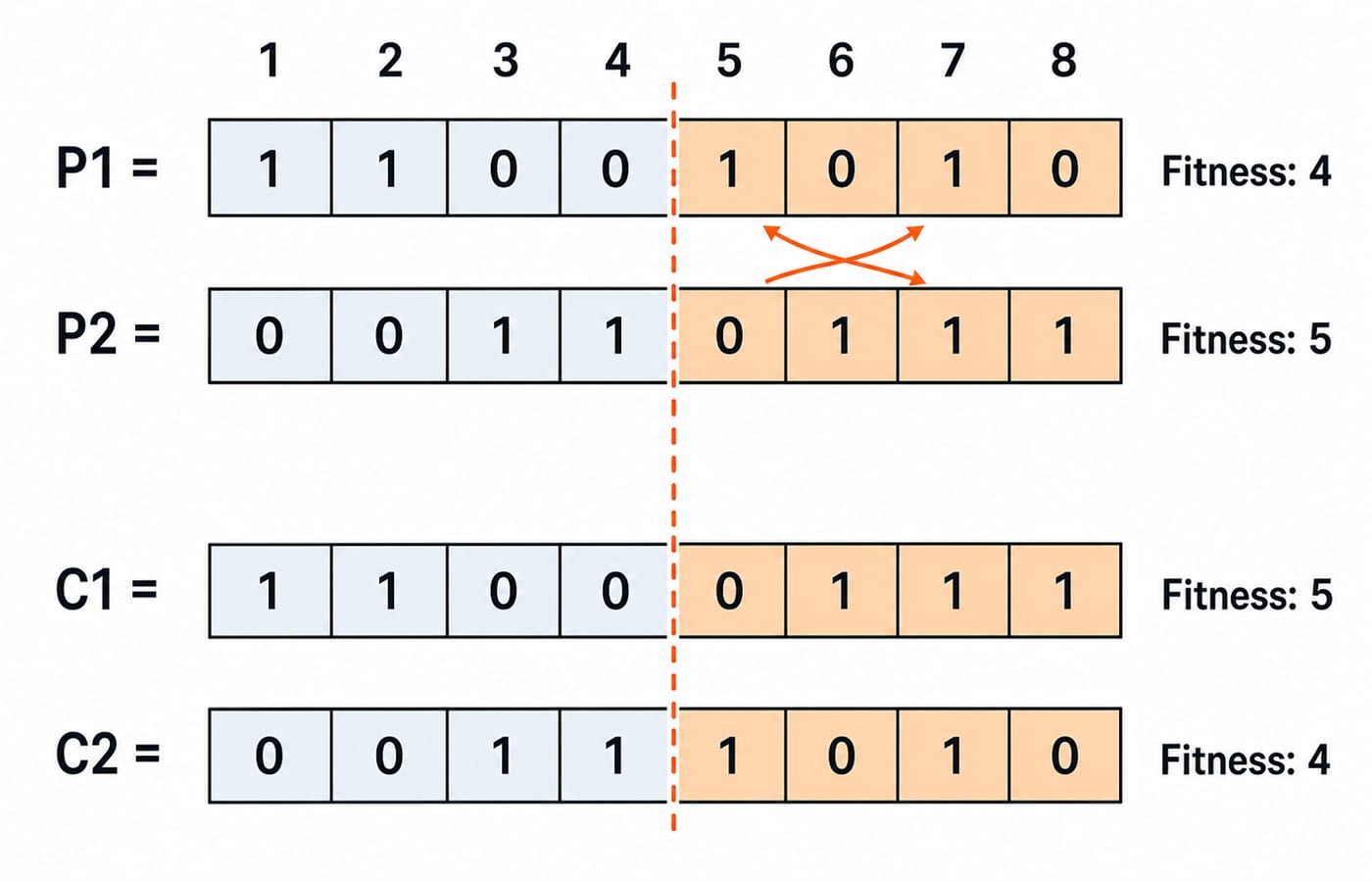
Take two 8-bit parents, with positions numbered 1 to 8:
P1 = 11001010
P2 = 00110111
Cut after position 4 and write:
P1 = 1100|1010
P2 = 0011|0111
Keep each prefix and exchange suffixes:
C1 = 1100|0111 = 11000111
C2 = 0011|1010 = 00111010
Define OneMax fitness as f(x) = number of 1 bits. Counting gives f(P1) = 4, f(P2) = 5, f(C1) = 5, and f(C2) = 4. The offspring preserve the parents' fitness values in this example, but crossover does not guarantee that.
Bit-flip mutation: probability, realised flips and fitness
Mutate C1 = 11000111 independently per bit with p_m = 0.10, using these fixed random draws:
u = [0.42, 0.08, 0.73, 0.19, 0.55, 0.91, 0.04, 0.60]
A bit flips when u_i < 0.10. Only positions 2 and 7 qualify, and both change from 1 to 0:
11000111 -> 10000101
Fitness falls from f(11000111) = 5 to f(10000101) = 3. Mutation created variation; selection may reject the weaker result. Mutation itself promises no improvement.
For a chromosome length L = 8, the expected number of flips is E[X] = Lp_m = 8(0.10) = 0.8. The probability of no flip is P(X = 0) = (1 - 0.10)^8 = 0.9^8 = 0.43046721. Therefore, the probability of at least one flip is 1 - 0.43046721 = 0.56953279.
The expected value 0.8 is a long-run average, not a realised flip count. Also distinguish an independent per-bit probability from one probability for mutating the chromosome as a whole.
Crossover variants: same parents, different offspring
Changing the crossover rule changes what is preserved. Using the same binary parents makes that difference visible.
Operator | Decision rule | Exact offspring |
|---|---|---|
One-point | Cut after position 4 and exchange suffixes |
|
Two-point | Cut after positions 2 and 6 and exchange the middle segment |
|
Uniform | Use |
|
For the uniform row, trace all eight positions. The mask selects P1, P2, P1, P1, P2, P2, P1, P2, producing 1 0 0 0 0 1 1 1. Reversing each parent choice produces 0 1 1 1 1 0 1 0.
One-point crossover preserves long prefix and suffix blocks, two-point crossover moves a bounded segment, and uniform crossover mixes position by position. The useful choice depends on the encoding and relationships among genes.
Order crossover and swap mutation: a permutation-safe example
A route chromosome must contain each value exactly once. Use:
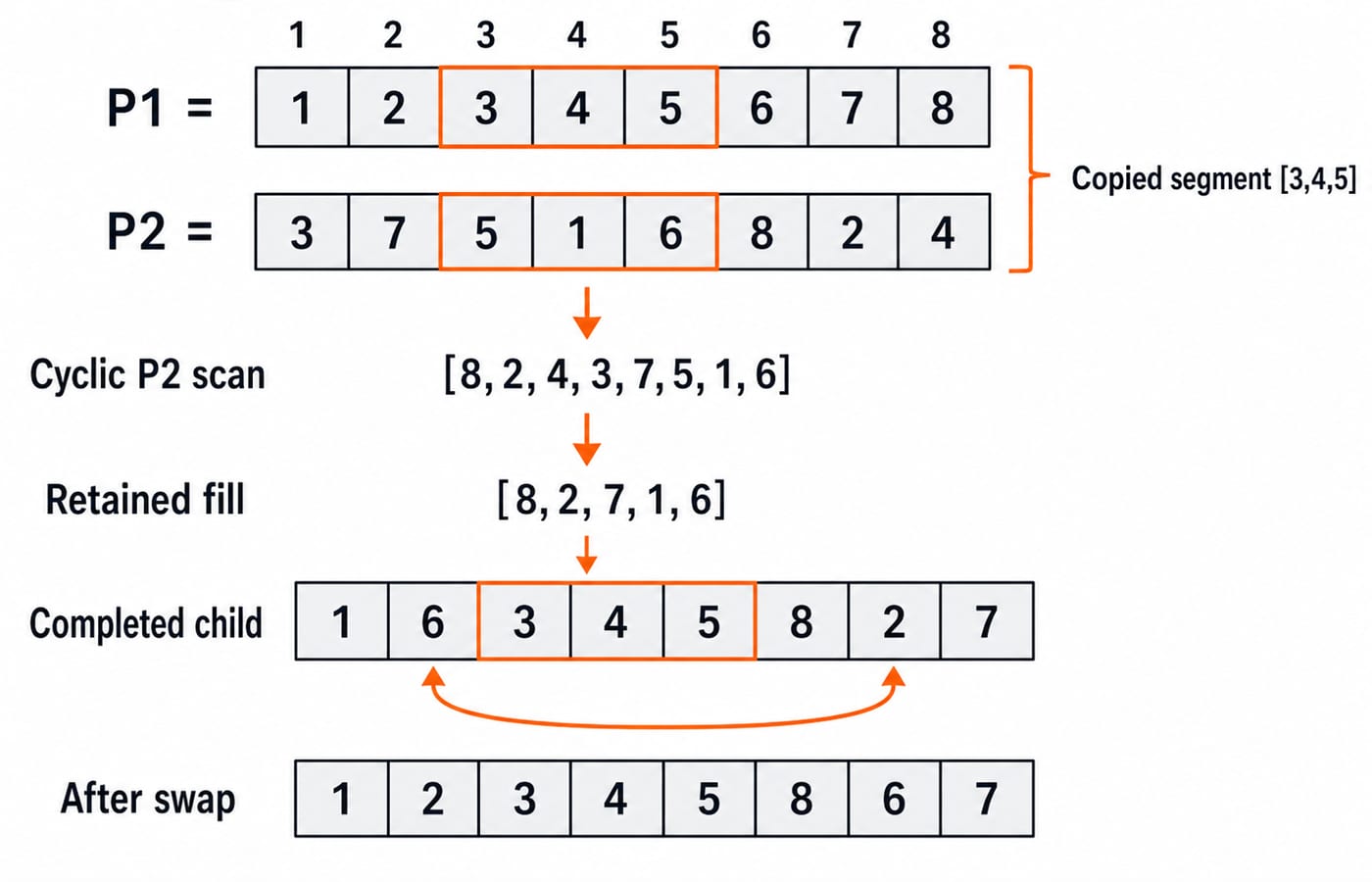
P1 = [1,2,3,4,5,6,7,8]
P2 = [3,7,5,1,6,8,2,4]
For order crossover, copy positions 3 through 5, [3,4,5], from P1. From position 6, scan P2 cyclically as [8,2,4,3,7,5,1,6]. Remove copied values 3, 4, and 5, leaving [8,2,7,1,6].
Fill positions 6, 7, 8, 1, and 2 in that order to obtain [1,6,3,4,5,8,2,7]. Swap mutation at positions 2 and 7 exchanges 6 and 2, producing [1,2,3,4,5,8,6,7]. Values 1 through 8 still appear exactly once, so the route remains valid.
Genetic-operator traps: encoding, boundaries and false guarantees
Each common mistake has a consequence and correction:
Mistake: count a cut bit instead of a boundary. The child receives the wrong prefix length. Label positions first and write
1100|1010before exchanging anything.Mistake: read p_m = 0.10 as exactly 10 percent of every child's bits. A realised child may have zero, one, or several flips. State whether the probability is per bit or per chromosome, then apply the stated random rule.
Mistake: assume mutation must improve fitness. You may reject a correct mutation merely because its fitness fell. Recompute fitness after crossover and mutation, then let the selection rule decide survival.
Mistake: apply bit flip or naive one-point crossover to a permutation. Bit flip has no defined meaning for route labels, and naive splicing can duplicate values while losing others. Use an encoding-compatible operator such as order crossover and swap mutation, then verify validity.
The full evolutionary cycle combines representation, selection, recombination, mutation, and fitness; Genetic Algorithms in AI: A Worked One-Generation Example traces those decisions together. Operator-level questions are narrower: exactly how do binary and permutation offspring change?
How exams test crossover and mutation
Questions usually ask you to derive children from a cut or mask, calculate mutation probabilities, identify an encoding-safe operator, or reason about diversity versus fitness. Check the core patterns:
After the position-4 cut in the binary example, what is the first child?
11000111.With
L = 8and per-bitp_m = 0.10, what is the probability of at least one flip?1 - 0.9^8 = 0.56953279.Which pair preserves uniqueness for the route example? Order crossover plus swap mutation. Ordinary bit flip is not defined for that encoding.
The IIT Guwahati official GATE 2026 papers and syllabus page records the past cycle. Check the syllabus from the current organizing institute before allocating revision time because inclusion can vary by paper and cycle. For timed application practice, use the GATE Test Series.
Genetic operators: the short version and next step
Use one five-step recall line: choose the encoding, label positions, apply crossover exactly, mutate under the stated probability rule, then recompute validity and fitness. Most errors happen when one of those steps remains implicit.
For broader subject-wise preparation, GATE Guidance by Sanchit Sir provides a structured next step. If this is your only weak concept, a better immediate move is to redo the binary and permutation examples without looking at the intermediate rows.
Keep learning
Problem Representation in AI: State Space, Worked Water-Jug Example and Exam Traps
Learn how states, operators, goals and costs turn a verbal task into a search problem. The worked water-jug trace separates valid states from reachable ones.
Updated 23 Oct 20265 min readML & Data Science
Foundations and Evolution of AI: Approaches, Timeline and a Worked Rational-Agent Example
Build a connected map of AI foundations, historical shifts and major paradigms, then calculate how a rational agent chooses under uncertainty.
Updated 19 Oct 20266 min readML & Data Science
Natural Language Processing Explained: Pipeline, TF-IDF Worked Example and Exam Patterns
Start from raw text, build BoW and TF-IDF vectors, compute cosine similarity, examine ambiguity, and finish with evaluation and exam-style checks.
Updated 15 Oct 20266 min readML & Data Science

Fundamentals of Planning in AI: STRIPS, State-Space Search and a Worked Blocks World Plan
Build a planning problem from facts, actions and goals, then follow every add and delete effect through a complete six-step Blocks World solution.
Updated 11 Oct 20266 min readML & Data Science