Fuzzy Systems and Inference Models: Membership Functions, Mamdani vs Sugeno, and a Worked Example
Learn how a fuzzy inference system turns crisp inputs into one useful output. Compare Mamdani, Sugeno, and Tsukamoto, then calculate a four-rule fan controller step by step.
KnowledgeGate Team
Exam prep & CS education
Updated 2 Sep 20265 min read142 views

Students often memorise words such as fuzzification, rule base, and defuzzification but struggle to carry one input through the complete system. Fuzzy membership differs from probability, Mamdani and Sugeno use different consequent models, and the controller output follows from the arithmetic. The operator matters: the same rules can produce a different numerical answer when a question changes the AND operation. The consequent model matters too, because Mamdani and Sugeno do not turn fired rules into a crisp result in the same way.
Fuzzy systems: partial membership, not partial truth by guesswork
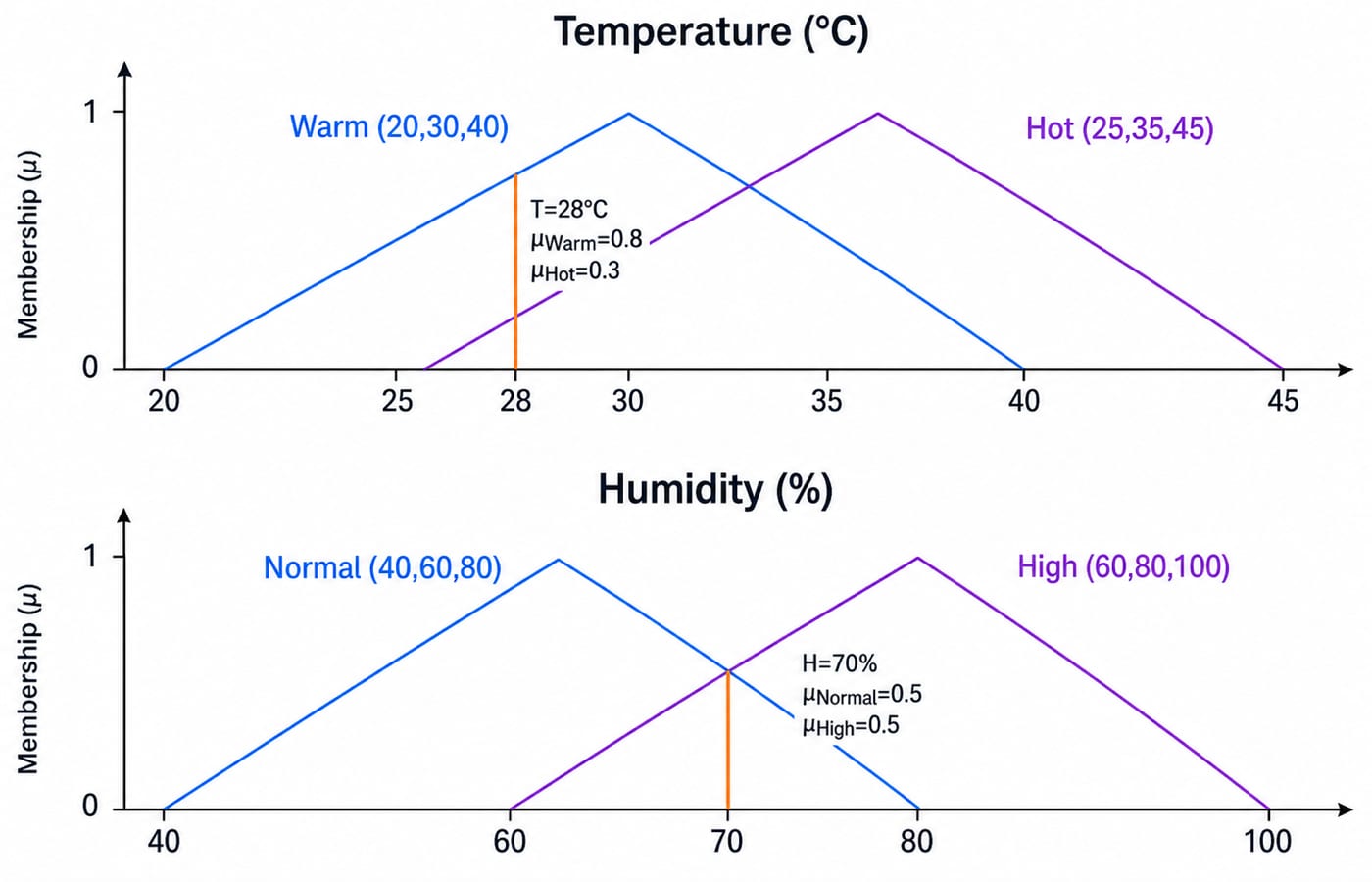
A fuzzy set A on a universe X is defined by a membership function μ_A: X → [0,1]. A crisp set permits only 0 or 1, while a fuzzy set represents gradual boundaries. For example, 28°C may belong to Warm with degree 0.8 and Hot with degree 0.3 at the same time. These values are compatibility grades, not probabilities, so they do not need to add to 1.
The universe of discourse is the allowed input range. A linguistic variable, such as temperature, has linguistic terms such as Cool, Warm, and Hot. Each term has a membership function. A crisp input is measured, the rule base relates input terms to output terms, and the system finally produces a crisp output. Thus, "temperature is Warm" becomes a graded proposition once Warm has a defined function. Start with the ordinary idea of a crisp set in Set Theory and Relations, then view fuzzy sets as its extension for gradual boundaries.
Fuzzy membership functions and operators: the arithmetic underneath the words
A triangular membership function tri(a,b,c) is 0 outside [a,c]. It rises as (x-a)/(b-a) for a < x ≤ b and falls as (c-x)/(c-b) for b < x < c. Trapezoidal functions add a flat top, while Gaussian functions give smooth curves, but triangles keep hand calculations transparent.
For membership grades, the standard Zadeh operators are:
complement: 1-μ
intersection: min(μ_A,μ_B)
union: max(μ_A,μ_B)
If μ_A = 0.8 and μ_B = 0.3, the complement of A is 0.2, their intersection is 0.3, and their union is 0.8. Algebraic product, μ_Aμ_B, is another valid AND operator. Min and product are alternative t-norm choices, not interchangeable steps.
An α-cut connects a fuzzy set back to an ordinary set. For α = 0.5, its crisp α-cut contains every x for which μ_A(x) ≥ 0.5.
Fuzzy inference system: fuzzify, fire rules, combine, defuzzify
The processing chain is crisp inputs → fuzzifier → knowledge base → inference engine → aggregation → defuzzifier or weighted output. The knowledge base contains the membership-function database and IF-THEN rules, such as: IF temperature is Warm AND humidity is High THEN fan speed is Fast.
Keep the operations separate. First calculate antecedent memberships. Next apply the specified t-norm to obtain each rule's firing strength. Then apply that strength to the consequent, aggregate the rule outputs, and obtain one crisp value.
In Mamdani inference, a common final step is centroid defuzzification:
z* = ∫zμ(z)dz / ∫μ(z)dz
That formula is not a generic final step for every model. Boolean rules use truth values, while fuzzy rules use grades, a useful contrast with propositional and predicate logic.
Mamdani, Sugeno, and Tsukamoto inference models: what actually changes
Model | Rule consequent | Rule output | Final crisp-output method | Typical exam clue |
|---|---|---|---|---|
Mamdani | Fuzzy set | Consequent set clipped or scaled by firing strength | Usually max-aggregate, then defuzzify, commonly by centroid | Output membership shapes and centroid |
Sugeno | Constant or linear function, such as z_i = p_i x + q_i y + r_i | Crisp z_i with weight w_i | Σw_i z_i / Σw_i | Constant or linear consequent equations |
Tsukamoto | Monotonic fuzzy set | Invert the consequent at firing strength to get crisp z_i | Weighted average of the z_i values | Monotonic consequent inversion |
The decision boundary is practical. Membership shapes in the output and a request for a centroid signal Mamdani-style inference. Constants or linear consequent equations signal zero-order or first-order Sugeno. A monotonic consequent that must be inverted for each rule signals Tsukamoto. Larsen is a Mamdani-family variant that uses product implication.
Sugeno fuzzy inference worked example: calculate the fan speed step by step
Let temperature T use Warm = tri(20,30,40) and Hot = tri(25,35,45). Let humidity H use Normal = tri(40,60,80) and High = tri(60,80,100). At T = 28°C and H = 70%:
μ_Warm(28) = (28-20)/(30-20) = 8/10 = 0.8
μ_Hot(28) = (28-25)/(35-25) = 3/10 = 0.3
μ_Normal(70) = (80-70)/(80-60) = 10/20 = 0.5
μ_High(70) = (70-60)/(80-60) = 10/20 = 0.5
Use a zero-order Sugeno rule base with product AND:
Rule | Antecedent | Consequent | Firing strength |
|---|---|---|---|
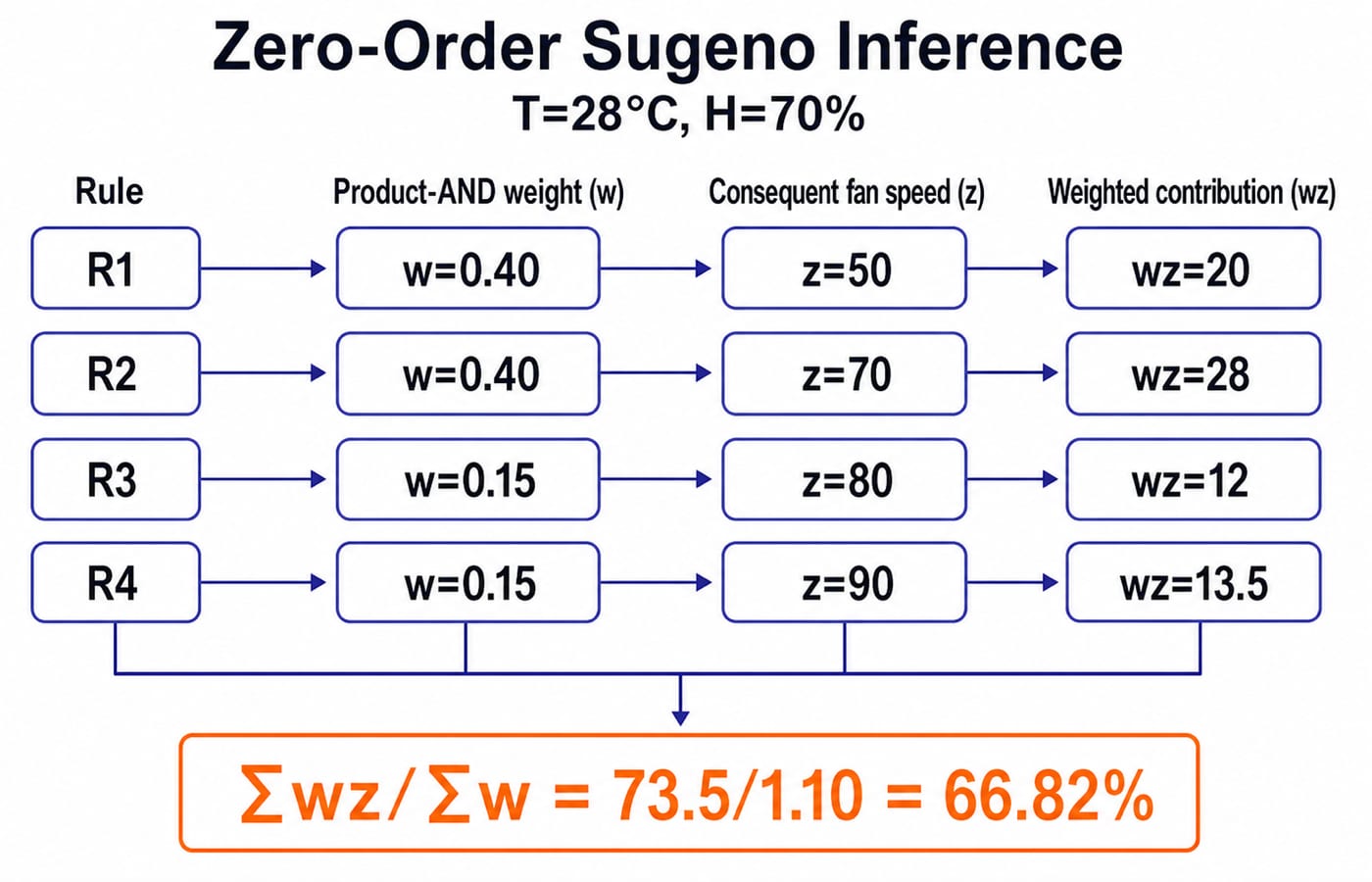
R1 | Warm AND Normal | z1 = 50 | w1 = 0.8×0.5 = 0.40 |
R2 | Warm AND High | z2 = 70 | w2 = 0.8×0.5 = 0.40 |
R3 | Hot AND Normal | z3 = 80 | w3 = 0.3×0.5 = 0.15 |
R4 | Hot AND High | z4 = 90 | w4 = 0.3×0.5 = 0.15 |
The weighted numerator is:
Σw_i z_i = 0.40×50 + 0.40×70 + 0.15×80 + 0.15×90
= 20 + 28 + 12 + 13.5 = 73.5
The denominator is:
Σw_i = 0.40 + 0.40 + 0.15 + 0.15 = 1.10
Therefore, fan speed = 73.5/1.10 = 66.818...%, reported as 66.82%. This passes two sanity checks: 66.82 lies between the active consequents 50 and 90, and the denominator is non-zero.
Fuzzy inference mistakes: min versus product, aggregation, and premature averaging
The most revealing trap is changing the t-norm silently. With the same memberships but min-AND, the weights are 0.5, 0.5, 0.3, and 0.3. The Sugeno result becomes:
(0.5×50 + 0.5×70 + 0.3×80 + 0.3×90)/(0.5+0.5+0.3+0.3)
= (25+35+24+27)/1.6 = 111/1.6 = 69.375%, or 69.38%.
This does not contradict 66.82%. It answers a different operator assumption. Also avoid treating memberships as probabilities and normalising them too early, averaging consequents without firing-strength weights, or applying Sugeno's weighted-average shortcut to a Mamdani output. Honour the declared universe, retain full precision until the end, and handle Σw_i = 0 instead of dividing by zero.
Fuzzy systems exam patterns: identify the model before doing the arithmetic
Common concept-level tasks are:
Read membership from a graph or formula.
Compute complement, union, or intersection.
Calculate a firing strength under the named operator.
Distinguish fuzzification, implication, aggregation, and defuzzification.
Identify Mamdani, Sugeno, or Tsukamoto from its consequent.
Finish a short numerical and check whether the result is reasonable.
Use a 30-second parsing routine: circle crisp inputs, underline membership functions, box AND or OR with its operator, label the consequent type, then write the correct final-output formula. There are at least 5 practice questions on this subtopic. Readers following the GATE track can place this topic within GATE CS Exam Preparation.
Fuzzy systems in the short version: one chain and the right next step
The complete chain is simple: define memberships, fuzzify the crisp input, compute rule strengths using the stated operator, process and aggregate the model-specific consequents, then obtain the crisp output by that model's method. In the worked zero-order Sugeno controller, product AND gives a fan speed of 66.82%.
Use AI & ML for Placements when you want a wider AI learning path. Choose GATE Guidance by Sanchit Sir when you need a structured exam-preparation route.
Keep learning

Agent Architecture and Program Types in AI: A Worked Warehouse Example and Exam Traps
Separate architecture, program and agent function, then compare four program types through one fully worked warehouse routing problem.
Updated 25 Oct 20266 min readML & Data Science

Problem Representation in AI: State Space, Worked Water-Jug Example and Exam Traps
Learn how states, operators, goals and costs turn a verbal task into a search problem. The worked water-jug trace separates valid states from reachable ones.
Updated 23 Oct 20265 min readML & Data Science
Foundations and Evolution of AI: Approaches, Timeline and a Worked Rational-Agent Example
Build a connected map of AI foundations, historical shifts and major paradigms, then calculate how a rational agent chooses under uncertainty.
Updated 19 Oct 20266 min readML & Data Science

Natural Language Processing Explained: Pipeline, TF-IDF Worked Example and Exam Patterns
Start from raw text, build BoW and TF-IDF vectors, compute cosine similarity, examine ambiguity, and finish with evaluation and exam-style checks.
Updated 15 Oct 20266 min readML & Data Science