

SCAN and C-SCAN Algorithms: Worked Example, Differences and Exam Traps
Solve the same eight-request queue with SCAN and C-SCAN, then learn how endpoints, direction, circular return, and service order change the answer.
KnowledgeGate Team
Exam prep & CS education
Updated 14 Nov 20266 min read
SCAN and C-SCAN sound like simple elevator rules, but one missed detail can change an entire numerical. You must know the initial direction, the physical disk boundary, and whether a circular return counts. On tracks 0-199, with head 53 and eight pending requests, the two routes total 331 and 382 tracks because their endpoint and return rules differ. File systems and disk scheduling in OS: 4 algorithms worked connects these routes to allocation, directories and seek time; Disk Scheduling in Operating Systems: 6 Algorithms with Worked Examples compares all six policies on this queue; for SCAN and C-SCAN, check every leg, count the circular return, and reverse the initial direction to expose a second pair of totals.
SCAN and C-SCAN disk scheduling: build the concept before calculating
A disk-scheduling problem specifies pending tracks, the head position, the valid range, and the initial direction. Add the absolute differences between consecutive positions on the complete route to get total head movement. The unit is tracks unless a seek-time conversion is supplied.
SCAN, the elevator algorithm, services requests in the current direction, reaches the physical end, reverses, and services the other side. C-SCAN reaches the end, returns to the opposite end without servicing, and resumes in the original direction. Count that physical circular return unless told otherwise.
SCAN and C-SCAN reach physical endpoints. LOOK turns at the last pending request, while C-LOOK wraps between pending-request limits. SCAN uses directional locality, and C-SCAN aims for more uniform waiting by track position. Neither always minimises movement. These rules sit within CS Fundamentals for Exams & Placements, alongside the operating-systems concepts that distinguish physical head movement from CPU scheduling.
Prepare the worked example: sort once, then construct each route
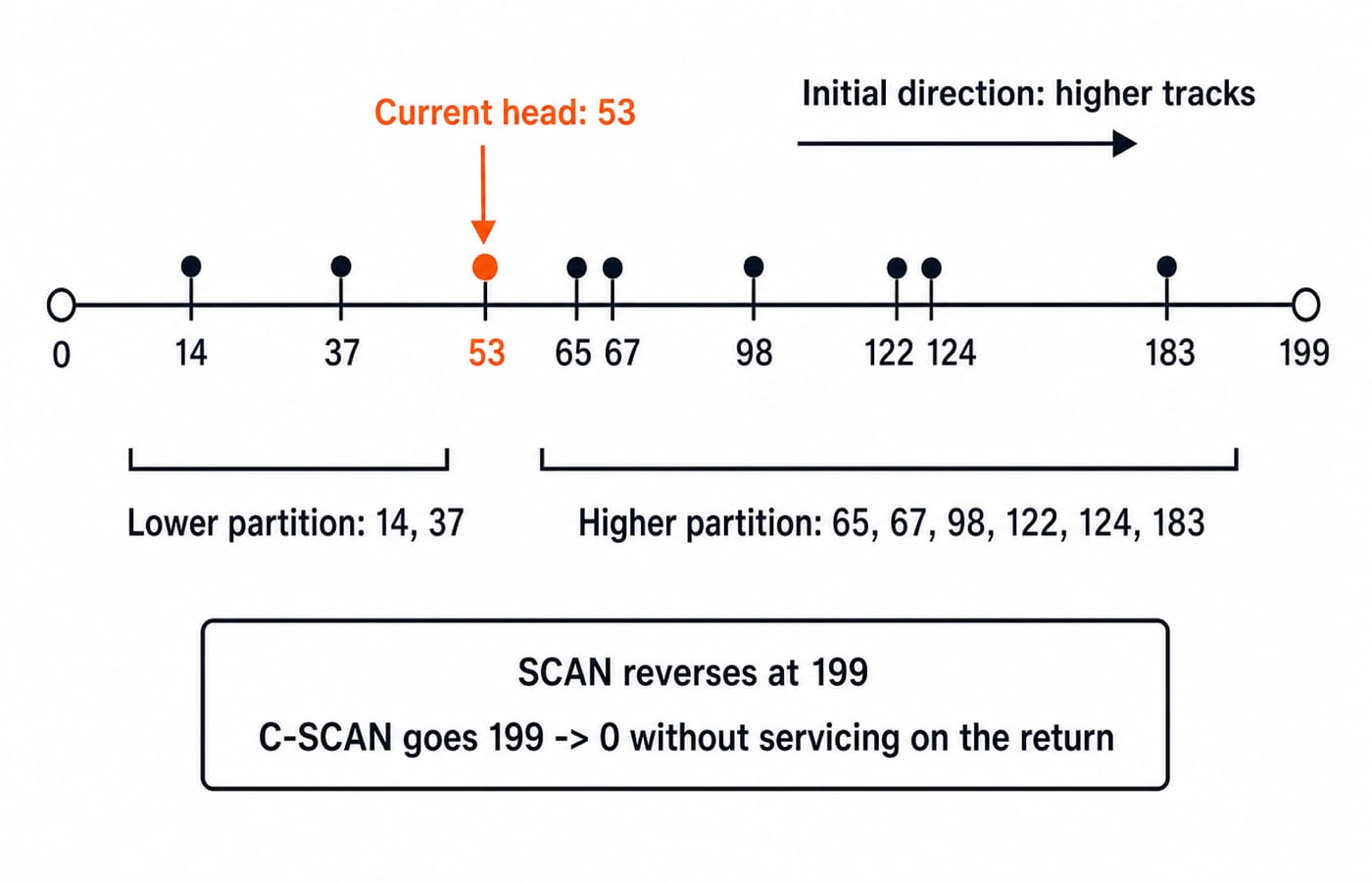
Tracks are 0-199, the head is 53, the queue is 98, 183, 37, 122, 14, 124, 65, 67, and direction is upward. Standard SCAN and C-SCAN reach endpoints, and the 199 to 0 C-SCAN return counts.
Sort and partition the requests:
14, 37 | head 53 | 65, 67, 98, 122, 124, 183
Sorting is not the service order. Direction decides which partition comes first. Before calculating, construct the routes:
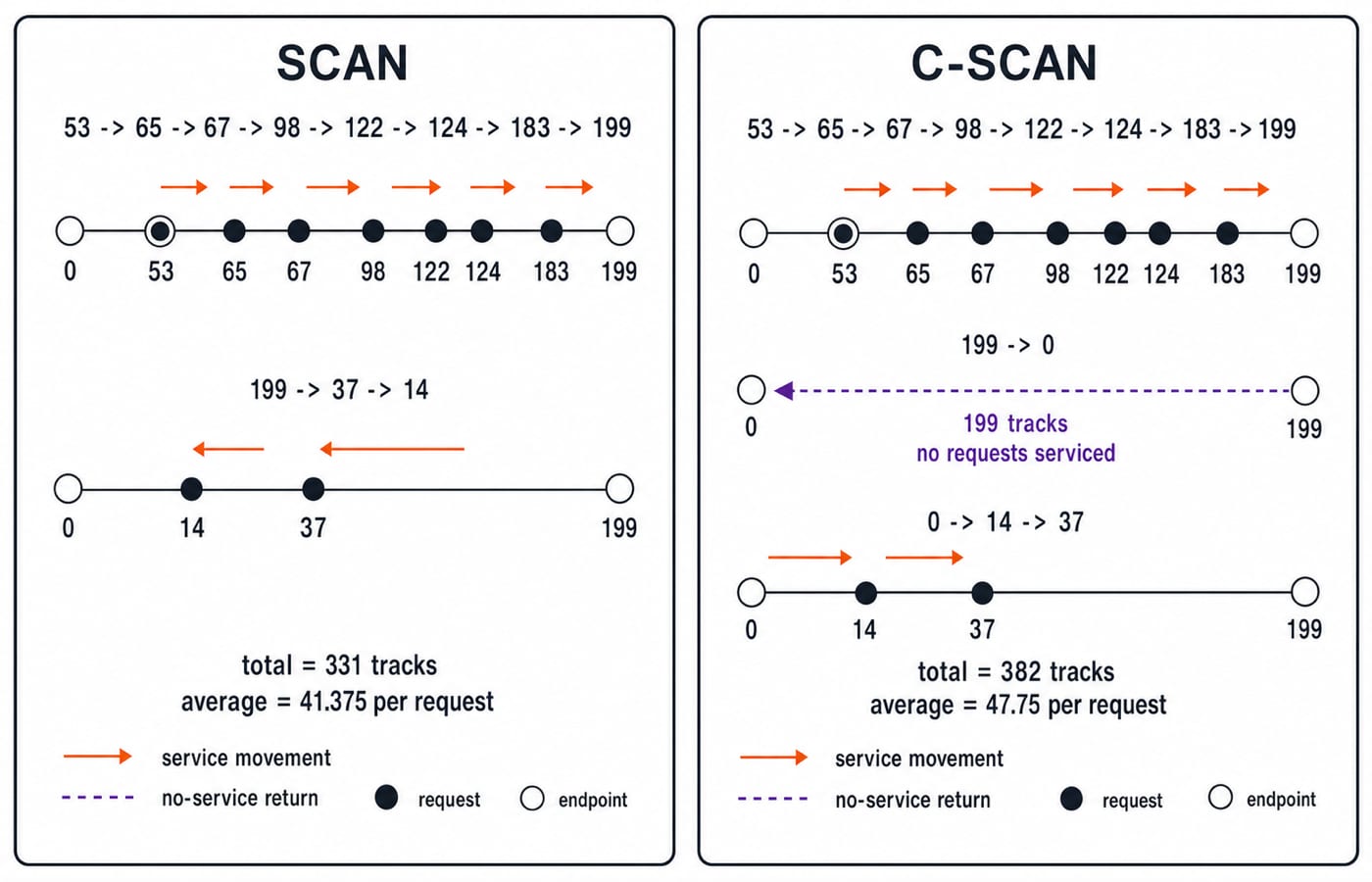
SCAN movement route:
53 -> 65 -> 67 -> 98 -> 122 -> 124 -> 183 -> 199 -> 37 -> 14SCAN service order:
65, 67, 98, 122, 124, 183, 37, 14C-SCAN movement route:
53 -> 65 -> 67 -> 98 -> 122 -> 124 -> 183 -> 199 -> 0 -> 14 -> 37C-SCAN service order:
65, 67, 98, 122, 124, 183, 14, 37
Endpoints can appear in a movement route without being requests.
SCAN worked example: calculate every leg and cross-check the total
From | To | Absolute movement |
|---|---|---|
53 | 65 | 12 |
65 | 67 | 2 |
67 | 98 | 31 |
98 | 122 | 24 |
122 | 124 | 2 |
124 | 183 | 59 |
183 | 199 | 16 |
199 | 37 | 162 |
37 | 14 | 23 |
The total is 12 + 2 + 31 + 24 + 2 + 59 + 16 + 162 + 23 = 331 tracks.
Geometric check: upward sweep 199 - 53 = 146; reverse sweep to the lowest request 199 - 14 = 185; total 146 + 185 = 331.
Average movement is 331 / 8 = 41.375 tracks per request, not average waiting time. Endpoint 199 is not a ninth request. With an explicit assumption of 0.2 ms per track, movement time is 331 x 0.2 = 66.2 ms.
C-SCAN worked example: include the circular return
From | To | Absolute movement |
|---|---|---|
53 | 65 | 12 |
65 | 67 | 2 |
67 | 98 | 31 |
98 | 122 | 24 |
122 | 124 | 2 |
124 | 183 | 59 |
183 | 199 | 16 |
199 | 0 | 199 |
0 | 14 | 14 |
14 | 37 | 23 |
The total is 12 + 2 + 31 + 24 + 2 + 59 + 16 + 199 + 14 + 23 = 382 tracks.
Monotonic check: upward sweep 199 - 53 = 146, circular return 199 - 0 = 199, and low-side sweep 37 - 0 = 37. Therefore, 146 + 199 + 37 = 382.
Average movement is 382 / 8 = 47.75 tracks per request. C-SCAN moves 382 - 331 = 51 more here, but is not universally worse. It targets more uniform service direction, not minimum movement on every queue.
SCAN vs C-SCAN vs LOOK: compare behaviour, not only totals
Feature | SCAN | C-SCAN | LOOK and C-LOOK |
|---|---|---|---|
Service direction | Both, after reversal | One direction only | LOOK uses both; C-LOOK uses one |
Endpoint behaviour | Reaches physical end | Reaches both physical ends | Uses last-request limits |
Return-path servicing | Yes | No during circular return | LOOK yes; C-LOOK no during wrap |
Running service order |
|
| Depends on variant |
Running total |
|
| Different route and total |
Waiting behaviour | Can favour the current sweep | Generally more uniform by position | Depends on request limits |
Under SCAN, a request just behind the head may wait through the outward sweep. C-SCAN approaches tracks in one service direction, so waiting is generally more uniform by position. Actual waiting still depends on arrivals and implementation.
Do not import CPU-scheduling language into this numerical. CPU scheduling orders processes using time and policy. Disk scheduling orders physical head movement across track positions.
Disk-scheduling traps: fix the assumption before the arithmetic
Turning at request
183: The calculation becomes(183 - 53) + (183 - 14) = 130 + 169 = 299. That is LOOK, not standard SCAN, because the route never reaches199.Omitting
199 -> 0: C-SCAN incorrectly falls from382to183. Count the199-track return unless told otherwise.Following written queue order: Upward movement services
65before37. Sort first, then apply direction.Treating
183as the disk maximum: It is only the maximum request. The physical maximum here is199. A range of0-499would change endpoint-based totals.Using signed differences: Every leg uses an absolute difference. Movement cannot be negative.
Using the wrong denominator: Divide by eight requests, not by route positions or boundaries. Duplicate requests at one track remain separate requests, with zero extra movement between them.
Write the route, calculate each leg, and finish with a monotonic-segment cross-check.
How exam-style questions test SCAN and C-SCAN
Questions may ask for service order, total or average movement, route identification, SCAN versus LOOK, circular-return servicing, or fairness. Here the quick checks are 331, 382, and a 51-track difference.
Assertion: upward C-SCAN services 14 and 37 only after reaching 199 and returning to 0. Reason: it services in one direction and not during the circular return. Both are true, and the reason explains the assertion.
Route 53 -> ... -> 183 -> 37 -> 14 is LOOK because it reverses at 183. Practise with Disk Scheduling MCQs: FCFS, SSTF and SCAN. The linked set contains 12 solved questions across FCFS, SSTF and SCAN.
SCAN and C-SCAN: the short version and next step
Use this five-step scratch method:
Write the track range and head position.
Mark the initial direction.
Sort and partition the requests.
Insert required endpoints and any circular return.
Sum absolute movements, then cross-check by monotonic segments.
The anchors are simple: upward SCAN is 331, upward C-SCAN is 382, and their averages across eight requests are 41.375 and 47.75.
Reverse the direction as a check. Downward SCAN visits 37, 14, 0, then 65, 67, 98, 122, 124, 183, for (53 - 0) + (183 - 0) = 236 tracks. Downward C-SCAN follows 53 -> 37 -> 14 -> 0 -> 199 -> 183 -> 124 -> 122 -> 98 -> 67 -> 65, for 53 + 199 + (199 - 65) = 386 tracks.
For structured semester-level core CS, continue with the Zero to Hero Complete CS Course. Keep movement route and service order separate.
Go deeper with the full courseOperating System
Keep learning
SCAN and C-SCAN Disk Scheduling MCQs: 12 Solved Questions with Head-Movement Traces
Practise 12 SCAN and C-SCAN disk scheduling questions, then check each path against worked explanations covering endpoints, reversals and circular wraps.
Updated 12 Aug 202610 min read52 viewsOperating System MCQs
LOOK and C-LOOK Disk Scheduling: Worked Examples and Exam Traps
Learn how LOOK reverses and C-LOOK wraps, then calculate both algorithms on two static queues. Includes checked totals and a repeatable solving routine.
Updated 12 Nov 20266 min readOperating Systems
Line Drawing Algorithms MCQs: 11 Solved DDA, Bresenham and Scan-Conversion Questions
Practise DDA point counts, Bresenham pixel decisions and scan-conversion artefacts through 11 solved, published MCQs with fresh explanations.
Updated 29 Oct 20267 min readMCQ Practice

LOOK and C-LOOK Algorithm MCQs: 10 Solved Questions with Explanations
Solve 10 LOOK and C-LOOK MCQs, from core definitions to complete service-order and seek-distance calculations, with a fresh explanation for every answer.
Updated 30 Oct 20267 min readOperating System MCQs