

Expert Systems and Uncertainty Interview Questions: Model Answers with Worked Reasoning
Prepare for expert-system follow-ups with a deterministic rule trace, two Bayesian updates, a certainty-factor calculation and an auditable design answer.
KnowledgeGate Team
Exam prep & CS education
Updated 18 Nov 20266 min read
Memorising that an expert system contains a knowledge base and an inference engine may secure a definition, but it does not prepare you for follow-up questions on rule firing, explanations, conflicting evidence or uncertain conclusions. An auditable vehicle-diagnosis rule trace updates a Bayesian belief from 10% to 30.8% and then 57.1%, and combines MYCIN-style certainty factors to reach 0.692. For broader interview context, Resume & Interview Preparation places this technical discussion within a wider preparation route.
Expert systems interview question: what is an expert system?
Model answer: An expert system is a knowledge-based AI program that represents domain expertise explicitly, applies an inference procedure to case facts, produces a recommendation or diagnosis, and can expose its reasoning path.
Its five working parts become clear in a vehicle case. The knowledge base stores rules. Working memory, or the fact base, begins with no_start=true, slow_crank=true, dim_lights=true and fuel_available=true. The inference engine matches those facts to rules. The explanation facility records what fired and why. The knowledge-acquisition interface lets an engineer add or revise rules.
Aspect | Expert system | Conventional program | Machine-learning model |
|---|---|---|---|
Where knowledge lives | Explicit rules | Procedural code | Learned parameters |
How behaviour changes | Edit rules | Edit code | Retrain or update |
Explanation | Rule trace | Code path | Model-dependent explanation |
Each approach fits different constraints; none is always superior.
Knowledge representation and inference: trace rules before naming the algorithm
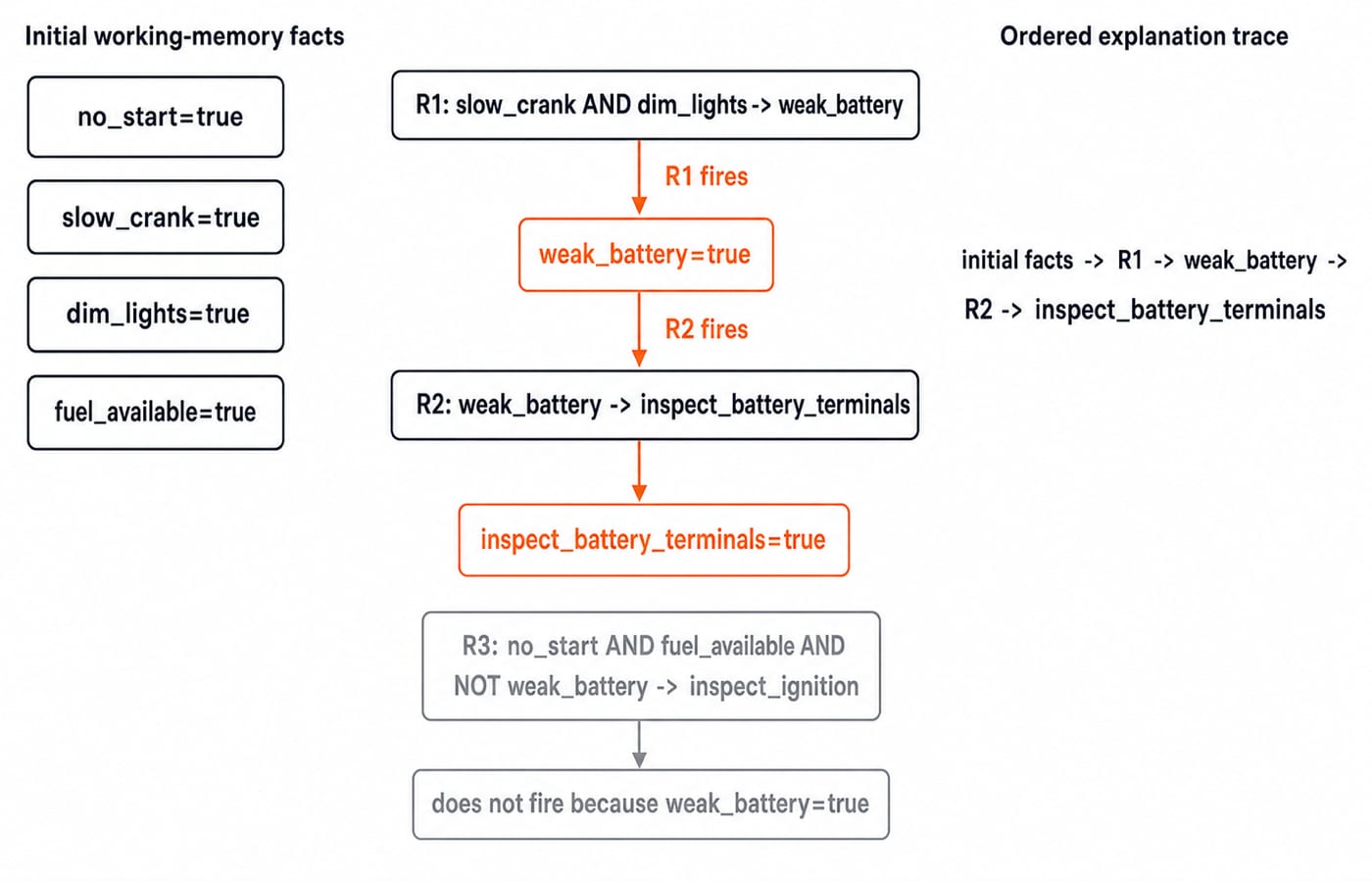
Use R1: IF slow_crank AND dim_lights THEN weak_battery, R2: IF weak_battery THEN inspect_battery_terminals, and R3: IF no_start AND fuel_available AND NOT weak_battery THEN inspect_ignition. From the four initial facts, R1 adds weak_battery; R2 then adds inspect_battery_terminals. R3 does not fire because NOT weak_battery is false.
Forward chaining is data-driven: it starts from facts and suits monitoring or cases where several conclusions may help. Backward chaining is goal-driven: starting with weak_battery, it asks whether slow_crank and dim_lights can be established. If several rules are eligible, specificity, priority or recency may resolve the conflict, but the system must define its policy. Knowledge Representation in AI: Logic, Frames and Rules develops the representation choices behind such rules.
The trace shows how updated working memory enables one rule and blocks another before any algorithm label is applied. The engine continues matching until no eligible rule remains.
Uncertainty in expert systems: probability, certainty factors and fuzzy truth
Uncertainty enters through noisy sensors, incomplete reports, heuristic rules or conflicting observations. It concerns whether a proposition is true; fuzziness concerns how strongly a graded term such as temperature is high applies.
Method | What it represents | Good fit | Limitation |
|---|---|---|---|
Bayesian probability | Calibrated belief under stated conditional probabilities | Credible priors and likelihoods | Needs defensible estimates |
Certainty factors | Expert confidence under a declared scheme | Transparent heuristic rules | Not calibrated probability |
Fuzzy logic | Graded membership, such as | Vague boundaries | Membership |
Dempster-Shafer theory | Support for sets of hypotheses, with mass left for ignorance | Evidence with uncommitted belief | Combination can be difficult under conflict |
Choose Bayes for credible probabilities, certainty factors for heuristic confidence, fuzzy logic for vague terms, and Dempster-Shafer when set-valued support matters. AI & ML for Placements offers a broader structured route through AI concepts.
Bayesian uncertainty interview question: update a weak-battery diagnosis
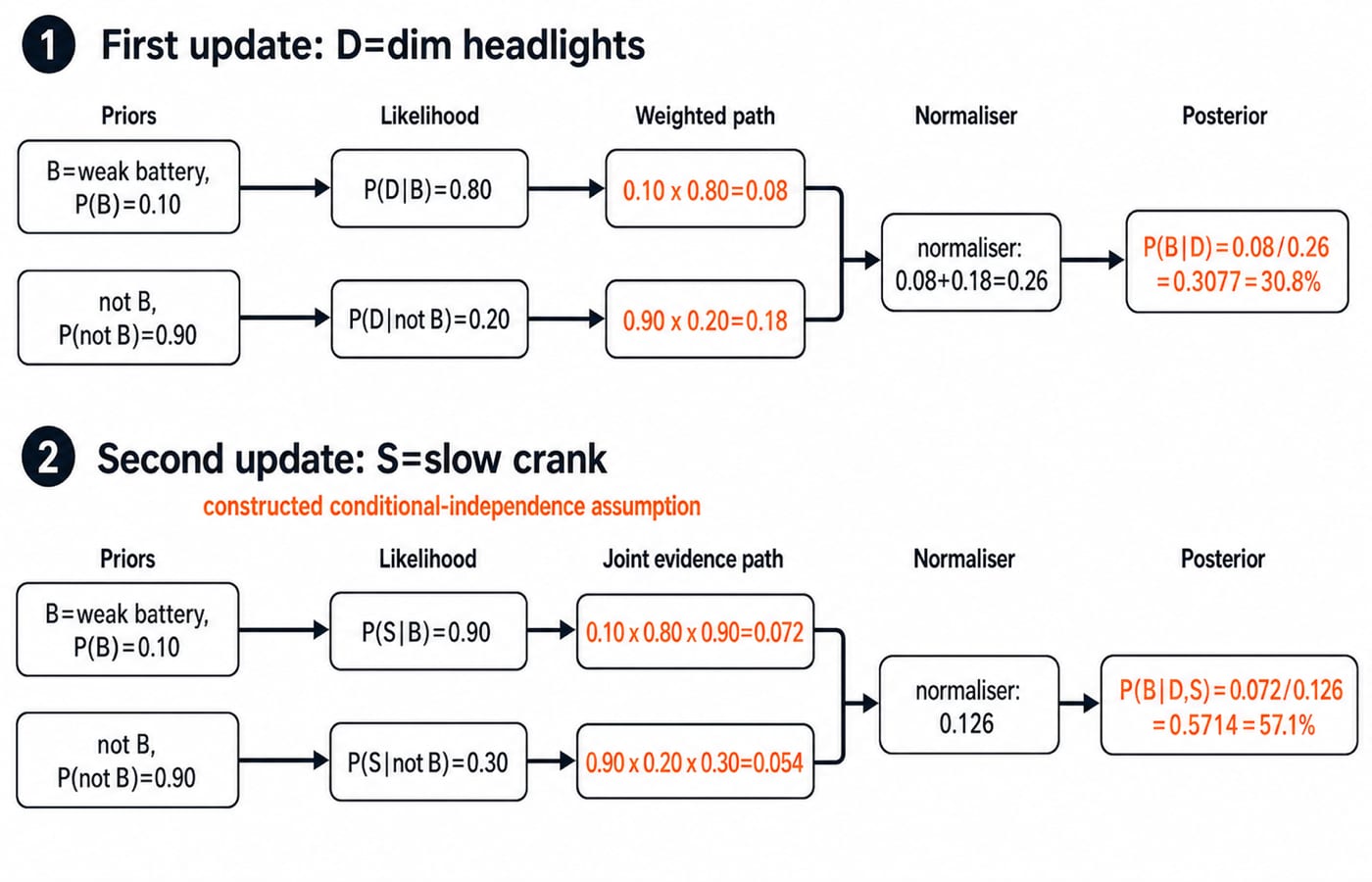
State the constructed assumptions first. Let B mean weak battery, with P(B)=0.10 and P(not B)=0.90. Let D mean dim headlights, with P(D|B)=0.80 and P(D|not B)=0.20.
Bayes gives:
P(B|D) = [0.80 x 0.10] / [(0.80 x 0.10) + (0.20 x 0.90)]
= 0.08 / (0.08 + 0.18) = 0.08 / 0.26 = 0.3077, or 30.8% to one decimal place.
Now add S = slow crank. For this toy calculation only, assume D and S are conditionally independent given B and given not B, with P(S|B)=0.90 and P(S|not B)=0.30.
P(B|D,S) = [0.10 x 0.80 x 0.90] / [(0.10 x 0.80 x 0.90) + (0.90 x 0.20 x 0.30)]
= 0.072 / (0.072 + 0.054) = 0.072 / 0.126 = 0.5714, or 57.1%.
The denominator normalises the weak-battery and not-weak-battery evidence paths, so the posterior remains coherent. Evidence changes belief through a likelihood ratio, not by adding percentages. The second result depends on conditional independence. If that assumption fails, use joint likelihoods P(D,S|B) and P(D,S|not B). This is a ranked belief, not a guaranteed diagnosis.
Certainty-factor interview question: combine two heuristic rules
Use a classic MYCIN-style toy convention, not probability. Facts have CF(slow_crank)=0.90, CF(dim_lights)=0.80 and CF(voltage_below_11.8V)=0.60.
R1: IF slow_crank AND dim_lights THEN weak_battery, rule CF=0.70R2: IF voltage_below_11.8V THEN weak_battery, rule CF=0.50
For R1, take the minimum premise confidence: min(0.90,0.80)=0.80. Its conclusion contribution is 0.80 x 0.70=0.56. R2 contributes 0.60 x 0.50=0.30.
The minimum makes the weaker conjunct limit R1's premise support. Multiplication then discounts that support by the rule's own CF. The positive combination adds R2 only to the support space left after R1.
For two positive contributions, declare CFcombined = CF1 + CF2(1-CF1):
0.56 + 0.30(1-0.56) = 0.56 + 0.30(0.44) = 0.56 + 0.132 = 0.692.
The toy action threshold is 0.65, so 0.692 >= 0.65 triggers recommend battery inspection. A useful explanation reports both rules, premise confidences, contributions 0.56 and 0.30, the combination formula, final 0.692 and threshold 0.65. The result is not calibrated 69.2% probability, and this threshold is not universal. Negative evidence needs the system's separately declared conflict formula.
Expert-system design question: make the answer maintainable and auditable
Interview prompt: Design a support expert system for this vehicle case with 500 rules, 40 observable facts and three possible recommendations.
A strong design defines a rule schema, typed fact validation, an agenda of eligible rules, deterministic conflict resolution, explanation traces, rule versioning, and tests for expected conclusions and rules that must not fire. Partition the 500 rules by subsystem and index premises so a new fact does not scan every rule. Store each inferred fact's provenance as (rule_id, input_fact_ids, rule_version).
Use a confidence threshold only after documenting its semantics and calibration. Route low-confidence cases or incompatible conclusions to human review. The knowledge-acquisition bottleneck is often harder than inference: teams must elicit tacit expertise, resolve disagreement and keep rules current. Assign review ownership, test every rule change, and monitor for stale or contradictory rules.
How service and product interviews probe expert systems
These are useful forms, not employer-process promises. Fundamentals rounds can test definition, components and chaining. Deeper rounds can require traces, model choices, defended assumptions, user explanations, maintenance or human escalation.
Weak answer | Why it fails | Stronger repair |
|---|---|---|
Expert systems learn rules automatically | Rules are explicit | A separate learning component may update them |
Fuzzy value | Membership differs from probability | Define membership |
Bayes adds evidence percentages | Bayes normalises prior-weighted likelihoods | Show numerator and normaliser |
CF | CF depends on its declared model | State the combination convention |
A fired rule proves the diagnosis | Inference depends on facts and rules | Expose the trace and assumptions |
For retrieval practice, try the companion Expert Systems and Uncertainty MCQs: 11 Solved Questions. The set does not show employer frequency.
Expert systems and uncertainty: the short version and next step
Knowledge is explicit.
Inference applies rules to case facts.
Forward chaining starts from data.
Backward chaining starts from a goal.
Uncertainty needs declared semantics and combination rules.
Recheck R1 -> weak_battery -> R2; Bayes 10% -> 30.8% -> 57.1% under the stated assumptions; and 0.56 plus 0.30 combining to 0.692, above the toy threshold 0.65. Ten-minute drill: give the 45-second definition, redraw the trace, recompute both examples, then distinguish CF from probability. The Interview & Resume Preparation Course provides a structured route.
Keep learning
Expert Systems and Uncertainty Explained: Rules, Certainty Factors and Worked Problems
Build an expert system from its core components, trace its rules in both directions, and solve the same pump case using certainty factors, Bayes and fuzzy logic.
Updated 21 Aug 20266 min readML & Data Science
Expert Systems and Uncertainty MCQs: 11 Solved Questions
Solve 11 previous-year MCQs on expert-system roles, inference strategies, Bayesian networks, conditional probability, and certainty-factor calculations.
Updated 30 Oct 20268 min readMCQ Practice
Fundamentals of Systems and Information Systems: Types, Components and a Worked Inventory Model
Learn the system vocabulary, compare classifications and TPS, MIS, DSS and ESS, then follow one warehouse case from raw transactions to a 480-unit order.
Updated 15 Nov 20266 min readGATE Strategy & Roadmap

DSA Mock Interview Rubric: A 100-Point Scorecard for Reasoning, Code and Communication
A practical six-part scorecard for running comparable DSA mocks, grading visible evidence and turning weak areas into the next week's practice.
Updated 30 Oct 20265 min readInterview Corner