ER Modeling Fundamentals MCQs: 12 Solved Questions with Explanations
Test the ER concepts that learners commonly mix up. Each of these 12 MCQs includes the correct answer, the reasoning behind it, and a running STUDENT-COURSE example.
KnowledgeGate Team
Exam prep & CS education
Updated 20 Sep 20267 min read
Rectangles, ovals and diamonds are only the notation layer. The harder distinctions are entity type versus instance, composite versus multivalued attribute, relationship degree versus cardinality, and weak versus strong ownership. Each answer depends on identifying the level, shape or dependency named in the stem. The broader GATE CS preparation route connects this ER practice to the rest of DBMS.
ER Modeling Fundamentals: The One-Minute Concept Map
An entity type is a template, while an entity set is the current collection of its instances. Attributes describe entities, and relationships connect entity types. The ER model captures this conceptual schema before choices about tables and physical storage.
Use a hospital model as the running example. PATIENT has an instance {PatientID: "P101", Name: {First: "Nila", Last: "Rao"}, DOB: "12 May 2004", Allergies: {Pollen, Penicillin}}. DOCTOR has {DoctorID: "D301", Specialty: "Cardiology"}. Nila and D301 participate in the binary relationship CONSULTS, whose attributes are {VisitDate: "21 July 2026", Room: "C4"}.
Name splits into the fixed components First and Last, so it is composite. Allergies holds several values of one property, so it is multivalued. Age is derived from DOB: on 21 July 2026, the birthday on 12 May has passed, so 2026 - 2004 = 22.
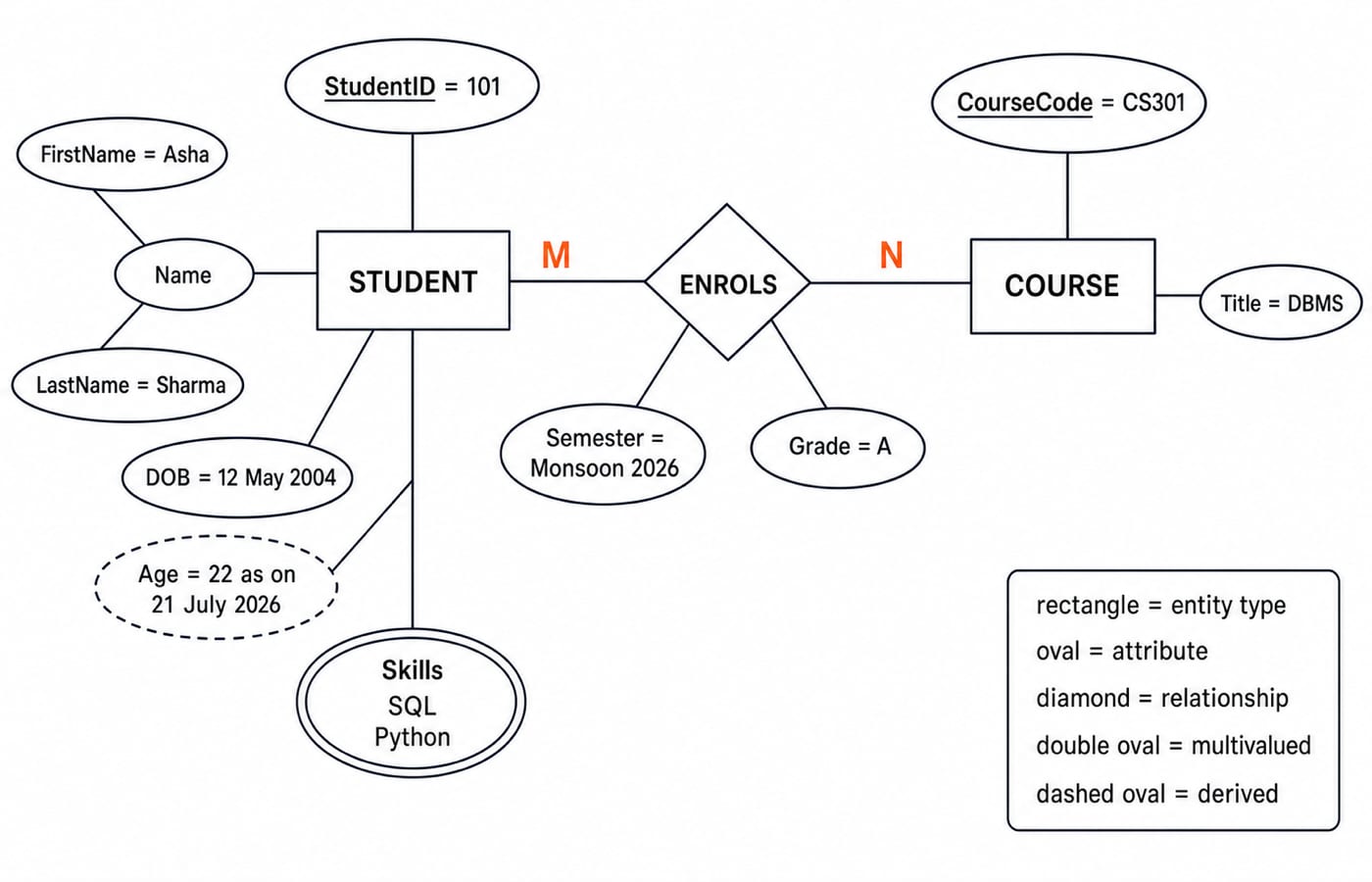
The figure uses a separate STUDENT-COURSE example to expose the same notation: keys are underlined, ENROLS is M:N, Skills is multivalued and Age is derived. The ER Model to Relational Mapping guide then converts those decisions into tables and keys. First identify the entity types, attributes, relationship degree and notation at the conceptual level.
Linked question headings open individual practice pages. Questions 5, 10, 11 and 12 are available through the ER Modeling Fundamentals practice hub instead.
Questions 1 to 3: Entity Types, Entity Sets, and ER Model Scope
Question 1
Which of the following provides the best description of an entity type?
A. A specific concrete object with a defined set of processes (e.g. Jatin with diabetes)
B. A value given to a particular attribute (e.g. height - 230 cm)
C. A thing that we wish to collect data about zero or more, possibly real world examples of it may exist
D. A template for a group of things with the same set of characteristics that may exist in the real world
Answer: D. An entity type is the template for similar objects. PATIENT is a type; Nila with PatientID = P101 is one instance. A value such as height = 230 cm is an attribute value, not an entity type.
Question 2
Which of the following is known as a set of entities of the same type that share same properties, or attributes?
A. Relation set
B. Tuples
C. Entity set
D. Entity Relation model
Answer: C. An entity set is the collection of same-type entities, such as all current PATIENT instances. A tuple is one row after relational mapping. The ER model is the broader design framework.
Question 3
An ER Model includes
I. An ER diagram portraying entity types.
II. Attributes for each entity type
III. Relationships among entity types.
IV. Semantic integrity constraints that reflects the business rules about data not captured in the ER diagram.
A. I, II, III & IV
B. I & IV
C. I, II & IV
D. I & III
Answer: A. A usable ER model covers entity types, attributes, relationships and accompanying business constraints. For example, PATIENT and DOCTOR participate in CONSULTS, while a constraint can require every CONSULTS occurrence to reference one existing patient and one existing doctor.
Questions 4 to 6: Conceptual Schema and ER Notation
Question 4
An ER Model describes which type of schema?
A. Internal Schema
B. External Schema
C. Conceptual Schema
D. Physical Schema
Answer: C. The ER model describes the database's conceptual structure. External schemas are user views. Internal and physical schemas deal with storage details, which an ER diagram does not primarily model.
Question 5
Which symbol represents an entity in an ER diagram?
A. Oval
B. Rectangle
C. Diamond
D. Circle
Answer: B. A rectangle represents an entity type. In the running figure, STUDENT and COURSE are rectangles, ENROLS is a diamond, and their attributes use ovals.
Question 6
Which symbol denote derived attributes in ER Model?
A. Double ellipse
B. Dashed ellipse
C. Squared ellipse
D. Ellipse with attribute name underlined
Answer: B. A derived attribute uses a dashed ellipse. Here, Age = 22 is calculated from DOB = 12 May 2004 as on 21 July 2026. A double ellipse instead marks the multivalued Skills attribute.
Questions 7 and 8: Composite, Complex, Derived, and Multivalued Attributes
Question 7
Consider the following statements:
Statement I: Composite attributes cannot be divided into smaller subparts.
Statement II: Complex attribute is formed by nesting composite attributes and multivalued attributes in an arbitrary way.
Statement III: A derived attribute is an attribute whose values are computed from other attribute.
Which of the following is correct ?
A. Statement I, Statement II and Statement III are true
B. Statement I true and Statement II, Statement III false
C. Statement I, Statement II true and Statement III false
D. Statement I false and Statement II, Statement III true
Answer: D. Statement I is false because a composite value can be split, for example Address = {Flat: 12, City: Jaipur, PIN: 302017}. Statement II is true because composite and multivalued structures can be nested. Statement III is also true: Age can be computed from DOB.
Question 8
In ER Model constructs, which type of attribute is most suitable to represent the skill(s) of an employee for an organization?
A. Derived attribute
B. Composite attribute
C. Atomic attribute
D. Multivalued attribute
Answer: D. One employee may have several independent skills, so {SQL, Python} is multivalued. It is not composite because SQL and Python are repeated values of one property, not fixed subparts of one value. During relational design, such repeating values must be represented without violating first normal form.
Questions 9 and 10: Degree of a Relationship
Question 9
Degree of relationship type is the number of participating ............. .
A. Keys types
B. Entity types
C. Condition types
D. Attribute types
Answer: B. Relationship degree counts participating entity types. CONSULTS(PATIENT P101, DOCTOR D301) is binary because exactly two entity types participate. The number of relationship attributes or stored occurrences does not change that degree.
Question 10
How many entities are associated in the quaternary relationship in E–R modelling?
A. 2
B. 3
C. 4
D. 5
Answer: C. Quaternary fixes the degree at four participating entity types. For example, one occurrence can say SUPPLIER S7 supplies PART P12 to PROJECT J3 through WAREHOUSE W2. Four counts the participating types, not relationship attributes or stored occurrences.
Questions 11 and 12: Weak Entities and Recursive Relationships
Question 11
In an ER model, Y is the dominant/strong entity and X is the subordinate/weak entity.
Which of the following statements is incorrect?
A. If X is deleted, Y is also deleted.
B. X's existence depends on Y.
C. If Y is deleted, X is also deleted.
D. If X is deleted, Y remains unchanged.
Answer: A. Dependency runs from weak X to strong Y, not the reverse. Suppose weak ORDER_LINE {LineNo: 2} belongs to strong ORDER {OrderID: "O17"}. Removing line 2 does not remove O17. If owner O17 is removed, that line occurrence cannot remain under this existence rule.
Question 12
Recursive entity set is
S1: It is an entity type with foreign key referring to same table or itself
S2: Recursive entity type occurs in unary relationship
Which of the above statements is/ are correct?
A. only S1
B. only S2
C. Both S1 & S2
D. Neither S1 nor S2
Answer: C. A recursive relationship is unary because the same entity type fills two roles. If CATEGORY C17 has parent CATEGORY C02, row C17 can carry ParentCategoryID = C02, a foreign key back to CATEGORY.
ER Modeling Answer Traps and the Next Practice Step
Use four checks when an option looks confusing:
Separate a type or template from one concrete instance.
Ask whether an attribute splits into fixed parts or repeats as several values.
Count participating entity types for degree. Do not count rows or attributes.
Test existence dependency from the weak entity towards its strong owner.
A quick elimination routine takes about 20 seconds: underline the level being asked, count participating entity types, inspect whether the value repeats or splits, and test the direction of dependency.
The compact key is 1-D, 2-C, 3-A, 4-C, 5-B, 6-B, 7-D, 8-D, 9-B, 10-C, 11-A, 12-C. Use Cardinalities, Participation and Entity Strength MCQs for concentrated maximum/minimum participation and entity-strength practice. The remaining questions require ER types, attributes, notation, degree and recursion. For structured coverage across the subject, use GATE Guidance by Sanchit Sir, then move to timed practice with the GATE Test Series.
Redraw the STUDENT-COURSE model from memory, including the derived and multivalued attributes. Then answer all 12 questions again without looking at the key.
Keep learning
SQL Library Functions MCQs: 12 Solved Math, Aggregate, String and Date Questions
Practise 12 solved SQL library function MCQs with inside-out calculations, exact intermediate values and clear explanations of the common traps.
Updated 3 Oct 20268 min readDBMS MCQs
SQL Introduction, Components & Structure MCQs: 12 Solved Questions
Test your SQL foundations with 12 explained MCQs covering terminology, query behaviour, metadata, dynamic SQL, database models and QBE.
28 Sep 20267 min readDBMS MCQs
GROUP BY Clause MCQs: 10 Solved SQL Questions with Explanations
Solve ten published GROUP BY questions, then check each answer with row-level and group-level reasoning. Two full traces make the common SQL traps visible.
Updated 25 Sep 20268 min readDBMS MCQs
Third Normal Form (3NF) MCQs: 12 Solved Questions with Explanations
Solve 12 real 3NF exam MCQs with clear explanations, candidate-key closures, a raw-row decomposition, and the prime-attribute exception that separates 3NF from BCNF.
Updated 24 Sep 20267 min readDBMS MCQs