Image Fundamentals MCQs: 12 Questions with Answers and Explanations
Test the distinctions that decide image-processing MCQs, then use each answer and explanation to repair weak concepts before your next practice set.
KnowledgeGate Team
Exam prep & CS education
Updated 12 Sep 20267 min read
Sampling, quantisation, resolution and intensity can sound interchangeable until an MCQ makes one distinction decisive. The 12 practice questions distinguish sampling, quantisation, resolution and intensity, each with an immediate answer and short explanation. Image-processing concepts also support broader NET CS preparation.
Image fundamentals in one minute
A digital image is a two-dimensional function, f(x, y). Coordinates x and y locate a sample, while amplitude gives its intensity. Thus, f(2, 1) = 173 means intensity 173 at (2, 1).
The flow is acquisition, sampling and quantisation, processing or enhancement, then segmentation or interpretation. Sampling discretises coordinates. Quantisation discretises amplitude.
Keep three anchors ready. With b bits, an image represents 2^b intensity levels. A 3-bit image has 8 levels, while 8-bit grayscale has 256. Pixels per inch equals pixels along one dimension divided by printed inches along that dimension.
MCQs 1 to 3: acquisition, the image function and quantisation
Question 1: the first processing step
Which of the following is the first and foremost step in Image Processing?
A. Image acquisition
B. Segmentation
C. Image enhancement
D. Image restoration
Answer: A. Image acquisition.
Acquisition creates the input through a sensor, camera or scanner. Enhancement, restoration and segmentation all need an image that already exists. Segmentation is the closest trap because it is a major processing stage, but it cannot come first.
Question 2: coordinates versus intensity
An image may be defined as a 2-dimensional function f(x, y) where x and y are _____ and the amplitude of the function is called _____ of the image at the point (x, y).
A. Intensity; coordinates
B. Intensity; brightness
C. Coordinates; intensity
D. Brightness; coordinates
Answer: C. Coordinates; intensity.
In f(2, 1) = 173, (2, 1) locates the sample and 173 is its intensity. Option A reverses position and measured value, so it cannot describe the function correctly.
Question 3: digitising amplitude
The process that digitizes the amplitude value of an image during its digital conversion is known as _____.
A. Sampling
B. Quantization
C. Filtering
D. Extraction
Answer: B. Quantization.
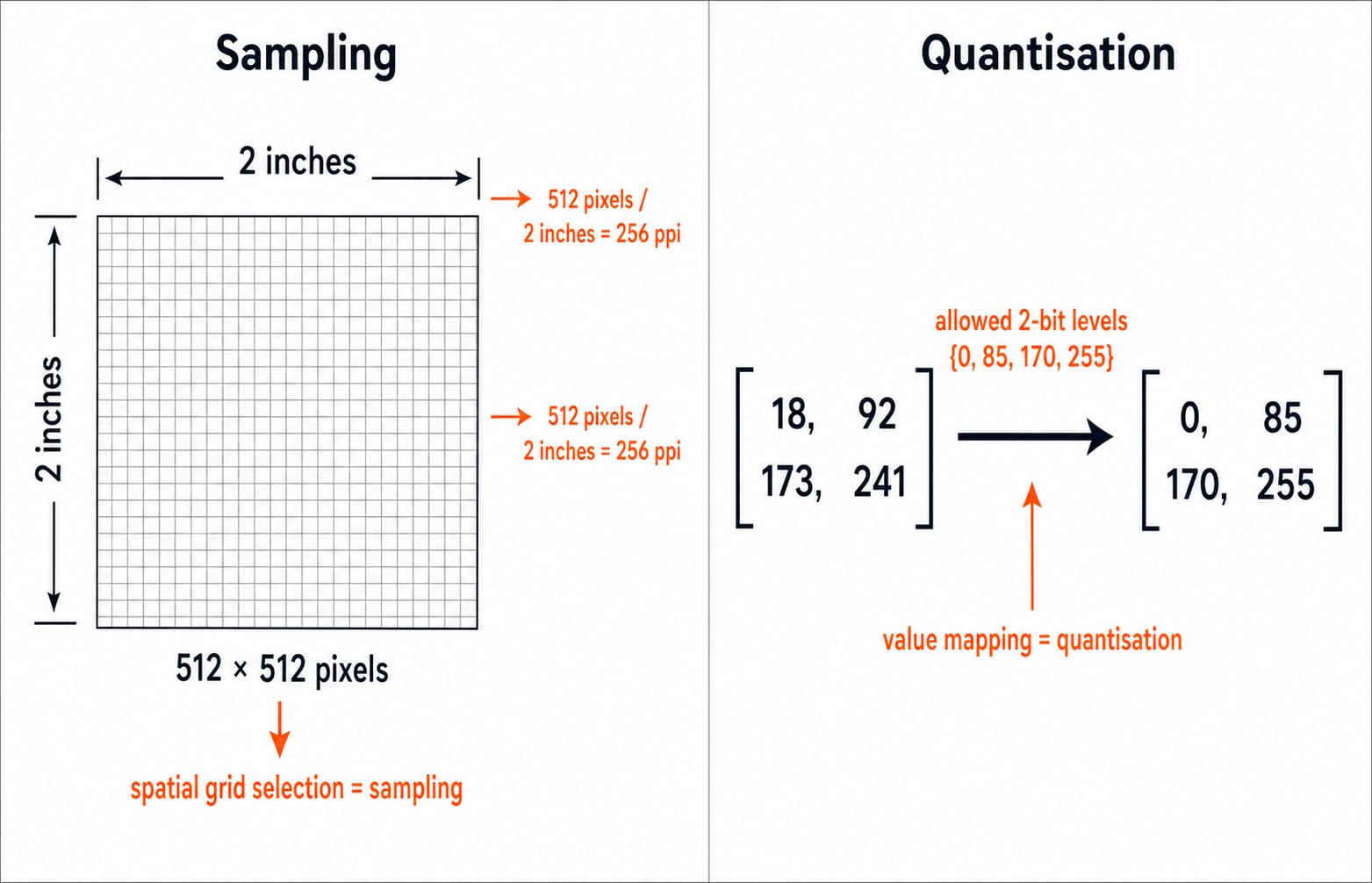
Quantisation maps each measured amplitude to a permitted level. A 3-bit representation has 2^3 = 8 levels. Sampling, the closest distractor, chooses discrete (x, y) positions. It digitises location, not amplitude.
MCQs 4 to 6: resolution and non-destructive editing
Question 4: pixels per inch
What is the resolution of 2 inch × 2 inch image which has 512 × 512 pixels?
A. 512 pixels per inch
B. 256 pixels per inch
C. 2048 pixels per inch
D. 128 pixels per inch
Answer: B. 256 pixels per inch.
Calculate each axis separately. Horizontally, 512 pixels / 2 inches = 256 ppi. Vertically, the same calculation gives 512 pixels / 2 inches = 256 ppi. Option A uses the side's pixel count without dividing by its physical length. Also, 512 × 512 = 262,144 is the total pixel count, not the print resolution.
Question 5: keeping the original pixels intact
When performing non-destructive image editing, which of the following techniques ensures that the original image data remains intact?
A. Using adjustment layers and masks
B. Flattening the image after each edit
C. Directly modifying the pixel values on the background layer
D. Merging all layers before applying adjustments
Answer: A. Using adjustment layers and masks.
An adjustment layer stores the correction separately, while its mask controls where it appears. Direct background editing is the closest trap because it can look identical but changes source pixels. Flattening and merging also bake elements together and reduce reversibility.
Question 6: changing brightness and contrast
Which of the following tools is typically used in image editing software to adjust brightness and contrast in a photo?
A. Crop Tool
B. Clone Stamp Tool
C. Text Tool
D. Levels or Curves Tool
Answer: D. Levels or Curves Tool.
Levels and Curves remap tonal values, changing brightness and contrast. Crop is the closest practical distractor, but it changes framing rather than tones. Clone Stamp copies pixels, while Text adds text.
MCQs 7 to 9: batch work, cropping, sampling and quantisation
Question 7: automating repeated exports
What does 'batch processing' automate in image exports?
A. Creative design choices
B. Vectorisation of raster images
C. Application of identical actions to multiple files
D. Manual colour grading
Answer: C. Application of identical actions to multiple files.
Suppose 40 images must each be resized to 1200 × 800 and exported as JPEG with one preset. Batch processing repeats those operations. Option A is the trap because automation follows defined actions, not fresh creative judgements.
Question 8: removing unwanted outer areas
In image editing software, which tool is most commonly used to eliminate extraneous sections of an image without altering the resolution of the retained portion?
A. Smudge Tool
B. Crop Tool
C. Magic Wand Tool
D. Clone Tool
Answer: B. Crop Tool.
Cropping removes unwanted outer rows or columns while leaving the retained pixels unchanged. If you remove 100 pixels from both the left and right sides of a 1200 × 800 image, its new dimensions are (1200 - 100 - 100) × 800 = 1000 × 800. Clone is the closest distractor, but it copies pixels to conceal content rather than trimming the canvas.
Question 9: the two requirements for digitisation
Which of the following is/are required to convert image data into a digital form? (i) Sampling (ii) Quantisation
A. Only (i)
B. Only (ii)
C. Both (i) and (ii)
D. Neither (i) nor (ii)
Answer: C. Both (i) and (ii).
Sampling converts continuous coordinates into a discrete pixel grid. Quantisation converts amplitudes into discrete levels. Option A is the closest trap because a grid alone still needs quantised values. Neither operation completes both parts.
MCQs 10 to 12: composition, export formats and PNG
Question 10: digital composition
Which activity best describes digital composition in the context of image editing?
A. Coding visual effects
B. Converting text to images
C. Scanning printed images into a computer
D. Assembling different visual components into one image
Answer: D. Assembling different visual components into one image.
An editor may combine a 1200 × 800 background, a cut-out subject and a logo on three layers. Scanning is the closest distractor, but it is acquisition. Composition combines components already available.
Question 11: cross-platform export
Which of the following options best describes an important consideration when exporting digital images for cross-platform compatibility?
A. Using a proprietary format to maintain editing layers
B. Exporting in a format that supports high compression only
C. Choosing a universally supported file format like PNG or JPEG
D. Embedding uncompressed RAW files in all exports for flexibility
Answer: C. Choosing a universally supported file format like PNG or JPEG.
Final delivery needs a format common devices can decode. A proprietary layered format, the closest distractor, is useful as an editable master but not a universal export. Compression alone does not guarantee compatibility.
Question 12: expanding PNG
What is the full form of PNG in Computer Graphics?
A. Port New Graphics
B. Portable Network Graphics
C. Printable New Graphical
D. Printable New Graphic
Answer: B. Portable Network Graphics.
Use “Portable” and “Network” as the recall hook for a widely supported format. Option A looks plausible because its initials fit, but it and the other distractors are fabricated expansions.
Three traps to repair before the next MCQ set
First, dimensions, total pixels and print resolution are different quantities. An 800 × 600 image printed at 4 × 3 inches gives 800 / 4 = 200 ppi horizontally and 600 / 3 = 200 ppi vertically. Its total pixel count is still 800 × 600 = 480,000.
Second, sampling asks, “Where did we measure?” Quantisation asks, “Which allowed value represents it?” Mapping [18, 92; 173, 241] to 2-bit levels {0, 85, 170, 255} produces [0, 85; 170, 255]. Grid and value mapping are separate decisions.
Third, masters and delivery files serve different jobs. Adjustment layers and masks keep a master reversible, while PNG or JPEG supports delivery. For adjacent practice, use Digital Electronics MCQs and Computer Organization MCQs. They are neighbouring areas, not image-processing substitutes.
Repair each miss with a closed-book redo
Sort every wrong answer by question group before rereading. Questions 1-2 point back to acquisition and the image model. Questions 3-6 point to sampling, quantisation, pixel dimensions and ppi. Questions 7-9 point to reversible editing and master files. Questions 10-12 point to delivery formats, interoperability and PNG. Revisit only the matching explanation and the relevant trap above.
Then close the page and write this chain from memory: acquisition, sampling, quantisation, pixel dimensions, print ppi, editable master, delivery format. Reattempt only the missed questions without looking at the options. Repeat the full set the next day in a different order. Treat a concept as repaired only when you can explain why each distractor fails.
For structured concept coverage, the NTA UGC NET Paper 2 course provides a complete Computer Science Paper 2 course and includes computer-graphics study in its curriculum. For timed follow-up practice, use the UGC NET CS Test Series.
Acquisition comes first. (x, y) gives position, amplitude gives intensity, sampling digitises position, quantisation digitises amplitude, and pixels / inches gives ppi.
Keep learning

ICT in Education MCQs: 12 Solved Questions on Digital Learning Tools
Solve 12 ICT in Education MCQs, then use clear explanations and a five-layer model to separate files, tools, platforms and public initiatives.
Updated 3 Oct 20268 min readUGC NET Computer Science

Requirements Elicitation Techniques and Use Case Development: Worked Library Example
Follow a fictional library reservation from interviews and observation through testable requirements, a UML use-case model, UC-07, and acceptance checks.
Updated 28 Sep 20266 min readUGC NET Computer Science

Quality Factors: McCall’s and ISO 9126 Models with a Worked Scoring Example
Build both quality models around one maintainability audit. This guide maps their vocabulary, calculates McCall-style and ISO-style scores, and ends with exam-focused checks.
Updated 25 Sep 20265 min readUGC NET Computer Science
Cohesion and Coupling MCQs: 10 Solved Questions on Functional Independence
Practise 10 solved MCQs on cohesion, coupling, functional independence, module dependencies, and the distinctions that make closely matched options easier to separate.
Updated 24 Sep 20267 min readUGC NET Computer Science