Multivalued Dependency (MVD) and 4NF MCQs: 12 Solved Questions
Attempt 12 MVD and 4NF questions, then study explanations covering the normal-form hierarchy, inference rules, tuple generation and lossless decomposition.
KnowledgeGate Team
Exam prep & CS education
Updated 19 Sep 20267 min read

MVD questions resemble ordinary normalization questions, but functional, multivalued and join dependencies differ. A BCNF relation may still repeat every hobby-language combination for one student. Solve these 12 MCQs before reading the explanations. The earlier DBMS Normalization MCQs owns mixed practice from 1NF through BCNF; this set concentrates on MVD rules and 4NF decompositions beyond BCNF.
1. MVD and 4NF in one worked relation
Student -> Hobby means each student determines one hobby. Student ↠ Hobby means the hobby set varies independently of the remaining attributes. Every FD implies its corresponding MVD, but not conversely. This is where 4NF goes beyond the FD-based forms in Normalization in DBMS: 1NF to BCNF.
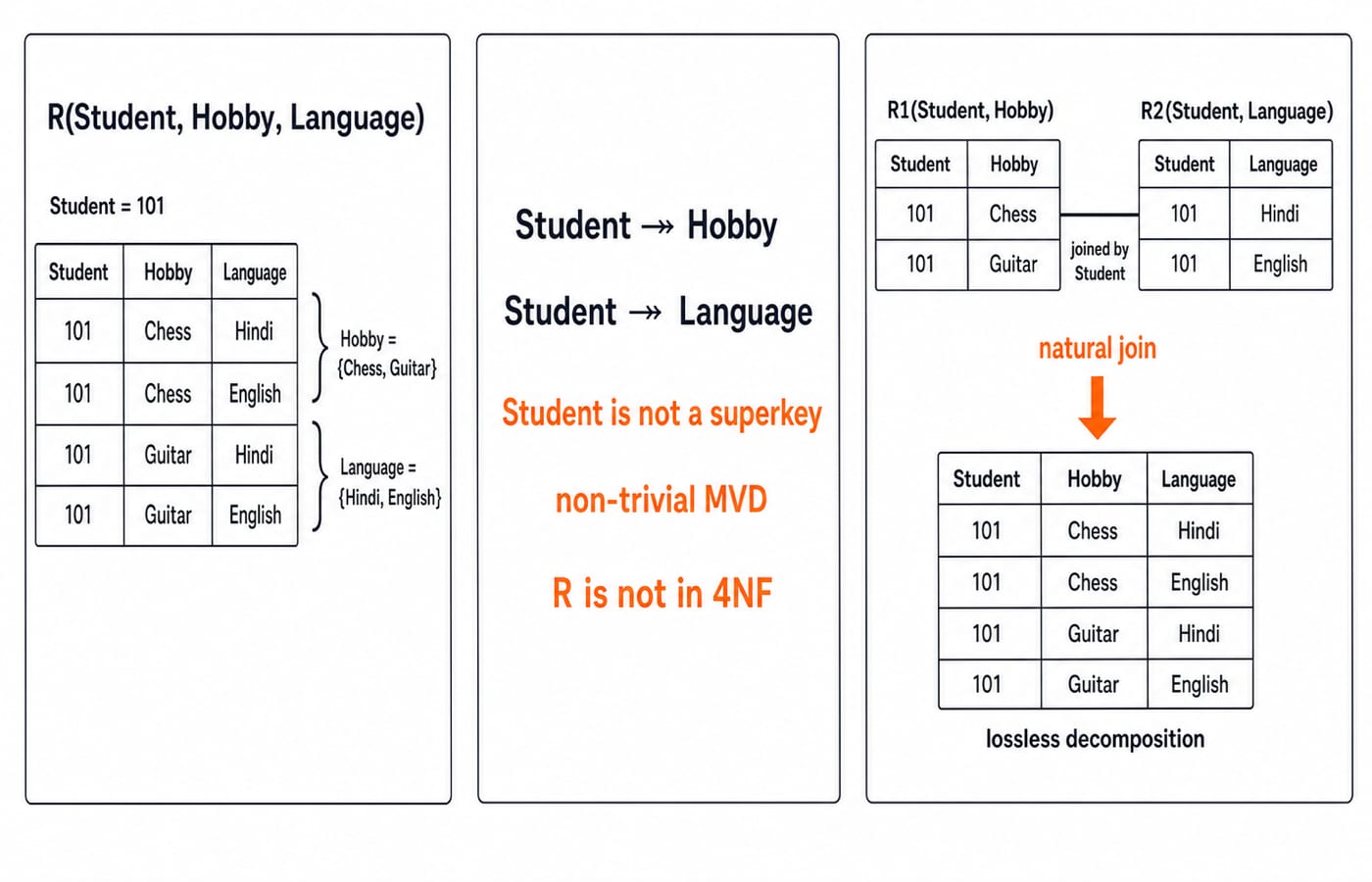
A relation is in 4NF only when, for every non-trivial MVD X ↠ Y in R, X must be a superkey. Consider R(Student, Hobby, Language) and Student = 101:
Student | Hobby | Language |
|---|---|---|
101 | Chess | Hindi |
101 | Chess | English |
101 | Guitar | Hindi |
101 | Guitar | English |
Here the hobby and language sets are independent. Therefore Student ↠ Hobby; complementation gives Student ↠ Language. Student is not a superkey because it identifies four rows. The first MVD is non-trivial: Hobby is not contained in Student, and Student ∪ Hobby is not all of R. Thus R violates 4NF even if it satisfies BCNF.
Decompose into R1(Student, Hobby) = {(101, Chess), (101, Guitar)} and R2(Student, Language) = {(101, Hindi), (101, English)}. Their natural join pairs two hobbies with two languages: 2 x 2 = 4 original tuples. The lossless decomposition stores each independent fact once. The earlier Lossless Join Decomposition MCQs: 12 Solved Questions with Explanations owns the general binary and multi-relation reconstruction tests; this example isolates the MVD-specific split used by 4NF.
2. MCQs 1-3: what 4NF removes and where BCNF stops
Question 1
TPSC 2026.
In database normalization, what problem does 4NF (Fourth Normal Form) address ?
A. Partial dependencies
B. Transitive dependencies
C. Multi-valued dependencies
D. Join dependencies
Answer: C. 2NF targets partial dependencies, 3NF transitive dependencies, 4NF violating non-trivial MVDs and 5NF non-trivial join dependencies. Trivial and superkey-determined MVDs are allowed in 4NF.
Question 2
Kendriya Vidyalaya Sangathan 2013.
If a table is in BCNF and has no multi-valued dependencies, then it is said to be in
A. Third Normal Form
B. Second Normal Form
C. Fourth Normal Form
D. Fifth Normal Form
Answer: C. “No multi-valued dependencies” means no violating non-trivial MVD. BCNF covers FDs; the added condition gives 4NF, while 5NF tests join dependencies.
Question 3
UGC NET 2019.
In relational databases, if relation R is in BCNF, then which of the following is true about relation R?
A. R is in 4NF
B. R is not in 1NF
C. R is in 2NF and not in 3NF
D. R is in 2NF and 3NF
Answer: D. BCNF implies 3NF and 2NF, but not necessarily 4NF, which also tests non-trivial MVDs.
3. MCQs 4-6: the formal 4NF rule and the normalization ladder
Question 4
Which of the following statements about fourth normal form (4NF) is true?
A. A relation in 4NF must be in BCNF and should not have any non-trivial MVDs.
B. A relation in 4NF must be in 3NF and should have only trivial MVDs.
C. A relation in 4NF must be in 2NF and should not have any trivial MVDs.
D. A relation in 4NF must be in BCNF and can have non-trivial MVDs.
Answer: D. As written, D is correct: 4NF permits a non-trivial MVD when its determinant is a superkey. The linked question labels A, but A is too broad because it forbids every non-trivial MVD instead of only the violating ones.
Question 5
UGC NET 2022.
Match List I with List II :
Choose the correct answer from the options given below:
A. (A)-(III), (B)-(II), (C)-(IV), (D)-(I)
B. (A)-(II), (B)-(IV), (C)-(I), (D)-(III)
C. (A)-(II), (B)-(III), (C)-(IV), (D)-(I)
D. (A)-(II), (B)-(I), (C)-(IV), (D)-(III)
Answer: C. Match BCNF with not always dependency preserving, 3NF with transitive dependency, 2NF with partial functional dependency, and 4NF with violating MVDs.
Question 6
UGC NET 2023.
Which of the follwing are true?
A. A database design is in BCNF if each member of the set of relation schemas that constitutes the design is in BCNF.
B. A BCNF schema can have transitive dependency.
C. It is always possible to obtain a 3NF design without sacrificing a lossless join.
D. There are multivalued dependencies in 4NF.
A. A, B and C only
B. B, C and D only
C. A, B and D only
D. A, C and D only
Answer: D. A holds schema by schema; B is false here; C follows from 3NF synthesis. D holds because trivial and superkey-determined MVDs remain.
4. MCQs 7-9: where MVDs come from and what they imply
Question 7
Tech Mahindra 2024.
If a multivalued dependency holds and is not implied by the corresponding functional dependency, it usually arises from one of the following sources.
A. A many-to-many relationship set
B. A multivalued attribute of an entity set
C. A one-to-many relationship set
D. Both A many-to-many relationship set and A multivalued attribute of an entity set
Answer: D. Many-to-many relationships and multivalued attributes can form independent value sets. One-to-many more naturally gives a directional FD.
Question 8
Tech Mahindra 2023.
Which of the following is a tuple-generating dependency?
A. Functional dependency
B. Equality-generating dependency
C. Multivalued dependency
D. Non-functional dependency
Answer: C. (101, Chess, Hindi) and (101, Guitar, English) require (101, Chess, English) and (101, Guitar, Hindi). This required tuple existence makes an MVD tuple-generating; an FD enforces equality.
Question 9
GATE 2007.
Consider the following implications relating to functional and multivalued dependencies given below, which may or may not be correct.
i. If A ↠ B and A ↠ C then A → BC
ii. If A → B and A → C then A ↠ BC
iii. If A ↠ BC and A → B then A → C
iv. If A → BC and A → B then A ↠ C
Exactly how many of the above implications are valid?
A. 0
B. 1
C. 2
D. 3
Answer: C. Exactly ii and iv hold. Union gives A -> BC, then its MVD; decomposition gives A -> C, then its MVD. Statement i promotes MVDs to an FD; in iii, A ↠ BC can be trivial while several C values remain.
5. MCQs 10-12: decomposition, hierarchy and wording traps
Question 10
UGC NET 2025.
Which of the following/s is/are FALSE statement?
A. An all key relation is always in BCNF since it has no FDs.
B. A relation that is not in 4NF due to nontrivial MVD must be decomposed to convert it into a set of relations in 4NF.
C. The decomposition removes the redundancy by the MVD.
D. 3NF is stronger than BCNF.
Choose the correct answer from the options given below:
A. A only
B. A, B only
C. D only
D. C only
Answer: C. D alone is false because BCNF is stronger. Under the intended all-key, no-non-trivial-FD reading, A is true. B and C remove MVD redundancy by decomposition.
Question 11
UGC NET 2005.
Match the following:
Left Side | Right Side |
|---|---|
(i) 5 NF | (a) Transitive dependencies eliminated |
(ii) 2 NF | (b) Multivalued attribute removed |
(iii) 3 NF | (c) Contains no partial functional dependencies |
(iv) 4 NF | (d) Contains no join dependency |
A. i- (a) ii-(c) iii-(b) iv-(d)
B. i-(d) ii-(c) iii-(a) iv-(b)
C. i-(d) ii-(c) iii-(b) iv-(a)
D. i-(d) ii-(c) iii-(b) iv-(a)
Answer: B. Match 5NF -> (d), 2NF -> (c), 3NF -> (a), and 4NF -> (b). Options C and D here are printed identically. “No join dependency” means no violating non-trivial one.
Question 12
UGC NET 2014.
Which of the following is false?
A. Every binary relation is never be in BCNF.
B. Every BCNF relation is in 3NF.
C. 1 NF, 2 NF, 3 NF and BCNF are based on functional dependencies.
D. Multivalued Dependency (MVD) is a special case of Join Dependency (JD).
Answer: A. In a binary relation, a non-trivial FD's determinant becomes a key; without one, no BCNF violation exists. B, C and D are true.
6. Four recurring traps in 4NF questions
Trap | Reliable fix |
|---|---|
Treating | Ask whether one X can have several Y values. If yes, that FD cannot hold. |
Assuming BCNF implies 4NF | Test non-trivial FDs for BCNF, then non-trivial MVDs for 4NF. |
Saying 4NF removes every MVD | Apply the determinant rule. Trivial and superkey-determined MVDs are allowed. |
Decomposing without checking the join | Project, join on the common determinant, and compare the result with the original. |
For the worked values, R1 ⋈ R2 pairs two hobbies with two languages and returns four tuples without missing or spurious combinations.
7. 4NF recall and practice
Every FD implies an MVD.
The converse is false.
Independent multivalued facts create a Cartesian-style cross-product.
4NF checks the determinants of non-trivial MVDs.
A non-superkey determinant violates 4NF.
Decompose, then verify a lossless join.
Allow 18 minutes for these 12 questions. Label each miss normal-form hierarchy, FD versus MVD, inference rule, source of MVD or decomposition. For decomposition practice, redraw the four-tuple Student relation and explain each recombined tuple.
For a sequenced GATE route, continue with GATE Guidance by Sanchit Sir. Placement-focused readers rebuilding DBMS alongside OS and Computer Networks can use CS Fundamentals for Placements as the broader category route.
Keep learning

SQL Library Functions MCQs: 12 Solved Math, Aggregate, String and Date Questions
Practise 12 solved SQL library function MCQs with inside-out calculations, exact intermediate values and clear explanations of the common traps.
Updated 3 Oct 20268 min readDBMS MCQs

SQL Introduction, Components & Structure MCQs: 12 Solved Questions
Test your SQL foundations with 12 explained MCQs covering terminology, query behaviour, metadata, dynamic SQL, database models and QBE.
28 Sep 20267 min readDBMS MCQs

GROUP BY Clause MCQs: 10 Solved SQL Questions with Explanations
Solve ten published GROUP BY questions, then check each answer with row-level and group-level reasoning. Two full traces make the common SQL traps visible.
Updated 25 Sep 20268 min readDBMS MCQs
Third Normal Form (3NF) MCQs: 12 Solved Questions with Explanations
Solve 12 real 3NF exam MCQs with clear explanations, candidate-key closures, a raw-row decomposition, and the prime-attribute exception that separates 3NF from BCNF.
Updated 24 Sep 20267 min readDBMS MCQs