Cardinalities, Participation and Entity Strength MCQs: 12 Solved DBMS Questions
Solve 12 DBMS MCQs on relationship cardinality, participation constraints and weak entities. Each answer includes the deciding ER-model rule.
KnowledgeGate Team
Exam prep & CS education
Updated 29 Jul 20267 min read96 views
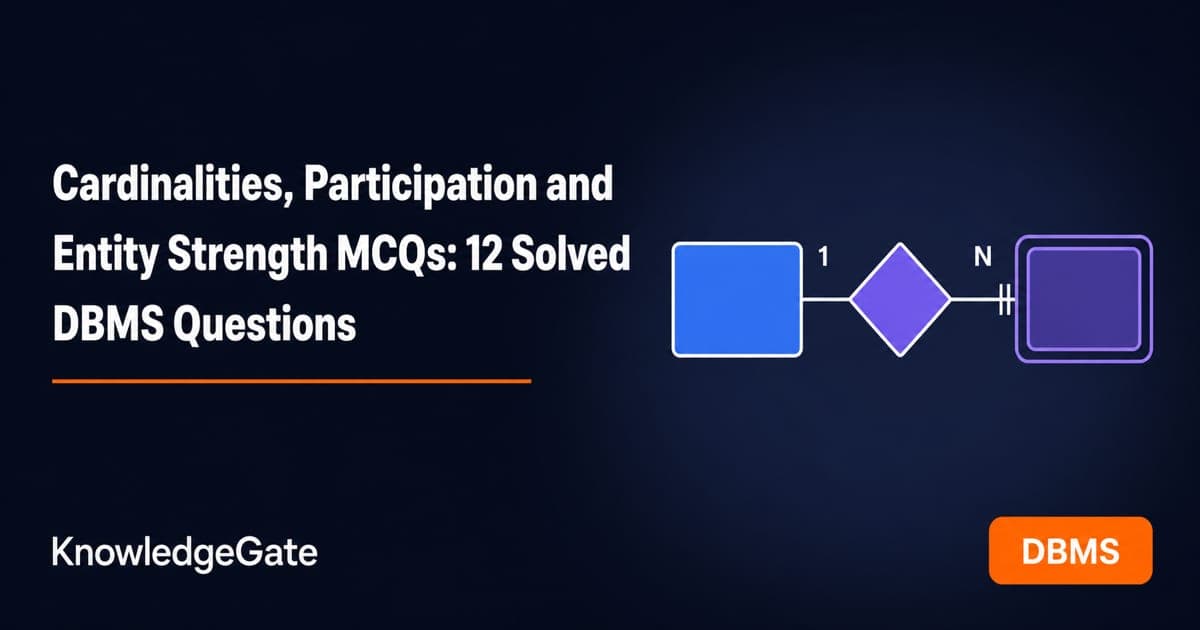
Cardinality gives the maximum, participation gives the minimum, and weak-entity questions combine both with ownership. These 12 solved questions show the rule after every answer. Ten of them carry a named paper, spanning UGC NET 2004 to RPSC 2024, with GATE, UPPSC and other recruitment exams in between.
Related reading: ER-to-table mapping and ER mapping MCQs.
Cardinality, participation and entity strength in 90 seconds
Concept | Question answered | Values or rule |
|---|---|---|
Cardinality ratio | At most how many? | 1:1, 1:N, N:1, M:N |
Participation | Must an entity participate? | Partial means minimum 0; total means minimum 1 |
Entity strength | Can the entity be identified by its own attributes? | Strong has its own key; weak needs its partial key plus the owner's key |
For AUTHOR(A1, A2) and BOOK(B1, B2, B3), A1 writes B1 and B2; A2 writes B2 and B3. Authors write many books and B2 has many authors, so Author-to-Book is M:N.
Cardinality MCQs: maximum participation and relationship ratios
Ask for the maximum on each side before choosing 1:1, 1:N, N:1 or M:N.
Question 1
Which of the following statements is TRUE?
A. The cardinality ratio for a binary relationship specifies the maximum number of relationship instances that an entity can participate in.
B. The cardinality ratio for a binary relationship specifies the minimum number of relationship instances that an entity can participate in.
C. The partial participation constraint is also called existence dependency.
D. The cardinality ratio for a binary relationship specifies the average number of relationship instances that an entity can participate in.
Answer: A.
Cardinality constrains maximum participation. Minimum belongs to the participation constraint; partial participation permits zero and is not existence dependency.
Question 2
Under normal circumstances, the cardinality ratio of the binary relationship “Write” relating “Author” and “Book” entities is:
A. 1 : N
B. N : 1
C. 1 : 1
D. M : N
Answer: D.
An author may write several books, and a book may have several authors. The A1, A2, B1, B2, B3 instance therefore has maximum many on both sides, giving M:N.
Question 3
In ER Model, which of the following relationship is correct for a condition that a person in INDIA has an Aadhaar Card?
A. One to one relationship
B. One to many relationship
C. Many to many relationship
D. Many to one relationship
Answer: A.
In the stated model, one person pairs with one card and one card with one person. The maximum is 1 on both sides, giving 1:1. Read the ratio from the maxima the question states, not from real-world exceptions.
Question 4
In an Entity-Relationship (ER) model, suppose R is a many-to-one relationship from entity set E1 to entity set E2. Assume that E1 and E2 participate totally in R and that the cardinality of E1 is greater than the cardinality of E2. Which one of the following is true about R?
A. Every entity in E1 is associated with exactly one entity in E2.
B. Some entity in E1 is associated with more than one entity in E2.
C. Every entity in E2 is associated with exactly one entity in E1.
D. Every entity in E2 is associated with at most one entity in E1.
Answer: A.
Many-to-one gives each E1 entity at most one E2 entity. Total participation gives at least one, so each has exactly one; the size inequality does not make the reverse side 1:1.
Participation MCQs: minimum cardinality and total participation
Partial means minimum 0; total means minimum 1. On an ER diagram that minimum is read off the connecting line rather than the ratio label: a double line into the relationship means total participation, a single line means partial. For more practice on the same distinction, work through the cardinalities, participation and entity strength module.
Question 5
In the context of owner and weak entity sets in the ER (Entity-Relationship) data model, which one of the following statements is TRUE?
A. The weak entity set MUST have total participation in the identifying relationship
B. The owner entity set MUST have total participation in the identifying relationship
C. Both weak and owner entity sets MUST have total participation in the identifying relationship
D. Neither weak entity set nor owner entity set MUST have total participation in the identifying relationship
Answer: A.
Every weak entity needs an owner, so every weak instance must participate. The owner side need not be total because a strong owner can exist alone.
Question 6
What should be the condition for total participation of the entity in a relation?
A. Maximum cardinality should be one
B. Minimum cardinality should be zero
C. Minimum cardinality should be one
D. None of these
Answer: C.
Total participation allows no entity instance to remain unrelated, so its minimum is 1. A maximum of 1 is different and does not force participation.
Question 7
Map the following statements with true (T) or false (F):
S1: Participation of the weak entity set in the identifying relationship must be total.
S2: Multivalued attributes in an E-R diagram require separate tables when converted into the relational model.
A. F T
B. T F
C. F F
D. T T
Answer: D.
S1 is true because a weak entity depends on its owner. S2 is true because a multivalued attribute maps to a separate relation linked by the owner's key, giving T,T.
Entity strength MCQs: weak entities and identifying relationships
A weak entity lacks a complete key, combines a partial key with its owner's key, and participates totally in the identifying relationship.
Question 8
Which of the following entities is weak?
A. Employee
B. Dependent
C. Department
D. Student
Answer: B.
In the conventional model, Dependent is identified with an Employee owner. The other entities commonly have independent keys; Dependent needs the employee key plus its partial key.
Question 9
Kendriya Vidyalaya Sangathan 2017.
An entity set that does not have sufficient attributes to form a key is termed as:
A. Primary entity set
B. Strong entity set
C. Weak entity set
D. Simple entity set
Answer: C.
A strong entity set forms its own key; a weak one cannot. It combines a partial key with its owner's key, which none of the other labels describes.
Question 10
UPPSC Polytechnic Lecturer 2022.
In the standard ER-model direction from the owning strong entity set to the weak entity set, a weak entity set must be part of which identifying relationship?
A. One-to-one relationship
B. One-to-many relationship
C. Many-to-many relationship
D. None of the above
Answer: B.
One owner may identify several weak entities, while each weak entity has one owner. Thus owner-to-weak is 1:N and weak-to-owner is N:1.
Question 11
Which one of the following is used to represent the supporting many-one relationships of a weak entity set in an entity-relationship diagram?
A. Diamonds with double/bold border
B. Rectangles with double/bold border
C. Ovals with double/bold border
D. Ovals that contain underlined identifiers
Answer: A.
An identifying relationship uses a double diamond or bold double border. A weak entity uses a double rectangle, while ovals represent attributes.
Question 12
The entity type on which the __________ type depends is called the identifying owner.
A. Strong entity
B. Relationship
C. Weak entity
D. E – R
Answer: C.
A weak entity depends on an owner for identification, making that entity the identifying owner. A strong entity has its own key and no such dependency.
Worked ER instances: combine maximum, minimum and ownership
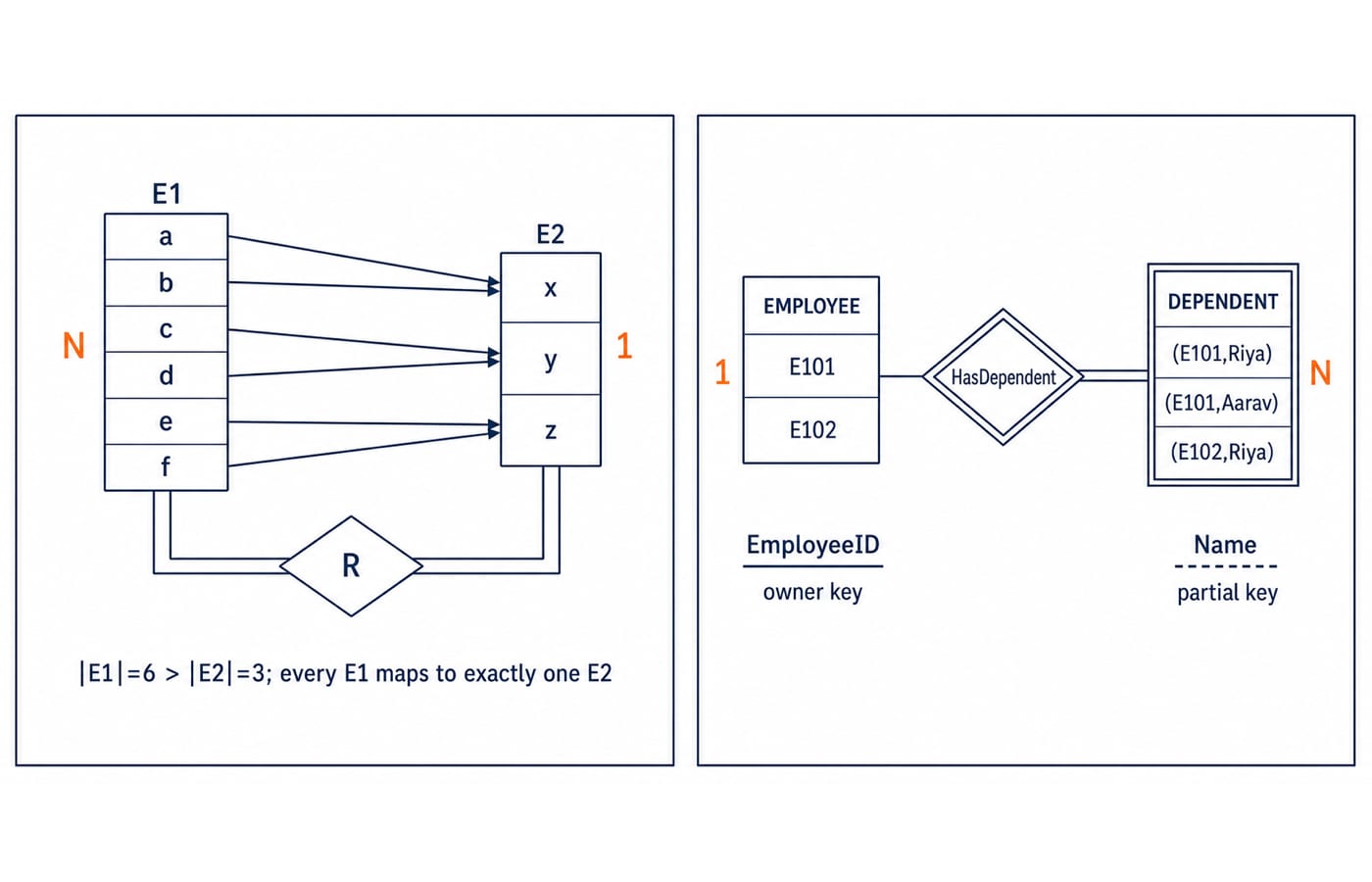
For Question 4, E1={a,b,c,d,e,f}, E2={x,y,z}, and R={(a,x),(b,x),(c,y),(d,y),(e,z),(f,z)}.
|E1|=6>|E2|=3.
Each E1 member appears exactly once in R, so every E1 maps to exactly one E2.
Each E2 member appears twice, so every E2 participates and accepts multiple E1 members.
E1-to-E2 is N:1, with total participation on both sides.
For EMPLOYEE={E101,E102} and DEPENDENT={(E101,Riya),(E101,Aarav),(E102,Riya)}, Name is not unique because Riya has two owners. (EmployeeID, Name) identifies all three rows. E101 owns two and E102 owns one, so Employee-to-Dependent is 1:N and the reverse is N:1. Every dependent participates totally.
Cardinality and weak-entity traps to check before answering
Trap | Correct distinction | Anchor |
|---|---|---|
Maximum versus minimum | Cardinality gives maximum; participation gives minimum | Question 1 |
Relationship cardinality versus relation cardinality | 1:N is a ratio; tuple count is the relation's size | Question 1 |
Direction reversal | Owner-to-weak is 1:N; weak-to-owner is N:1 | Question 10 |
Double rectangle versus double diamond | Weak entity versus identifying relationship | Question 11 |
Total weak side versus total owner side | Weak must be total; owner need not be total | Question 5 |
In 20 seconds: identify direction, write both minima and maxima, test for a full key, then inspect the symbol. Next, try DBMS normalization MCQs for constraints or DBMS transaction MCQs for state and concurrency.
The short version and next DBMS practice step
Questions 1 to 4 test maximum cardinality, Questions 5 to 7 test minimum participation, and Questions 8 to 12 test weak-entity ownership and notation. Redraw the two worked instances without looking, then re-attempt Questions 4, 5, 10 and 11. If you want DBMS, OS, CN and other core subjects in one structured route, see CS Fundamentals for Placements by Sanchit Sir. If you are comparing the subject route first, use the CS Fundamentals for Exams & Placements category. Both are optional next steps; the immediate test is whether you can state each minimum, maximum and ownership direction from memory.
Keep learning
SQL Library Functions MCQs: 12 Solved Math, Aggregate, String and Date Questions
Practise 12 solved SQL library function MCQs with inside-out calculations, exact intermediate values and clear explanations of the common traps.
Updated 3 Oct 20268 min readDBMS MCQs
SQL Introduction, Components & Structure MCQs: 12 Solved Questions
Test your SQL foundations with 12 explained MCQs covering terminology, query behaviour, metadata, dynamic SQL, database models and QBE.
28 Sep 20267 min readDBMS MCQs
GROUP BY Clause MCQs: 10 Solved SQL Questions with Explanations
Solve ten published GROUP BY questions, then check each answer with row-level and group-level reasoning. Two full traces make the common SQL traps visible.
Updated 25 Sep 20268 min readDBMS MCQs
Third Normal Form (3NF) MCQs: 12 Solved Questions with Explanations
Solve 12 real 3NF exam MCQs with clear explanations, candidate-key closures, a raw-row decomposition, and the prime-attribute exception that separates 3NF from BCNF.
Updated 24 Sep 20267 min readDBMS MCQs