

Data Privacy and Data Security: Concepts, Worked Example and Exam Traps
Separate privacy decisions from security controls, then practise both ideas through a 12-record k-anonymity calculation and exam-style scenarios.
KnowledgeGate Team
Exam prep & CS education
Updated 31 Oct 20265 min read
A system can protect every file with encryption and still violate privacy by using student data for an undisclosed purpose. The reverse also happens: a clear privacy promise means little when the storage bucket is publicly readable. The difficulty is that data privacy and data security overlap without meaning the same thing.
Data privacy and data security are related, not interchangeable
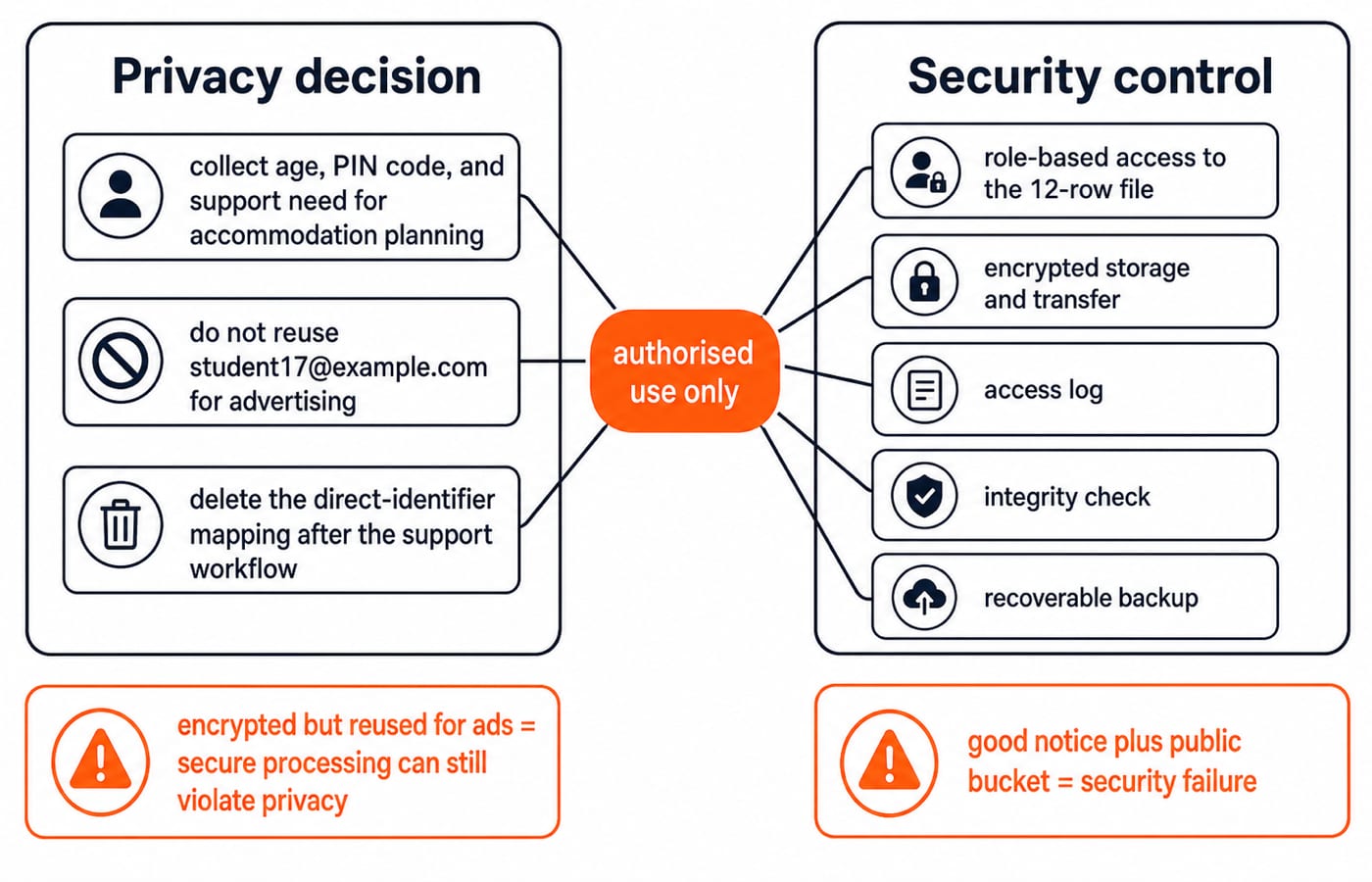
Data privacy governs collection purpose, necessary fields, permitted use and sharing, retention, and the data subject's control. Data security protects data against unauthorised disclosure, alteration, destruction, or loss of access.
An encrypted student database used for undisclosed advertising may be secure against outsiders but not privacy-respecting. A portal with a careful privacy notice but a publicly readable storage bucket has a security failure.
Privacy sets the permitted purpose and boundary. Security supplies controls that enforce it. They overlap without becoming interchangeable. For Indian legal duties, check the Digital Personal Data Protection Act, 2023 on India Code; purpose, consent and retention duties depend on the law, not on a security-control checklist.
Classify the data before choosing a control
Start by identifying what each value can reveal:
student17@example.comis a direct identifier because it directly points to an account or person.Age
23and PIN code110002are quasi-identifiers. Either may look harmless alone, but a combination can narrow the possible person.Screen readeris a sensitive support need.The 12-record support table is the dataset being protected.
Data is in transit while a CSV moves to an authorised reviewer, at rest while stored, and in use while the reviewer filters it. Encryption can protect transfer or storage, but an authorised process normally needs plaintext during use.
Collect only necessary fields, separate direct identifiers, grant least-privilege access, encrypt appropriate copies and transfers, log access, keep recoverable backups, and delete or aggregate data when its purpose ends.
Worked example: reduce re-identification risk in a 12-record release
Suppose a support-planning team removes the email column before releasing this hypothetical table. Age and PIN remain quasi-identifiers.
Row | Age | PIN | Support need |
|---|---|---|---|
R1 | 22 | 110001 | None |
R2 | 22 | 110001 | Extra time |
R3 | 23 | 110002 | None |
R4 | 23 | 110002 | Screen reader |
R5 | 24 | 110003 | Extra time |
R6 | 24 | 110003 | None |
R7 | 25 | 110004 | Screen reader |
R8 | 25 | 110004 | None |
R9 | 26 | 110011 | Extra time |
R10 | 26 | 110011 | None |
R11 | 27 | 110012 | Screen reader |
R12 | 27 | 110012 | None |
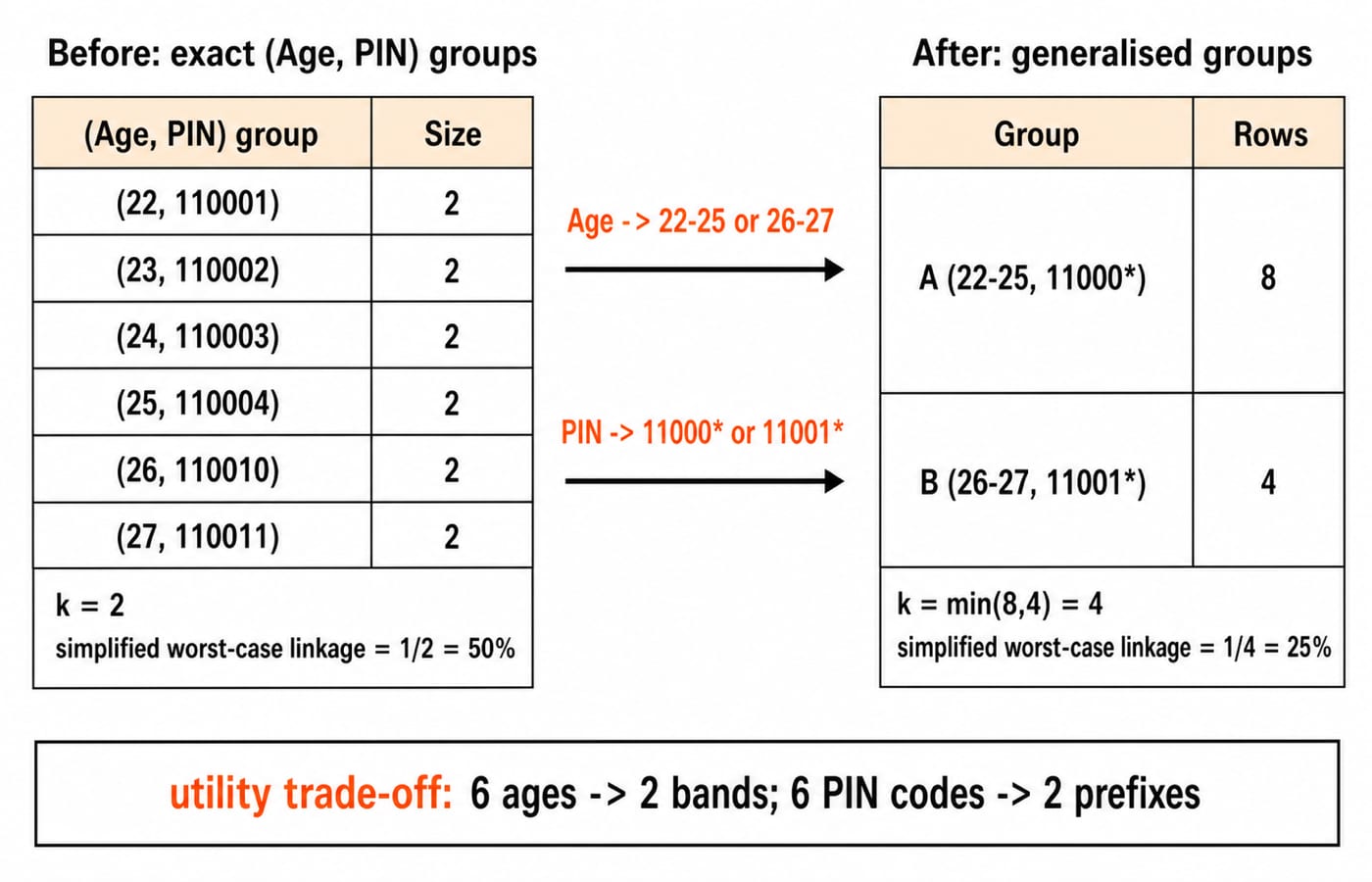
Group records by exact (Age, PIN). The pairs (22, 110001), (23, 110002), (24, 110003), (25, 110004), (26, 110011), and (27, 110012) each appear twice.
The smallest equivalence class has 2 records:
k = min(2, 2, 2, 2, 2, 2) = 2
Under a simplified equal-likelihood assumption, the worst-case record-linkage probability is:
1/k = 1/2 = 0.50 = 50%
Generalise ages 22-25 and 26-27 into two bands. Replace PINs 110001-110004 with 11000* and 110011-110012 with 11001*. The new classes contain R1 to R8 and R9 to R12, giving sizes 8 and 4.
k = min(8, 4) = 4
The simplified worst-case linkage probability becomes:
1/k = 1/4 = 0.25 = 25%
This costs utility: six exact ages become two bands and six exact PIN codes become two prefixes. K-anonymity reduces privacy risk. It is not encryption or a guarantee against every inference attack.
Map threats to confidentiality, integrity, availability and privacy
CIA classifies security objectives. Privacy also asks whether an authorised use stays within its permitted purpose.
Case | Property at risk | Matching control |
|---|---|---|
An attacker reads all 12 support rows | Confidentiality, with possible privacy harm | Access control and encryption |
A clerk changes R9's score from | Integrity | Authorisation, audit trails and integrity checks |
An outage blocks the portal for | Availability | Redundancy and tested recovery |
An authorised team reuses 12 email addresses for ads | Privacy purpose | Purpose limitation and data minimisation |
Network protections are one security layer. They do not decide whether collection or later use is permitted.
Common traps that turn correct definitions into wrong answers
Replacing student17@example.com with T017 is pseudonymisation if a separate lookup restores identity. The token remains personal data in this example. Deleting the lookup does not prove anonymity if age and PIN can still single out someone.
Keep these pairs separate:
Authentication asks who the user is. Authorisation asks what that user may do. Accountability records what was done.
Encryption is reversible with the right key. A cryptographic hash is designed as a one-way digest.
A backup supports recovery and availability, but does not by itself prevent disclosure.
First name the asset and permitted purpose. Identify the threat, classify the property at risk, then choose the control. Avoid absolutes such as "encrypted means private" or "consent makes every later use valid".
How exams turn the topic into questions
Expect definition matching, privacy-versus-security scenarios, CIA-to-control mapping, and small equivalence-class calculations such as k = min(8, 4) = 4. No fixed frequency is implied for any named exam.
For a 20-second scenario method:
Underline the action:
read,changed,unavailable, orreused.Identify whether the actor was authorised.
Check the stated purpose.
Select confidentiality, integrity, availability, privacy, or a combination.
Self-check: why is authorised advertising reuse a privacy problem rather than a confidentiality breach? Because the team had access, but the new purpose crossed the permitted-use boundary. No outsider needed to read the data.
Use the UGC NET Computer Science syllabus areas to place this subtopic in the wider Paper 2 map, then practise with the UGC NET complete CS test series.
The short version and what to study next
Privacy governs permitted collection and use.
Security protects data.
Confidentiality, integrity and availability classify security objectives.
Quasi-identifiers can re-identify records after names are removed.
One control never solves every risk.
Now change the smaller generalised class from 4 records to 3. The result is k = min(8, 3) = 3, and the simplified worst-case linkage probability is 1/3 = 0.333..., or about 33.3%. This variant shows why shrinking the smallest class increases linkage risk.
For topic prioritisation, read UGC NET Computer Science high-yield topics. Continue with the structured NTA UGC NET Paper 2 course, or explore the broader UGC NET category before choosing the next area to revise.
Go deeper with the full courseUGC NET Computer Science (Paper 1 + Paper 2)
Keep learning

Application and Data Security: Controls, Worked Examples and Exam Traps
Follow one refund request through transport, identity, policy, validation, database, and audit controls. Then work through toy RSA arithmetic and key exam traps.
Updated 20 Sep 20265 min readComputer Networks

IISc Administrative Assistant Email, Internet and Data Security: Office Workflows, Phishing and Safe Sharing
Build one practical model for email fields, web use, file permissions and account safety, then test it through an end-to-end office scenario and five drills.
Updated 30 Jul 20266 min readIISC Administrative Assistant

Society, Law and Ethics in ICT: Privacy, Cybercrime and Worked Examples
Learn to separate social, legal, ethical and security questions through worked ICT cases on access, privacy, phishing, intellectual property and e-waste.
Updated 11 Aug 20266 min readGATE Strategy & Roadmap
SCAN and C-SCAN Algorithms: Worked Example, Differences and Exam Traps
Solve the same eight-request queue with SCAN and C-SCAN, then learn how endpoints, direction, circular return, and service order change the answer.
Updated 14 Nov 20266 min readOperating Systems