CSMA/CD MCQs: 12 Solved Questions on Collision Detection, Frame Size and Backoff
Solve 12 CSMA/CD MCQs step by step, covering Ethernet collision handling, round-trip delay, minimum frame size, backoff probabilities and useful bandwidth.
KnowledgeGate Team
Exam prep & CS education
Updated 10 Aug 20267 min read57 views
CSMA/CD MCQs look repetitive until the wording quietly switches between one-way propagation delay, round-trip delay, bits, bytes, backoff slots and available-bandwidth fractions. One rule settles most of them: a station must still be transmitting when the worst-case collision gets back to it, so a frame has to occupy the wire for at least 2Tp. Attempt each question before reading its answer, and keep every length in bits until the last line, because the byte conversion is where most marks are lost. For the wider topic, work through the CSMA/CD learn-module hub.
1. CSMA/CD basics: carrier sensing, collision detection and the jam signal
In shared, half-duplex Ethernet, a station listens, transmits if idle, and keeps listening. After a collision, it sends a jam signal, stops, then backs off randomly. Full-duplex links do not use collision detection. See CS Fundamentals for Exams & Placements for the wider subject.
Q1. Collision signalling, ISRO 2016
A. Preamble
B. Postamble
C. Jam
D. None of the above
Answer: C. Jam
The preamble synchronises a receiver at the start of an ordinary frame. A station sends a jam signal after detecting a collision so that the shared collision domain notices it.
Q2. Propagation delay and protocol suitability, GATE 2005
Question: Which of the following statements is TRUE about CSMA/CD
A. IEEE 802.11 wireless LAN runs CSMA/CD protocol
B. Ethernet is not based on CSMA/CD protocol
C. CSMA/CD is not suitable for a high propagation delay network like satellite network
D. There is no contention in a CSMA/CD network
Answer: C. CSMA/CD is not suitable for a high propagation delay network like satellite network
The sender must still be transmitting when the worst-case collision returns. Large delay makes the required frame impractically long. Wireless LAN uses collision avoidance, shared Ethernet uses CSMA/CD, and CSMA/CD has contention, eliminating A, B and D.
Q3. Expanding the acronym, TPSC 2026
Question: In Ethernet, what does CSMA/CD stand for ?
A. Carrier Sense Multiple Access with Collision Detection
B. Circuit Switch Multiple Access with Collision Domain
C. Carrier Signal Multiple Amplitude with Collision Delay
D. Circuit Sense Multiple Amplitude with Collision Detection
Answer: A. Carrier Sense Multiple Access with Collision Detection
Carrier Sense means listening first, Multiple Access means sharing, and Collision Detection means monitoring while transmitting. The distractors use unrelated ideas such as circuit switching and amplitude.
2. Random access and contention: where CSMA/CD belongs
Random access lets stations contend. Controlled access assigns turns through polling or token passing. Channelisation partitions the resource, as TDMA does by time.
Q4. Random-access classification
Question: Which of the following is a random access protocol used in the Data Link Layer?
A. TDMA
B. CSMA/CD
C. Polling
D. Token Passing
Answer: B. CSMA/CD
CSMA/CD is random access because stations contend rather than receive fixed turns. TDMA is channelisation, while polling and token passing are controlled-access methods.
Q5. The familiar contention-based network, Bihar STET 2025
Question: Contention-based MAC protocols are commonly used in:
A. Ethernet networks
B. Token Ring networks
C. ATM networks
D. Point-to-Point networks
Answer: A. Ethernet networks
Classic shared Ethernet has one contention domain. Token Ring uses a token, ATM uses switched connections, and a point-to-point link has no competing group. This does not describe full-duplex switched Ethernet.
3. Minimum frame size: use round-trip delay
For rate R bits/s, distance d, and propagation speed v, Tp = d/v and the collision window is 2Tp. Therefore:
Lmin = R x 2Tp = 2Rd/v bits
Convert kilometres to metres for m/s. Divide by 8 only after finding bits.
Q6. Minimum frame over 200 m, GATE 2008
Question: The minimum frame size required for a CSMA/CD based computer network running at 1 Gbps on a 200m cable with a link speed of 2 × 10⁸m/s is
A. 125 bytes
B. 250 bytes
C. 500 bytes
D. None of these
Answer: B. 250 bytes
Tp = 200/(2 x 10^8) = 1 microsecond, so 2Tp = 2 microseconds. Thus 1 x 10^9 x 2 x 10^-6 = 2,000 bits = 250 bytes. Using one-way delay gives 125 bytes; doubling the round trip again gives 500 bytes.
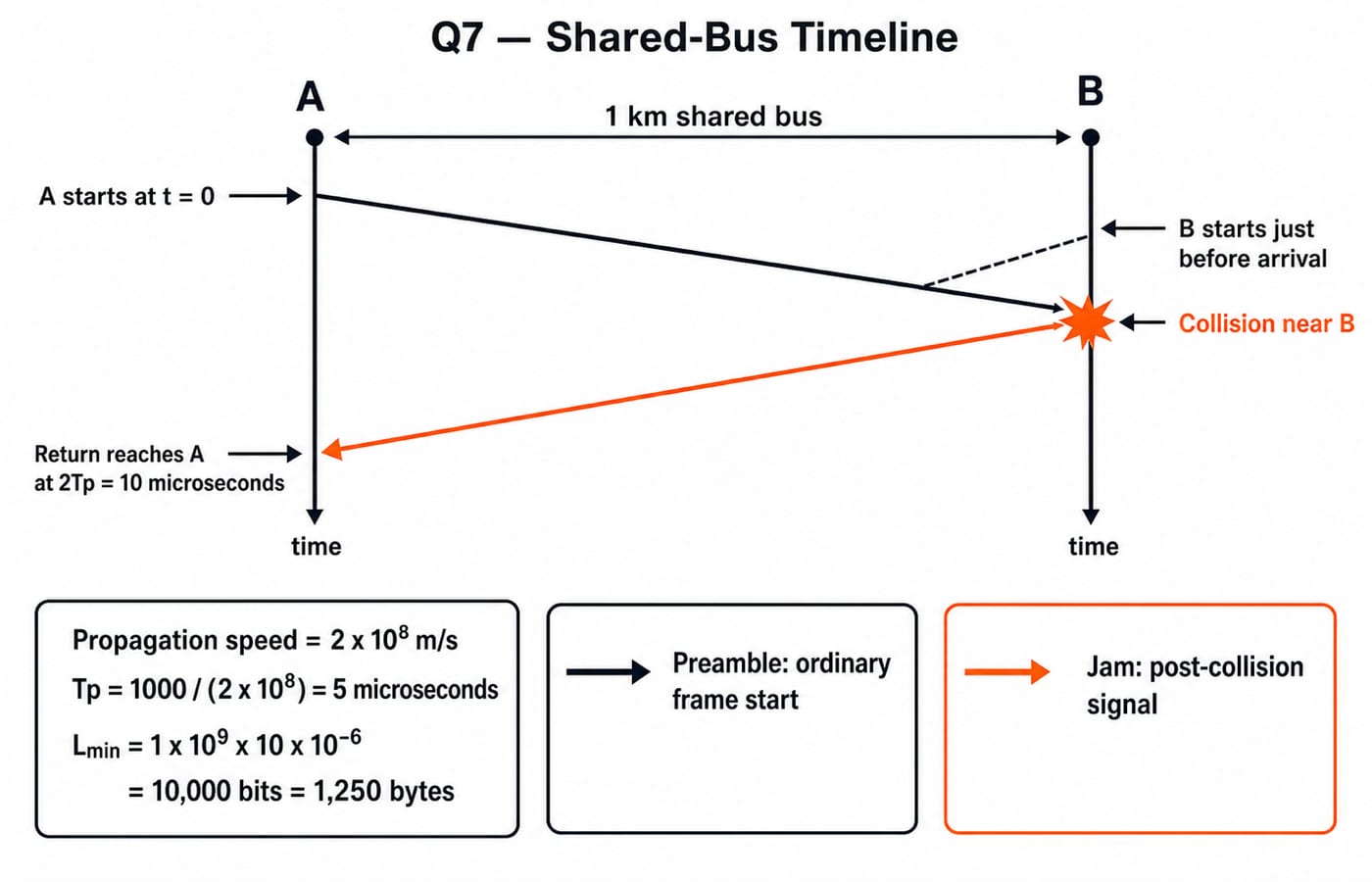
Q7. Minimum frame over 1 km, GATE 2005
Question: A network with CSMA/CD protocol in the MAC layer is running at 1 Gbps over a 1 km cable with no repeaters. The signal speed in the cable is 2 x 10⁸ m/sec. The minimum frame size for this network should be
A. 10000 bits
B. 10000 bytes
C. 5000 bits
D. 5000 bytes
Answer: A. 10000 bits
Convert 1 km to 1,000 m: Tp = 1000/(2 x 10^8) = 5 microseconds, so 2Tp = 10 microseconds. Then Lmin = 1 x 10^9 x 10 x 10^-6 = 10,000 bits = 1,250 bytes. Option A uses bits; 5,000 bits uses one-way delay, and 10,000 bytes is the unit trap.
4. Reverse calculations: recover speed or frame length
From L = 2Rd/v, obtain v = 2Rd/L. Keep L in bits and label any supplied time as one way or round trip.
Q8. Recover signal speed, UGC NET 2024
A. 8000
B. 16000
C. 12000
D. 20000
Answer: D. 20000
1,250 bytes = 10,000 bits, transmitted in 10,000/(100 x 10^6) = 100 microseconds. This is round-trip delay, so Tp = 50 microseconds. Thus v = 1 km/(50 x 10^-6 s) = 20,000 km/s; treating 100 microseconds as Tp halves the answer.
Q9. Propagation time is supplied, UGC NET 2025
A. 500 bits
B. 1000 bits
C. 1500 bits
D. 2000 bits
Answer: B. 1000 bits
The 25 microseconds is one-way, so 2Tp = 50 microseconds. Then Lmin = 20 x 10^6 x 50 x 10^-6 = 1,000 bits. A 500-bit frame covers one direction.
For another calculation-heavy Computer Networks set, continue with Subnetting MCQs: 12 Solved IP Addressing Questions.
5. Binary exponential backoff: windows and race probabilities
After collision i, the simplified uncapped model chooses from 0 through 2^i - 1 slots. Two stations at that stage tie with probability 1/2^i. Real implementations cap the growth, but these questions give no retry limits.
Q10. What changes after successive collisions?
Question: With each successive collision in CSMA/CD Protocol
A. Backoff time increases two times.
B. Collision probability increases exponentially
C. Collision probability decreases exponentially
D. Backoff time decreases exponentially.
Answer: C. Collision probability decreases exponentially
At stage i, 2^i of the 2^(2i) ordered slot pairs match. Collision probability is 1/2^i, giving 1/2, 1/4, 1/8 at stages 1, 2 and 3. The window doubles, but the random wait need not, so A is imprecise.
Q11. Unequal backoff stages after one station wins
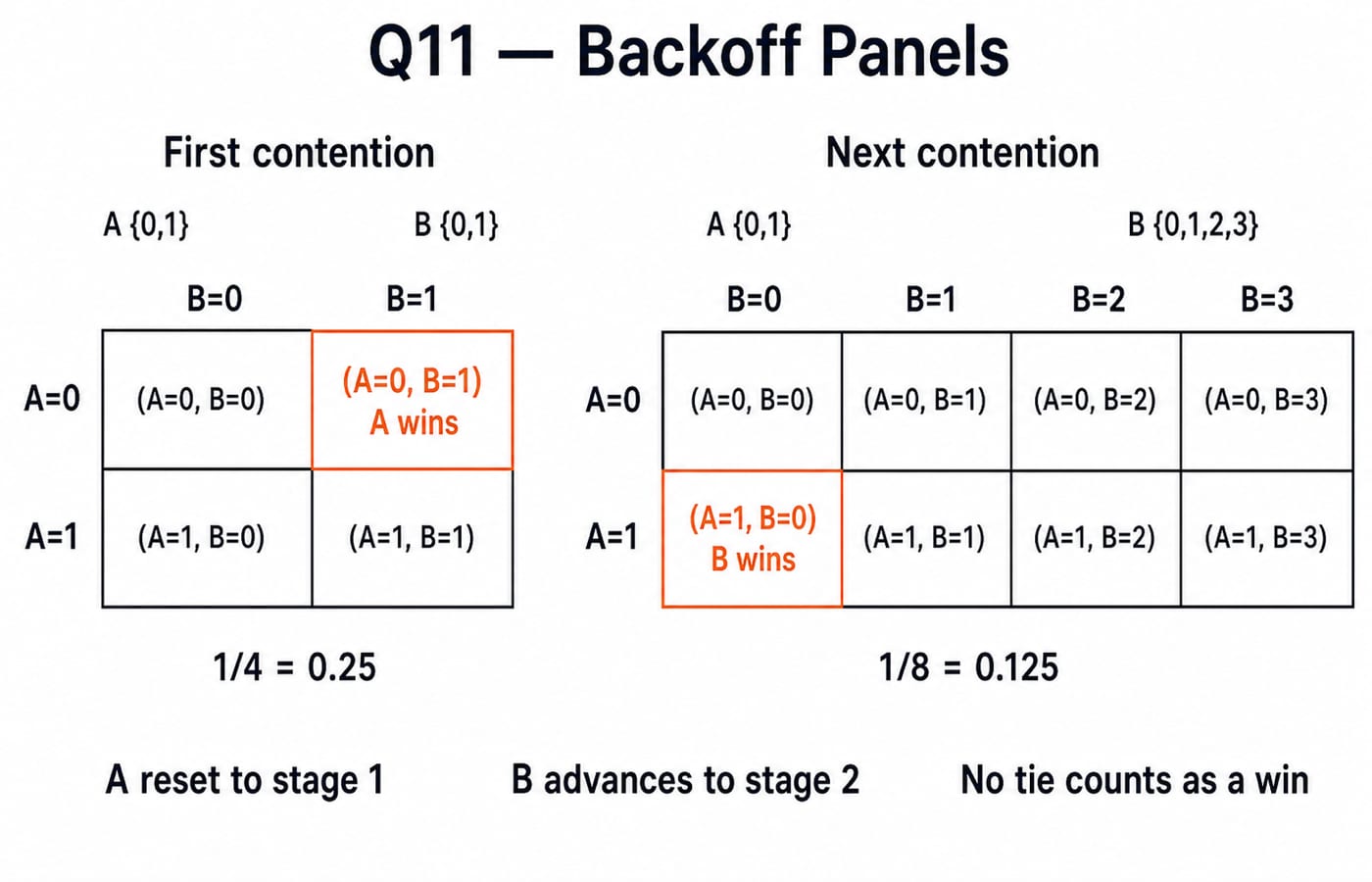
Question: Two stations A and B are transmitting over CSMA/CD. Both attempt to transmit but they collide and A wins the backoff race. Now again both attempt to transmit but they collide. This time B wins the backoff race. What is the probability with which both A and B wins their respective backoff races?
A. A - 0.5 and B – 0.625
B. A – 0.25 and B – 0.125
C. A – 0.75 and B – 0.25
D. A – 0.5 and B – 0.25
Answer: B. A – 0.25 and B – 0.125
Both first choose from {0,1}. Only (A=0, B=1) lets A win, with probability 1/4 = 0.25. A's success resets its count, so after the next collision A chooses {0,1} and B chooses {0,1,2,3}. Only (A=1, B=0) lets B win, with probability 1/8 = 0.125.
6. Available bandwidth under contention
When contention overhead is supplied, divide packet time by packet time plus contention time.
Q12. Payload time divided by payload plus contention time
Question: Suppose that ‘N’ Ethernet stations, all trying to send at the same time, require N / 2 slot times to sort out who transmits next. Assuming the average packet. Size is 5 slot times, express the available bandwidth as a function of N.
A. 5 / (N + 10)
B. 10 / N
C. 10 / (10 + N)
D. 10 / (5 + N)
Answer: C. 10 / (10 + N)
Useful time is 5 slots and contention is N/2, so the fraction is 5/(5 + N/2). Multiply both parts by 2 to get 10/(10 + N). At N=10, both forms give 1/2, confirming C.
7. How CSMA/CD is examined, and what to solve next
Identify mechanisms in Q1 to Q5, enforce Tframe >= 2Tp in Q6 to Q9, count backoff outcomes in Q10 and Q11, then form Q12's useful fraction.
Draw the timeline, mark Tp and 2Tp, keep L in bits, convert to bytes last, and list backoff sets before counting. Doubling Q6's cable from 200 m to 400 m doubles Tp from 1 to 2 microseconds, 2Tp from 2 to 4 microseconds, and the frame from 2,000 to 4,000 bits, or 250 to 500 bytes.
KnowledgeGate carries over 50 CSMA/CD questions. Continue with GATE Guidance by Sanchit Sir, or practise TCP and UDP MCQs: 12 Solved Transport Layer Questions next.
Keep learning
Computer Networks Basics & Criteria MCQs: 12 Solved Questions with Explanations
Solve 12 Computer Networks questions, then use clear explanations and worked criteria checks to separate similar terms confidently.
3 Oct 20268 min readComputer Networks MCQs
TCP Timers, RTT Estimation & SWS: 10 Solved MCQs and NATs
Solve 10 TCP exam questions covering timer roles, Silly Window Syndrome, recursive RTT estimates, Jacobson/Karels RTO and Karn's rule.
Updated 28 Sep 20267 min readComputer Networks MCQs

RSA Algorithm MCQs: 12 Solved Questions with Step-by-Step Explanations
Practise RSA key generation, modular inverses, encryption, signatures and defining equations, with concise working for conceptual and numerical answers.
25 Sep 20268 min readComputer Networks MCQs
Firewall, VPN, IDS and IPS MCQs: 11 Network Security Questions Solved
Solve 11 previous-year questions on firewalls, VPNs, IDS and IPS. Learn rule filtering, connection state, DMZ design, IPsec modes, tunnels and signatures.
Updated 24 Sep 20267 min readComputer Networks MCQs