

Circular and Grouping Permutations: 10 Questions with Solutions
Decide what counts as a different arrangement before choosing a factorial. Work through ten questions on circular seating, contiguous groups, repeated letters and separated groups, with each solution explained immediately.
KnowledgeGate Team
Exam prep & CS education
Updated 9 Nov 20267 min read
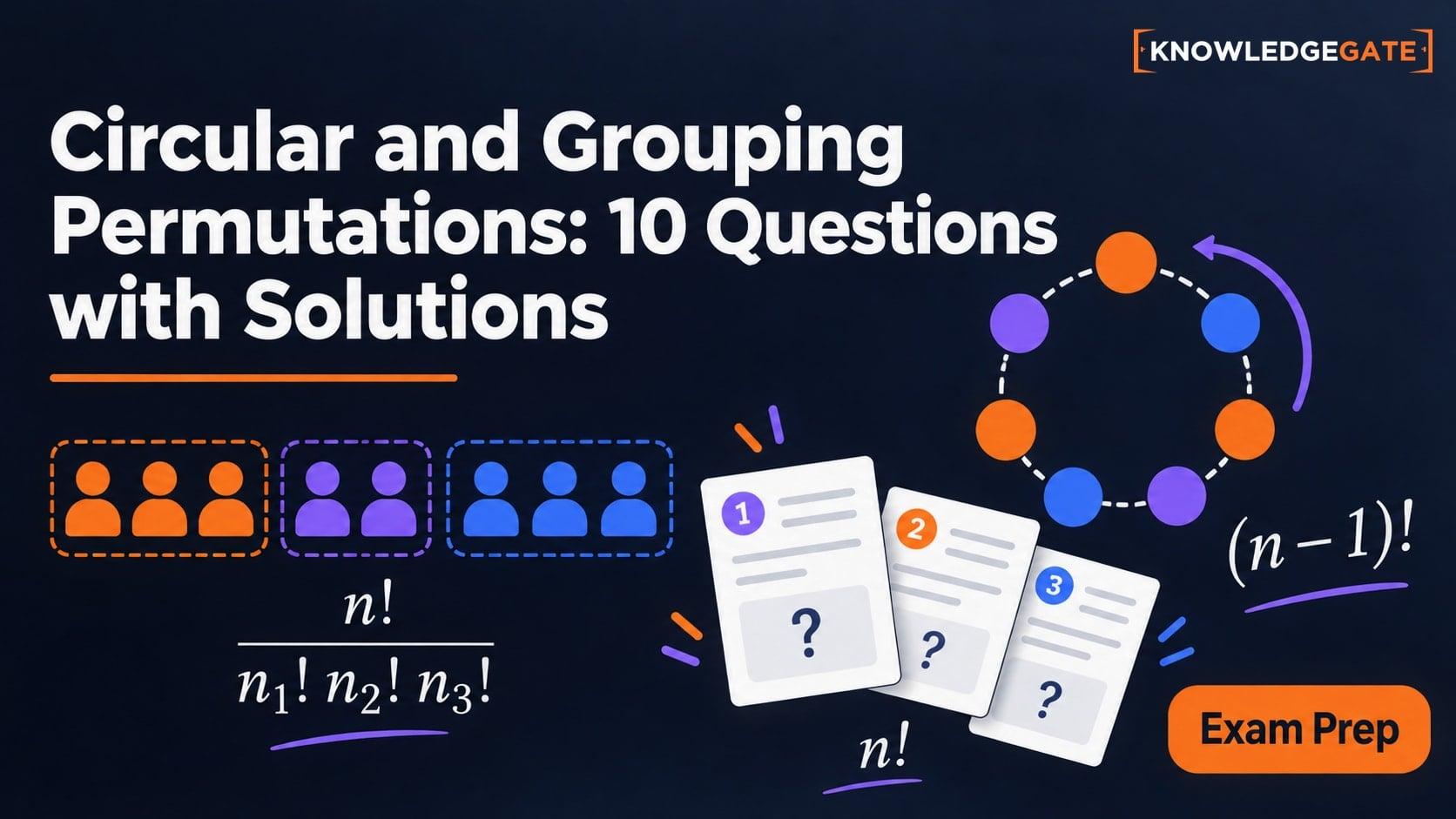
The difficult part of a permutation question is deciding which arrangements count as different before choosing a factorial. Placement preparation depends on choosing the right counting model for table rotations, contiguous groups, repeated vowels and circular gaps. Treat people and individual books as distinct unless repetition is explicit. Try each question before reading its solution, and write down what every factor counts: a correct number without a counting model is difficult to reproduce.
Choose the counting model before starting
Make three decisions: is the arrangement a row or a circle, must objects form blocks or occupy separated gaps, and are any objects identical?
Four people in a row have 4! = 24 orders. Around an unlabelled circular table, each seating appears four times among those orders, so there are 24 / 4 = 6 arrangements. Numbered chairs preserve all 24 assignments because changing a person's chair changes the seating.
Ordinary table seating identifies rotations but preserves reflections. Do not halve the result again. For k distinct blocks, the outside order contributes k! in a row and (k-1)! in a circle. Revise the circular-permutation formulas if that distinction needs another look.
Remove rotations, not mirror images
Q1. Four people at a table
How many different ways can 4 people be seated around a circular table ?
(a) 4!
(b) 3!
(c) 4
(d) 1
Answer: (b). Fix one person as the reference. The remaining three people can occupy the positions around that person in 3! = 3 x 2 x 1 = 6 ways.
Fixing a person removes the repeated rotations; it does not reserve a numbered chair. Counting 4! would treat rotated copies as new arrangements. Dividing by two would wrongly merge clockwise and anticlockwise orders.
Q2. Alex and his friends
In how many ways can Alex and his 5 friends be seated around a circular table if clockwise and anti-clockwise directions are considered different? (Infosys Hiring Test 2023; Cognizant GenC 2023; Tech Mahindra Hiring Assessment 2020)
(a) 120
(b) 720
(c) 60
(d) 360
Answer: (a). Alex plus five friends means six people. Fix Alex and arrange the five friends: (6-1)! = 5! = 5 x 4 x 3 x 2 x 1 = 120 ways.
The explicit direction condition rules out 60, which incorrectly merges mirror images. The total 720 counts six rotated copies of each seating. Revisit Alex and five friends: solved circular seating after attempting it yourself.
Keep each group together on a line
Q3. Books grouped by subject
3 books of mathematics and 5 books of physics are placed on a shelf so that the books of the same subject always remain together. In how many ways can this be done? (Tech Mahindra Hiring Assessment 2024)
(a) 1440
(b) 1956
(c) 720
(d) None of these
Answer: (a). Treat the individual books as distinct. Make one mathematics block M and one physics block P. The shelf permits MP or PM, giving 2! block orders.
Within M, the books have 3! orders; within P, they have 5! orders. Therefore, the total is 2! x 3! x 5! = 2 x 6 x 120 = 1,440.
The answer 720 misses the choice of which subject comes first. Use same-subject books: solved block arrangement to check the two counting stages.
Q4. Nationality groups in a row
In how many ways can 8 Indians, 4 Americans and 4 Englishmen be seated in a row such that all persons of the same nationality sit together?
(a) 3!x4!x8!x4!
(b) 3!x8!
(c) 4!x4!
(d) 8!x4!x4!
Answer: (a). Three nationality blocks have 3! outside orders. Their internal arrangements contribute 8!, 4! and 4!, respectively.
Multiply: 3! x 8! x 4! x 4! = 6 x 40,320 x 24 x 24 = 139,345,920.
The two groups of four are different groups containing distinct people. Equal group sizes do not justify dividing by 2!. Option (d) leaves the nationality-block order fixed and therefore misses a factor of six.
Turn vowels into a block
Q5. Vowels together in MANISH
Arrange the word " MANISH " if vowels come together.
(a) 260
(b) 230
(c) 240
(d) 250
Answer: (c). The vowels A and I must be adjacent. Replace them temporarily with one block V. The outside objects are V, M, N, S and H: five distinct objects with 5! orders.
The block has two internal orders, AI and IA. Thus, 5! x 2! = 120 x 2 = 240 arrangements. Spaces and quotation marks are not letters of the word.
A block keeps its members together without fixing their order. Forgetting the internal factor would count only half the valid words.
Q6. Vowels together in LEADING
In how many different ways can the letters of the word "LEADING " be arranged in such a way that vowels always come together .
(a) 750
(b) 720
(c) 600
(d) 650
Answer: (b). The seven letters contain three vowels, E, A and I. Their block joins L, D, N and G to make five outside objects.
Arrange those objects in 5! ways, then arrange the vowels within their block in 3! ways. The total is 5! x 3! = 120 x 6 = 720.
Compare this with MANISH: both have five outside objects, but LEADING has six internal vowel orders instead of two.
Correct for repeated letters in COORDINATION
Q7. A vowel block with repetitions
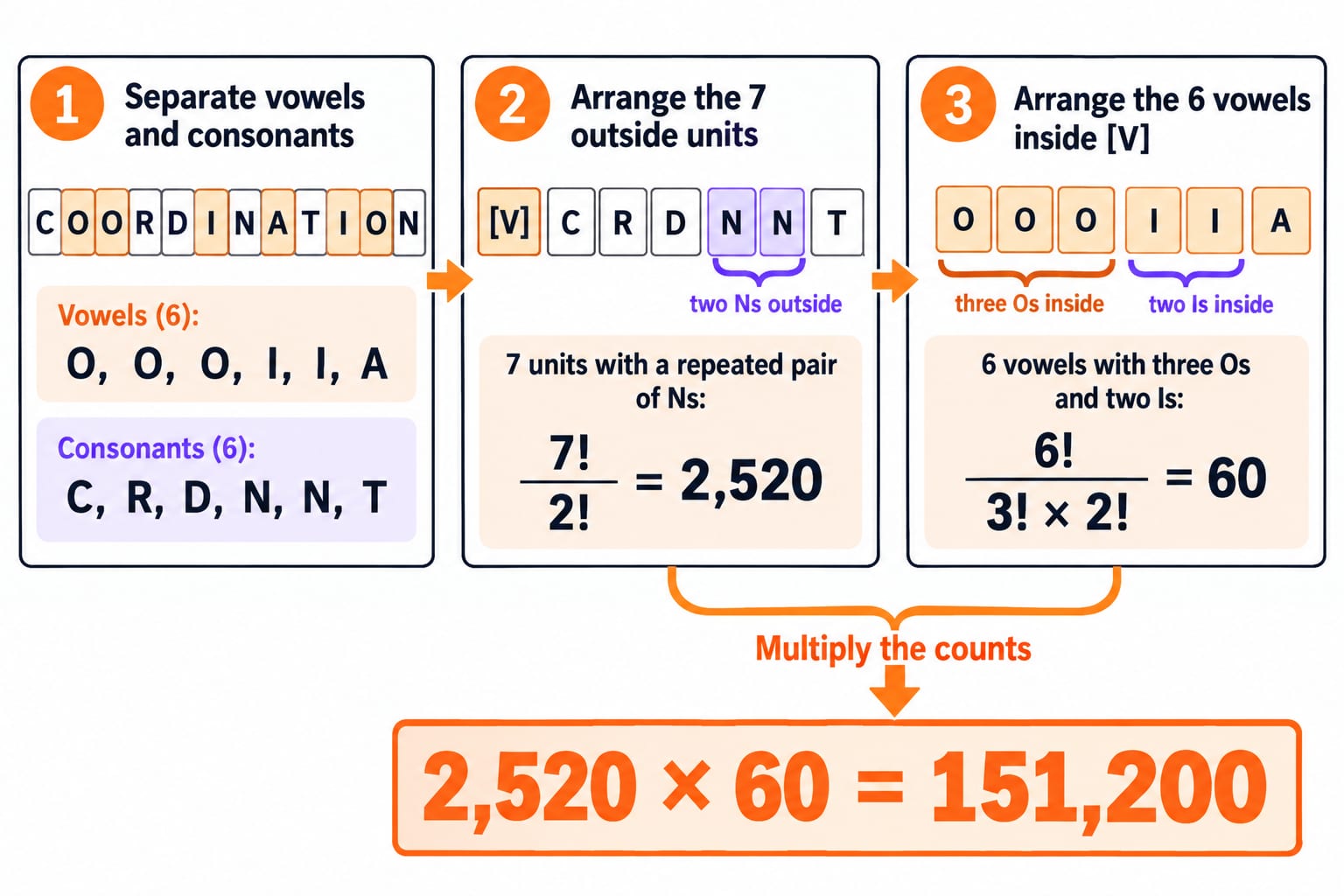
In how many different ways can the letters of the word 'COORDINATION' be arranged so that the vowels always come together? (Tech Mahindra Hiring Assessment 2023)
(a) 50400
(b) 96300
(c) 151200
(d) 148600
Answer: (c). First inventory the letters. The vowels are O, O, O, I, I, A. The consonants are C, R, D, N, N, T.
One vowel block plus six consonants gives seven outside units. The two Ns are identical, so the outside count is 7!/2! = 5,040/2 = 2,520.
Inside the block, correct separately for three Os and two Is: 6!/(3! x 2!) = 720/(6 x 2) = 60. Multiply the independent counts: 2,520 x 60 = 151,200.
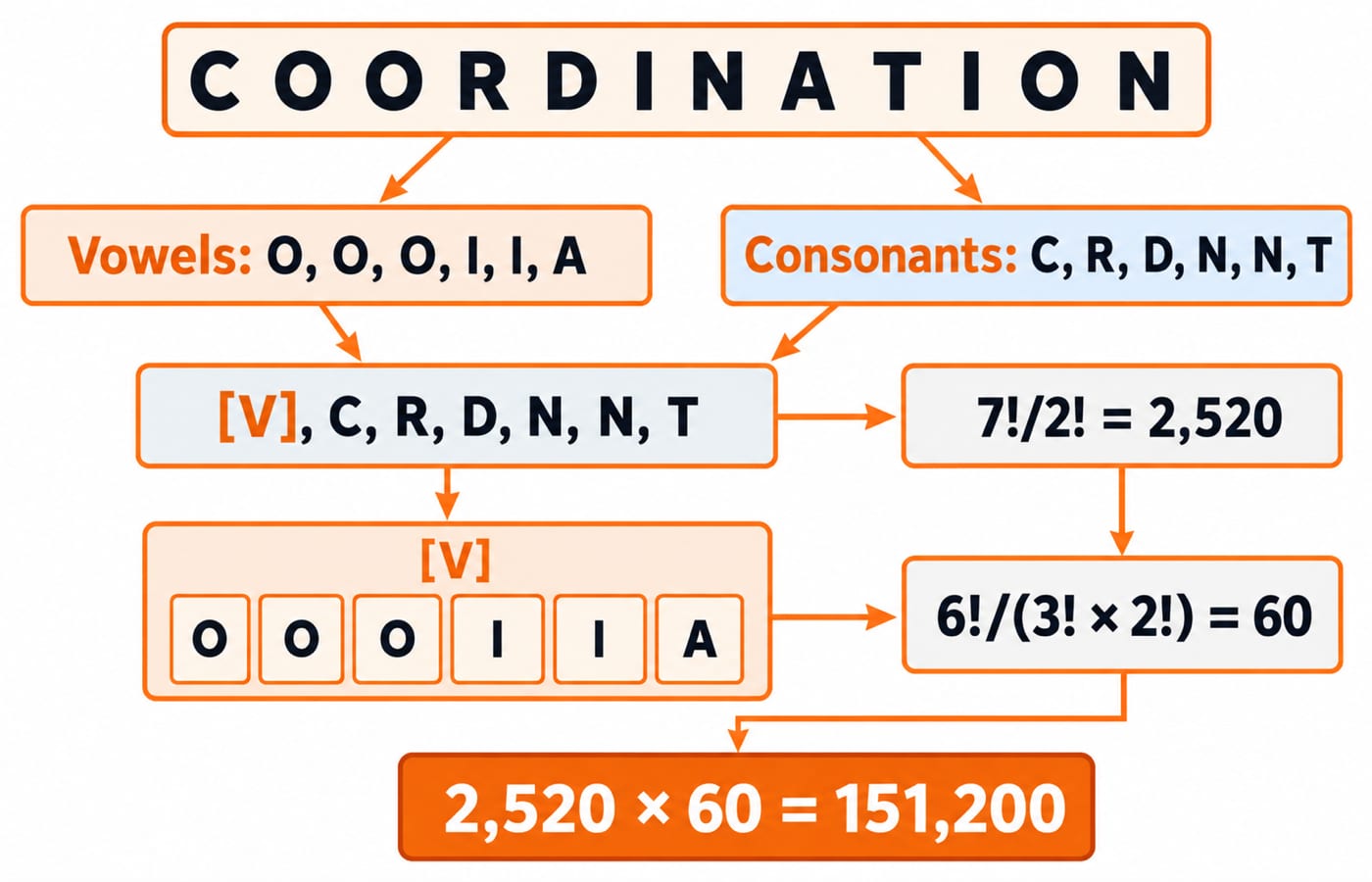
Both repetition corrections matter. Recheck the inventory through COORDINATION: solved repeated-letter example.
Use circular gaps for alternating and separated groups
Q8. Alternating girls and boys
In how many different ways can 6 girls and 6 boys form a circle such that the boys and the girls alternate? (Infosys Hiring Test 2025)
(a) 14400
(b) 36280
(c) 518400
(d) 86400
Answer: (d). Arrange the six boys around the circle in (6-1)! = 120 ways. There are exactly six gaps between consecutive boys, including the gap closing the circle.
Put one girl in each gap in 6! = 720 ways. Total: 120 x 720 = 86,400. Do not multiply by two for which gender starts: an unlabelled circle has no starting seat. See six boys and six girls: solved alternating circle.
Q9. Separate the consultants
There are 5 clients and 5 consultants at a round table meeting. In how many ways can the 5 clients and 5 consultants be seated around the table so that no two consultants sit next to each other?
(a) 5! x 6!
(b) 4! x 4!
(c) 4! x 5!
(d) 9!
Answer: (c). Arrange the clients first in (5-1)! = 4! = 24 ways. Their circle has five gaps. Each gap must receive exactly one consultant, giving 5! = 120 assignments.
Hence, 4! x 5! = 24 x 120 = 2,880. Five objects in a line have six gaps, but closing the line into a circle joins the two end gaps.
Q10. Separate five women among seven men
There are 7 men and 5 women sitting around a circular table. Find the number of ways in which they can be seated so that no two women sit together.
(a) P(7, 5)
(b) P(7, 5) x 6!
(c) P(7, 5) / 6!
(d) None of these
Answer: (b). Arrange the seven men in 6! = 720 circular orders. Choose five of their seven gaps, then arrange the women: C(7,5) x 5! = 21 x 120 = 2,520 = P(7, 5).
Multiply: 720 x 2,520 = 1,814,400. Two gaps remain unused, so separation does not require strict alternation. For related practice, use the permutation-and-combination module.
Diagnose the missing factor, then practise again
Answer check: Q1 (b), 6; Q2 (a), 120; Q3 (a), 1,440; Q4 (a), 139,345,920; Q5 (c), 240; Q6 (b), 720; Q7 (c), 151,200; Q8 (d), 86,400; Q9 (c), 2,880; Q10 (b), 1,814,400.
For each mistake, name the missing factor: rotational correction, block order, internal permutations, repeated-letter divisor or choice of gaps. Cover the solutions and redo only the missed questions. Explain each factor aloud before multiplying; this catches more errors than memorising the final product.
Return to the counting method if choosing versus arranging still causes confusion. For structured practice across aptitude topics, continue with the Aptitude Course for Placement.
Go deeper with the full courseDiscrete Mathematics
Keep learning

Circular Permutations: Formulas and Shortcuts for Seating Problems
Learn how to choose the right circular permutation model, derive each formula, and solve together, apart, alternating, opposite, and fixed-gap cases.
Updated 8 Sep 20265 min read74 viewsAptitude & Reasoning
Basic Concepts & Counting Principles Questions with Solutions: 10 Worked MCQs
Decide what to count before choosing a formula. These ten worked MCQs explain repetition, unordered groups, restricted positions and disjoint cases, with the common mistake behind each model.
Updated 8 Nov 20267 min readDiscrete Mathematics MCQs
Advanced Counting Theorems Questions with Solutions: 10 Worked Problems
Choose the counting model before reaching for a formula. Solve six MCQs and four numerical-answer questions, with worked explanations of overlaps, initial conditions and identical objects.
Updated 6 Nov 20268 min readDiscrete Mathematics MCQs
Concept of Remainders Questions with Solutions: 10 Worked MCQs
Try ten remainder questions, then follow each calculation to check your method. Learn when a divisor can change, how quotient conditions combine, and why huge powers need only small residues.
Updated 4 Nov 20267 min readDiscrete Mathematics MCQs