

Basic Concepts & Counting Principles Questions with Solutions: 10 Worked MCQs
Decide what to count before choosing a formula. These ten worked MCQs explain repetition, unordered groups, restricted positions and disjoint cases, with the common mistake behind each model.
KnowledgeGate Team
Exam prep & CS education
Updated 8 Nov 20267 min read
Counting questions become confusing when you cannot decide whether to add, multiply, select or arrange. These ten counting MCQs support your placement preparation with worked calculations and explanations of common wrong approaches. Attempt each question before reading its answer, and write down what one complete outcome looks like: a number, a group, an arrangement or a choice of questions. That small step helps you choose the correct counting rule instead of matching a familiar formula to a few numbers.
1. Decide what one outcome means before choosing a formula
An ordered code changes when its symbols exchange positions: ABC and BAC are different codes. An unordered group does not change when you list its members differently. This distinction decides whether arrangement or selection is required.
Use the product rule for successive choices that together form one outcome. One of 3 shirts and one of 2 trousers gives 3 x 2 = 6 outfits. Use addition for disjoint alternatives: choosing one drink from 3 teas or 2 coffees gives 3 + 2 = 5 options, assuming all drinks are distinct.
For distinct items without repetition, nPr = n!/(n - r)! counts ordered choices, while nCr = n!/[r!(n - r)!] counts unordered selections. The extra r! removes repeated orders of the same group. For concept revision, revisit the permutations and combinations counting method, then identify the outcome in each question below.
2. Count ordered positions with and without repetition
Q1. Three-letter initials
How many symbols must an alphabet contain to form exactly 1 million possible distinct three-letter initials, assuming repetition is allowed?
(a) 140
(b) 1000
(c) 10
(d) 100
Answer: (d) 100. Let the alphabet contain n symbols. An initial has three ordered positions, and each position can use any of the n symbols. Repetition means that using a symbol does not remove it from later choices.
Therefore, n x n x n = 1,000,000. Taking the cube root gives n = 100, since 100 x 100 x 100 = 1,000,000.
The question asks for the alphabet size, not the number of initials. An alphabet of 10 symbols would give only 10^3 = 1000 initials. Dividing a million by three would also be wrong: position counts multiply, they do not add.
Q2. Four-digit numbers without repetition
How many 4 digit numbers can be made by using 1, 2, 3, 4, 5, 6 & 7. Repetition is not allowed
(a) 42
(b) 4 !
(c) 840
(d) 8 !
Answer: (c) 840. Fill the four positions from left to right. Their choice counts are 7, 6, 5 and 4 because each used digit becomes unavailable.
The count is 7 x 6 x 5 x 4 = 42 x 20 = 840. None of the available digits is zero, so every permitted first digit creates a four-digit number.
Choosing four digits alone misses their arrangements. Conversely, 4! arranges only one already chosen set of four digits; it does not account for all possible sets.
3. Handle forbidden digits and neighbouring colours
Q3. Excluding two digits
Find the total number of 4-digit numbers that do not contain the digit 3 or 6 (that is, numbers in which neither 3 nor 6 appears in any place).
(a) 2700
(b) 3700
(c) 3584
(d) 3784
Answer: (c) 3584. The allowed digits are {0, 1, 2, 4, 5, 7, 8, 9}. There are eight, but zero cannot occupy the thousands position. That position therefore has seven choices.
Each remaining position has eight choices because the question does not prohibit repetition. Thus the count is 7 x 8^3 = 7 x 512 = 3584.
Using 8^4 would include strings beginning with zero. As a check, subtract those strings: 8^4 - 8^3 = 4096 - 512 = 3584. The solved question on excluding digits is useful for revisiting this first-position restriction.
Q4. Adjacent strips must differ
A new political party flag has six vertical strips. Each strip uses yellow, green, blue or red, and adjacent strips must differ. How many such flags can be made?
(a) 1024
(b) 812
(c) 972
(d) 1260
Answer: (c) 972. The first strip has four choices. Each of the next five strips has three choices, since only the immediately preceding colour is forbidden.
Multiply: 4 x 3^5 = 4 x 243 = 972.
A colour can return after a different colour. Yellow, green, yellow is permitted, so this is not a problem where every used colour is removed. Also, "some or all" means you need not force all four colours to appear. Count the positions using the stated neighbour restriction only.
4. Select groups without counting their orders
Q5. Choosing ships
A navy admiral must choose 3 ships from a fleet of 8 destroyers. In how many ways can this be done?
(a) 120
(b) 48
(c) 56
(d) 336
Answer: (c) 56. The outcome is a set of three ships, with no assigned positions or roles. Use C(8,3) = (8 x 7 x 6)/(3 x 2 x 1) = 336/6 = 56.
The distractor 336 counts ordered selections. Each chosen set appears in 3! = 6 different orders, although all six describe the same three ships. Dividing by six removes that overcount.
Q6. Choosing men and women
In how many ways can a group of 6 men and 3 women be made out of a total of 8 men and 5 women ?
(a) 406
(b) 154
(c) 308
(d) 280
Answer: (d) 280. Choose the men in C(8,6) = C(8,2) = (8 x 7)/2 = 28 ways. Choose the women in C(5,3) = (5 x 4 x 3)/(3 x 2 x 1) = 10 ways.
Each selection of men can accompany every selection of women. Both are required, so the total is 28 x 10 = 280.
Adding 28 and 10 counts alternatives from separate categories, not complete groups containing both. Choosing any nine people from thirteen would also ignore the required composition.
Q7. Comparing pairs of columns
A content manager is checking an Excel sheet with six columns, A through F. She compares two columns at a time to find duplicate entries. How many pairwise comparisons are needed to check every pair?
(a) 7
(b) 8
(c) 15
(d) 10
Answer: (c) 15. Each unordered pair needs one comparison. Comparing A with B is the same check as comparing B with A.
Hence C(6,2) = (6 x 5)/2 = 15. Alternatively, compare each column with those after it: 5 + 4 + 3 + 2 + 1 = 15. This is the total number of comparisons; "repeat" does not mean subtracting an initial check.
5. Arrange letter blocks and constrained end positions
Q8. Keep the vowels together
In how many different ways can the letters of LEADING be arranged so that the vowels always come together?
(a) 548
(b) 689
(c) 720
(d) 786
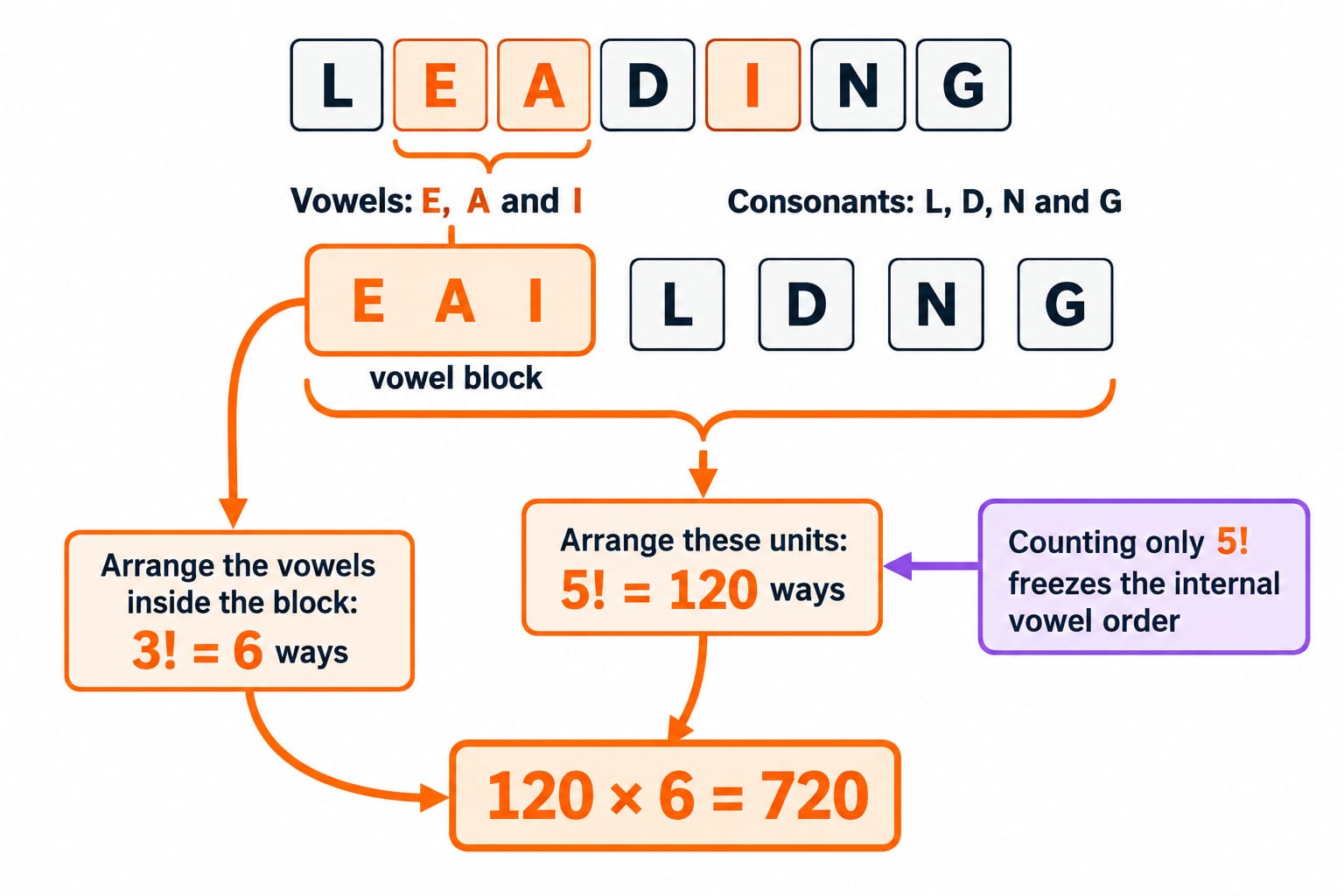
Answer: (c) 720. The vowels are E, A and I; the consonants are L, D, N and G. Treat the three vowels as one block. You now have five distinct units: the vowel block and four consonants.
Arrange these units in 5! = 120 ways. Within the block, arrange the vowels in 3! = 6 ways. The full count is 120 x 6 = 720.
Counting only 5! freezes the internal vowel order, even though EAI and AEI produce different arrangements. Review the LEADING vowel-block solution when you need to separate these two levels of arrangement.
Q9. Fix the end letters
In how many ways can the letters of the word OMEGA be arranged so that O and A occupy the end places?
(a) 24
(b) 6
(c) 12
(d) 120
Answer: (c) 12. The two ends can be O...A or A...O, giving 2! = 2 orders. The middle positions contain M, E and G, which can be arranged in 3! = 6 orders.
Multiply the independent choices: 2 x 6 = 12. The condition fixes which letters occupy the ends, not which letter is on the left. Answer 6 misses the reversed end order; 120 counts every arrangement without enforcing the restriction.
6. Add disjoint cases for an "at least" condition
Q10. Choose at least four from the first five
A student must answer 10 of 13 examination questions, choosing at least 4 from the first 5. How many choices are available?
(a) 280
(b) 140
(c) 346
(d) 196
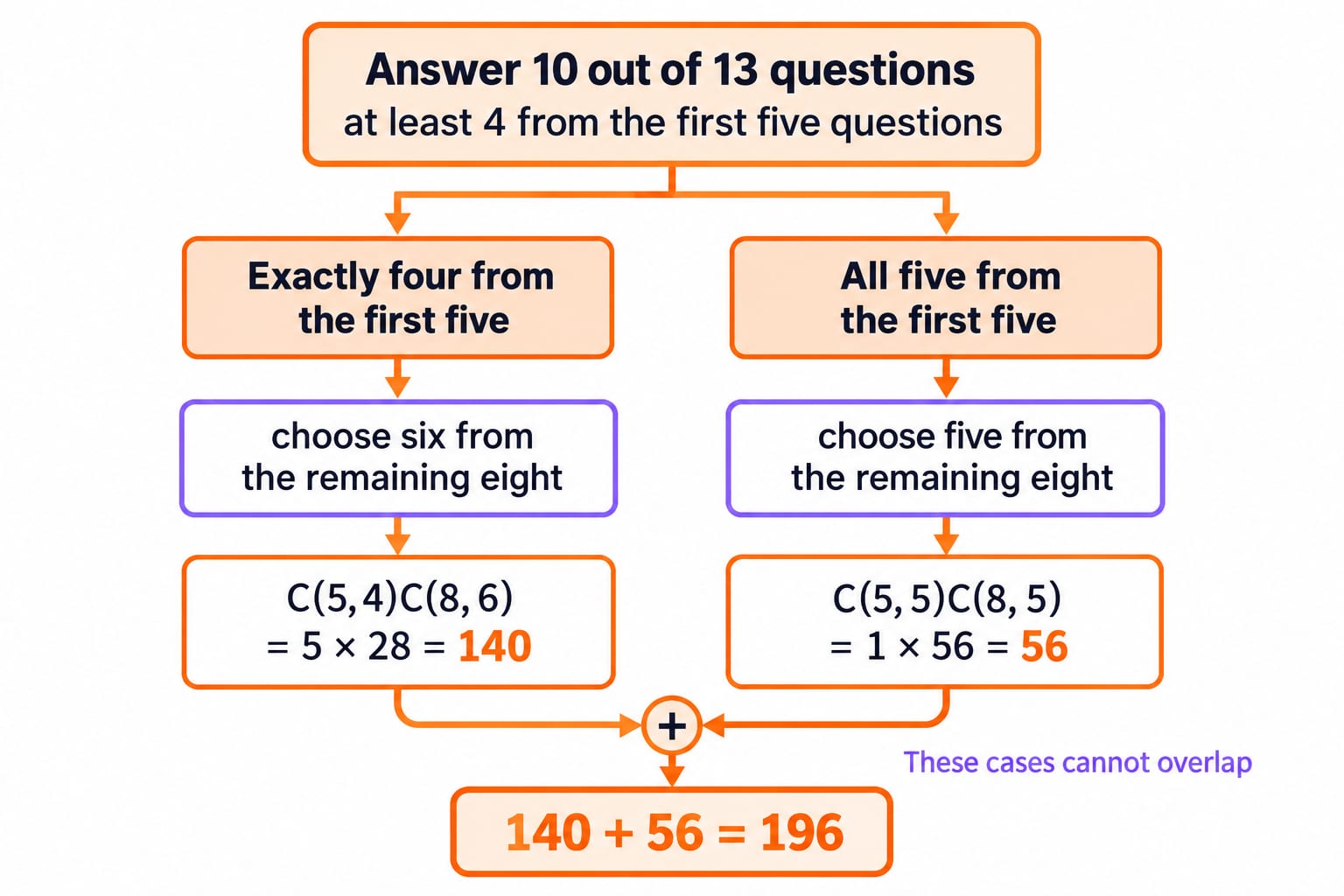
Answer: (d) 196. There are eight questions outside the first five. Split the selection into two cases:
Exactly four from the first five: choose six from the remaining eight. C(5,4)C(8,6) = 5 x 28 = 140.
All five from the first five: choose five from the remaining eight. C(5,5)C(8,5) = 1 x 56 = 56.
These cases cannot overlap, so add 140 + 56 = 196. Answer 140 forgets that "at least four" includes five. C(13,10) would ignore the restriction entirely. Revisit the worked solution for the at-least-four condition to practise identifying complete, disjoint cases.
7. Check your counting model and choose the next practice step
Before calculating, ask: does order matter, can an item repeat, and are the cases disjoint? Then check the special restriction. Q3 excludes a leading zero, Q8 needs internal block arrangements, and Q10 includes the five-question case.
For first-principles practice, use the order, repetition, restriction and case-split questions here. The earlier advanced counting set handles pigeonhole, recurrences and generating functions, while the earlier combinations set focuses on restricted selections and repetition. Choose those pages when that is the specific model you need to practise.
Retry missed questions without reading the solutions. Record the modelling error beside each answer, such as "counted orders of a group" or "missed a case".
Practise more questions on Basic Concepts & Counting Principles in the placement question bank. For guided aptitude practice beyond these examples, explore the Aptitude Course for Placement.
Go deeper with the full courseDiscrete Mathematics
Keep learning
Advanced Counting Theorems Questions with Solutions: 10 Worked Problems
Choose the counting model before reaching for a formula. Solve six MCQs and four numerical-answer questions, with worked explanations of overlaps, initial conditions and identical objects.
Updated 6 Nov 20268 min readDiscrete Mathematics MCQs

Bijective Function MCQs: 10 Solved Questions on Definition, Counting and Properties
Solve 10 bijective-function MCQs with collision checks, range analysis, composition logic and permutation counting, each followed by a worked explanation.
Updated 30 Oct 20267 min readDiscrete Mathematics MCQs
Number of Graphs MCQs: 10 Solved Questions on Simple, Undirected, Labeled and Unlabeled Graphs
Practise ten published graph-counting questions with fresh solutions. Learn when to count edge slots, labeled graph subsets, unlabeled shapes, cycles, grid edges and paths.
Updated 25 Aug 20267 min readDiscrete Mathematics MCQs
Circular and Grouping Permutations: 10 Questions with Solutions
Decide what counts as a different arrangement before choosing a factorial. Work through ten questions on circular seating, contiguous groups, repeated letters and separated groups, with each solution explained immediately.
Updated 9 Nov 20267 min readDiscrete Mathematics MCQs