

Basic Concepts and Classification of Numbers: 10 Questions with Solutions
Can an odd number be composite, and can a negative number be real? Work through ten number-classification questions with clear definitions, counterexamples and exact calculations.
KnowledgeGate Team
Exam prep & CS education
Updated 3 Nov 20267 min read
Number-classification questions become confusing when you expect each number to fit only one label: 2 is natural, whole, integer, rational and real at the same time. Other traps are just as simple: an odd number can be composite, and a recurring decimal is rational even though its digits never end. These ten MCQs have short worked solutions; attempt each one and write your reason before reading the answer. If you are building a broader aptitude foundation, placement preparation offers an optional learning path alongside this practice.
1. Prime or composite? Start with definitions
A prime is an integer greater than 1 with exactly two positive divisors. A composite is an integer greater than 1 with more than two positive divisors. Neither 0 nor 1 is prime or composite. Notice that the definitions count divisors, not whether the number looks odd or even.
Q1
The smallest prime number is
(a) zero / शून्य
(b) one / एक
(c) two / दो
(d) three / तीन
Answer: (c), two. Zero fails the requirement of being greater than 1. The number 1 has only one positive divisor, itself. The positive divisors of 2 are exactly 1 and 2, so it is prime. Three is also prime, but it is larger than 2.
Also, 2 is the only even prime. Every even integer greater than 2 has 1, 2 and itself as distinct positive divisors, making it composite.
Q2
How many prime numbers are less than 25
(a) 5
(b) 7
(c) 8
(d) 9
Answer: (d), 9. List the primes in order:
2, 3, 5, 7, 11, 13, 17, 19, 23.
Counting gives nine. Exclude 1, and check the tempting odd candidates: 9 = 3 x 3, 15 = 3 x 5 and 21 = 3 x 7 are composite. The phrase "less than 25" excludes 25, which is composite anyway because 25 = 5 x 5.
Q3
Which of the following statements about prime and composite numbers is correct?
(a) The sum of two prime numbers is always a prime number.
(b) A composite number can be odd.
(c) The smallest prime number is 1.
(d) There is no even prime number.
Answer: (b). The number 9 = 3 x 3 is odd and composite. Option (a) fails because 3 + 5 = 8, a composite number. Option (c) fails because 1 has only one positive divisor, and option (d) fails because 2 is even and prime. One counterexample is enough to disprove an "always" statement.
2. Use divisibility to test three prime candidates
Q4
If a, a + 2, and a + 4 are all prime numbers, how many possible values can a take?
(a) Three
(b) Two
(c) More than three
(d) One
Answer: (d), One. Among these three numbers, exactly one is divisible by 3. To see why, consider the remainder of a when divided by 3: if it is 0, a is divisible; if it is 1, a + 2 is divisible; if it is 2, a + 4 is divisible.
If a > 3, the divisible term exceeds 3 and is composite. Since a must itself be prime, only the remaining candidates 2 and 3 need checking:
a = 2 gives (2, 4, 6), which fails.
a = 3 gives (3, 5, 7), which works.
Thus the value is 3, but the number of possible values is 1. For more practice with these tests, read divisibility rules and worked examples.
3. Check what integer operations actually preserve
Q5
Which one of the following statements is not true for integers?
(a) Multiplication is associative.
(b) Division is commutative.
(c) 1 is the multiplicative identity.
(d) Subtraction is not commutative.
Answer: (b). Commutativity means that exchanging the operands leaves the answer unchanged. Division fails this test: 6 / 3 = 2, whereas 3 / 6 = 1/2.
Check the other statements separately:
Associativity concerns grouping: (2 x 3) x 4 = 6 x 4 = 24, and 2 x (3 x 4) = 2 x 12 = 24.
Multiplicative identity means multiplying by 1 preserves the number: (-5) x 1 = -5.
Subtraction is not commutative: 5 - 2 = 3, while 2 - 5 = -3.
Closure is a separate property: the result must stay within the same set. Integers are not closed under division, as 3 / 6 = 1/2 shows. Division by zero is undefined. Read "not true" carefully before choosing an option.
4. Rational numbers include zero and recurring decimals
A rational number can be written as p/q, where p and q are integers and q != 0. The denominator restriction is essential; the numerator is allowed to be zero.
Q6
A student listed the following properties of Rational Numbers. Which one/ones is/are correct?
(i) All integers are rational numbers.
(ii) 0 (zero) is not a rational number.
(iii) All fractions are rational numbers.
Choose the correct option:
(a) (i) and (iii)
(b) Only (ii)
(c) Only (iii)
(d) (i) and (ii)
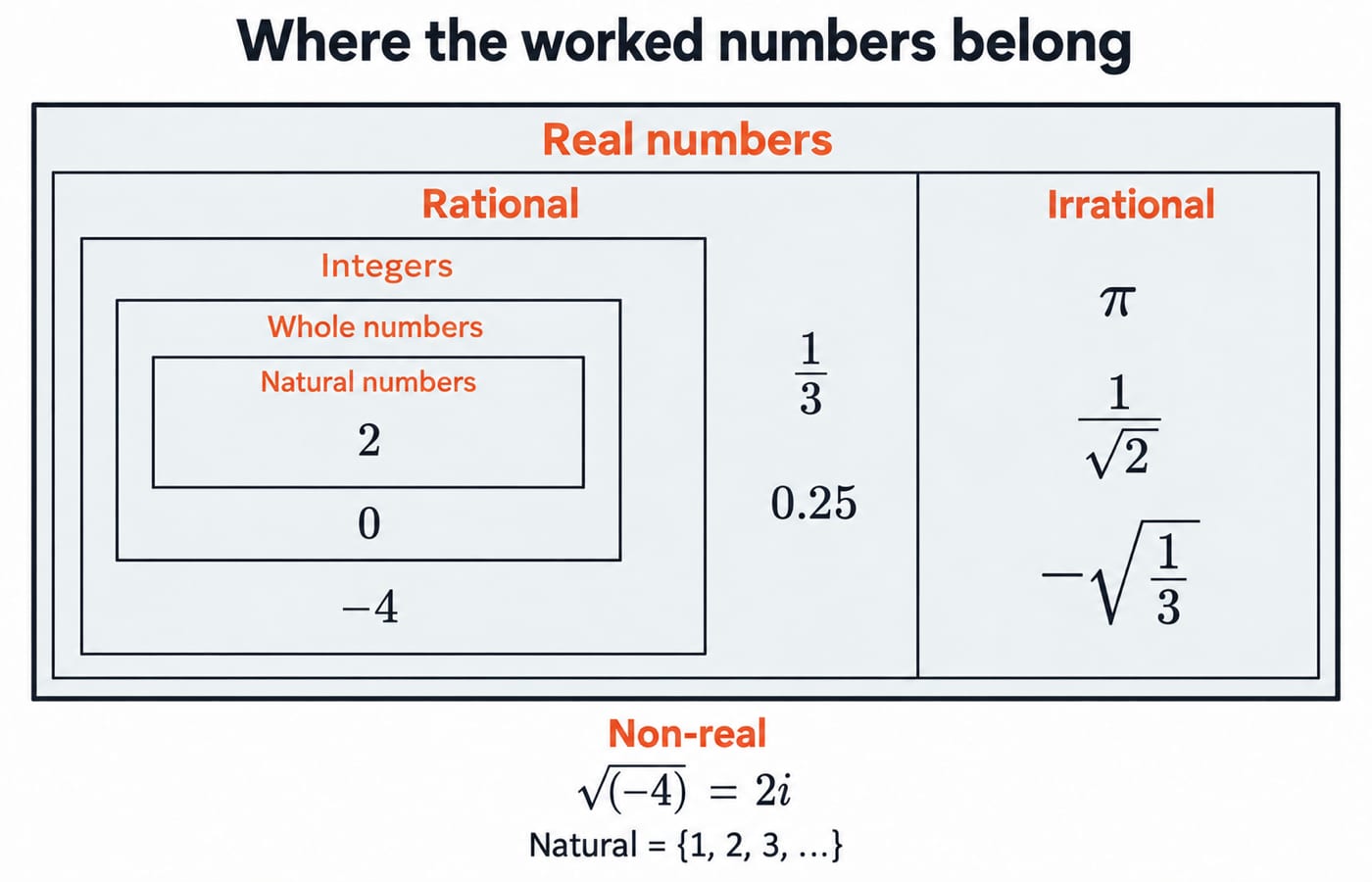
Answer: (a), statements (i) and (iii). Every integer n equals n/1. For example, -4 = -4/1, so negative integers are rational too. Zero is rational because 0 = 0/1; statement (ii) is false.
Here, fractions mean ratios of integers with nonzero denominators, such as 3/5. Merely writing an expression with a slash does not make it rational: 1/sqrt2 does not meet that definition as written, and its value is irrational.
Q7
A non-terminating but recurring decimal is
(a) an integer
(b) a natural number
(c) a rational number
(d) an irrational number
Answer: (c). Consider x = 0.333... . Multiplying by 10 gives 10x = 3.333... . Subtract the first equation from the second:
10x - x = 3.333... - 0.333... = 3.
Therefore 9x = 3, so x = 3/9 = 1/3.
An eventually recurring decimal is rational even though it does not terminate. A terminating decimal such as 0.25 = 25/100 = 1/4 is rational too. Non-terminating alone does not imply irrational; the repeating pattern matters.
5. Separate irrational numbers from non-real numbers
Rational and irrational numbers together form the real numbers. Irrational numbers cannot be expressed as ratios of integers with nonzero denominators, but they still lie on the real number line.
Q8
pi is a/an
(a) rational number
(b) irrational number
(c) prime number
(d) integer
Answer: (b). pi is irrational and real. It cannot equal an integer ratio p/q with q != 0. The familiar value 22/7 is a rational approximation, not pi itself. Likewise, 3.14 = 314/100 is a terminating rational approximation.
pi is not an integer, so it cannot belong to the narrower category of prime integers either. An approximation used in a calculation does not change the classification of the original number.
Q9
Which one of the following is not a real number?
(a) pi
(b) 1/sqrt2
(c) -(1/3)^(1/2)
(d) sqrt-4
Answer: (d), sqrt-4. Every real number x satisfies x2 >= 0, so no real number squares to -4. Its principal complex square root is 2i, where i2 = -1.
The other options are real and irrational:
pi is real despite being irrational.
1/sqrt2 = sqrt2/2 is a real irrational number.
-(1/3)^(1/2) = -1/sqrt3 is also real and irrational.
In option (c), the minus sign is outside the square root; its radicand is positive. A negative real number is not automatically non-real.
For the classification below, use Natural = {1, 2, 3, ...}; whole numbers include zero as well.
6. Compare rational numbers without guessing
Q10
Which one of the following is the greatest number? 3/2, 4/3, 5/6, 9/7
(a) 9/7
(b) 4/3
(c) 3/2
(d) 5/6
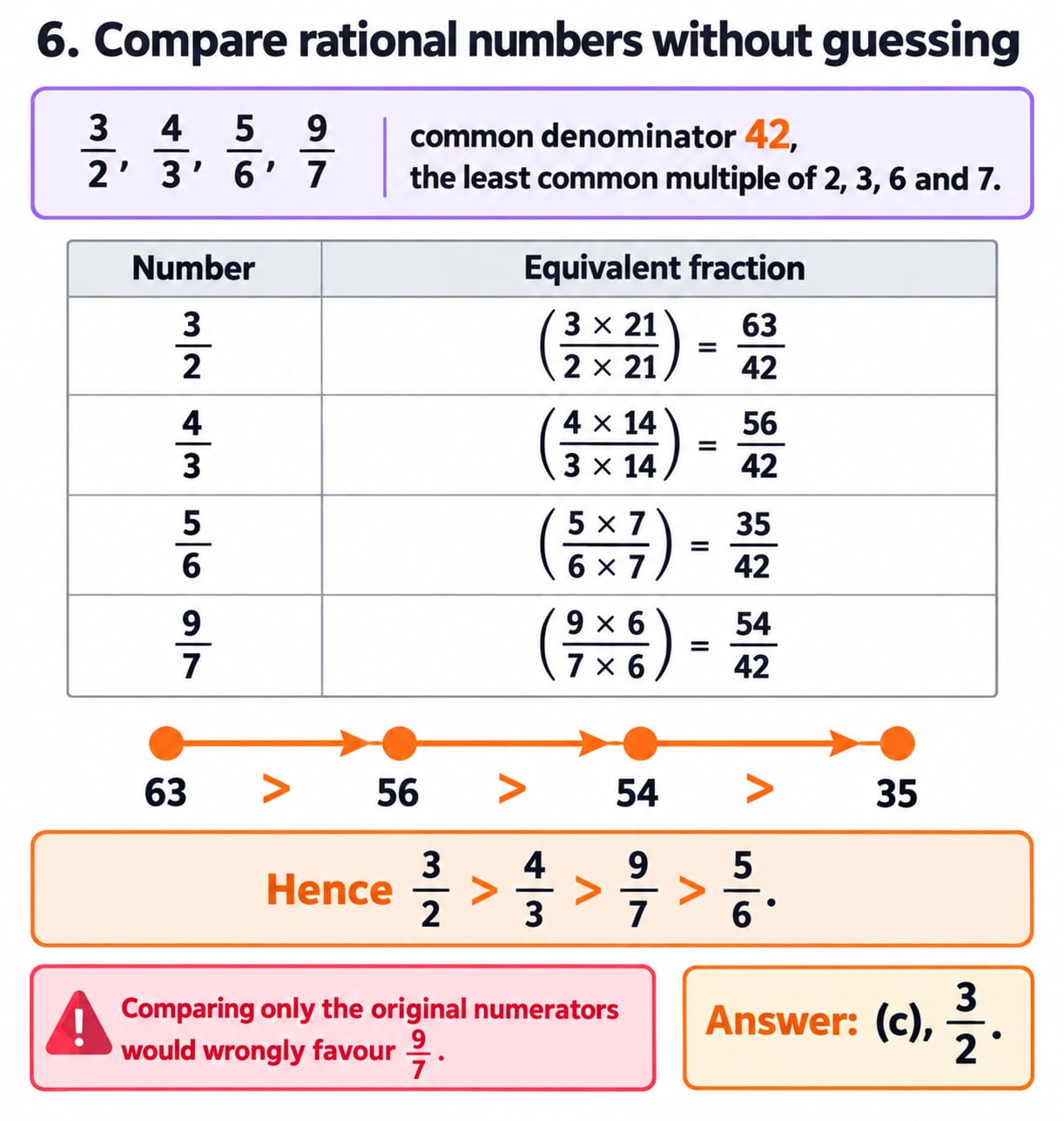
Answer: (c), 3/2. Use the common denominator 42, the least common multiple of 2, 3, 6 and 7:
Number | Equivalent fraction |
|---|---|
3/2 | (3 x 21)/(2 x 21) = 63/42 |
4/3 | (4 x 14)/(3 x 14) = 56/42 |
5/6 | (5 x 7)/(6 x 7) = 35/42 |
9/7 | (9 x 6)/(7 x 6) = 54/42 |
Since the common denominator is positive, compare the numerators: 63 > 56 > 54 > 35. Hence 3/2 > 4/3 > 9/7 > 5/6.
Comparing only the original numerators would wrongly favour 9/7. Comparing only denominators also fails when numerators differ. Equivalent fractions make the comparison exact without rounded decimal estimates.
7. Review the error, then choose the next practice step
Answer key: 1 (c), 2 (d), 3 (b), 4 (d), 5 (b), 6 (a), 7 (c), 8 (b), 9 (d), 10 (c).
Label each missed question as a definition, counterexample or calculation error. For a definition error, rewrite the condition you missed. For a counterexample error, find one number that disproves the claim. For a calculation error, redo the intermediate steps.
Try the missed questions again after one day, stating your reason before looking at the options. If you want structured aptitude practice beyond this set, explore the Aptitude for Placement course as an optional next step. Keep checking the reason behind each answer, even when the correct letter feels obvious.
Go deeper with the full courseDiscrete Mathematics
Keep learning
Circular and Grouping Permutations: 10 Questions with Solutions
Decide what counts as a different arrangement before choosing a factorial. Work through ten questions on circular seating, contiguous groups, repeated letters and separated groups, with each solution explained immediately.
Updated 9 Nov 20267 min readDiscrete Mathematics MCQs
Basic Concepts & Counting Principles Questions with Solutions: 10 Worked MCQs
Decide what to count before choosing a formula. These ten worked MCQs explain repetition, unordered groups, restricted positions and disjoint cases, with the common mistake behind each model.
Updated 8 Nov 20267 min readDiscrete Mathematics MCQs
Advanced Counting Theorems Questions with Solutions: 10 Worked Problems
Choose the counting model before reaching for a formula. Solve six MCQs and four numerical-answer questions, with worked explanations of overlaps, initial conditions and identical objects.
Updated 6 Nov 20268 min readDiscrete Mathematics MCQs
Concept of Remainders Questions with Solutions: 10 Worked MCQs
Try ten remainder questions, then follow each calculation to check your method. Learn when a divisor can change, how quotient conditions combine, and why huge powers need only small residues.
Updated 4 Nov 20267 min readDiscrete Mathematics MCQs