Commutative Property and Abelian Groups MCQs: 12 Solved Questions
Test whether groups and custom operations commute, then learn from concise solutions covering counterexamples, generators, inverses, and Abelian identities.
KnowledgeGate Team
Exam prep & CS education
20 Aug 20267 min read
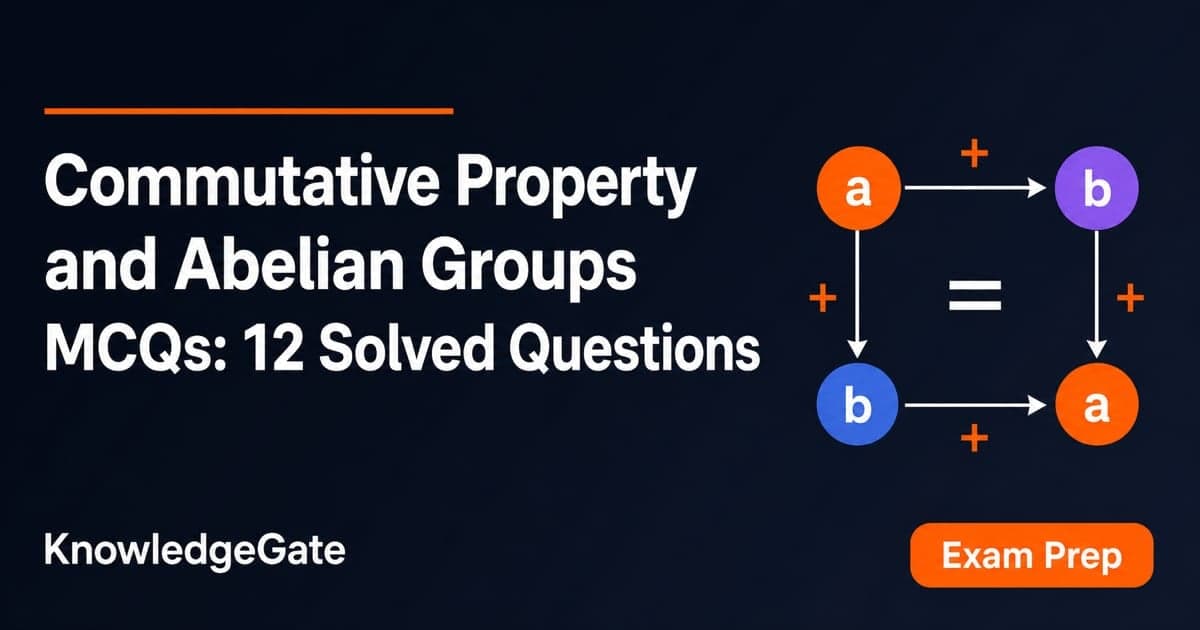
Students often use “commutative” as a loose synonym for “well behaved”. That creates confusion between commutativity, associativity, identity, inverses, and distributivity when the operation changes. Attempt each question before reading its answer, because the useful skill is choosing the right property test. These are previous-year questions from GATE, UGC NET, UPPSC and ISRO papers between 1996 and 2025, and the same short list of checks settles every one of them. If you cannot yet list the four group axioms, revise the group theory and algebraic structures guide first.
Abelian group definition MCQs: identify the extra axiom
A group already has closure, associativity, an identity, and an inverse for every element. It becomes Abelian when it also satisfies for every .
Question 1 (UGC NET 2015)
Which of the following property/ies a Group G must hold, in order to be an Abelian group? (a) The distributive property (b) The commutative property (c)The symmetric property Codes :
A. (a) and (b)
B. (b) and (c)
C. (a) only
D. (b) only
Answer: D. Since is already a group, the one additional condition is for every pair. Distributivity and a separately named symmetric property are distractors, not extra group axioms.
Question 2 (UPPSC Polytechnic Lecturer 2018)
Which one of the following is not necessarily a property of a group?
A. Commutativity
B. Associativity
C. Existence of inverse for every element
D. Existence of identity
Answer: A. Associativity, identity, and inverses are required, but commutativity is optional. In , take and ; with right-to-left composition, while , so this valid group is noncommutative.
Does the set and operation form a group?
Use the same diagnostic every time: check closure, associativity, identity, inverses, then commutativity. A commutative operation can still fail the group test if even one element lacks an inverse.
Question 3 (GATE 1996)
Which of the following statements is FALSE?
A. The set of rational numbers is an abelian group under addition
B. The set of integers is an abelian group under addition
C. The set of rational numbers form an abelian group under multiplication
D. The set of real numbers excluding zero is an abelian group under multiplication
Answer: C. The rational number has no multiplicative inverse because no rational satisfies . By contrast, every in or has inverse , while and under addition have identity and contain their additive inverses.
Question 4 (GATE 2003)
Consider the set Σ* of all strings over the alphabet Σ = {0, 1}. Σ* with the concatenation operator for strings
A. does not form a group
B. forms a non-commutative group
C. does not have a right identity element
D. forms a group if the empty string is removed from Σ*
Answer: A. The empty string is both a left and right identity, but no binary string makes or , so nonempty strings lack inverses. Also, , and removing removes the identity rather than repairing the structure.
Commutative versus associative binary operations
Swap the inputs to test commutativity. To test associativity, compare with ; one unequal triple disproves it.
Question 5 (GATE 2013)
A binary operation on a set of integers is defined as . Which one of the following statements is TRUE about ?
A. Commutative but not associative
B. Both commutative and associative
C. Associative but not commutative
D. Neither commutative nor associative
Answer: A. It is commutative because . For , , so , whereas and ; since , it is not associative.
Question 6 (GATE 2015 Set 1)
The binary operator ≠ is defined by the following truth table. Which one of the following is true about the binary operator ≠?
A. Both commutative and associative
B. Commutative but not associative
C. Not commutative but associative
D. Neither commutative nor associative
Answer: A. This is XOR, or addition modulo 2, so symmetry in gives commutativity and both parenthesisations equal . For , and . Continue this style of truth-table practice in the propositional and predicate logic MCQ set.
Custom operators and pointwise operations
For an unfamiliar symbol, substitute its definition before using familiar algebra. Then check whether the identity and required inverses stay inside the stated set.
Question 7 (GATE 2024 Set 1, MSQ)
Consider the operators ◊ and □ defined by 𝑎 ◊ 𝑏 = 𝑎 + 2𝑏, 𝑎□𝑏 = 𝑎𝑏, for positive integers. Which of the following statements is/are TRUE?
A. Operator ◊ obeys the associative law
B. Operator □ obeys the associative law
C. Operator ◊ over the operator □ obeys the distributive law
D. Operator □ over the operator ◊ obeys the distributive law
Answer: B and D. For A, , but ; ordinary multiplication proves B. For D, ; at , both sides are . For C, , while .
Question 8 (GATE 2025 Set 1, MSQ)
is the set of non-negative integers. Let be the set of functions from to itself. For any two functions, , we define for every number in . Which of the following is/are CORRECT about the mathematical structure ?
A. is an Abelian group.
B. is an Abelian monoid.
C. is a non-Abelian group.
D. is a non-Abelian monoid.
Answer: B. For and , , still a function from to ; pointwise addition is associative and commutative, and is its identity. It is not a group because an inverse of would require , which lies outside , so the structure is an Abelian monoid.
Finite Abelian groups and generators
Now reduce group words and classify small Abelian groups. A maximum needs both an upper bound and an example that attains it.
Question 9 (GATE 2014 Set 3, NAT)
There are two elements in a group such that every element in the group can be written as a product of some number of 's and 's in some order. It is known that , where is the identity element. The maximum number of elements in such a group is ____.
Answer: 4. The elements and generate the whole group, so every element is a word in and . From , we get and ; since , . Every word therefore reduces to one of , giving at most four elements, and the Klein four group , with every nonidentity element squaring to , attains four.
Question 10 (GATE 2007)
How many different non-isomorphic Abelian groups of order 4 are there
A. 2
B. 3
C. 4
D. 5
Answer: A. The two types are under addition modulo 4 and under componentwise addition modulo 2. They are not isomorphic because and have order 4 in , while every nonidentity element in , the Question 9 structure, has order 2.
Identities that force a group to be Abelian
Expand powers without changing factor order, then cancel by multiplying with inverses in legal positions. Do not swap factors before commutativity has been proved.
Question 11 (UGC NET 2025)
Choose the correct statement for a group G:
A. If for all x, y ∈ G, (xy)² = x²y² then G is Commutative.
B. If for all x ∈ G, x³ = 1, then G is Commutative. 1 is the identity element of G.
C. If for all x ∈ G, x⁵ = 1, then G is Commutative. 1 is the identity element of G.
D. If G is Commutative, the sub-group of G need not be Commutative.
Answer: A. Expanding gives ; left-multiplication by gives , and right-multiplication by gives . Options B and C fail because the noncommutative groups and have every element satisfying the respective power identity; for and , has an extra term while does not. Option D fails because every subgroup inherits commutativity from its group.
Question 12 (ISRO 2016)
If (G, .) is a group such that (ab)⁻¹ = a⁻¹ b⁻¹, for all a,b belongs to G, then G is a /an :
A. Commutative semi group
B. Abelian Group
C. Non-Abelian group
D. None of these
Answer: B. Every group satisfies , while the question gives , so ; inverting both sides yields . As a contrast in , for , the products and are different.
Commutative property MCQ answer key and next step
The compact key is 1-D, 2-A, 3-C, 4-A, 5-A, 6-A, 7-B+D, 8-B, 9-4, 10-A, 11-A, 12-B. Five moves settle almost every question in this area: asking which single axiom upgrades a group to Abelian, offering an operation that commutes but leaves some element without an inverse, testing associativity or distributivity of an unfamiliar operator on one triple, deriving commutativity from an identity such as , and counting the elements or the isomorphism types of a small finite group.
For revision, reproduce three checks without looking: calculate versus in Question 5, reduce every word to in Question 9, and cancel to reach in Question 11. The set theory and relations MCQ set is the next practice set in this discrete-mathematics cluster.
For the full Discrete Mathematics sequence and its Group Theory lesson path, use GATE Guidance by Sanchit Sir. The GATE CS Exam Preparation Courses & Test Series category is the broader route to related preparation resources.
Keep learning
Graph Traversal MCQs: 12 Solved Questions on Walks, Paths, Trails, Circuits and Connectivity
Attempt 12 graph traversal and connectivity questions, then check each answer through definitions, reachability, degree conditions and edge-count arguments.
Updated 3 Oct 20267 min readDiscrete Mathematics MCQs
Planar Graphs MCQs: 12 Solved Questions on Kuratowski’s Theorem, Homeomorphism and Edge Bounds
Solve 12 planar graph questions, then check each answer through a forbidden-subdivision argument, a crossing-free redraw, or a short calculation.
Updated 28 Sep 20268 min readDiscrete Mathematics MCQs
Power Set and Cardinality MCQs: 12 Solved Questions with Explanations
Solve 12 power set questions, from direct enumeration and nested sets to inclusion chains, ordered pairs and recurrence-based counting.
25 Sep 20267 min readDiscrete Mathematics MCQs
Null Set, Universal Set, Subset and Proper Subset MCQs: 12 Solved Questions
Practise 12 MCQs on null sets, universal sets, subsets, proper subsets, complements and nested inclusion, with clear reasoning for every answer.
Updated 24 Sep 20267 min readDiscrete Mathematics MCQs