

CNN Output Shapes: Calculate Every Convolution and Pooling Dimension by Hand
Learn a repeatable axis-by-axis method, then follow a 32 x 32 x 3 tensor through two convolutions, max pooling and global average pooling.
KnowledgeGate Team
Exam prep & CS education
Updated 25 Nov 20266 min read
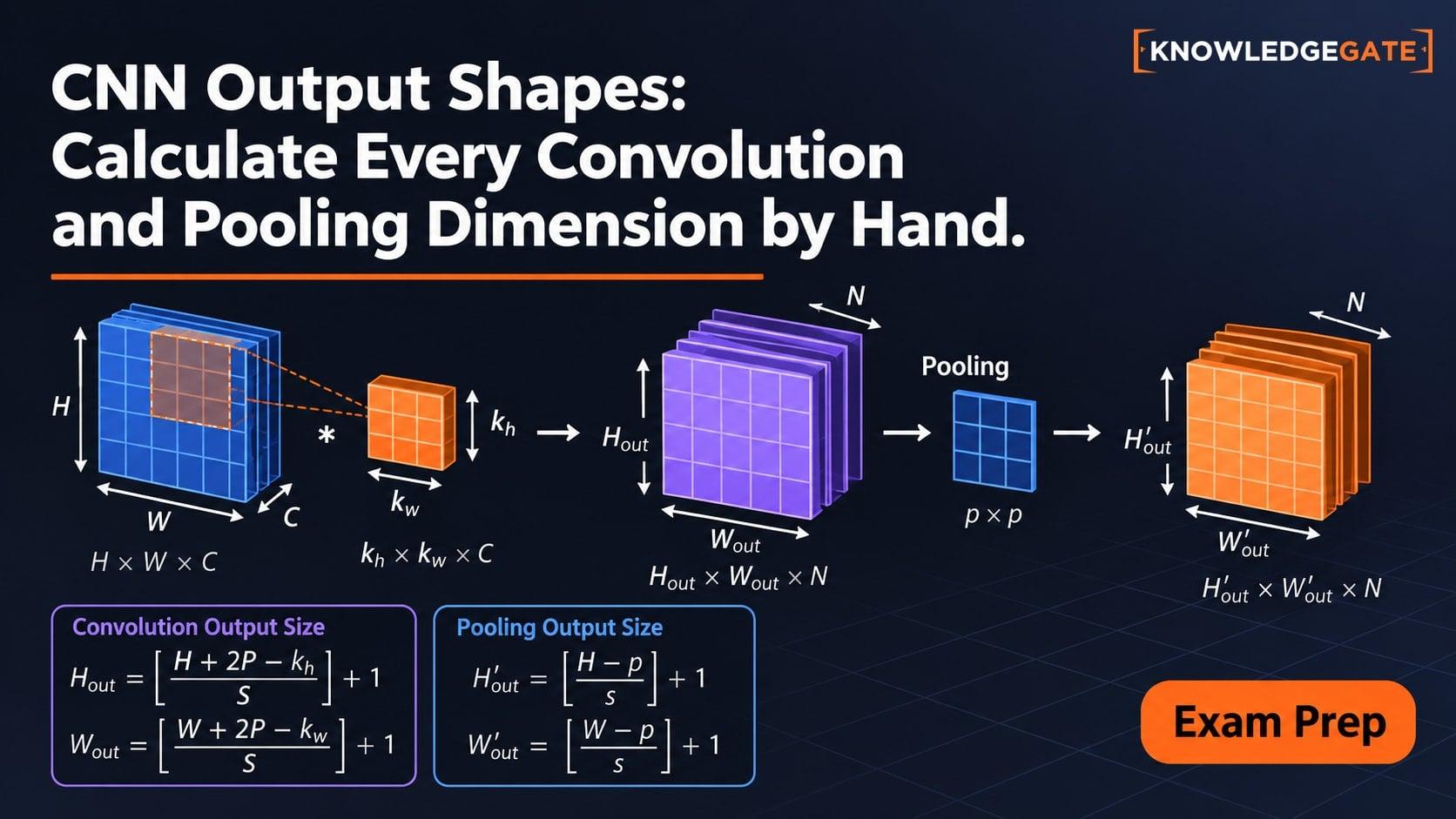
A CNN layer can look correct while one wrong assumption about stride, padding, dilation or filter count breaks later tensor shapes. Use a repeatable method. Catch errors before they spread. A 32 x 32 x 3 input passes through a convolution, max pooling, a second convolution and global average pooling. Rectangular, dilated and SAME cases require separate checks. Solve each spatial axis independently; channels follow another rule.
1. CNN output-shape formula: separate space from channels
Write input as H_in x W_in x C_in. A convolution specifies kernel K_h, K_w, stride S_h, S_w, dilation D_h, D_w, four padding values and F filters. Batch is preserved and omitted. Libraries may display NHWC or NCHW; the axes are identical.
First find K_eff,h = D_h(K_h - 1) + 1 and K_eff,w = D_w(K_w - 1) + 1. Then use:
H_out = floor[(H_in + P_top + P_bottom - K_eff,h) / S_h] + 1
W_out = floor[(W_in + P_left + P_right - K_eff,w) / S_w] + 1
Axis | Changed by | Not changed by |
|---|---|---|
Height |
| Width values, |
Width |
| Height values, |
Channels |
| Spatial values |
Batch | Nothing here | Everything here |
Each kernel spans all C_in channels, which are absent from the spatial formula. Skill Development Courses lists related skill tracks; Approaches to AI gives broader context.
2. CNN convolution output: work 32 x 32 x 3 to 16 x 16 x 8
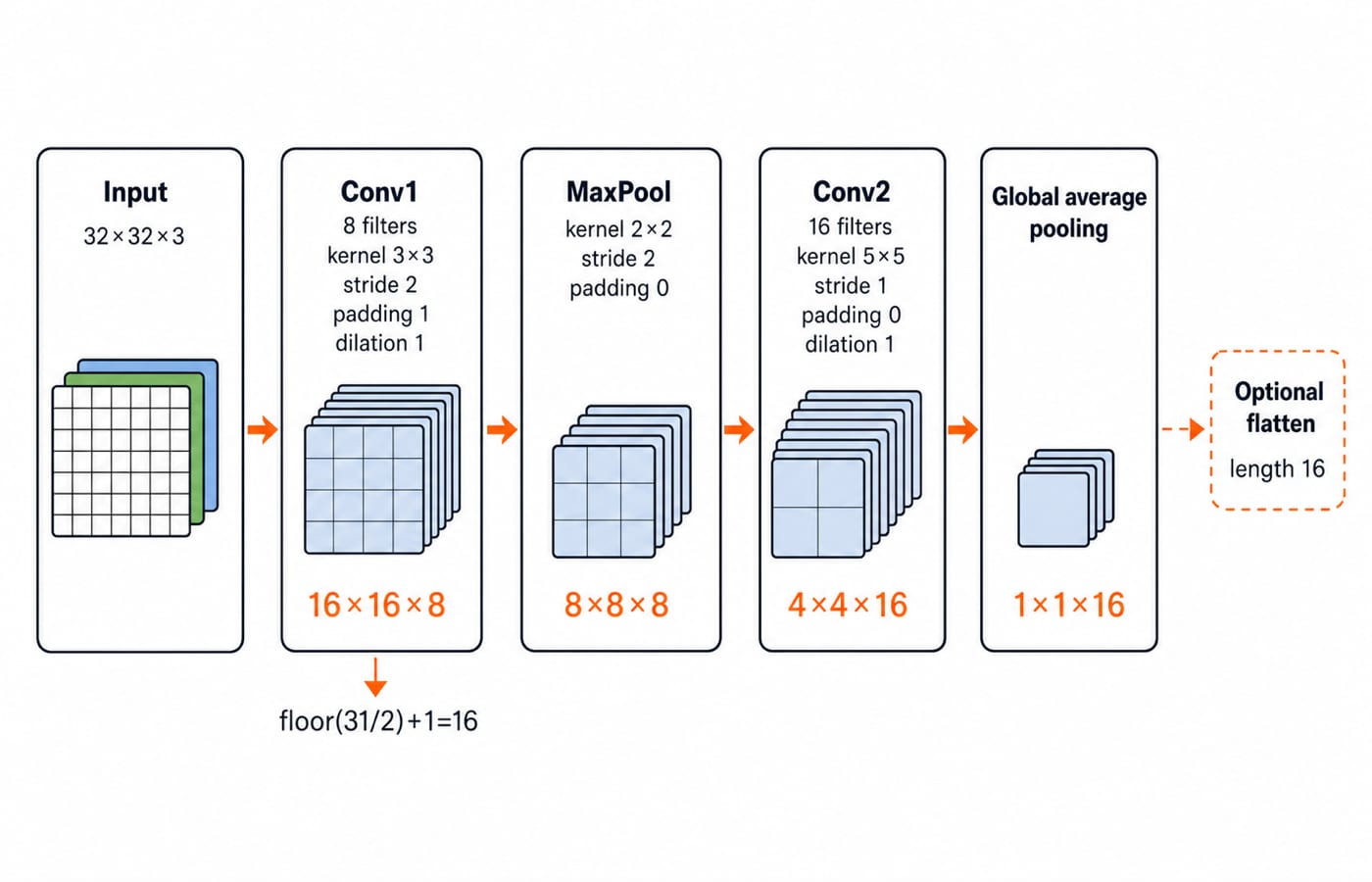
Use input 32 x 32 x 3, 8 filters, kernel 3 x 3, stride 2 x 2, padding 1 per side and dilation 1 x 1. Both effective kernels are 1(3 - 1) + 1 = 3.
H_out = floor[(32 + 1 + 1 - 3)/2] + 1
= floor(31/2) + 1 = 15 + 1 = 16
Width is identical, so W_out = 16. Eight filters set depth, giving 16 x 16 x 8.
Shape is not parameter count. Each filter has 3 x 3 x 3 = 27 weights. One bias each gives 27 x 8 + 8 = 224 trainable parameters, not a tensor dimension.
3. CNN pooling and a second convolution: finish the shape pipeline
Max-pool 16 x 16 x 8 with a 2 x 2 window, stride 2, zero padding and dilation 1:
H_out = W_out = floor[(16 - 2)/2] + 1 = 7 + 1 = 8
Pooling acts inside each channel, producing 8 x 8 x 8, not 8 x 8 x 1 or 8 x 8 x 16.
Conv2 takes 8 x 8 x 8 with 16 filters, kernel 5 x 5, stride 1, zero padding and dilation 1:
H_out = W_out = floor[(8 - 5)/1] + 1 = 4
Filter count gives 4 x 4 x 16. Global average pooling reduces each 4 x 4 map to one scalar, producing 1 x 1 x 16, or length 16 after flattening.
The chain is 32 x 32 x 3 -> 16 x 16 x 8 -> 8 x 8 x 8 -> 4 x 4 x 16 -> 16.
4. Rectangular CNN inputs: calculate height and width independently
Take input 31 x 27 x 3, 12 filters, kernel 5 x 3, stride 2 x 1, dilation 1 x 1, padding 2 above and below, and 1 left and right.
Axis | Calculation | Output |
|---|---|---|
Height |
|
|
Width |
|
|
Twelve filters make 16 x 27 x 12. Here, 5 x 3 describes two kernel axes, 2 x 1 gives independent strides, and padding is per side. Input depth 3 must match each kernel's depth, but cannot turn 12 filters into 36 channels.
5. Dilation and SAME padding: replace labels with numbers
For length 15, kernel 3, dilation 2, stride 2 and padding 1 per side, K_eff = 2(3 - 1) + 1 = 5. Output is floor[(15 + 1 + 1 - 5)/2] + 1 = floor(12/2) + 1 = 7. A common shortcut skips the dilation step and uses K_eff = 3: floor[(15 + 2 - 3)/2] + 1 = 8, which is wrong.
Under the explicit SAME convention output = ceil(input/stride), calculate P_total = max[(output - 1)S + K_eff - input, 0].
For input 8, kernel 3, dilation 1, stride 2, output is ceil(8/2) = 4. Padding totals (4 - 1)2 + 3 - 8 = 1, split 0 before and 1 after. Input 7 also outputs 4, but padding totals 2, split 1 and 1.
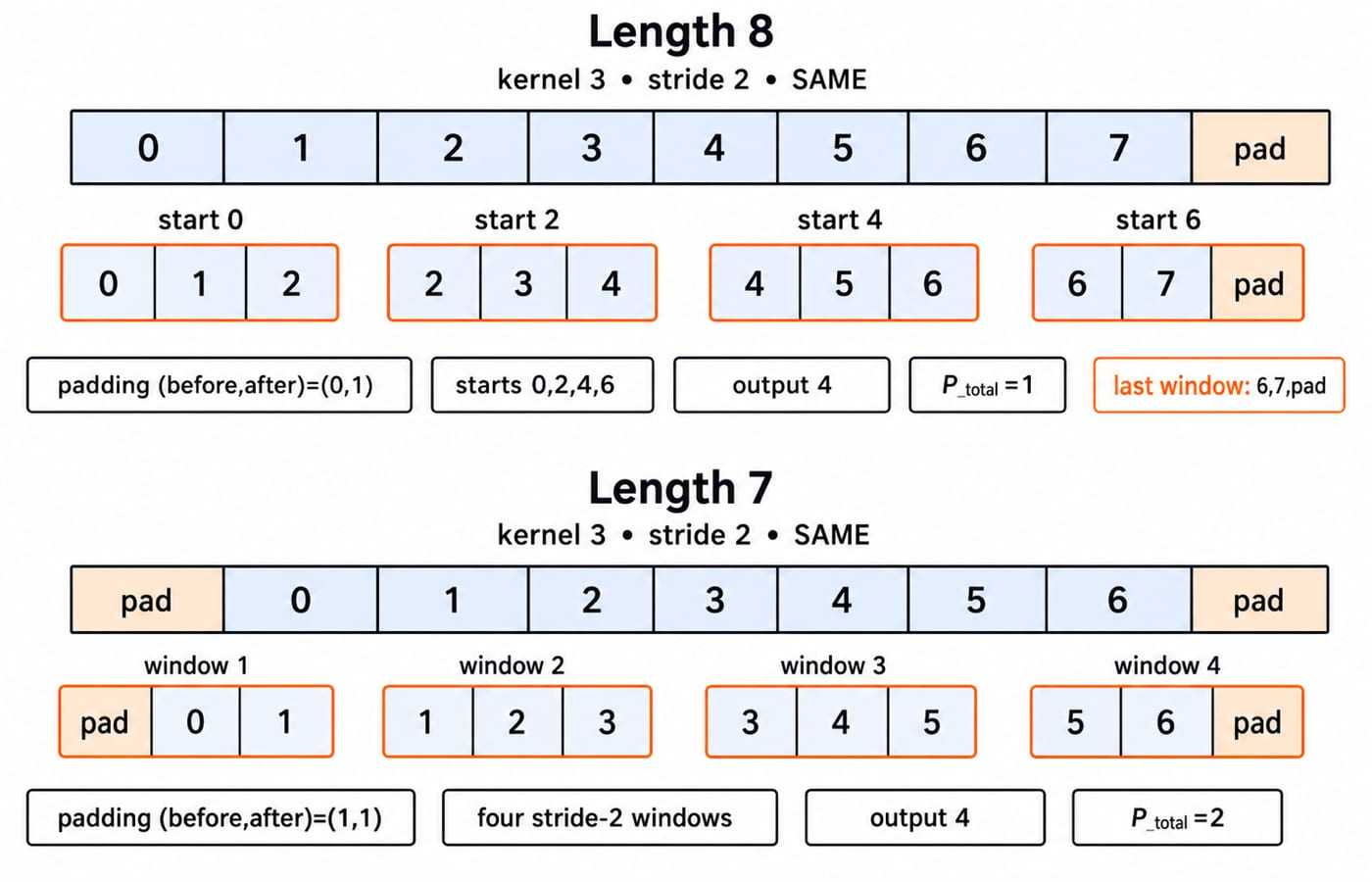
Use numeric padding directly and zero for VALID. For SAME, state the convention and derive each side. It need not be symmetric or preserve size when stride exceeds 1.
6. CNN output-shape mistakes: catch them before the next layer
Mistake | Wrong consequence | Repair |
|---|---|---|
Omit final | One fewer position | Add after floor |
Divide before subtracting | Wrong rounding | Finish numerator |
Round instead of floor | Count partial window | Floor quotient |
Use | Output too large | Expand dilation |
Multiply channels by | Inflate depth | Depth equals |
Reduce channels in pooling | Lose maps | Preserve depth |
Make stride | Reduce width | Separate axes |
Assume symmetric | Misplace padding | Derive and split |
Checks: Conv1 depth is 8, max pool keeps 8, and Conv2 depth is 16. Spatial sizes cannot be negative; each floored window count is an integer. A negative numerator means no fit.
Conv1's padded length is 32 + 2 = 34. Width-3 starts 0, 2, ..., 30 give 16 legal windows; start 32 crosses the boundary.
7. CNN output-shape questions: three exact checks
A. 28 x 28 x 1, 6 filters, kernel 5, stride 1, padding 0 gives 24 x 24 x 6. A following 2 x 2, stride-2 pool gives 12 x 12 x 6.
B. 64 x 48 x 16, 32 filters, kernel 3 x 5, stride 2 x 2, symmetric padding 1 x 2, dilation 1 gives 32 x 24 x 32. Height is floor[(64 + 2 - 3)/2] + 1 = floor(63/2) + 1 = 32; width is floor[(48 + 4 - 5)/2] + 1 = floor(47/2) + 1 = 24. Flooring discards the half-window.
C. Length 10, kernel 3, dilation 2, stride 1, padding 0 has effective kernel 5 and output (10 - 5)/1 + 1 = 6.
Use Artificial Neural Networks MCQs for broader practice. To compare image tensors with sequence-based concepts, use the adjacent Introduction to Natural Language Processing MCQs.
8. CNN output shapes: the short version and next step
Write the input axes.
Expand dilation into the effective kernel.
Calculate height and width separately.
Floor only after the complete division.
Set channels from filters, or preserve them through ordinary pooling.
The result to recover is 32 x 32 x 3 -> Conv1 16 x 16 x 8 -> MaxPool 8 x 8 x 8 -> Conv2 4 x 4 x 16 -> global average pool length 16. Hide it, derive the chain including K_eff, then change Conv1 stride from 2 to 1 and repeat.
Before writing model code, draw each layer's shape. For a structured broader AI and machine-learning path, explore Artificial Intelligence (AI).
Keep learning

Decision Trees: Calculate Information Gain and Prune Weak Branches
Build one classification tree by hand from ten machine rows, audit every candidate threshold, and see why validation can justify removing a perfectly pure training branch.
Updated 15 Nov 20266 min readML & Data Science

VM Integration in Operating Systems: Resource Pooling, Virtual I/O and Worked Examples
See how a hypervisor connects guests to finite CPU, memory, storage and network pools. Work through admission, fair-share CPU and saturated-network calculations.
Updated 20 Nov 20265 min readOperating Systems

Fast Fourier Transform (FFT): Polynomial Multiplication, Convolution and Signal Processing
Connect roots of unity, polynomial products and signal convolution through one complete four-point FFT example, including butterflies and inverse recovery.
Updated 1 Nov 20266 min readDSA & Algorithms
Gradient Descent for Linear Regression: Derive and Run One Update by Hand
See prediction, residual, gradient and parameter update as one continuous calculation. Then verify the lower loss and test what an oversized learning rate does.
Updated 17 Nov 20265 min readML & Data Science